
On Monday 6th October, we had an insightful guest lecture from our Senior Lecturer in Games & Media Art, Jordan Magnuson. He has a very strong history of working with how videogames are able to express poetic meaning: founding TIGSource (The Independent Gaming Source), an indie community that aided in the launch of modern classic indies including Spelunky, Fez and even Minecraft. He speaks often at industry events such as GDC and Indiecade, and has been collaborating with researchers and artists to explore the cultural impacts and potential of the games medium.
–
Our talk was centered around the concept of “Game Poems” – miniature game-like experiences that convey meaning through simple, abstract mechanics. He gave us a showcase of several games that he and other students had made previously, making use of an exhibition that was previously set up for the third-year class.
–
Two games that stuck out to me in particular were “Loneliness” and “Freedom Bridge”, both created by Jordan in 2010. Both are very abstracted in presentation, with the player exploring empty spaces as a square and facing various obstacles/interactions along the way.
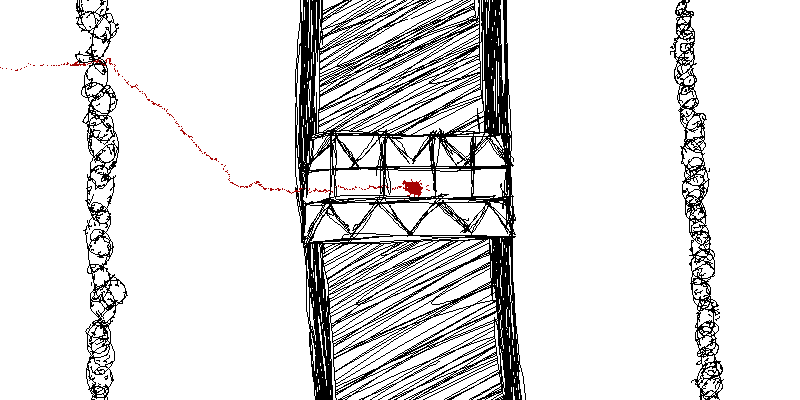
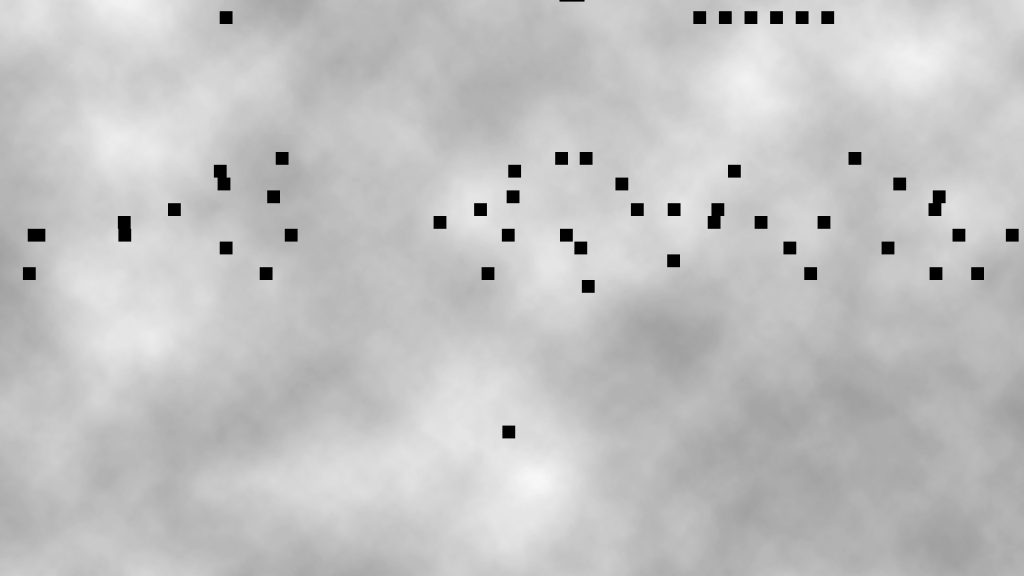
Freedom Bridge tells the story of the bridge between North and South Korea – the player travels on a slow painful and monotonous trek across walls of barbed wire to cross the bridge – when halfway across, they are shot and killed, and the game ends. It quickly and harshly reminds of these sorts of horrors that happen constantly across the world that we are not aware of, or may try to ignore or forget.
Loneliness is a lot more abstract, but similarly meaningful. Through nothing but moving squares and empty spaces it tells an interactive story about struggling to fit in among others. Admittedly though I did not find it particularly thought-provoking despite its praise – I found that it relied quite too much on repetition, even though the way said repetition was executed I found rather playful.
It felt to me more like a means of illustrating the idea of loneliness to someone that has not experienced it before, rather than something that people that are/have been lonely before can latch onto and use to explore their feelings. Perhaps that is why I feel such a way towards it. However, I do realise that these game poems were very much the first of their kind – now we have many games that explore these kind of emotions, so I can appreciate that in some ways it is a product of its time.
–
Afterwards we came back to resume the talk – together we critiqued the ways in which we talk about making “good” video games, in both narrative and gameplay: we talked about the idea of making a game “fun” and how, in some cases such as game poems, it might be preferable to do the opposite, make the player feel things that oppose fun an joy whilst playing.
–
Jordan posed us the question of “What is a game poem?” and gave us a list of 7 criteria to look towards for guidance:
- Game poems are short.
- Game poems juxtapose signified meaning with material meaning.
- Game poems are bound to metaphor and ambiguous imagery.
- Game poems are hyperbolic.
- Game poems are subjective.
- Game poems make use of poetic address.
- Game poems exist in a ritual space, rather than a narrative space.
–
He then took us through some lessons from poetry that we can apply to our video games and game poem projects:
- Strip away the inessential.
- This could manifest in expansive but spare environments – an example here that Jordan dwelled on was Shadow of the Colossus’ wide and empty fields that encourage the player to reflect on their actions.
- Simple mechanics – games like Inside or Limbo are a good example of this.
- Sharp focus on simple, personal elements – Ellie’s guitar mechanic from TLoU Part 2.
- Leverage poetic devices – like rhythm, rhyme, line breaks or symbolism.
- Draw attention to certain things in your game.
- Prompt reflection.
- Layer and heighten meaning.
- Embrace ambiguity – allow the player to make their own assumptions through their own learnt experience.
- Leave key moments up to ambiguity – encouraging players to think deeply and discuss theories with one another.
- Allow room for moral ambiguity, provoking thoughtfulness and emotional responses.
- Reimagine “fun gameplay”.
- Don’t limit yourself and the creative process to crafting perfectly balanced or traditional gameplay.
- Consider interesting asymmetry, interesting rhetoric, poetic resonance, etc.
–
This concluded our talk. I found it quite interesting and it certainly made me reflect on what I consider fun and meaningful gameplay. We would later go on to create our own game poems as small group projects – I plan to cover this in further blogs – but this talk would go on to greatly aid me in that process.
Leave a Reply