On 20th November 2025, we had a talk from guest speaker Abbie Foster on the principles of character design. Like other guest speakers, Abbie is UoS alumni, studying Games Design & Art between 2017-2020. She went on to be a junior and eventually lead artist at smartphone software studio Six to Start, to a freelance concept artist at Outright Games to eventually a co-founder and creative director of local indie studio Flightful Pear, covering aspects from world-building and dialogue writing to character design and 2D art.
Our lecture established a number of principles to follow that will help us create more cohesive and meaningful character designs:
- Colour
- Association – what associations do different colours on our characters have? What do they represent about them?
- Colour theory – ideally, restrict designs to a palette of 3: primary, secondary, and accent colours.
- Progression – will the character’s colours change as the story progresses? What changes within them will this reflect?
- Shape
- Association pt .2 – what associations do different shapes have? How can they be used to articulate a character’s personality?
- Silhouette – if your character was reduced to a single block silhouette, would you still recognise them?
- Narrative
- Objects of importance – are they wearing/ carrying relevant items?
- Scars/ tattoos – they can look very cool but also justify them!
- Physical condition – are they buff? Covered in blood? Why?!
–
We then were challenged to create character design concepts for our game: I already had some concepts in mind and this was a really good oppurtunity to put them to paper using what I had learned.
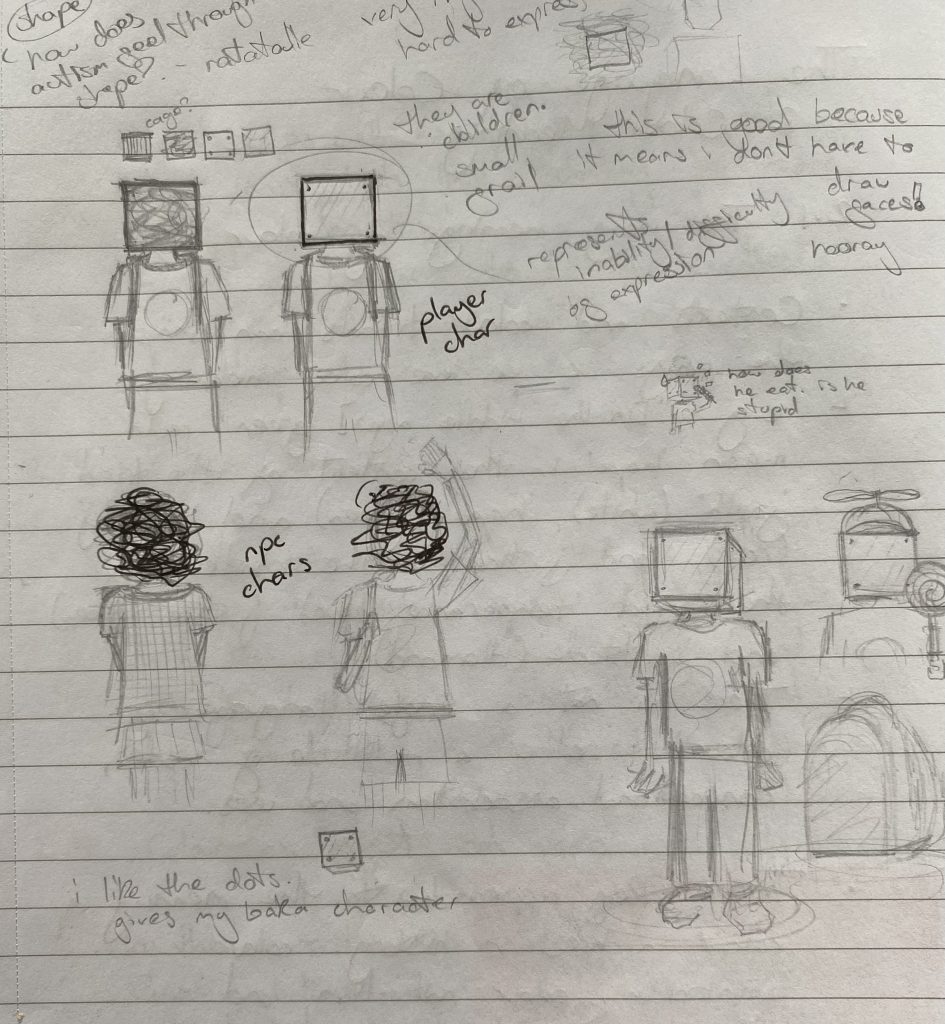
I deliberately chose the “block-head” idea to represent the difficulties ASD people have with expressing their emotions, specifically in terms of showing facial expression. At the same time, I thought, it could also be a metaphorical implication of masking. Similarly, made the decision for all NPC characters to have animated scribbles drawn over their heads: this is representative of the challenges people with ASD face with reading emotions and social cues form other people.
Later, I spoke to Abbie about the designs, asking for her opinion not only as a character designer but also because she too suffers from ASD: she told me that they immediately resonated with her, especially the block-head design as it very clearly communicates the challenges of ASD, capturing well the idea of feeling like “a robot in human skin”.
I am very thankful for her opinion and found it very uplifting that I could immediately connect with my peers in this way. It gave me a lot of confidence going forward with the project, actually – it finally felt like my work could really awaken something in others and that made me really excited and truly driven to make the best of this project going forwards.
–
Leave a Reply