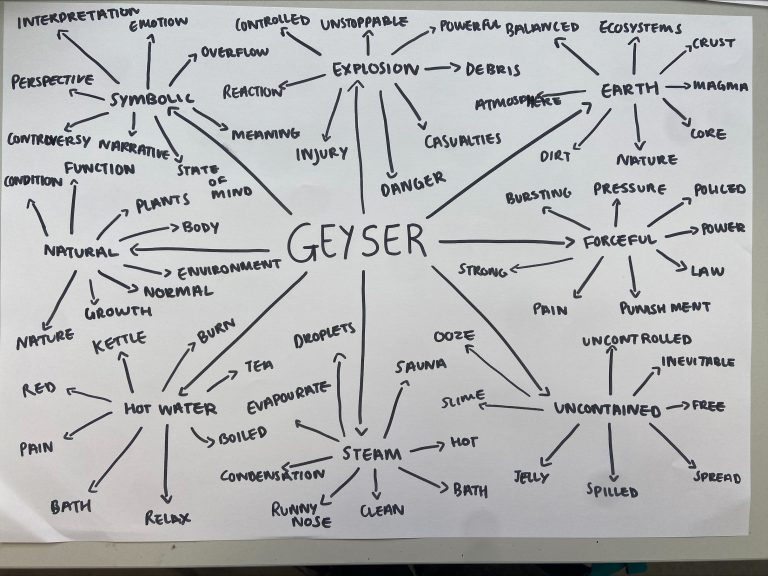
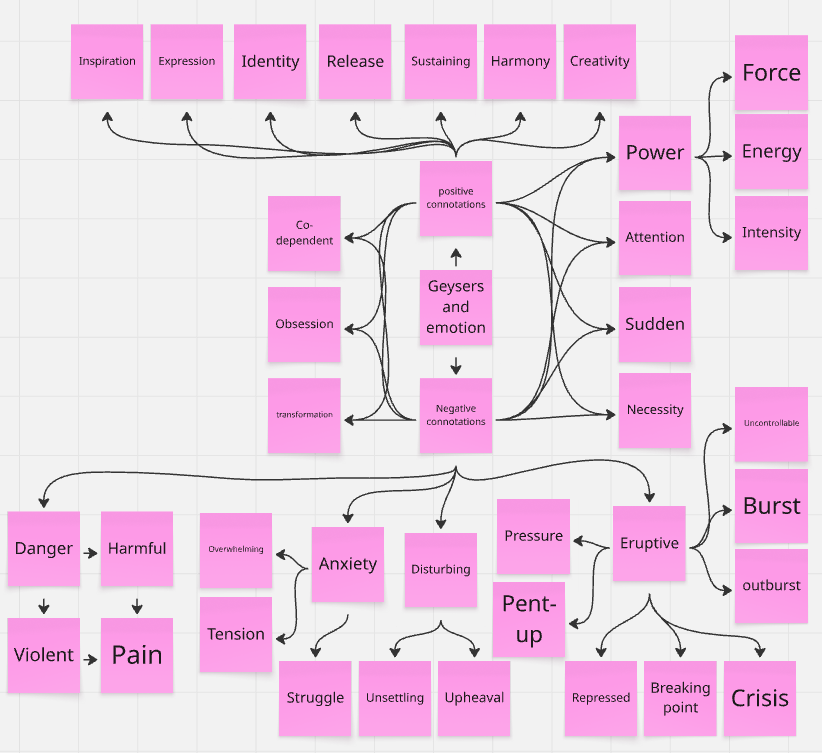
Original mind map:
Research board:
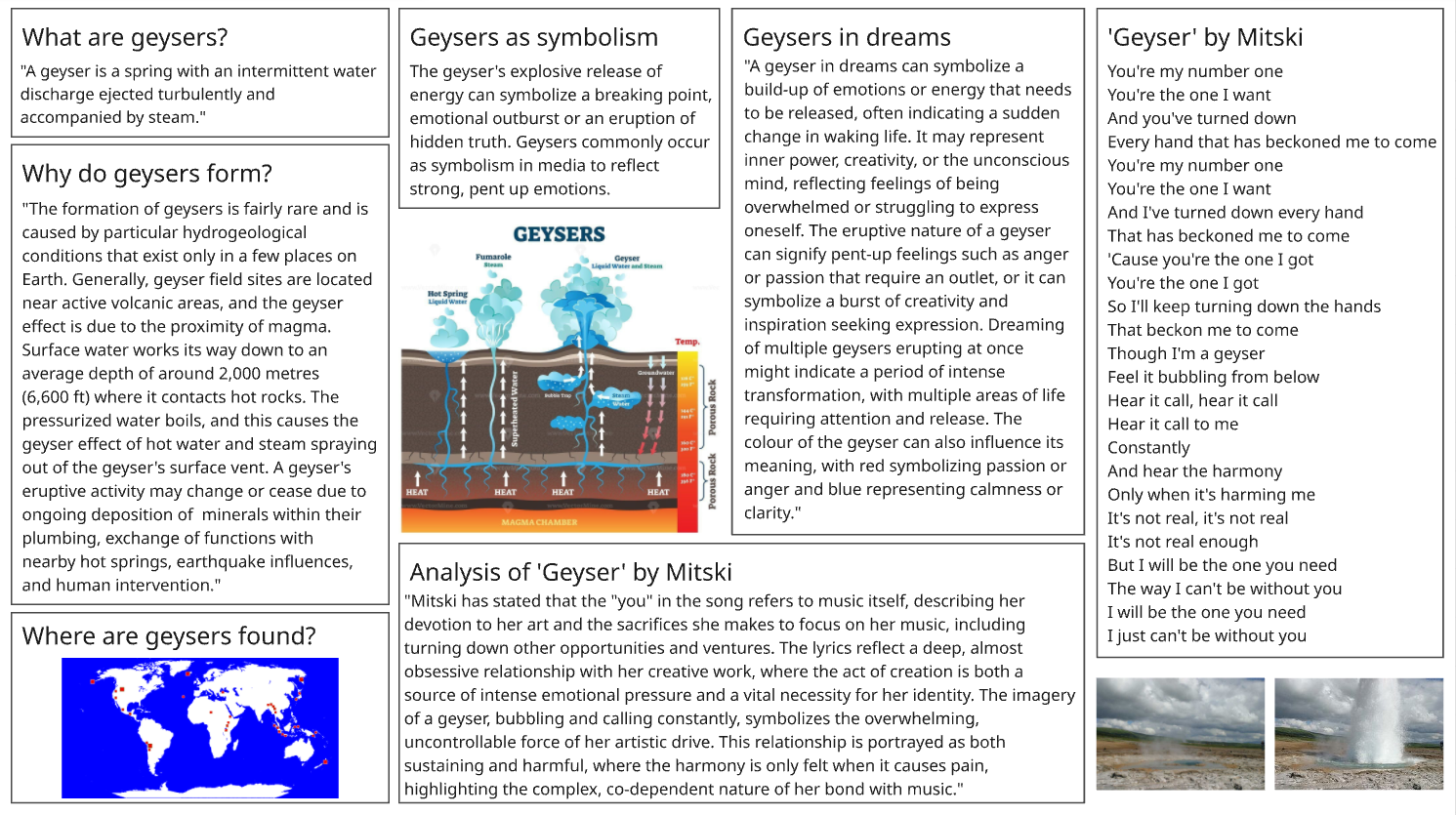
Systems and symbolism:
Systems:
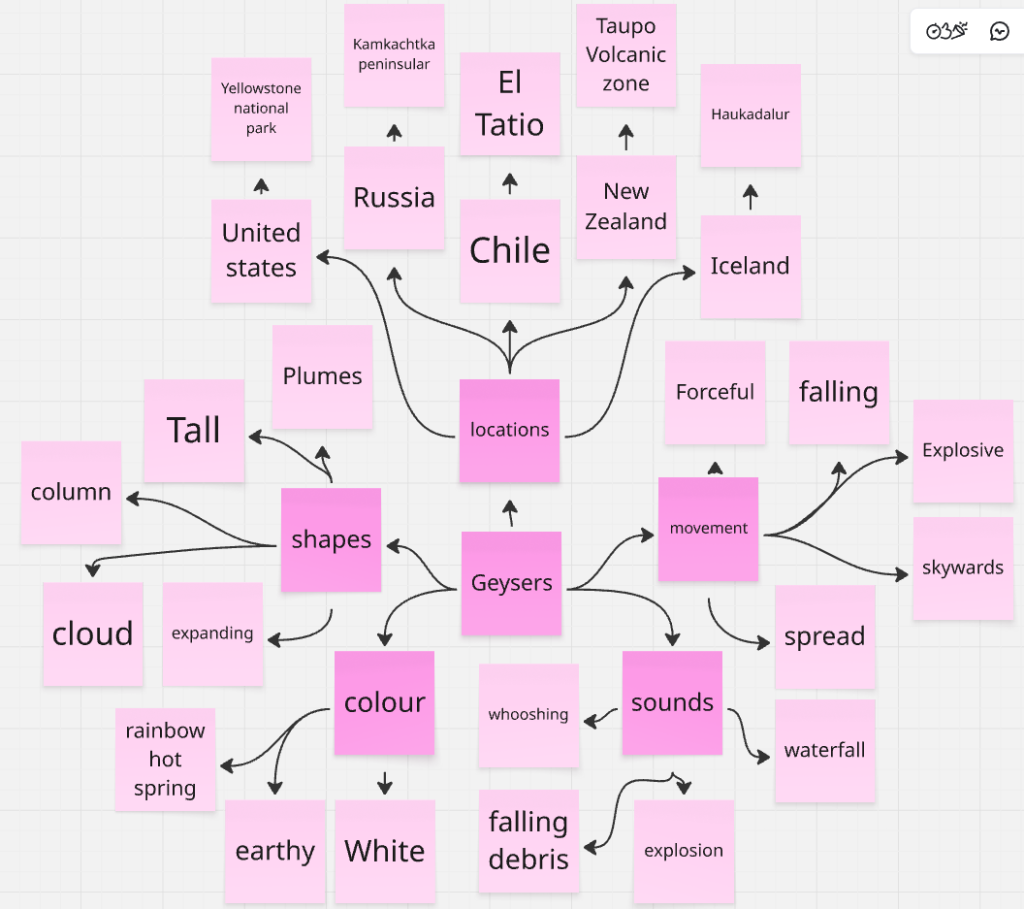
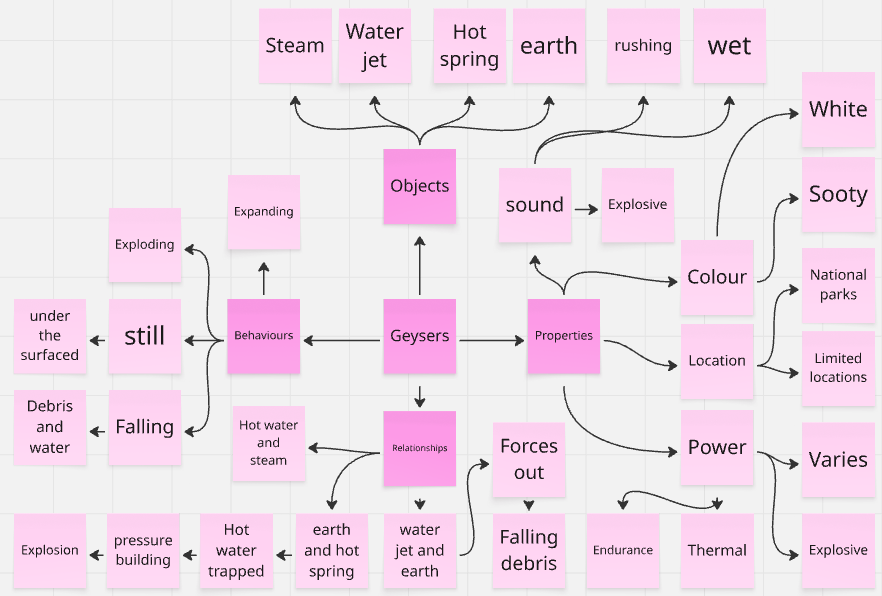
Geysers and emotion:
Mood Board:
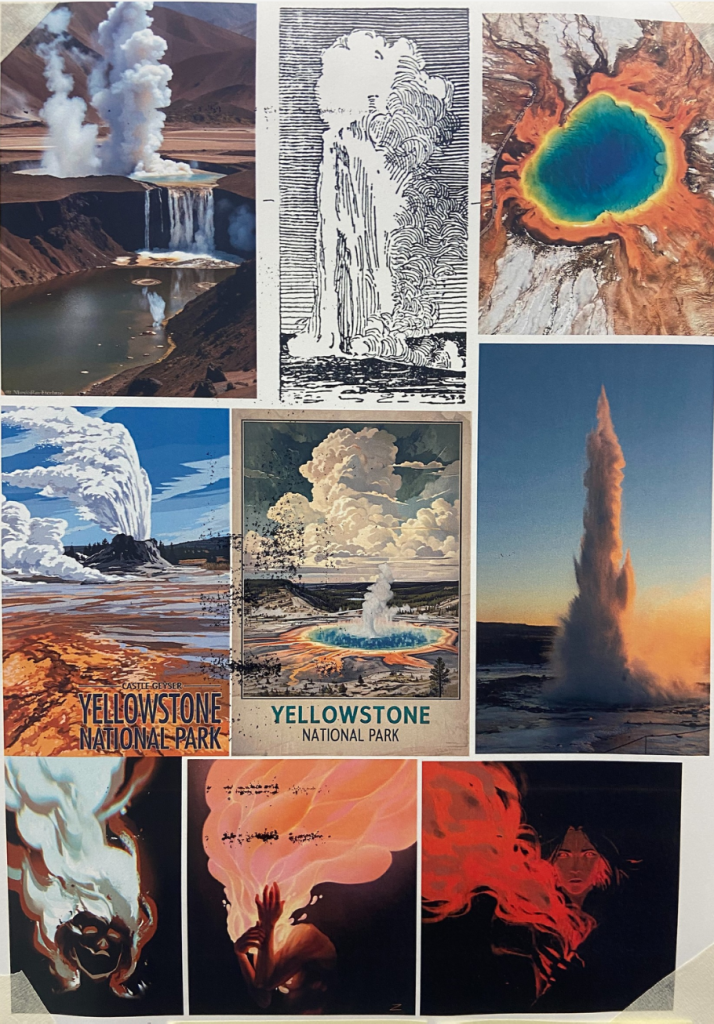
Extra Research:
Form and function:
Geysers are non-permanent geological features. Geysers are generally associated with areas of recent magmatism. As the water boils, the resulting pressure forces a superheated column of steam and water to the surface through the geyser’s internal plumbing. The formation of geysers specifically requires the combination of three geologic conditions that are usually found in volcanic terrain: heat, water, and a subsurface hydraulic system with the right geometry.
The heat needed for geyser formation comes from magma that needs to be close to the surface of the Earth. For the heated water to form a geyser, a plumbing system (made of fractures, fissures, porous spaces, and sometimes cavities) is required. This includes a reservoir to hold the water while it is being heated.
Geysers tend to be coated with geyserite, or siliceous sinter. The water in geysers comes in contact with hot silica-containing rocks, such as rhyolite. The heated water dissolves the silica. As it gets closer to the surface, the water cools and the silica drops out of solution, leaving a deposit of amorphous opal. Gradually the opal anneals into quartz, forming geyserite. Geyserite often covers the microbial mats that grow in geysers. As the mats grow and the silica is deposited, the mats can form up to 50% of the volume of the geyserite.
Eruptions:
Geyser activity, like all hot spring activity, is caused by surface water gradually seeping down through the ground until it meets geothermally heated rock. In non-eruptive hot springs, the heated water then rises back toward the surface by convection through porous and fractured rocks, while in geysers, the water instead is explosively forced upwards by the high steam pressure created when water boils below. Geysers also differ from non-eruptive hot springs in their subterranean structure: geysers have constrictions in their plumbing that create pressure build-up.
As the geyser fills, the water at the top of the column cools off, but because of the narrowness of the channel, convective cooling of the water in the reservoir is impossible. The cooler water above presses down on the hotter water beneath, not unlike the lid of a pressure cooker, allowing the water in the reservoir to become superheated, i.e. to remain liquid at temperatures well above the standard-pressure boiling point.
Ultimately, the temperatures near the bottom of the geyser rise to a point where boiling begins, forcing steam bubbles to rise to the top of the column. As they burst through the geyser’s vent, some water overflows or splashes out, reducing the weight of the column and thus the pressure on the water below. With this release of pressure, the superheated water flashes into steam, boiling violently throughout the column. The resulting froth of expanding steam and hot water then sprays out of the geyser vent.
Eventually the water remaining in the geyser cools back to below the boiling point and the eruption ends; heated groundwater begins seeping back into the reservoir, and the whole cycle begins again. The duration of eruptions and the time between successive eruptions vary greatly from geyser to geyser; Strokkur in Iceland erupts for a few seconds every few minutes, while Grand Geyser in the United States erupts for up to 10 minutes every 8–12 hours.
References:
Hollen, J.L. (2024). The Meaning Behind The Song: Geyser by Mitski – Musician Wages. [online] Musician Wages. Available at: https://www.musicianwages.com/the-meaning-behind-the-song-geyser-by-mitski/ [Accessed 14 Oct. 2025].
MyMythos | Personal Mythology. (2025). Geyser – MyMythos | Personal Mythology. [online] Available at: https://mymythos.org/archetype/geyser/ [Accessed 14 Oct. 2025].
NPR. (2018). Hear A Conversation With Mitski About Her New Song, ‘Geyser’. [online] Available at: https://www.npr.org/sections/allsongs/2018/05/14/610868651/mitski-shares-and-talks-about-new-song-and-album.
Symbolopedia. (2023). Geyser Symbolism & Meaning – Symbolopedia. [online] Available at: https://symbolopedia.com/geyser-symbolism-meaning/ [Accessed 14 Oct. 2025].
Wikipedia Contributors (2019). Geyser. [online] Wikipedia. Available at: https://en.wikipedia.org/wiki/Geyser.
Reply