
In this post I will be looking at the games made by the Italian creator Molleindustria.
McDonald’s Video Game
The McDonald’s Video Game is perhaps the most well known games out of his collection so I’ll start here. The game parodies the McDonalds Corp and allows the player to simulate the experience of running their own Fast Food restaurant, with the environmental and society downsides it brings. In this game you destroy the environment to grow cattle and GMO soy, slaughter cows for beef burgers, disipline or fire unhappy workers, and try to please the board of directors, all in the name of growing profit. The games anti-capitalist messaging is pretty obvious playing as an adult, but this was one of those games whose messaging wasn’t apparent playing as a child.

Sick cows are no good for business! You can destory them and they will be rather cartoonishly burned.

Look! An indigenous tribe. You can destroy it for soy or cattle if you want. Theres also some land that you can bribe to use.

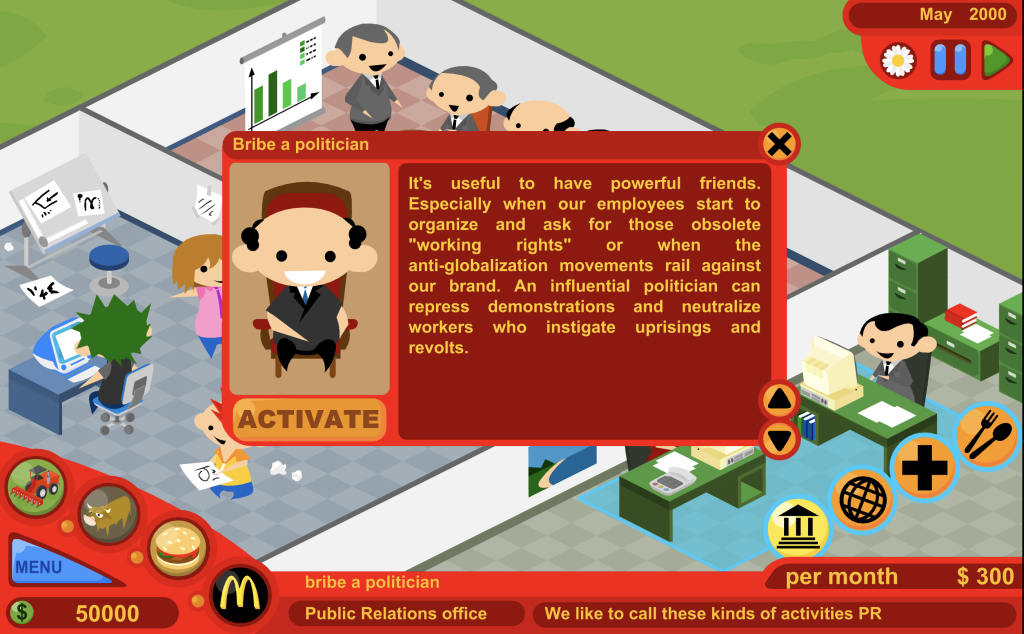
You’ll also get employees who will be unhappy at work. If you fire too many however they’ll start to try to unionize, but you can always bribe a politician to fix this.
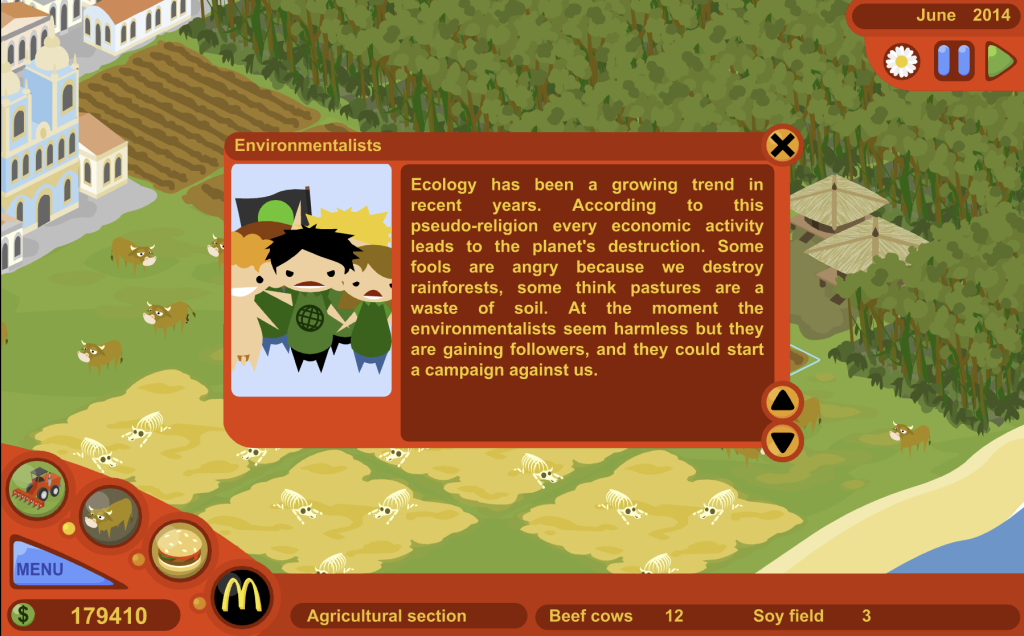
Sooner or later you’ll get people who will complain about the way you conduct business.
(I also did not notice the naked guy on the left hand side until now).
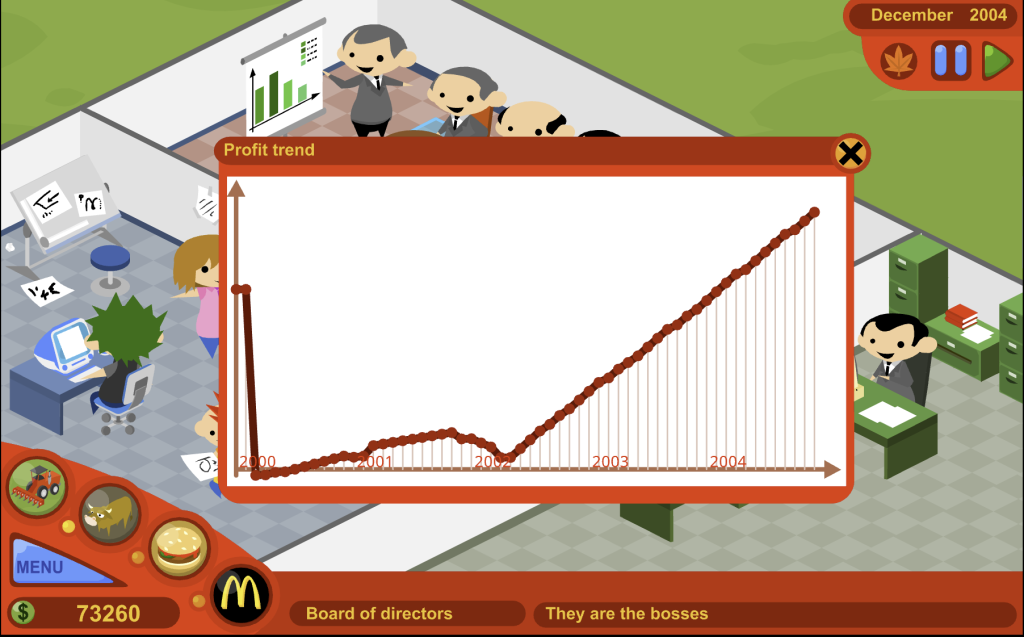
Line must go up, forever! As the creator of the game admits “The McDonald’s videogame is a game you can’t win, it just keeps going, with the investors demanding more profits until the environment is depleted, or you are stopped by various social breakdowns.” (Paolo 2020). In this case, the McDonalds Video Game is more like a survival game, trying to keep the business viable and in profit for as long as possible.
Oiligarghy
The game that had the most relevancy to my project was Oiligarghy, a 2008 game where you control an Oil company. This is once again a business simulation that parodies a harmful type of business. This game is my favourite compared to the McDonald’s Video Game because some of the actions you take and their are much more explicitly shown to you. Whereas in the McDonald’s Video Game you can cut down trees for cattle, in Oiligarghy you can also cut down trees to look for Oil, but you can also invade communites for Oil too!
The game puts you in the shoes of an Oil CEO after World War 2. The main way you interact with this game is by searching for Oil and building machines to extract that Oil.
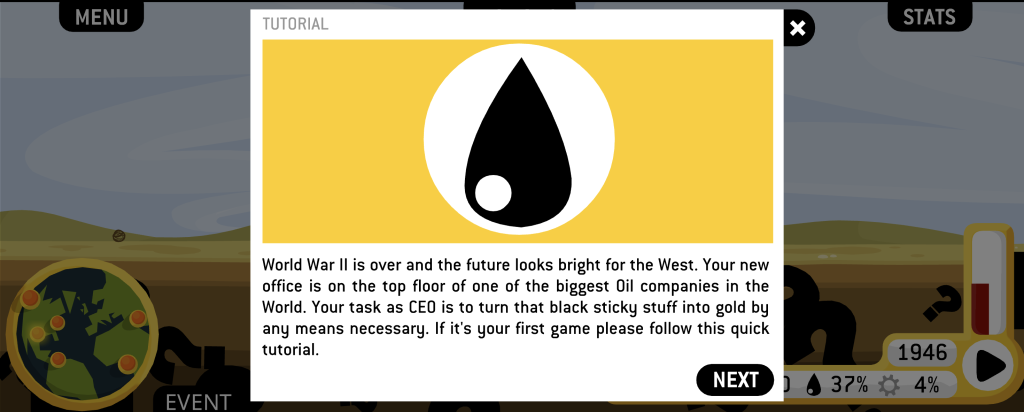

Oiligarghy is also a much more graphic game in this regard, whereas the McDonald’s Video Game never really showed anything explicitly graphic beyond maybe a penis, Oiligarghy is much more explicit about the outcomes of your actions. Here you can corrupt goverments to hang protesters on your behalf.


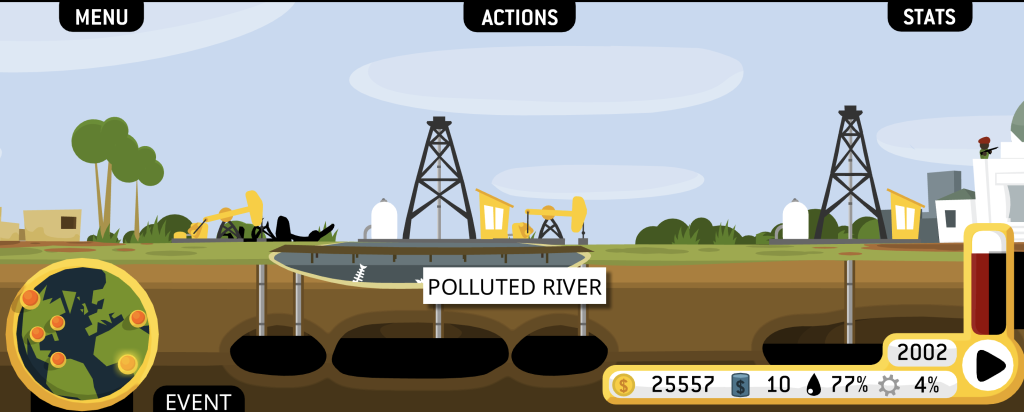
Some of the ways the game shows your impact is through cut down trees and polluted rivers with dead trees.
But hey! The shareholders are hay.

Overall this is an effective game for showing the negative consequences that extracting Oil can bring.
Phone Story
Phone Story was banned from the App Store when it launched in 2011, but can still be accessed through the developers website using the Ruffle extension (Dredge, S. 2011).
This is a game which has 4 minigames, where the player has a look at the “dark side of your favorite smartphone.” The game has a robotic narrator which does contrast with the rather grim minigames that it presents the player with.
The first one is where the player takes control of guards to prevent children from taking a rest from mining, by moving the guard to that child so they can shout at them.

The second game has you moving around a trampoline to prevent workers from jumping to their death. As if the first minigame wasn’t dark this is considerably darker.

The third one is considerably less dark but still leans in the satirical side of things. Here you are flinging phones to obsessive customers.


The final minigame is where you need to seperate parts for “recycling”, or really, burning. This was the minigame that wasn’t immediately clear how to play as it required matching the colour of the part to the colour of the
A lot of the issues that the game describes are still relevant in the smartphone production cycle today, which makes Phone Story still important for understanding the supply chain for smartphones (or any modern tech) (TED-Ed 2018).
Conclusion
Overall, Molleindustria’s satirical games make for good reference points when it comes to making games designed for a satirical message, which is what I am aiming for my game. These games at least have a standard business simulation look but subverts that by showing to the player the negative impacts of these businesses.
References
Paolo (2020). Gone with a Flash (talk transcript) – Molleindustria. [online] Molleindustria.org. Available at: https://www.molleindustria.org/blog/gone-with-a-flash-talk/ [Accessed 9 Jan. 2026].
Dredge, S. (2011). Apple bans satirical iPhone game Phone Story from its App Store. [online] the Guardian. Available at: https://www.theguardian.com/technology/appsblog/2011/sep/14/apple-phone-story-rejection [Accessed 9 Jan. 2026].
TED-Ed (2018). What’s a smartphone made of? – Kim Preshoff. YouTube. Available at: https://www.youtube.com/watch?v=eIdJ22AfsO8.