Career planning is an important decision that every student approaching graduation must face. Over the past few weeks, several graduates and guests who have already entered the industry gave presentations and shared their experiences with career choices and their work. In this blog, I will look back on what they discussed, reflect on my own learning and work over the past three years, and consider how I can take a new step in thinking about my future path.
# Important Things About Getting into the Industry
– Communication and collaboration
In most cases, a game cannot be completed by just one person. Once you join a team, you have to deal with communication with colleagues and different departments.
In Jamie Blacknell’s talk, he explained how to communicate with colleagues and leaders in a game company. And in Megan Matthews’s talk, she shared many ways to exchange ideas and inspiration with teammates.
In many cases, the designs created by concept artists cannot be fully realised in the actual game. An idea may look great in a concept illustration, but once implemented in code, the final result may not meet the concept artist’s expectations.
I was assigned to be the technical artist in the second semester of my second year. My team encountered this issue while developing Memories of a Misty Seashore. First, we decided to present the game within a UI frame like a surveillance camera or television screen, but this decision introduced a new challenge. In the original GDD, the main exploration scene, the hotel room, was designed in a vertical layout. We had to decide whether to preserve the original environmental designs or to redesign them entirely to fit this new presentation style. As Blacknell mentioned in his talk, “it is useful to be specific about the actual desired outcome, rather than asking for a specific task”, I showed the concept of UI, and our environmental artist quickly understood what I was trying to convey, then we decided to adjust all the environmental concept art into a horizontal layout, and we created new background images based on the original composition and colour tone of the concept art, which better aligned with our development direction.
Similarly, collaboration is also a very important part of making a game. Matthews’s presentation showed some tools and methods that their company, ustwo games, uses to share ideas and information, such as digital cool boards, which show all ideas, and people can vote on them in order from best to some not that suitable, Crazy 8s, playing paper prototypes, one-on-one collaboration and feedback.
My team members couldn’t always meet at school, and some of them preferred to communicate online. So we created a group on Discord and used several collaboration tools like Miro board and GitHub to work together.
For example, in the Memories of a Misty Seashore project, the narrative designer added some metaphors into the story. I passed this information on Discord and Miro to the environment artist so she could include elements that reflect these metaphors when creating the background.
We also used some tools to track the timeline, but in the end, we didn’t use them very well. However, we still finished making the game before the showcase. Since the GDD was already set, we didn’t discuss many ideas, and still, with this experience, we can refer to Matthews’ methods to share ideas and feedback in future team projects.
– Networking and social media
More than half of the guests mentioned the importance of networking and the benefits it can bring. In Blacknell’s talk, he noted that because AI is becoming more common and developing so quickly, communication between people has become even more important. Talking with people in the industry and learning how they work, joining game jams and other challenging events, and being active in different communities are all good ways to build a network.
In Olivia Gregory’s talk, her advice on networking also encouraged us to communicate more with real people. Most people in the industry will not turn down a polite conversation, but we should also respect their time and resources. Volunteering at different events is an easy and low-cost way to build connections. At these events, we can meet others who also want to enter the industry, and we may also meet experienced people who can offer helpful advice. If someone truly helps you, you should pass that kindness on. It’s a way to help both yourself and others. Just like in her own experience, the conversations she had while working at a café helped her get her first job. Now, she is passing these experiences on to us, helping us find a direction to move forward during this challenging period.
Matthews also talked about many benefits of networking that help both sides. For example, it gives you more chances to be remembered, builds confidence, may bring job opportunities in the future, and makes the whole industry more friendly and interesting.
After her talk, I looked at her previous blog posts, where she shared her experiences of using social media to grow her network. These efforts also brought her a lot of exposure and job opportunities.
The game industry today relies heavily on social media. Whether it’s sharing information and promotions for new games or communication between developers and players, most of it depends on social media.
She pointed out that posting your own content on social media is only one part of networking. Taking part in discussions is just as important because it helps you understand what topics are popular in the community and shows that you are active in the community. In addition, using the right hashtags on social media can increase the reach of your posts and help them reach the right target audience more accurately.
Networking is something I’m not very good at. I’m an introverted person, and talking to strangers in real life makes me feel a bit stressed, even if they are friendly. Because of this, I often find it hard to express my ideas clearly, even when I have something I want to say. However, communicating online is easier for me, so maybe I can start with social media.
I haven’t shared anything about my process of game-making or experiences before, mainly because I’m not very confident in my work. As a result, I wasn’t willing to post anything about my game development.
After listening to these talks, I realised that everyone’s career path begins with small steps and gradually expands as they build new skills. Recording my own growth isn’t something to feel embarrassed about. It helps people see your progress and, along the way, reveals the advantage that makes each person unique.
Many of the speakers mentioned that game studios pay a lot of attention to your personal charm, whether they’d like to work with “you” as an individual. Tracing your own journey shows these qualities more clearly, and sometimes it even attracts people who share similar values or creative energy.
So moving forward, I want to be more active on social media and share records of my game design process. This will be my way of slowly building a network and shaping the path that goes into the industry ahead of me.
# How Does the University Help with the Preparation?
– Teamwork
As I mentioned before, game development is rarely a one-person journey. Working harmoniously with team members is essential in this industry. Before entering university, I didn’t have many opportunities to participate in group projects, so I developed a somewhat negative attitude toward the teamwork I knew I would face in the years ahead. But once I actually started my studies, I realised that although group work can be frustrating at times, the overall experience has been surprisingly positive, perhaps because I’ve been lucky enough to work with some really great teammates.
Over the past three years of team projects, I’ve taken on roles such as programmer, writer, artist, mechanic designer, and technical artist. Just as Bea Grove mentioned in her talk: “Design branches into many other roles, and you need to know how they work.” These experiences helped me understand the responsibilities behind each position, and they also made communication with teammates much easier across different parts.
– Founding your own interests
After listening to these different talks, I realised that everyone enters the industry in their own way. Some people set their goals early and pursue them with determination in the game industry, while others step into the field by chance and circumstance. And even though they all graduated from the same school, the paths they chose once they entered the industry diverged in many different directions. Grove introduced many career paths within game studios, and in Rhys Shepherd’s presentation on technical art, he outlined the various specialisations within the role.
Right now, I’m still not entirely sure which direction I want to pursue. I have experience in many areas, but I’m not fully specialised in any single one. For example, I can create concept art or character design sketches, but without formal artistic training, I don’t think my skills can take on highly detailed or precision-focused art tasks at a professional level. It’s the same with programming. Although I managed to create two playable prototypes in past projects, Little Raven and Memories of a Misty Seashore, I don’t actually have any foundation in coding. Most of the work was done by following online tutorials and using Fungus, a plugin that doesn’t require coding knowledge. Because of this, I’m still not able to develop a full project through independent programming.
But through all these project experiences at school, I realised that a QA (Quality Assurance) tester is actually a role that suits me very well.
Before doing any career research, I didn’t have a full understanding of what a QA tester actually does. I only knew that before a game’s official release, there are usually several testing phases or an early access period, during which studios gather player feedback and fix bugs based on those reports. So I decided to look deeper into the exact role and position of a QA tester within the industry.
Think of a QA tester as a detective, looking for any mistakes or problems in the game. They meticulously play through games, repeatedly testing various strategies to pinpoint issues. Collaborating closely with game developers and programmers, they ensure that these problems are addressed (8bitplay). In simple terms, QA testing is about thoroughly checking a game before its release to ensure that no serious bugs remain, especially those that could disrupt the gameplay experience. Also, besides understanding a game’s design concept and expected performance, and ensuring that the development meets its intended goals, a QA tester has another crucial task: “breaking” the gameplay. This doesn’t mean maliciously interfering with gameplay, but rather testing it from new angles to see how it plays out in the game under different conditions.
Jade Carter, who began her career in QA and eventually became a producer, shared many valuable insights about QA in her talk. She explained that QA is an excellent entry point into the industry, especially for new game designers who are still unsure about their strengths.
She also emphasised that QA is a role where you can gradually show your abilities. Different departments may notice your strengths through your work in QA and invite you to join roles that better match your talents.
– Quality assurance experience in past projects
After looking into it, I realised that I had actually taken on the role of a QA tester in the Memories of a Misty Seashore project. Moreover, this was a role that developed gradually over time.
During the second playtest, a student deliberately pressed random keys while playing, trying to trigger bugs. Indeed, this led to the discovery of many issues we hadn’t noticed. At that time, my teammates and I felt a bit frustrated because our game is a detective game, and the student wasn’t experiencing the parts of the game we intended players to explore; instead, they were testing aspects unrelated to the game’s main content.
Yet, because of this, I gradually came to realise the importance of system testing and interaction testing in the development process. Now, I am truly grateful for that student’s actions, as they helped me fully understand the value of quality assurance.
When I was designing the camera system, the experience from that student’s earlier stress-testing inspired me to implement a more rigorous structure for a much more complex version of the camera logic. The basement scene is the most complex environment in the entire game, and it can be divided into 2 main sections, A and B, and 4 sub-sections: 1 and 2 (belonging to A), and 3 and 4 (belonging to B).
To manage this, I first created 4 highest-priority variables: LockAllView and LockMove, which lock the camera whenever the player is in dialogue or interacting with an object, preventing any unintended camera movement. I also added LockUp and LockDown, which control whether the player can move vertically within the scene.
The second-level variables are LockViewA and LockViewB, which determine whether the player is currently in section A or B. This prevents situations where pressing a key would move the camera to the wrong section.
The third-level variables, View1, View2, View3, and View4, manage transitions between the 4 sub-sections and prevent invalid transitions, such as jumping directly from View1 to View4.
The overall camera logic works as follows: first, check whether the player is in dialogue or clicking on an object. If so, all camera movement is disabled. Then, check whether the current scene allows vertical movement. Next, determine whether the player is in section A or B, which decides whether horizontal movement occurs between Views 1–2 or 3–4. Finally, determine the valid vertical transitions, either between 1–3 or 2–4. With this layered approach, the camera system remains stable and coherent even in highly complex environments.
Moreover, during testing, inspired by that student who tested the game in unexpected ways and the experience of developing the camera system, I suddenly realised that players might not follow the intended order at all. So I added logic for many unexpected interactions: for example, what happens if the player finds other tapes before interacting with the camcorder, or how the system should handle different viewing orders of the tapes.
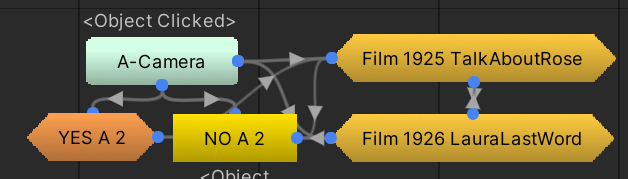
During the final showcase, these additional development efforts proved to be absolutely necessary. They effectively prevented many potential bugs that could have appeared when players explored the basement in their own unexpected ways.
Although players were unaware of the work behind these systems, I still vividly remember the complicated realisation. When I discovered the flaw in video cassette recorder interactions, I felt a strong sense of collapse, knowing that the workload was about to double. Yet at the same time, uncovering more of the players’ logic and the different choices they might make was really exciting. I realised that exploring these varied gameplay possibilities is not only fascinating for me, but also deeply rewarding, like discovering countless hidden Easter eggs.
# Current Goal and Plan
Even though I received many years of English and international education, and have loved western culture, such as movies, literature, comics, since I was young, I still came to realise several challenges caused by cultural differences during the years I’ve lived in this country. So I decided that after graduation, I will prioritise looking for job opportunities in game companies in China.
– Goal
My current goal is to put in my best effort for the final project. At the same time, I plan to apply the advice on portfolios and CVs from the presentations to build a portfolio that shows my abilities and supports my future job applications.
Also, based on my own gaming preferences, I’ve realised that learning Japanese is becoming increasingly important for me. During the recent livestream for the new Final Fantasy XIV expansion, the development team announced a recruitment call for game testers, and even students were allowed to apply. This opportunity aligns perfectly with my career goals.
Although my current Japanese level isn’t strong enough for written communication, and I may not be selected, the announcement still shows that there is an active demand for QA tester roles within the development team.
Because of this, I plan to study Japanese systematically, as long as it does not affect the progress of my final project.
– Career plan
At the moment, there is a game company that I really hope to work for. I am already a player of their game and have actively taken part in activities such as game surveys, social media interactions, and fan creations. This company is a small studio that focuses on female-oriented mobile games, and currently it only has one title in operation. Compared with large and popular game companies where the competition is intense, and many applicants have years of industry experience, I may not be as competitive as a fresh graduate. Because of this, a small company like this could be a good stepping stone for me to enter the game industry.
In Bea Grove’s talk, she mentioned that we should research a company before going into an interview. Although I haven’t reached the interview stage yet, I still decided to look into the company I’m currently interested in. However, I noticed that the company’s subsidiary has serious credit issues and is involved in several legal disputes. I realised that I cannot place all my hopes on a company that is facing such risks, so I still need to research other options carefully.
# Conclusion
Before listening to these talks, I honestly didn’t have a clear sense of my career path. But after reflecting on everything above, I now have a much clearer direction for my future, and I feel more confident in my own abilities.
Although I still don’t know how things will change in the future, I’m now much more willing to try, to explore, and to keep moving forward.
# Resources
8bitplay (2023) ‘QA Game Tester Jobs: Comprehensive guide to the game development roles’, 8bitplay, 6 September. Available at: https://8bitplay.com/blog/qa-game-tester-jobs-guide-to-the-game-development-roles/ (Accessed: 3 December 2025).
# Special Thanks To:
Jamie Blacknell, the Unity Developer.
Olivia Gregory, the Game Artist
Bea Grove, the Senior Game Designer
Rhys Shepherd, the Technical Artist
Megan Matthews, the Game Designer
Jade Carter, the Producer
All the tutors who offered their valuable help.
Leave a Reply