All projects / 01 Trailbound / 02 Factory Flow / 03 Frontline Command
PROJECT 02 · EARLY GAME CONCEPT
Factory Flow
Build a production line that can meet increasingly demanding timed orders.
MANAGE · FACTORY · EFFICIENT
Single-player automation and production puzzle / PC / Timed orders: 2–5 minutes
Arrange machines, conveyor belts and power systems to transform raw materials into finished components. Every component takes time to manufacture, and later orders demand more complicated products within tighter limits.
01 / The player experience
You are a factory manager and production-line designer. Each level gives you an order, a deadline, limited floor space and a construction budget. You build the line, run it, watch where materials wait and redesign the slowest stage.
Player goal: Deliver the required quantity before the order timer expires.
Emotional goal: Turn a slow or confusing process into a clear, reliable and efficient system.
How the timed orders become harder
| Stage | Order time | Production demand |
|---|---|---|
| Introduction | 5 minutes | One material and one processing step. |
| Developing | 4 minutes | Two materials, multiple machines and a shared belt. |
| Advanced | 3 minutes | Parallel component lines, assembly and a power limit. |
| Expert | 2 minutes | A higher quantity of complex products with little spare capacity. |
The exact deadline depends on the order. Difficulty rises through shorter deadlines, larger quantities and additional manufacturing steps rather than simply making every machine slower.
02 / Game references
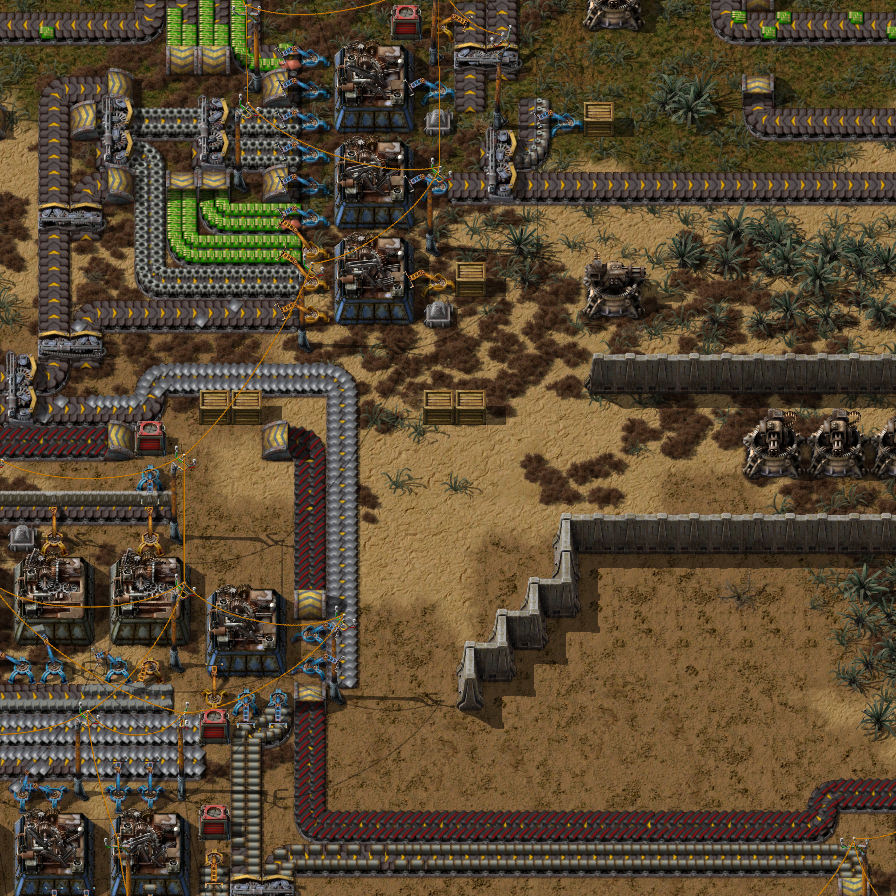

These are reference screenshots from existing games. They do not show a playable Factory Flow build.
03 / Core gameplay loop
Read the order → Check part times → Place machines → Connect belts and power → Run production → Find the bottleneck → Improve before time expires
Example manufacturing times
Machines have visible cycle times so players can calculate the required throughput. Starting values could be: metal plate 2 seconds, wire 3 seconds, gear 4 seconds, circuit board 6 seconds and motor 10 seconds. A motor also needs a gear, wire and circuit board, so its real production time depends on every earlier stage.
- Build: Place and rotate machines, belts, splitters, storage buffers and power connections on a grid.
- Connect: Belt arrows and machine ports show where materials enter and leave.
- Power: Generators provide a limited electrical supply. A line that demands too much power runs more slowly or enters a visible brownout state.
- Observe: Timers, queues, machine status lights and per-minute output make the slowest stage visible.
- Improve: Pause to reroute a belt, add a parallel machine, expand power or rebalance material flow.
Production example: Ore → Furnace → Metal plate → Gear press. A second line turns copper into wire. Gears, wire and circuit boards then enter a motor assembler before delivery.
04 / Increasing production challenge
An early order may ask for 20 gears in five minutes. The player only needs one ore source, one furnace and one gear press. A later order may request 12 motors in three minutes. It requires several component lines, enough electrical power, storage buffers and parallel machines working at the correct ratios.
A faster conveyor cannot fix a slow assembler, and extra machines cannot help when the power network is overloaded. The player must identify the actual limit and improve the correct part of the system.
05 / Playable scope
- A sequence of timed orders progressing from five-minute introductory jobs to two-minute expert challenges.
- Raw ore, metal plates, gears, copper wire, circuit boards and motors, each with a visible manufacturing time.
- Conveyor belts, splitters, storage buffers, furnaces, component machines and final assembly machines.
- Power generators and cables, with clear supply, demand and overload feedback.
- Pause, run, reset, order timer, delivery count, throughput display and saved layouts.
06 / Gameplay research
The project can expand beyond a single conveyor puzzle while keeping every added system understandable and connected to production.
- Electricity: Compare small reliable generators with larger systems that need more space or fuel. Power should create planning choices without requiring detailed electrical engineering.
- More production lines: Introduce separate metal, wire and circuit lines that eventually combine into one product. Every intermediate component should have a clear purpose.
- Reasonable complexity: Add one new idea at a time—splitters, buffers, power, parallel machines and upgrades—then reuse it in later orders. Avoid introducing several unfamiliar systems in the same level.
- Ratios and bottlenecks: Use visible cycle times and output-per-minute values so players can understand why materials accumulate.
- Multiple solutions: Let players choose between compact layouts, high-power fast layouts and slower efficient layouts, provided each can meet the order.
- Scaling: Move from one product to factories that produce several components at once, while colour coding inputs and keeping machine ports readable.
Research direction from Factorio: how power, machine ratios and resource flow create connected management decisions.
Research direction from shapez 2: how clear visual language, modular production steps and large factories make complicated automation easier to read.
Status: concept proposal. Manufacturing times, deadlines and order quantities are starting values that can be adjusted as the design develops.
All projects / 01 Trailbound / 02 Factory Flow / 03 Frontline Command