Written by Yulia
This page explores the evolving world behind our project.
It presents the narrative foundation, ecological relationships, and character context that define the Forest Keeper’s journey.
Together, these elements shape a unified and intentional fantasy setting.

Solid arrows — water flow
Dashed arrows — seed dispersal
Lines — elevation
Icons — animals
Ecosystem Logic
1.Local ecosystem functions
While I designed these three explorable regions, I did not do it so that they could just be three independent visual spaces but rather three interconnected ecologies.
The Lake region mainly offers water and promotes vegetation, making it more conducive for the existence of those animals and plants which are dependent on a humid environment. Unlike the Wasteland with varying ecosystems, the Clearing is more like a transition area where the activities of some plants and animals meet. Regarding the cliffside, I designed it to be the environmental bounding of the whole world, so you find the terrain and atmospheric here more exposed than the other two regions.
Because of the differentiation in ecological role across the different regions, the world seems more believable than a simple succession of scenes, and the environment structure appears more consistent.
2.Circulation of Materials Between Locations
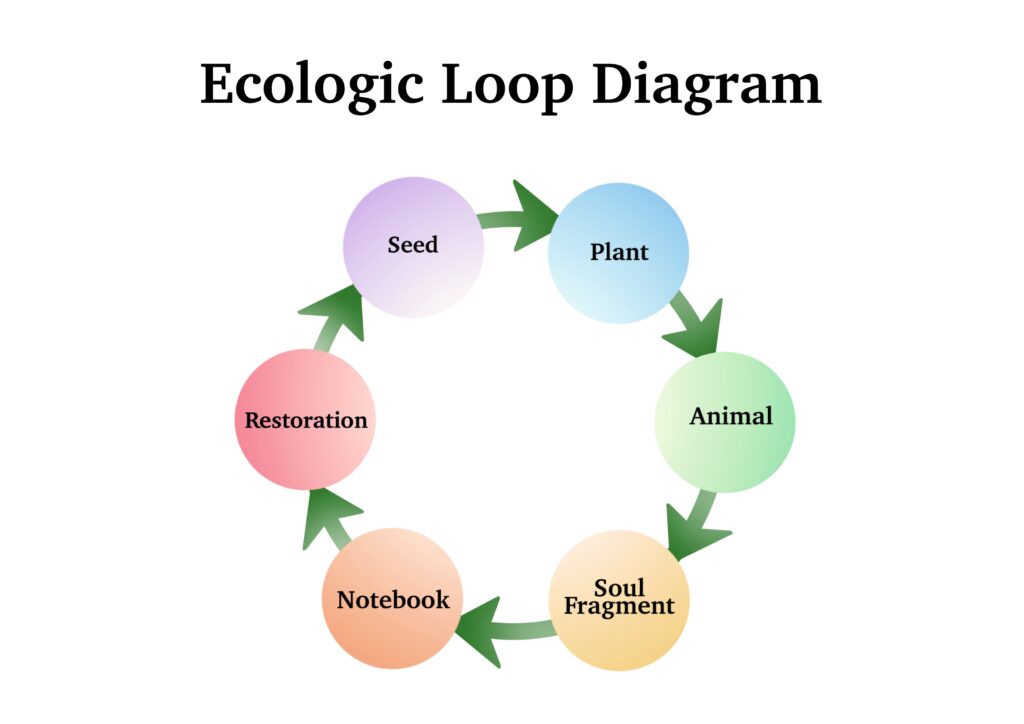
Environmental systems will also express the links between areas. For example, a forest.
- Seed scattering
- movement of water
- Indications of animal activity
Some of the plants may exist in more than one region while the water may flow very slowly from the forest till the sea which is below the sides of the cliff. The game will not feature a full migration system, but I’d like to include small details of environmental storytelling to create a sense that ecological interactions exist between regions.
These tracks may deem animal tracks, marks or disturbances on vegetation, an abandoned bird’s nest, and so forth which can provide clues.
Such information makes the world more interconnected as a tightly-knit ecosystem rather than a mere assemblage of standalone gameplay spaces.
Resource Integration
1.Resource Origin
Currently, resources in the game world mainly come from the natural environment itself, namely.
- plants
- branches
- fruits
Resources are varied according to the environment and ecology, letting players perceive the differences more accurately as they explore the various locations.
2.Regeneration
Most plant-based resources will remain in a relatively subtle state of renewability.
Rather than emphasising resource depletion, the entire resource system is designed to foster a sense of ecological continuity and environmental stability, which is also more in keeping with the generally tranquil atmosphere of Forest Keeper.
3.Environmental Impact of Collection
Resource gathering does not cause any significant damage to the environment itself.
Compared to traditional collection mechanics, resource interactions here are designed to strengthen the relationship between the Keeper and the surrounding ecosystem.
Consequently, resource interactions not only drive gameplay progression but also further reinforce the environmental balance and coexistence within the world.
Spatial Narrative
1.Intended Player Emotion
When entering different areas, the overall atmosphere is designed to evoke feelings of curiosity, safety and a sense of connection with the environment and the animals.
Rather than emphasising danger or the pressure to survive, the world as a whole encourages players to explore through the environment itself, gradually helping them to develop an understanding of the Forest Keeper world.
2.Visual Navigation Cues
Visual Navigation Cues
The player’s direction of movement is primarily guided by the environment itself, for example water flow, changes in vegetation density, differences in elevation and variation in plant life. These environmental details help players to naturally understand spatial orientation without having to rely too heavily on explicit UI guidance.
Animal Placement Logic
Animals appear in specific areas based on the ecological conditions of their respective habitats, rather than being placed randomly across the map.
The distribution of different species not only helps to emphasise the differences between biomes, but also makes the environment itself appear more believable, whilst further enhancing the player’s interaction with the environment.
World Expansion Potential
At present, these concepts are still at an early stage, but we may well expand into new ecological regions in the future.
For example, in addition to forests, we might introduce more extreme environments, or areas where the ecological balance has already been disrupted. Compared to the relatively tranquil atmosphere currently in place, these regions may allow players to experience more clearly the impact that environmental changes have on the world.
The Keeper’s actions may also extend beyond simply tending to local environments, gradually influencing the recovery and evolution of the entire ecosystem.
References
- ecological system references
- environmental storytelling references
- Journey
- game ecology inspiration
Leave a Reply