Introduction
This page primarily documents my development process regarding world design and ecological structure in Soul Keeper.
Rather than simply presenting the final result, I am more interested in recording how these environmental structures and ecological concepts evolved step by step, and what adjustments were made along the way.
Early World Structure Exploration
When I first started working on this section, I began by using relatively simple environmental sketches to map out the general structure of the world.
At that stage, I was primarily focused on the spatial relationships between different areas, as well as the direction of player movement between them. Initially, Lake, Clearing and Cliffside were merely three basic regional concepts rather than a complete ecosystem structure.
As I continued to refine my ideas, I began to consider whether these areas could form an interconnected ecosystem, rather than simply being separate scenes. The sketching process at this stage helped me gradually clarify the environmental flow of the entire world.
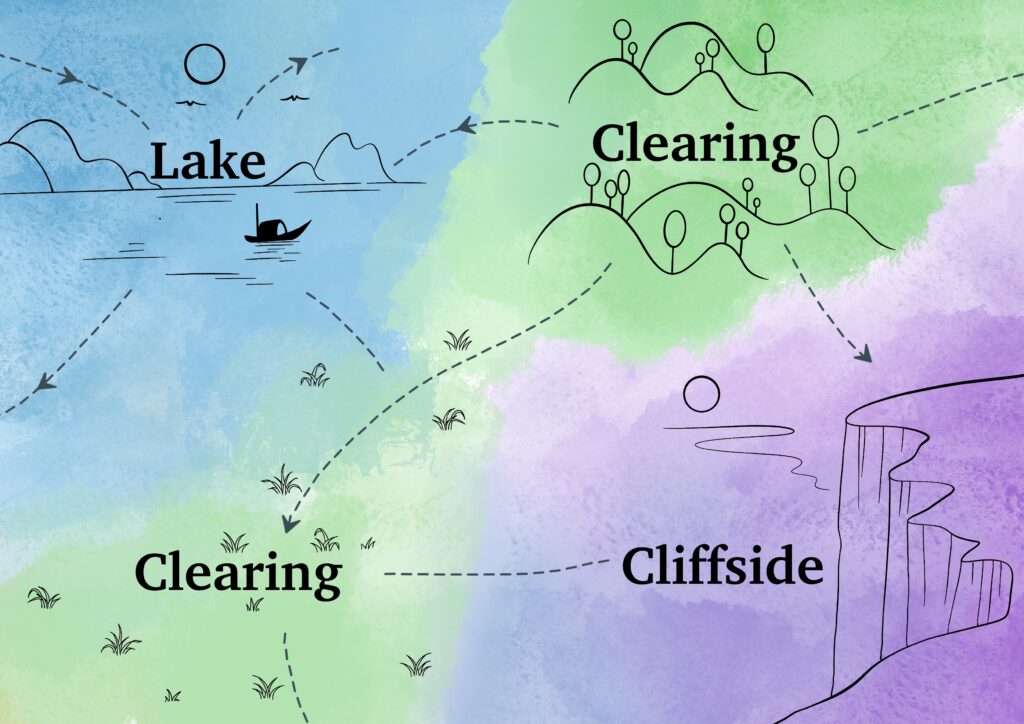
Process Video — Environmental Mapping
Challenges & Adjustments
I had some problems during this development process of the app When I started arranging these areas, I realised that the world already consisted of a base atmosphere but the connections did not seem particularly explicit among the areas. The Lake, Clearing and Cliffside felt less like a combined ecosystem and more like three separate scenes.
As I was working on the world structures, I specifically started to notice that if I simply created the visual environment, there would be a lack of internal logic. After this, I started playing around with diagrams and ecological mapping to cluster different types of ecological connections like water movement, seed dispersal, and animal relationships. This approach helped me link, piece by piece gameplay, environment and ecosystem structure. It was also challenging to ensure the visual atmosphere matched the system logic. I would like the world to retain a soft and dreamlike quality but without making the environment look fully arbitrary.
Consequently, I began to think more along the lines of environmental storytelling which was more about. animal footprints, vegetation dispersion and landform transmutation As a result of these particulars, a finer bond was formed between areas, and as a whole created a more believable world.
Ecological System Development
Once the basic areas were complete, I began to reflect further on the connection between ecosystem logic and gameplay. I gradually realised that if each area were merely a standalone visual scene, the world as a whole would lack a sense of ecological connection.
So, I subsequently began experimenting with incorporating ecological concepts such as seed dispersal, water movement, animal interaction and the restoration cycle. This ecological loop diagram primarily served to help me organise the relationships between gameplay, the environment and environmental storytelling.
Compared to the earlier environmental sketches, this stage involved more than just considering the visual atmosphere; it began to focus more on systems thinking.
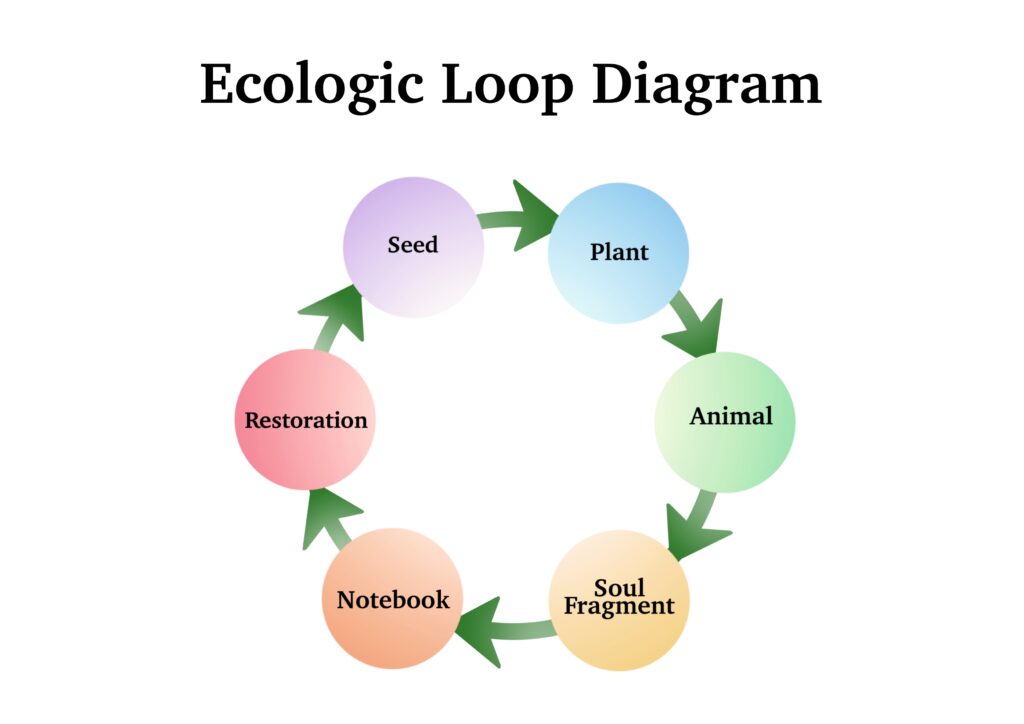
Process Video — Ecological Loop Diagram
Reflection
As I went through the development process, I slowly started to realise world design is not solely about the environment’s visual design. The interaction of gameplay, ecology, player emotion and environmental storytelling is what really matters. I now invest greater amounts of time contemplating the intersection of systems and how to elevate the world’s overall believability, as compared to when I began the project.
Leave a Reply