Introduction
This page primarily documents my development process regarding world narrative and player experience in Soul Keeper.
Whereas the story direction was rather vague at the outset, I subsequently began to gradually interweave narrative, ecology and gameplay, ensuring that the world possesses not merely an atmosphere, but a genuine internal logic.
Early Narrative Direction
When I first started organising the narrative structure, I began by creating a simple player journey map.
At this stage, I was mainly focusing on player progression, environmental transitions and emotional pacing.
Initially, my narrative ideas were more focused on atmosphere and were quite abstract, so I wanted to use a relatively simple structure to organise what the player would experience at different stages. In this phase, ‘Awakening’ served more as an introduction, ‘Lake’ marked the start of exploration, ‘Clearing’ introduced relationship-building and puzzle-solving, whilst ‘Cliffside’ leaned more towards restoration and completion.
This process helped me gradually link the narrative flow with gameplay progression.
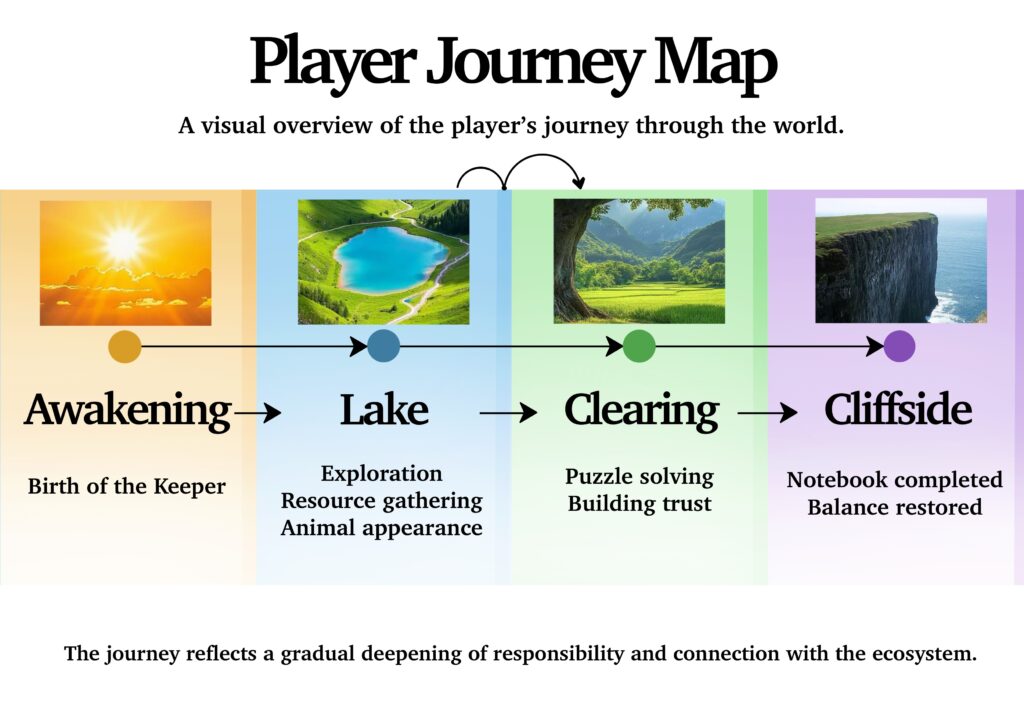
Process Video — Player Journey Map
Narrative System Development
As I continued to refine the narrative, I began to notice a problem.
Although the world as a whole already had a fairly distinct visual atmosphere, the narrative and gameplay were actually still somewhat disconnected. Particularly at the beginning, the narrative I had written leaned more towards a poetic atmosphere; whilst it appeared rather dreamlike, certain elements made it difficult for the player to grasp their objectives.
After that, I began to rethink why this world had come to be in this state, and why the player should help these animals. Consequently, I began to incorporate narrative concepts such as ecological fading, environmental memory and relational trust.
Compared to traditional narratives of destruction, I wanted this world to convey a sense of slowly fading away. The forest is not suddenly destroyed, but rather gradually forgets how to function. This narrative direction also aligns better with the gentle and dreamlike atmosphere of Soul Keeper itself.
Challenges & Adjustments
Achieving the perfect balance between mood and clarity, however, is often the hardest part of this narrative process. At first, my writing was more emotional and visual but then through further discussion, I slowly started to realise, that if the narrative was too abstract, players would not be sure of what they have to do.
The opening text was especially the one which was more poetic during my first draft but ceased to be so after changing it up as I began to think about clarity of information, e.g. Who is the player? Why is he here? What does he have to do? This information was put into the opening story later. Another difficulty was with the relationship between the narrative and the ecosystem. At first glance, the narrative and the ecological structure felt separate.
After that, I began experimenting with ways to ensure that gameplay behaviours—such as animal trust, environmental restoration, and player exploration— directly influenced the narrative progression. Following this adjustment, I felt the entire world began to feel more cohesive, rather than merely serving as a backdrop.
Reflection
Through this process, I have slowly come to realise that narrative design is about more than just writing the story. More important is how the story ties in with the gameplay, environment and player behaviour While I used to concentrate on only the atmosphere, now I do a lot more. how participants will have a sense of this world. And the means through which players interact with the game world.
Leave a Reply