
This week we had a guest lecture from Oguz Orkun Doma about level design. I greatly enjoyed this lecture as I had never given much thought to level design before especially in such an in depth way and I learned a lot.
What is Level Design?
Practical definition
- creation of spaces, missions, stages, or scenarios
- structuring the game flow, moment-to-moment challenges and the path through
In summary it is the creation of bounded experiences or challenges in a larger game. The way it is represented on screen can vary wildly however. There are many different ways to represent a space.
- Text Based
- Fixed 2D
- Wrap around
- Side Scrolling 2D
- Parallax Scrolling – This one caught my eye as it uses layers to give the impression of depth and it works well in point-and-click games.
- Isomteric Projection
- Ray Casting 3D
- 3D Space
Core Principles of Level Design
- Flow – the players journey
- Affordances – defining what’s possible
- Guidance – use of Cues
- Spatiel Orientation – the environment
- Gating and keys – structuring progression
- Difficulty curves – balancing challenge and flow
Activity
The lecture also had an activity where we used narrative action bubbles to create a level of a made up game.

This is a narrative action flow chart map, it breaks the level down into a manageable focussed experience.
I worked in a pair and we decided to adapt the season 2 finale of a tv show called Dexter into a level. It consists of the ex-girlfriend of the main character looking for him in the woods and stumbling across a cabin where a hostage is being held, in this game version the player is the ex and they have the ability of discovering evidence that the MC is a serial killer. The final choice is whether or not to release the hostage or protect the MC.
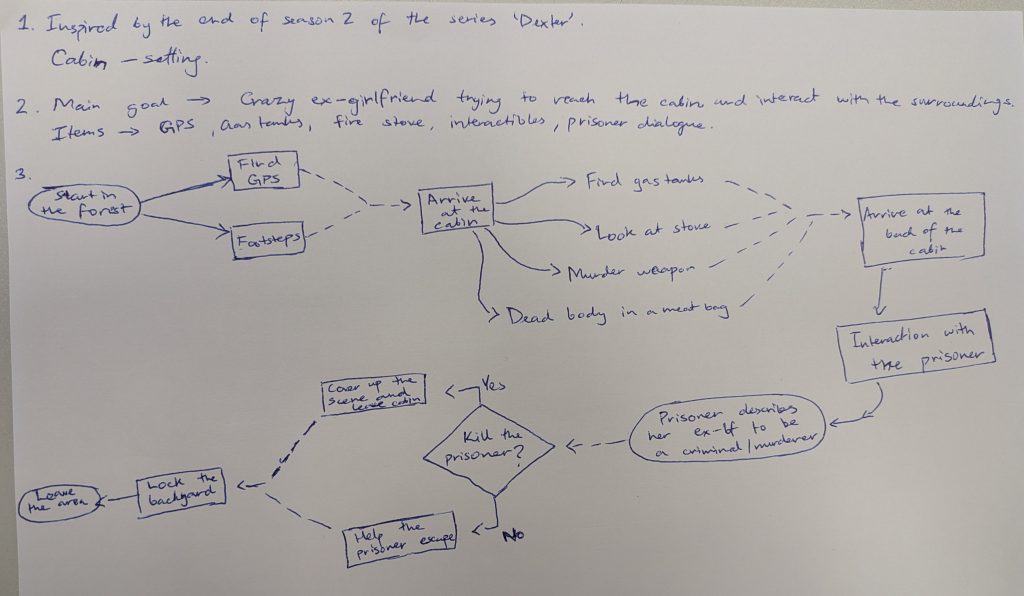
Once we had done that activity the lecturer moved onto level design procedures introducing concepts such as blockmesh, environment art and spatial layouts. We were then tasked with expanding on the game world by breaking down three areas into elements and gameplay elements.
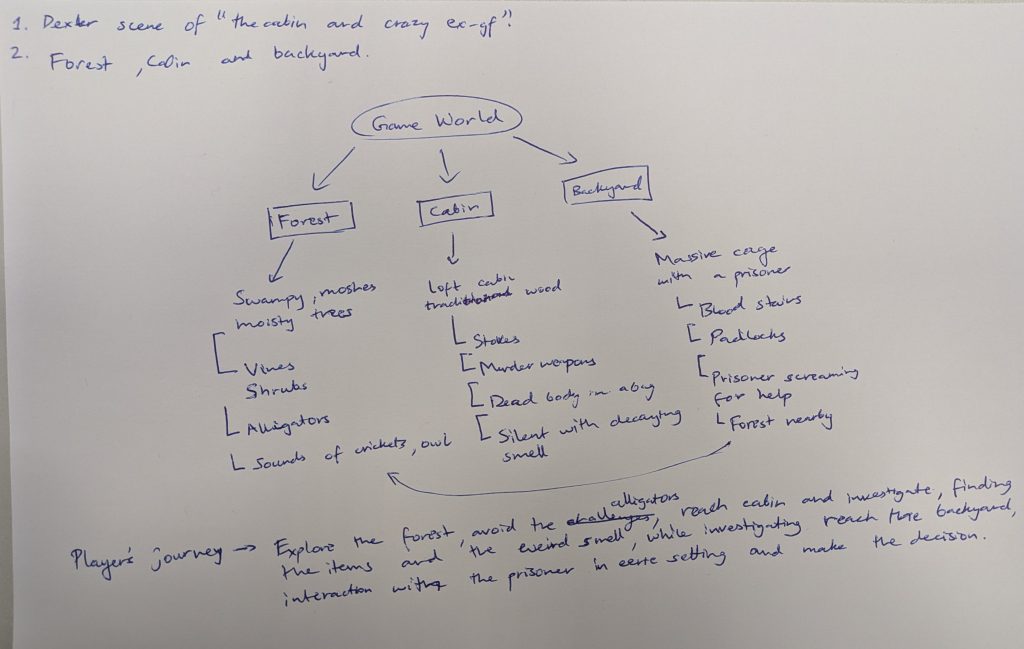
This activity was helpful as it got me thinking more about my game world and how best to bring it to life easily and quickly so I can iterate different ideas smoothly.
The workshop for this week was about building game worlds. We were assigned to groups of three and given a world building excersise sheet.
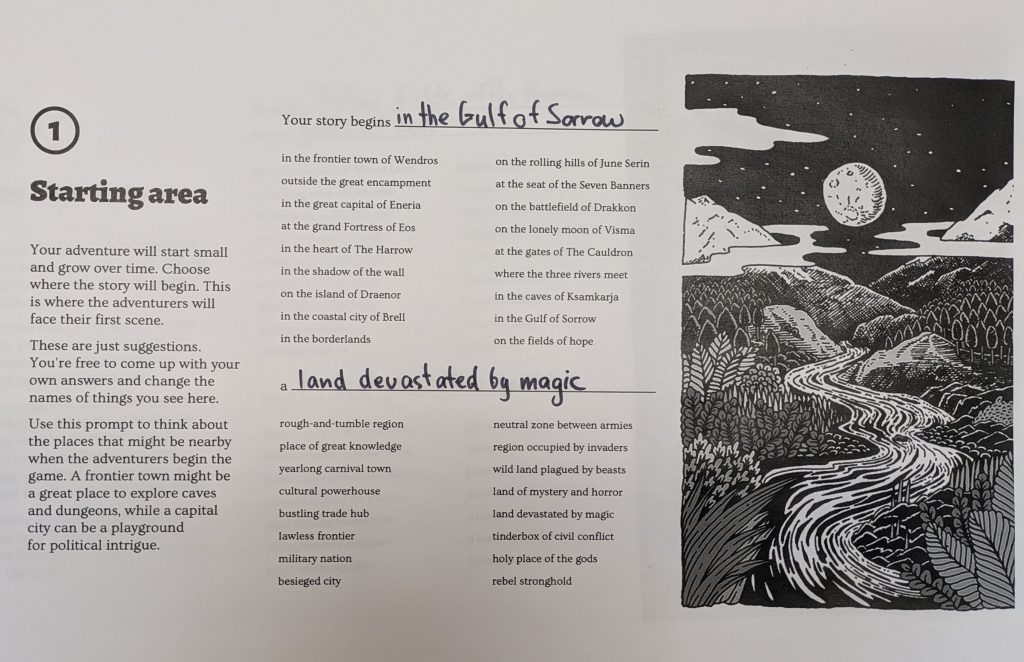
We began with the starting area, choosing the options of the gulf of sorrow and a land devastated by magic.
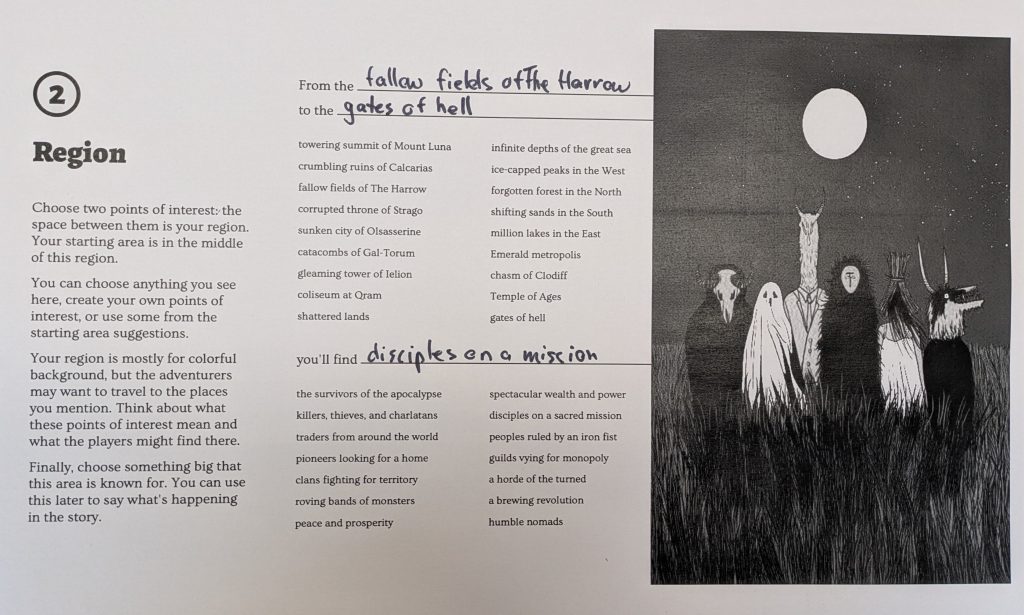
Our next choice was where to situate our world we chose, between the fallow fields of the Harrow to the Gates of Hell.
Our characters are disciples on a mission.
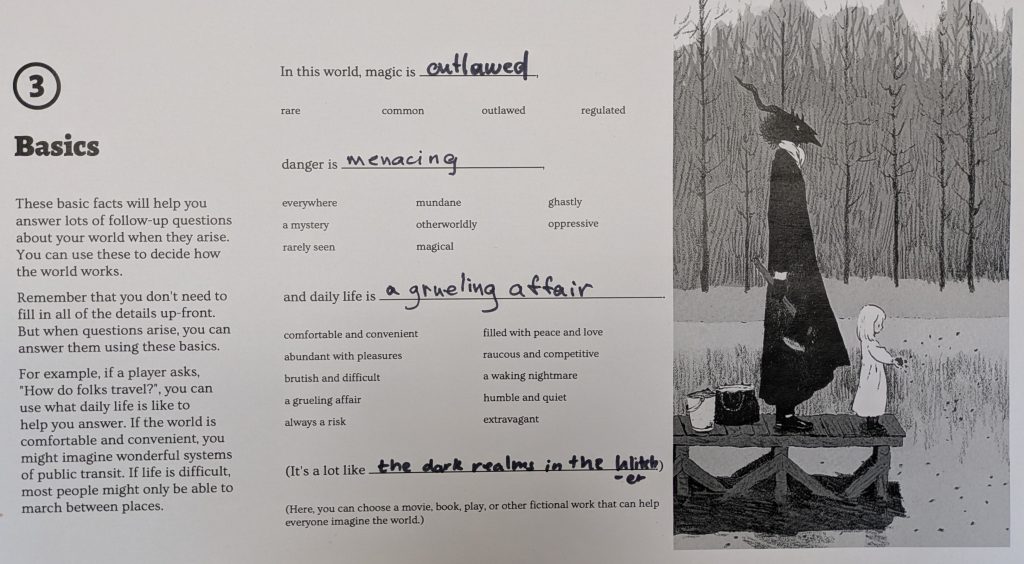
We then started adding in what the worlds lifestyle is like, magic outlawed, danger is menacing, and life is a grueling affair.
It is similar to the dark realms in the witcher.
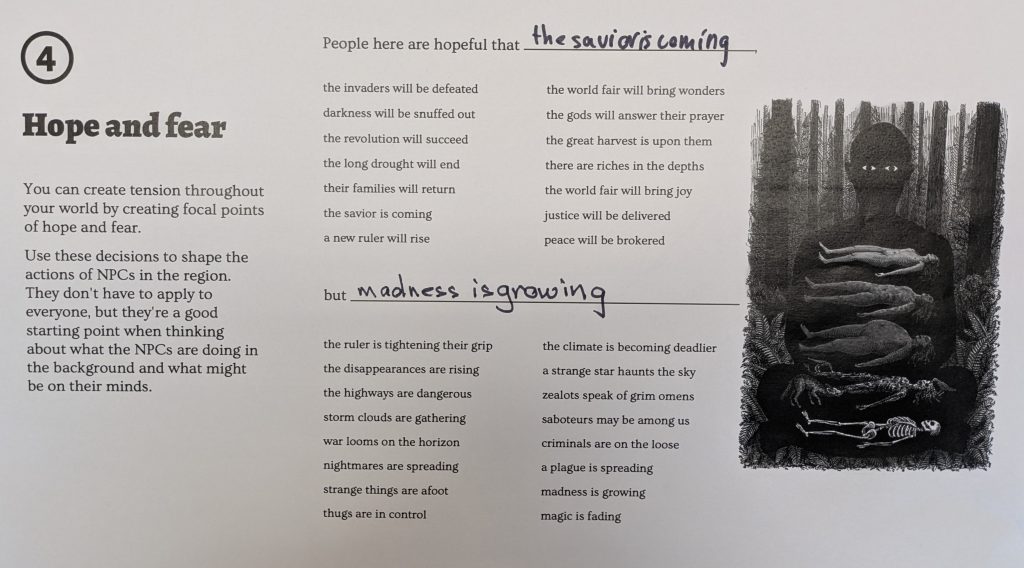
We then added stakes to the world as the people belive the saviour is coming but madness is growing.
This helped us to decide that our player character would either help the disciples find the saviour or they are the savior.
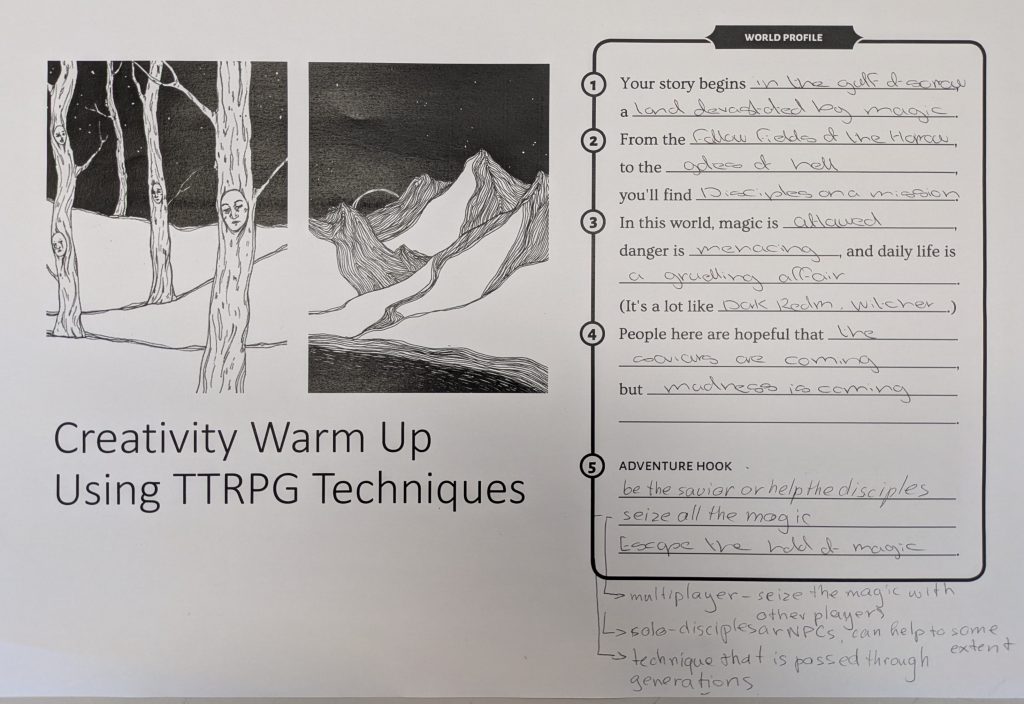
This is the final world that we created. Our game mechanics would revolve around the player being able to absorb magic and stop its harmful effects.
Overall, this workshop was very helpful and was a good way to get the creative ball rolling.
Next Steps –
I will take forward the flowcharts, and conduct research into how I want my screen to look.
Leave a Reply