After the session on Ink I decided to test it in Unity by myself to see if it will be a good tool to use for my dialogue.
Last year I adapted a screenplay of mine into an Ink game so I made that the base for my test project.
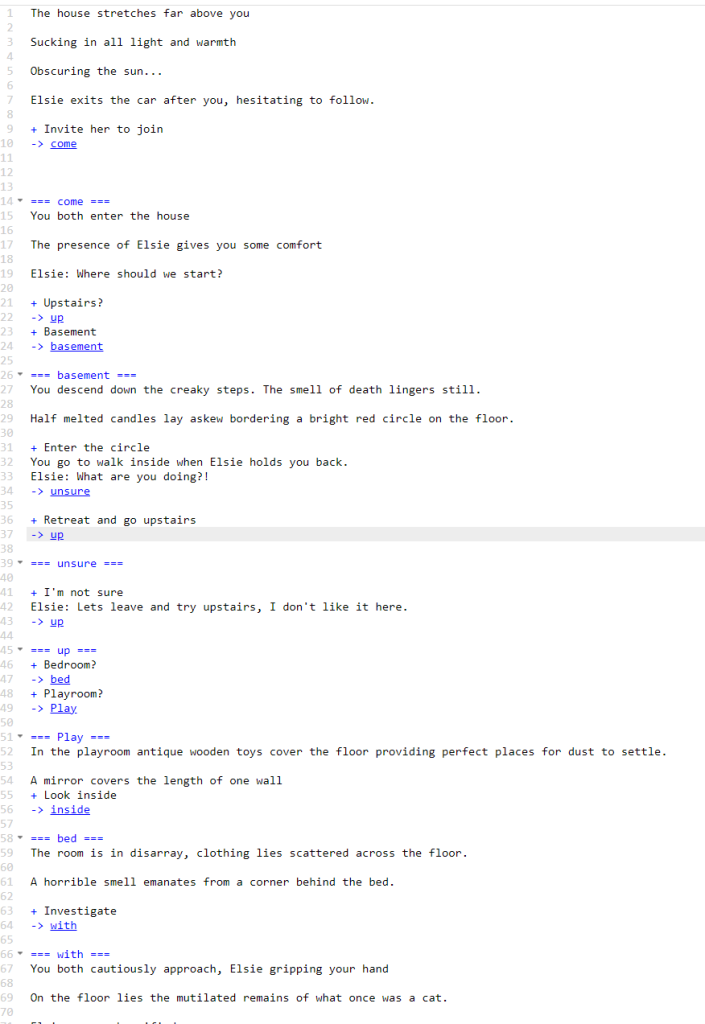
This is an excerpt of the script in Ink, I used knots to organise my scenes. Everytime there is a choice both will lead to different knots depending on what the player picks.
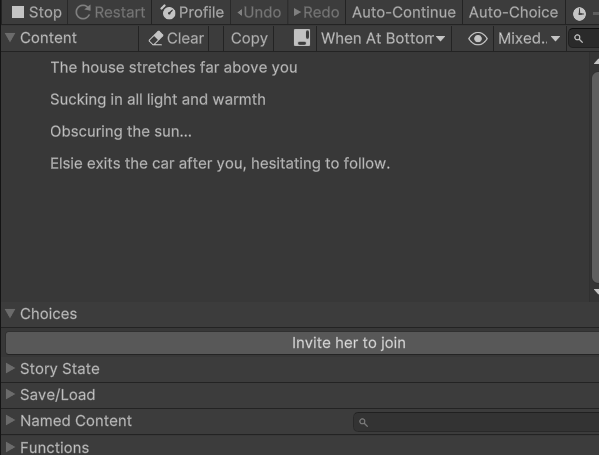
This is the view in Unity, you can easily test out the writing in the Unity inspector this saves time instead of running the game each time.
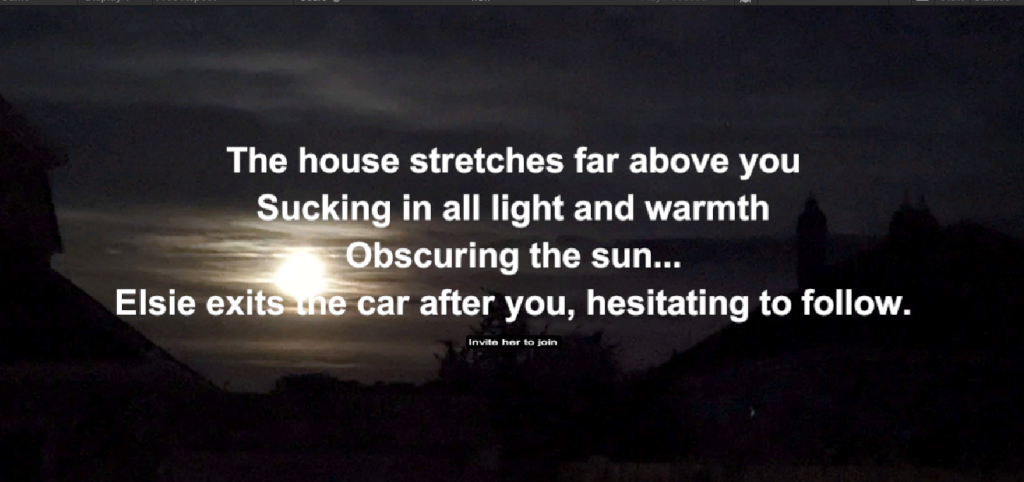
This is what the game looks like, I added a picture in the background and managed to figure out how to change the text size, I was unfortunbately unable to change the size of the buttons.
I found using Ink easy and merging it with Unity was not too difficult, once in Unity however customising the look and appareance was more challenging and I eventually had to give up. I think this would be a good tool but it would require more research than I anticipated.
I will not be using it for prototyping but it is a good tool to be aware of.
Game pillars are the elements that support the design intention by encompassing the core emotions and objectives the developer wants the player to experience.
When creating my game pillars I focused on keeping my essential experience and design intention at the front of my brain.
EE – To encourage nostalgia through an old-fashioned adventure
DE – Being taken back to childhoodthrough a digital camera
To help us create our game pillars we were shown a mobile game companies’ design pillars that they used to keep the team on track.
Easy to understand numbers
Board-game like feel
No hidden information
playful interactions
All of these serve to further enhance the EE and DE of the game
Design Intention: exploring reconciliation through dreams.
Essential Experience: emotional repair and reflection.
Core Emotion: connection and forgiveness.
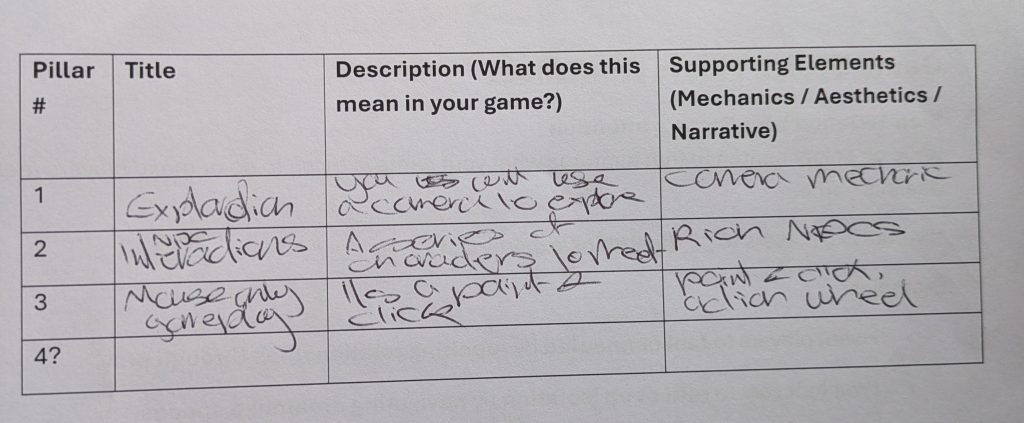
To figure out my pillars I used a worksheet given to us to play around, I started by breaking it down into small mainly mechanic based pillars then looking at my deisgn intentions and assigning emotions and feelings to each one.
Final Design Pillars – subject to change
Design Pillar Development
In week 6 we had another game pitch presentation, at this point in the project we have had multiple guest speakers that have stressed the importance of being succinct in our writing.
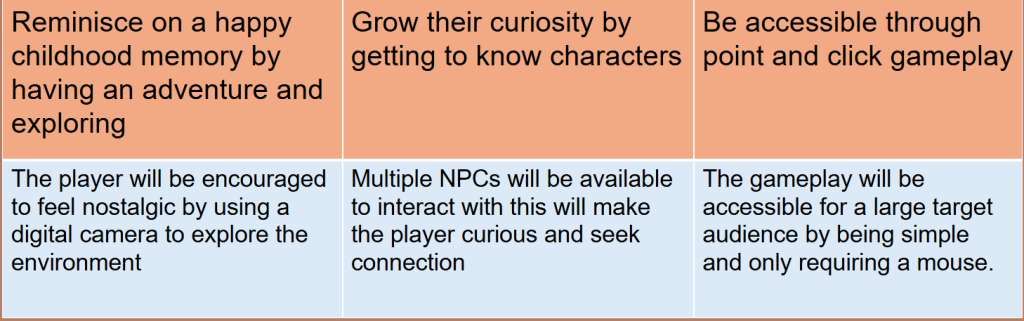
For the presentation I have reworked the pillars so they are explained better.
Exploration Based Puzzles
Quirky Characters and World
Accessible Gameplay
To progress the player must explore and discover what they can do.
The world is populated with quirky, memorable characters and locations.
The gameplay is highly accessible, only requiring a mouse as it is a point and click interface.
The essential experience of a game are the emotions you want the player to experience. To create a game that sticks and resonates with people understanding what you want it to do as a developer is very important.
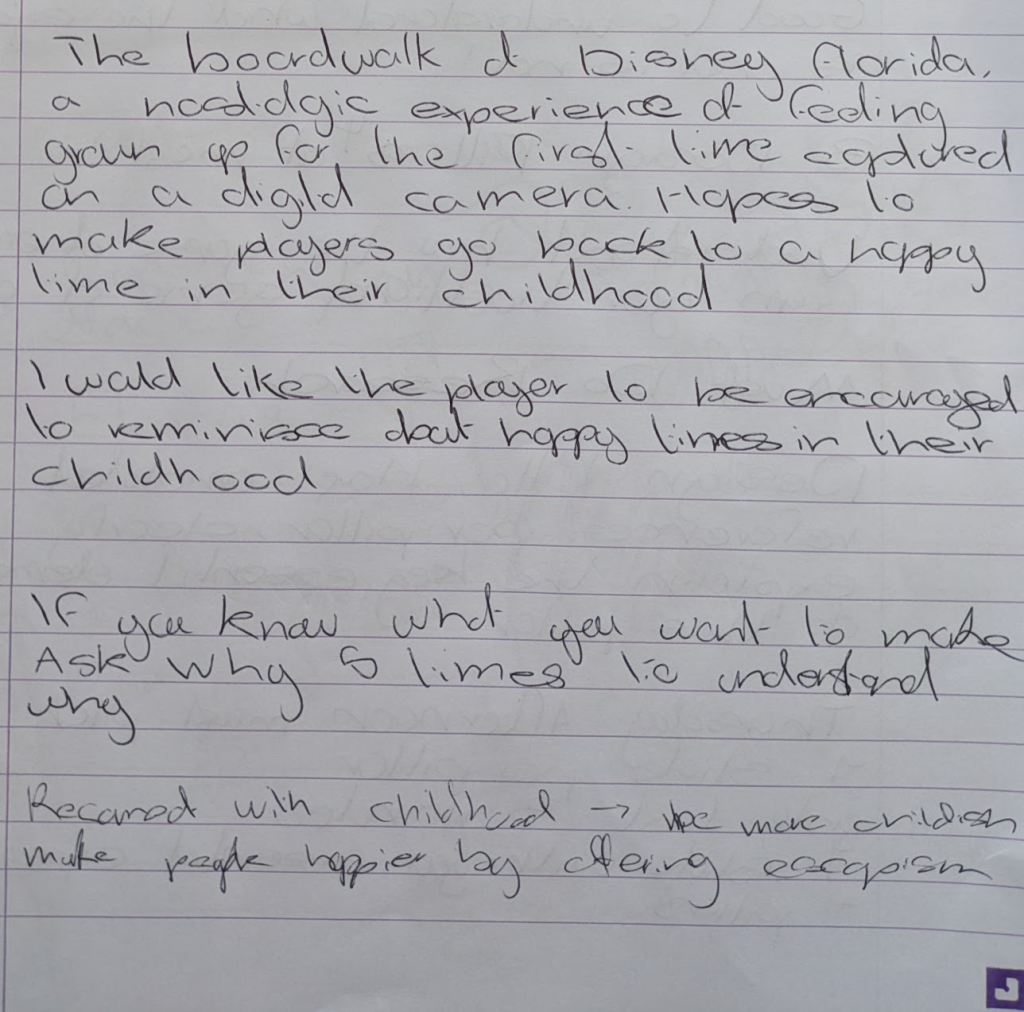
I decided to use nostalgia after exploring experiential metaphors in week one and focusing on a lived experience you have had. This made me think of the experience on a Disney World Florida boardwalk when I was 10, I had a digital camera and was using it to explore the area.
Some notes I took about the experience.
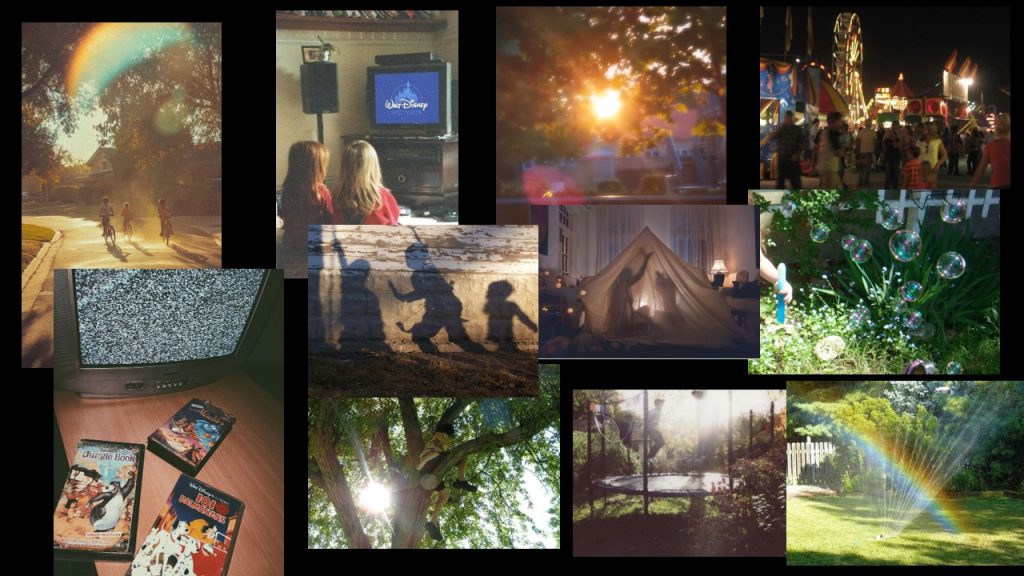
Nostalgia is a particularly hard subject to represent visually as it is different for everyone and takes many shapes. It can also be awakened through, scents, sounds and sights dependent on the person. As the edxperience is mine I decided to create a moodboard of things that made me nostalgic for my childhood.
I focused on finding images of childhood, of course not all of these will resonate with people but i found a strong attraction to them. I also noticed that they have some things in common with one another they are all fuzzy and out of focus, the light in them catching the lenses and creating effects. I want to replicate this within the visual style.
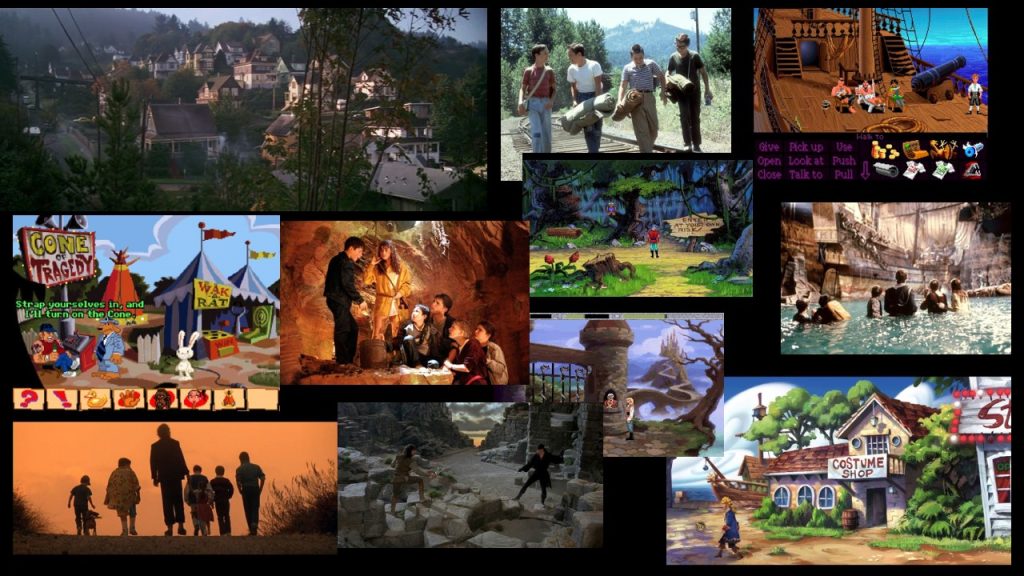
The content of the game will be heavily inspired by 80s style grand adventures. From films such as The Goonies, The Princess Bride, The Monster Squad, The Neverending Story etc. All kid centered films about discovering oneself and growing up. It will also be inspired by old point-and-click adventure games. I have chosen these as they were a large part of my childhood despite me not being in the correct generation for them as I was introduced to them by my family. I believe this is the case for a lot of people being introduced to stuff from their own parents childhood thus becoming nostalgic about it themselves.
I have compiled these inspirations into a preliminary moodboard.
Conclusion
I want the players to feel nostalgic and happy, by tapping into childhood nostalgia based off of my own experiences. The game will be inspired by grand adventure films and point-and-click games that I enjoyed throughout my childhood. The game should encourage the player to feel like a kid again.
How will I do this?
By focusing on the games visual style and aesthetics to make them feel nostalgic and warm. The game’s narrative will also be important as it must feel like an adventure a child would go on. To create a good game world the character NPCs must also be definined and interesting