Game Prototypes
I made about 2 prototypes – one for each idea.
Tahtib Prototype (SooDuel)
For this prototype, I wanted to make a basic stick-control movement system. I had already decided that the movement in the game was going to utilise procedural animations and ik systems in Unity, so it was just a matter of designing a character, rigging it, and then coding in the controls. I designed a basic traditional Egyptian farmer in Aseprite and then separated each limb to make it easier to rig later.

After designing the character and separating the limbs, I watched a few videos on how to set up a bone system in Unity 2D.
These two videos helped immensely in rigging the character up. I ended up making 2 rigs, one with the stick as an attached bone part of the player’s model and another without the stick in which I made it a separate game object.

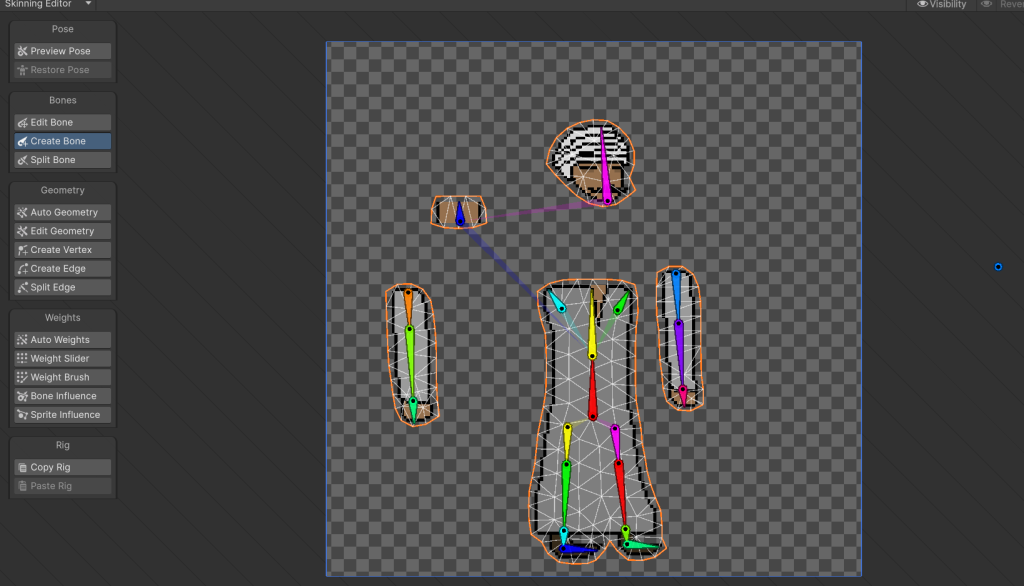
The reason for this was that when I initially made the stick a bone as part of the player, it seemed to restrict the movement a bit. I had created a script using ChatGPT to move the arms for the rig with the stick attached. It resulted in fluid movement, but without allowing the arms to fully extend over the head, as I had coded it for the left arm to keep attached to the stick. When I disabled it, the entire movement got corrupted, so I left it as is and decided to create a second version in which the stick was a separate object. This version had fine movement, but the stick did not fully follow the mouse as it needed to. It also went over the hand rather than under it due to the skeleton being all on one layer and not separate ones. The differences can be seen in the video below.
Even if neither version here was optimal, they got the point across for what the movement would look like in the game, which was good for when I showed it to Adam and when I presented it to the class. After completing these prototypes I created a very rough and basic concept of what the gameplay may look like.
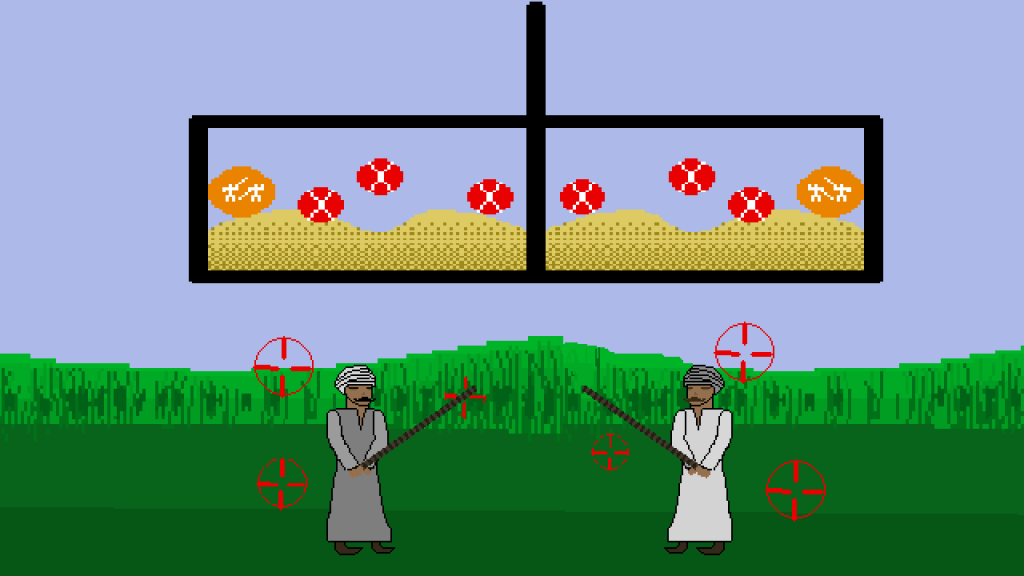
This image showcases the key parts of the gameplay. Firstly, the targets appearing around each player are the beats the player must hit between when they enter “attack/defend mode”. There would be music playing in the background with specific beats being played and appearing in the bar above them signified by the red icons, as the red icons appear, targets appear around the player which is where the player needs to move their stick to. As the icons move to the center of the bar they shrink in the “real world” so the player needs to be cautious of it and continuously hit the targets. Every now and then an orange marker appears in the bar above, this signifies the attack/defend phase, where in which the player must be ready to either attack their opponent or defend themselves. Thus the players must multitask playing to the rhythm, watching their opponent’s next move, and getting ready to strike or defend.
The screenshot sample combined with the prototype gives a general idea of what the game will be like and how it will play, albeit not totally polished.
Moustache Prototype
For this prototype myself and E-Jay divided up the work amongst between each other. I was responsible for creating the visuals and he was responsible for creating the story. The prototype would act as a tutorial where the player would be tasked with cutting the hair of historical figures, this was so we could have a relatively linear story that we could design for and have a prototype that we could feasibly make within the allotted time. In the prototype the player would make choices on a twine game, and then physically (or virtually) make those choices a reality by cutting the hair of their specific clients in the game.
I worked on creating a visual style for the game, I wasn’t sure how cartoony or how realistic to make the characters so I did multiple renditions of the same historical figure; Joseph Stalin. We picked 3 figures to focus on including Abraham Lincoln and Mansa Musa. I used Stalin as the base as he had a very striking face that worked well for different art styles.


These were a bunch of different styles I went for but the one I and my peers (whose feedback I beseeched) liked best was the large pen drawing on the left-hand side. Stalin’s face and moustache stood out especially in that one so it seemed fitting for the kind of aesthetic this game needed; one where every character is recognisable at a glance and very memorable, with striking features. After these initial sketches I then went on Aseprite and made several more pixel-art designs.

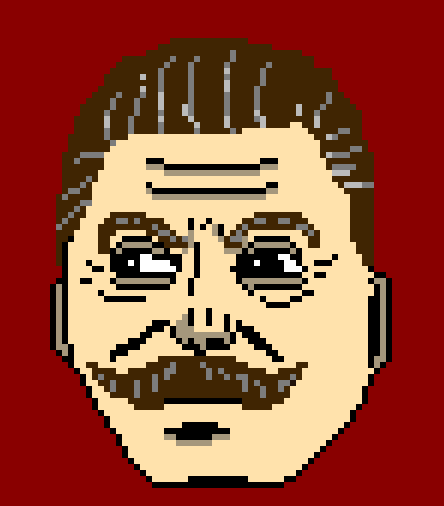

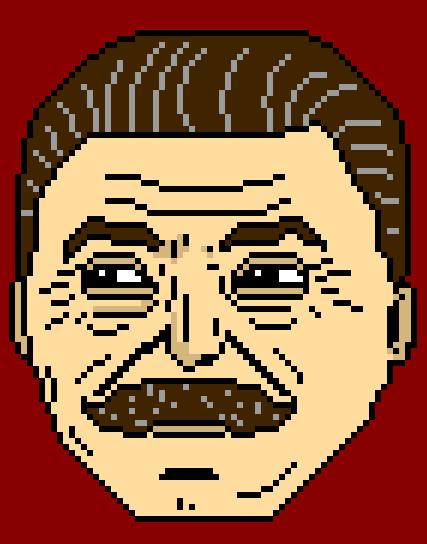
These were the four designs I came up with. The first one was an attempt to keep it simple while still looking like Stalin. The second one was an attempt to make a more saturated and brighter version. The third was an attempt to go for a more realistic and detailed look. The fourth was coming from a similar design philosophy as the second, but a bit more saturated and with more outlines.
I then showcased these designs to several of my peers to get a gauge on what people liked best as well as to see how immediately people recognised the historical figure I was portraying. Almost everyone who knew who Stalin was knew immediately what my caricatures were portraying. Most people liked the first and second designs, with a few liking the third, and no one liked the fourth. People who liked the first liked the limited colour palette and simple expression of Stalin. People who liked the second liked the saturated colour palette and the animated expression. People who liked the third liked the sterner expression. I took all this feedback and produced a final version that most people agreed was the best one.

This design maintained the simplicity of the first two designs, the colour palette of the first, the more animated aesthetic of the third, and the stern expression of the fourth. It was also a bit smaller than the others making it easier to edit if need be. This was another factor I thought of; if this game were to be made the character faces should not be too big or elaborate, they should be simple so that many faces can be efficiently created. This final design was the most optimal one and is what I used as a sort of template for the other two characters.

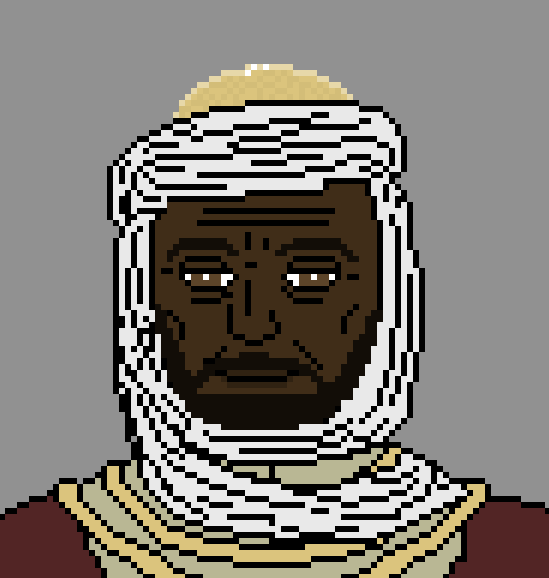
These designs kept similar proportions and a similar level of detail as the original Stalin one. Of course their clothing and other aspects of their designs may make them a bit more detailed than what the average random customer in the game may be wearing. These are historical figures so extra care is taken with them as opposed to the average random customer the player would be seeing.
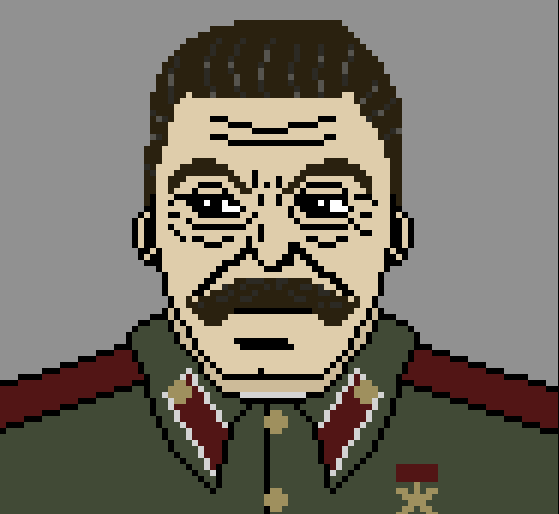
I also made a torso section for Stalin.
Since the players would be cutting hair I also made hairy versions of the characters for the player to cut. When cutting they’d use the erase tool in Aseprite after or before making decisions on the Twine game.


That was what I did for this prototype.
Reflection
I believe for the first prototype I did a sufficient job getting the gameplay idea across. The UI gameplay concept screenshot was rougher than I wanted it to be but I had been more focused on the time travelling game and the actual functional prototype that I neglected it more than I should have. Next time I will get my priorities in order. I had a functional prototype as well, I just wanted to create an improved version and unfortunately got stuck on it for longer than I wanted to. Aside from that I believe what I created for the Tahtib game was satisfactory and I learned a lot creating the basic prototypes such as how to rig a 2D character.
For the time travelling game I believe E-Jay and I did well, unfortunately however, we never got around to play-testing the prototype. Still, thinking about how the game would play out and creating visuals allowed for a better vision of what the game would look and play like. In the presentation I believe both of us portrayed our vision of the game effectively and that was due to the work we did in creating this prototype, even if it never got to be play-tested.
One thought on “Game Prototypes”