Ideation & Presentation – SooDuel (Tahtib Game)
By the time we were ready to present our ideas for the end of phase four, I had a good idea of what I wanted the game to look and sound like.
Name
While I was working on the presentation, I was thinking about the name of the game and what it could be. I ended up going with the name SooDuel. The reasoning is two things: firstly, the game is based on Tahtib, which itself is kind of a pretend fight. You’re not supposed to hurt your opponent, but you’re supposed to perform like you’re going to, so it’s kind of a pretend duel, or a pseudo-duel. So the name was derived from pseudo-duel, but also the word “Soo!” Which is a word yelled at during traditional tahtib to indicate to the duellists to stop. The word’s meaning isn’t known; it is not an Arabic word, so it is theorised that the word is derived from an Ancient Egyptian word or is literally an Ancient Egyptian word that has been forgotten. Thus, it seemed fitting to incorporate it into the name of the game, along with the fact that this video game will be portraying a pseudo-duel, hence the name, “SooDuel”.
Art Style
Mood Boards
I initially was going for a pixel art style, but I slowly got more and more interested in older, more traditional art styles. For instance, in my game proposal presentation, I mentioned the art styles I would be interested in.

Particularly, the Arab and Egyptian art aesthetics interested me most. As such, when I settled on this game idea, I began looking at those specific art styles more than before. I created several mood boards for what SooDuel could look like or what art styles could inspire it.

The above image showcases traditional Egyptian art. I found it interesting as there were many different types of art styles, some more influenced by ancient Egypt, while others had more emphasis on the overall scenes than the individuals in them. They were all also very colourful, which would be a useful trait for my game to have. I liked several of these tapestries, especially for the continuity they had with Ancient Egypt, and so they went on to greatly influence the art style SooDuel.

This mood board has several Arab artworks depicting Arab epics and famous heroes such as Antarah Ibn Shaddad. These were interesting for their colour usage and the general styles they had; for instance, all of them feature huge moustaches and figures on horses. They also featured Arabic writing on them, some containing poetic verses, others just names denoting the figures. They were interesting, and I could see them influencing specific skins or maps for the game, but as a whole, I would more likely defer to the Egyptian art style over these Arab Epic art styles.

This mood board contains Ancient Egyptian art. Of course, this style is synonymous with Egypt, thus making my game based solely on Ancient Egyptian art may be a bit passé due to its overuse whenever any media depicts or focuses on Egypt. However, it could be interesting to use this style to depict eras other than the Ancient one, such as the medieval or modern eras. I did go on to defer to this style’s proportions and renderings of the individuals within them when creating my art style, but overall, I was more influenced by the modern traditional style, which itself is inspired by the ancient style.

This last moodboard was focused on Egyptian floral and geometric art. It’s a style I would like to incorporate into my game somehow. The main idea I have now is to use it for UI; however, when I made my art design drafts for the presentation, I neglected to do so. Later on, I plan on using it for that purpose. I may also use it for specific skins or maps in the game.
Artworks

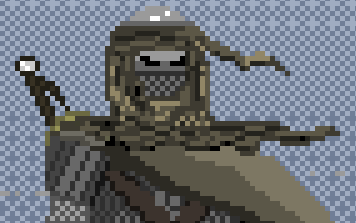
For my initial game proposal presentation, I made a basic scene using my first draft characters as seen above. This was just meant to very loosely give an idea of what the gameplay would look like, but I wanted to make more memorable artworks for this presentation.

This was the initial artwork I made. It depicts two farmers playing Tahtib on the banks of the Nile by their village, relatively close to the Pyramids of Giza. I focused a lot on colour in this image and loosely based the houses on those depicted in the traditional tapestries shown in the earlier mood board. I think this artwork sufficiently captures the aesthetic I want to go for in SooDuel. It is colourful and is influenced by ancient and traditional styles. I also went on to make two more versions of this artwork, showcasing different eras from Egypt’s history, as Tahtib has been played for thousands of years.

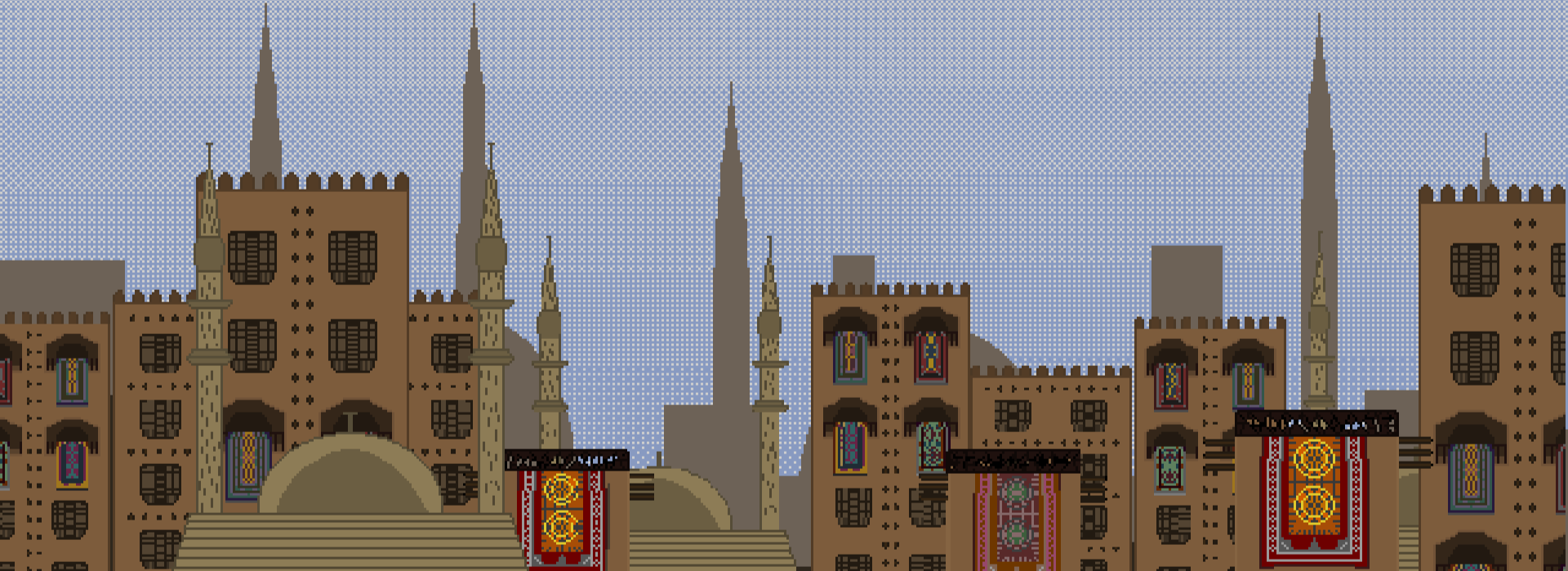
This artwork depicts the medieval era. I have two Egyptian warriors here playing it, as there is evidence to suggest that certain aspects of Tahtib were utilised by the local military during the Middle Ages. The background shows an expanding city by the Pyramids, meant to represent either Cairo or Fustat, as they were cities established by the initial Islamic conquests in Egypt. They also depict churches and mosques showcasing the Abrahamic faiths in Egypt. The soldiers in this image were inspired by an Ottoman depiction of the initial Islamic conquests seen below. This was mostly to keep the art style influenced by traditional styles, even if it may be sacrificing some form of historical authenticity. I also changed the colours of this one to match those older Islamic artworks and their palettes.

The last one I did was based on the Ancient Egyptian era.

This one is meant to resemble ancient wall paintings. The colours resemble the sandstone walls those paintings were on, and more closely resemble the ancient art style overall. Two Egyptians are depicted as well, with one wearing a helmet, indicating they may be soldiers in training, which is when Tahtib was properly utilised as a tool for training. The background showcases a much more limited town as well as the third pyramid under construction, meaning this scene is very old.
Each scene indicates a different era of Egypt, which is reflected in the small details and colour palettes. Though these artworks are simple, they represent the general style I want to go for with SooDuel, and I believe I did a good job portraying this when I gave my presentation.
Music
In traditional Tahtib, music is integral, specifically the usage of the mizmar. The mizmar is an ancient Egyptian instrument with a distinct sound. However, it can be a bit harsh on the ears, and ideally I would like this game to be appealing to all demographics, thus when thinking about the game’s music, which is also just as integral as it is to the real Tahtib, I wanted to maintain the traditional style music but to perhaps broaden the range of it. The mizmar may still be used in the music of SooDuel, but if not, it would certainly be used for specific aspects of the gameplay, maybe to indicate it is time for the players to attack, or maybe it plays when one person scores a point, or when the game ends or starts. Since the mizmar is integral to traditional Tahtib, it will be incorporated in some way, just in what specific way is the subject of thought at this point in development, and when I was making the presentation.
This song: https://open.spotify.com/track/5qn4cFl3UVTgJpWxAuiSR8?si=61286ead0608493e, titled “Zarhat el Louxor” utilises the mizmar in a way I quite like. The song itself could be used for my game, albeit cut down a lot. It contains clapping hands, drums, the mizmar, and a flute, which captures the essence of Upper Egypt, which is where Tahtib is predominantly played.
This song: https://open.spotify.com/track/2Vv0svOVueMOfhDFn3SBdn?si=d5ced9f6b4e745d3, titled “Longa Riad” is a song based on the Longa form of music, which is an Arabic adaptation of Eastern European and Turkish dance music. This particular song was composed by a great Egyptian musician named Sayed Darwish. It utilises traditional instruments, such as the Oud. Its overall vibe and sound would fit a rhythm game, especially one about the subject matter of my game. Although it is not directly related to Tahtib, it could be used as an inspiration for whatever music I utilise for my game.
This song: https://open.spotify.com/track/4XBiOnI3joHp6pADFAmPNu?si=6ea32642115f4ec4, titled “Shufutu al-qamar” is a Sawahli song which is a genre of Egyptian music associated with the coast of Egypt, such as Suez, and utilises the simsimiyya instrument, which is an ancient stringed instrument. This song retains the traditional style of Egyptian music but is different from the type utilised in Tahtib, with no mizmar and an emphasis on a stringed instrument over a wind one. This particular song has a fast rhythm and vocals as opposed to the other two, which may be interesting for my game.
Overall, all of these songs will be important to draw from for SooDuel’s music, if not outright utilise. Ideally, I would like to cross these songs with more modern types of music, or maybe even with chiptune, but that requires further ideation, thought, and discussion before a specific direction is chosen.
Presentation & Reflection
The presentation may be accessed here. It shows off the artworks I made, a mood board, and the music the game would need, as well as the inspiration for the game as a whole. Overall, I am pleased with the way this process has gone. I have come up with a name for the game, a more concrete art style inspired by prominent art styles in Egypt, and have found several key songs that may be utilised as inspiration for the final game. I look forward to continuing to work on SooDuel.
4 thoughts on “Ideation & Presentation – SooDuel (Tahtib Game)”