In the past weeks I am facing the existential crises, like I strongly feels that I do not belong here. But I get recovered through out attend the class normally. The more I come to class the better feeling I get I guess.
I kept thinking to make my game ideas highly completed, I feel worrying about If my game is too complex, too big, or not that interesting to play, and I don’t have a representitive prototype would makes me bad. I didn’t ask for help, that’s what I realised now.
Additional Research:
https://docs.google.com/document/d/1MofW3YzrEfE6K-LfrR3-qop18gk3DXQiuU4lj6V17Ig/edit?usp=sharing
Research Raft:
https://en.wikipedia.org/wiki/Raft_(video_game)
https://store.steampowered.com/app/648800/Raft
My analyse:
Elevator Pitch: SandBox Survivor Video Game. Players try to catch resources floating on the sea to craft equipment, build living facilities, and expand the raft, in order to be able to face ocean dangers.
Game loop: Gather debris – craft tools/items – expand raft – spot islands/structure – explore – gather resources – back to raft – keep gather debris
Game Pillars: Survival, resource gathering, floating home, exploration
Game Mechanics: Hook(to gather), hunger/thirst, crafting, planting/fishing, farm/cook, diving, island exploration, fighting with mobs, narrative, multi-player cooperation.
Things that inspired me:
The point of grabbing resources on the sea surface, crafting tools, expanding the raft, and the hunger, thirst, and health point. They have a strong way to keep players play, and also there is risk around so players should keep doing this to survive. Also it seems to be an interesting way to play, because when I saw the game play I was quite interested.
So I think the idea of survival, sand box games is really interesting. But Raft provides a clearer goal, you have to build up your home, find islands or structures, explore the story of this world, but eventually to build more on the raft, to make it eventually home.
In my game, I imagine players are doing similar exploration, like to find ruined structures(islands in RAFT), get in and search for resources.
But my game is driving a space ship in space, how to relate the item grabbing from Raft? I think maybe the abandoned/ destroyed objects are floating around the ship so players might have the ability to grab those pieces, so they can get some tools built or fix some important machines that could make an impact on game play.
I imagine the ‘raft’ (the spaceship) that the player uses as the only safe home, there’re already broken machines waiting for fixing. This system could somehow be the ‘crafting’ in my game.
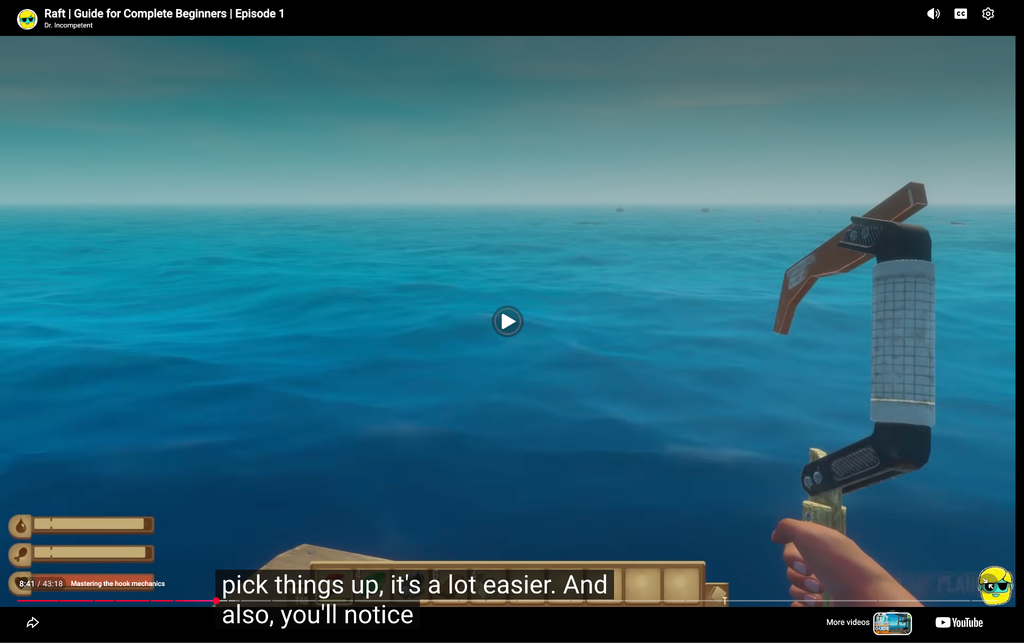
Actual UI of Raft
Research Noman’s Sky
https://www.nomanssky.com/about
No Man’s Sky is a game about exploration and survival in an infinite procedurally degenerated galaxy.
I think the feeling of this game is pretty ‘free’, like players can go anywhere if they see their destination. So every star in the sky is an actual accessible sun.
I actually really like the mechanic, that the world will generate itself randomly, and since generated it becomes part of the game. But It seems my game is about the structures, floating stations, so I might want to set them up and put them in the order that I want.
Things that inspired me:
I like the feeling that you can go somewhere if you saw it. Like the game RAFT, you can’t see there is something on the sea, but sometimes a shape appears on the horizon, that feeling of excitement is really important. I want to keep working on the idea of loneliness, so this feeling can help I think.
In this game, every landscape on every planet is different. This is interesting because it always provides interest to the player so players would have the willingness to keep exploring different planets. But It is hard to build in my game, if I have to set up the scenes before the play.
Another point I got is the UI design. It feels simplistic, like there is not too much information on the screen, it is transparent, it is clean, and just built up by basic elements. I want my UI to be quite similar.
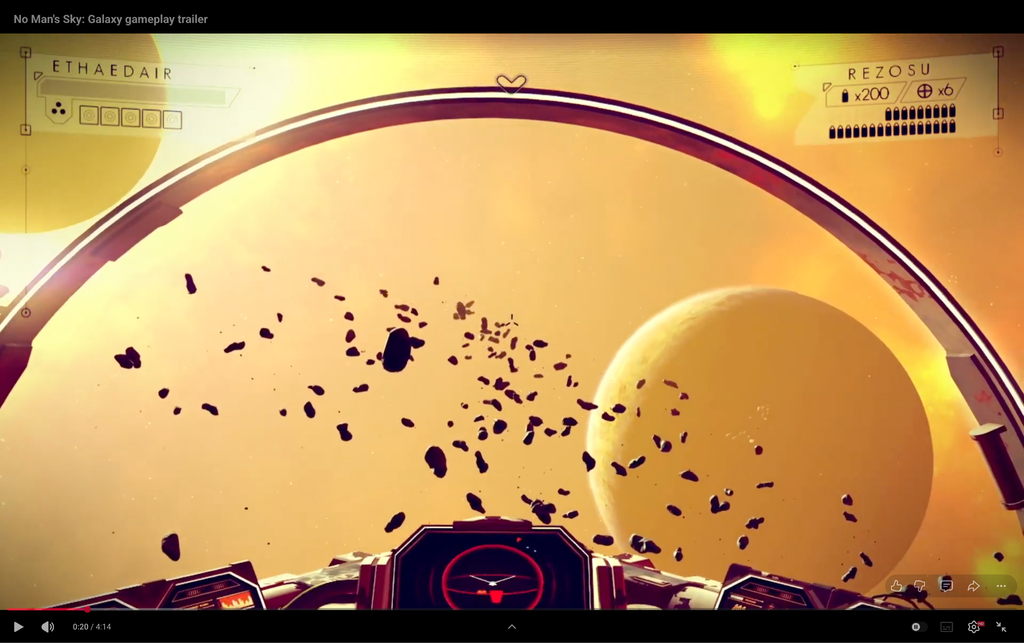
UI No Man’s Sky
Research Firewatch:
https://en.wikipedia.org/wiki/Firewatch
‘Firewatch is a mystery set in the Wyoming wilderness, where your only emotional lifeline is the person on the other end of a handheld radio.’
This game is a first person adventure walking simulator game. Players play as a wire lookout to keep the wild safe. Players experience the strange things around and manually unlock the true story of the world.
I really like the idea of ‘radio is the only contact of the world you’ve left behind’. This looks so good at representing loneliness. By the trailer I can see the game is like experiencing the adventure through different landscapes, seeing different scenes, and the atmosphere fits quite well.
In the trailer they seems to be contacting quite often, but I think the video is just a collection of the moment when they’re chatting, I think to my game I would take this idea of radio connection, but what I imagine about the radio, is like in the movie Interstellar, the protagonist sometimes have a vision from the TV to see how his family has changed after he went away.
Things that inspired me:
In firewatch the radio is a strong emotional support, in my game there could be a similar system, which takes the rule of sending missions, answering questions, giving analysis, etc. So what my game needs is emotional support, maybe being around with the player from the start to the end.
I think this game creates loneliness & isolation by minimise actual human contact and visual, and the quiet environment storytelling.
My game could involve these points.
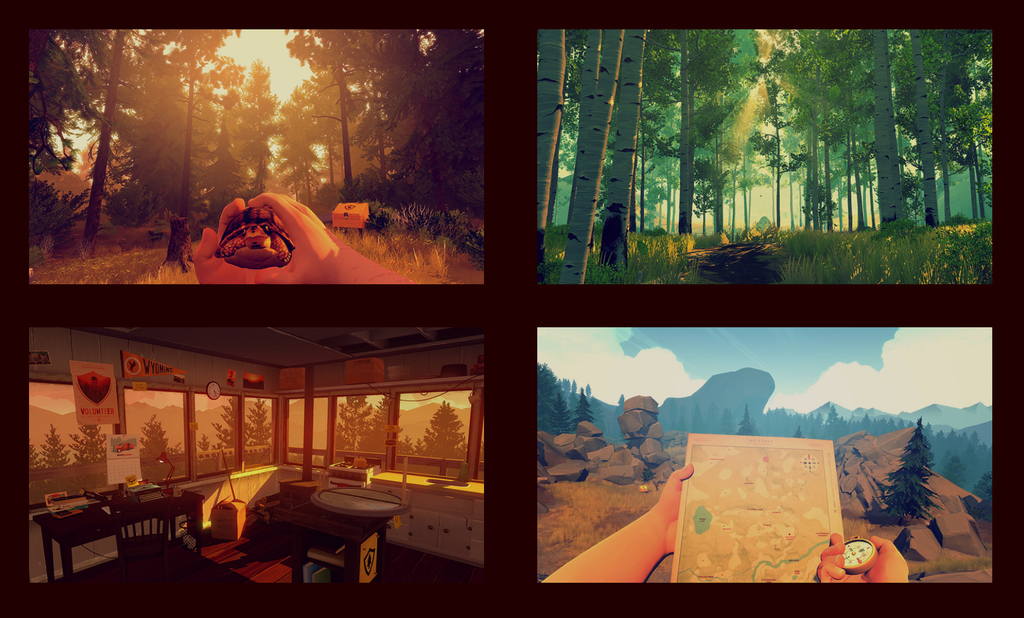
Game Art Firewatch
Research Outer Wilds:
https://www.mobiusdigitalgames.com/outer-wilds.html
https://en.wikipedia.org/wiki/Outer_Wilds
Another strong art sample.
‘Outer Wilds is an action-adventure game set in a small planetary system in which the player character, an unnamed space explorer referred to as “hatchling”, explores and investigates its mysteries in a self-directed manner. Whenever the Hatchling dies, the game resets to the beginning; this happens regardless after 22 minutes of gameplay due to the star going supernova. The player uses these repeated time loops to discover the secrets of the Nomai, an alien species that has left ruins scattered throughout the planetary system, including why the star is exploding.’
I like the idea that planets will evolve through time. It makes the planets feel alive, more interactive. I mean I can see the things that get in the way are about the dangerous environment on different planets, and players sort of must experience it to find clues of the world.
Something interesting I realised from this game is that those planets actually look pretty small when the player is reaching, because I can see that huge curve of the planet horizon, even the whole planet is visible from outside. But they keep their complex when the player gets onto it.
Things that inspired me:
The time loop idea is really interesting, it is like a very meaningful adventure that has been provided to the players. It feels like we have to get the mission finished and the players which are us are the only ones who can do it.
What I want to take ideas from this game is, like there are events happening on the planets, the structures in my game could have similar events to make the place more interactive. I mean I love the time loop idea, but I’m more suitable with the fact that there is an actual end of the game which feels relief, and I think the time loop in some way is right like players do similar things for the game loop again and again, they both take time and there is a cycle. In my game what players do is to collect different components again and again to be able to fix things, become stronger, safer, and then they succeed.
Another thing important of this game, is each time players adventure, they will get new information, and that information would help future adventures. This is quite interesting and I would imagine to my game is, there is a notebook which players could use them to record information and helps them to explore deeper. I think for the ‘megastructure’ idea in my game, it’s kind of similar with the time loop, the player just get in that structure over and over again, but every time there is a chance to go deeper and see new things. I’d like to take that idea.
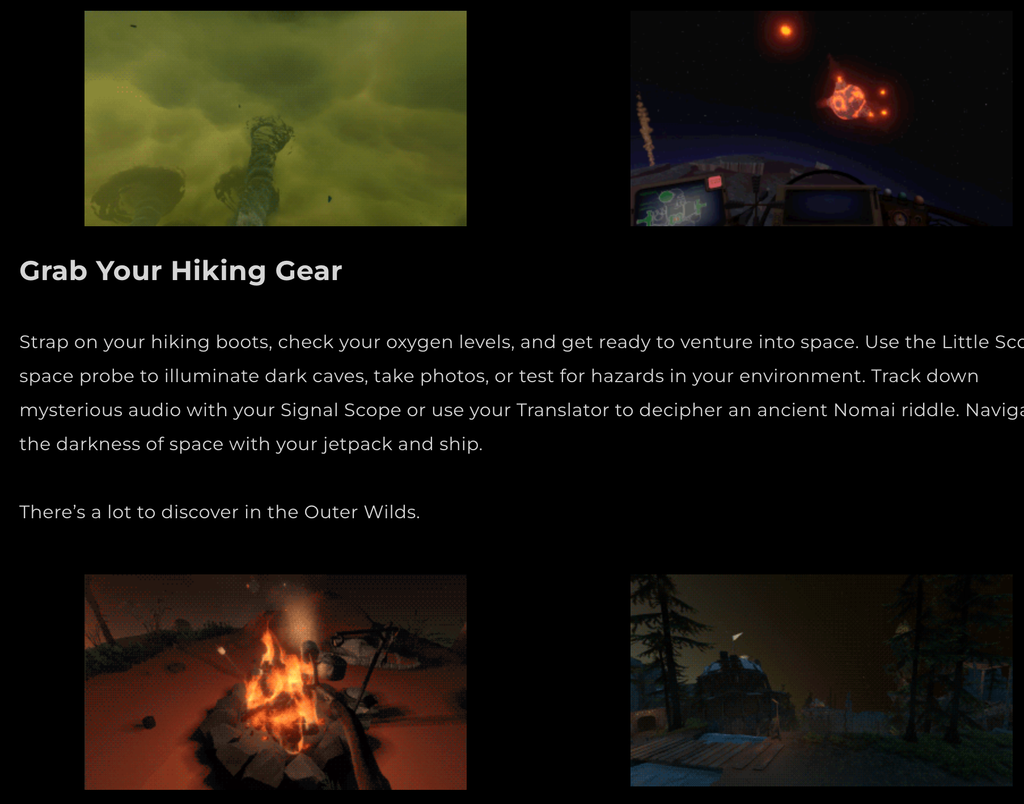
Official Website Screen Shot
Idea Development After (Based on) Research:
So My Ideas were developed through multiple times. At the beginning, my game is pretty much like a ‘Space Raft’ game, but here is the additional thinking:
1.You can’t meat any human beings. Maybe you can, but they’re all almost/already dead. You spawn in your broken ship, first you have to do something to fix your ship. Like pick up separate pieces.
2.The radio system. Also have to be fixed on the ship. When it is unlocked, you receive some information that tells you what happened to this world. Maybe give you some emotional connection between people.
3. Note system. You can find a notebook, it helps to know yourself in the past. You can add new notes in it, like if you fixed something, killed something, or went somewhere. There is always an option add to notes. The information player add to the notes are defined by developer. The note option will appear when a player event is done.
4. You can kill something. They truly exist, they’re the threat. Killing them will give some reward, like item pieces.
5.pieces are floating in the space. you have to go out of the ship in order to collect them. But when the automatic collection system is fixed, no need on this, but still can.
6.AI that gives you suggestions of what to do, information, item recognize, or helping information recording. Maybe alarm risks, attack things for player.
7.Broken machines on the ship. Radio, AI (a screen to display it, and maybe the battery or electronic system), attacking, power, auto space grab, or more, like locked / blocked doors of some room.
Now The game loop / pillars are pretty much changed to:
Explore – Salvage – Identify – Understand – Repair – Unlock – TravelFurther
Pillar 1: Isolation. Related to the player emotion, loneliness.
Pillar 2: Reconstruction. Players will manually fix different systems to enrich the game play.
Pillar 3: Discovery. Player discover unknown structures, components, and gradually get the understanding of the world.
I’m not sure if the game pillars are not supposed to be changed by developments, but I think they both could be considered as my game pillars, just how they’re neccessary has changed.
So basically two elements were removed:
Multiple abandoned stations to explore (like the islands in RAFT) – One colossal structure with different levels.
This is because I want to make things easier to build, without the loss of the original feelings that I wish to provide.
Collect objects & info, rescue survivors – collect objects and info only.
This is because I want to emphasise the isolation. Also because of the additional research I decided to maintain ‘past human contact signals’ but not with some actual human contact in the game. It will bring more mystery to the colossal structure as well I think.
The third idea evolution based on more thinking:
If I set all the items in the scene, except for those belonging to the scene, as items that can be picked up, and there will be no prompt to pick up anything on the first try, but only an increase in the space of the backpack.
I can imagine that when players first try to collect resources, seeing that everything can be picked up and just randomly grabing around, but not getting the key materials will quickly fill up the backpack. Then the players will go back to identify the materials and find that they can only make some unnecessary things. So they will start to manage the space later.
I think crafting can be included in this situation, while keeping any item that is picked up can be decomposed into ‘raw materials’. These raw materials have a wider range of uses, but some basic raw materials can only be used to make items with a sense of life, such as furniture and so on. I want this initial “home” to have its own changes over time after playing it, such as in the middle stage of game play, players can start to make furniture with raw materials, and the journey later will be more towards a relaxed pace, but occasionally there will be major events that players need to enter a tense state to make decisions.
I feel that if I do this, the game objects and item scanning and identification will become too complex after too many of them, and a better classification and UI design is needed.
At the same time, if I set the initial location as a larger space station, when players go to obtain resources, they will need to drive a small resource collection ship. Also, the target location will be changed from multiple to only one, but the structure will be larger, like something like “Cybertron” with larger structures, with different danger levels, and a map is provided.
I think the basic exploratory content will become much more, and the expandable space of the “home” will be very large.
I also feel that being able to add special content related to food acquisition, such as breeding, thirst, and immersion, seems to make the experience stronger.
So my design intentions might have some development as well:
I want the players to explore … what should I say (Later message: its included in the Pitch Deck)
The newest game loop:
Explore → Salvage → Return → Identify → Recycle / Keep → Repair / Craft → Expand Home → Unlock Deeper Exploration
To explore the mega structure – to salvage items – return home(station) – identify unknown items – recycle the raw materials/keep the valuables – repair important systems/craft small things with those raw materials- expand home – be able to explore deeper with knowledge, fixed systems and tools potentially.
Flick game prototype published on itch.io:
https://choujue.itch.io/beyond-the-light-years
Few screenshots:
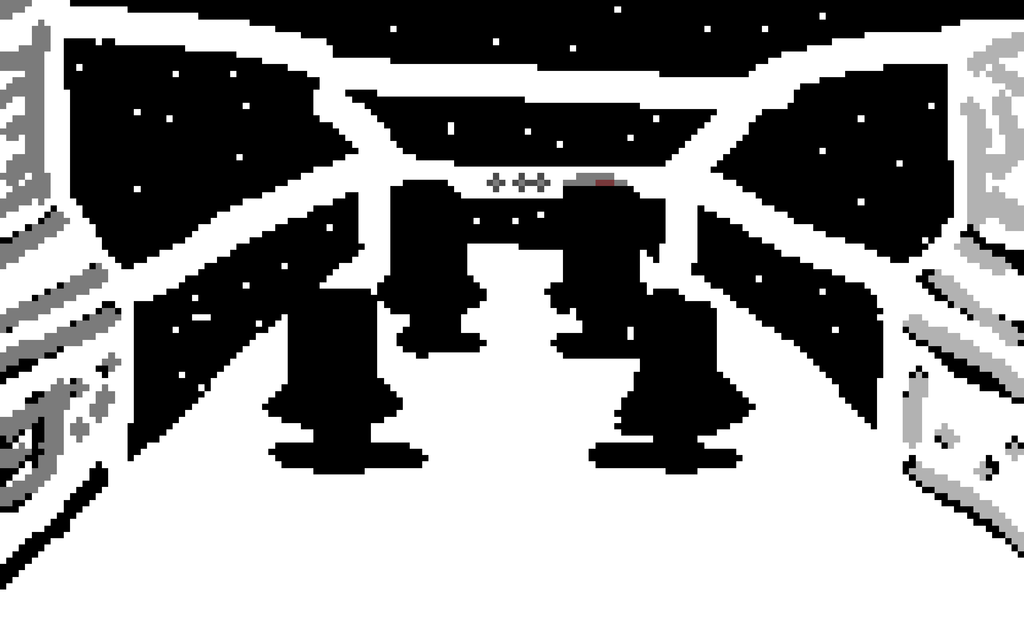

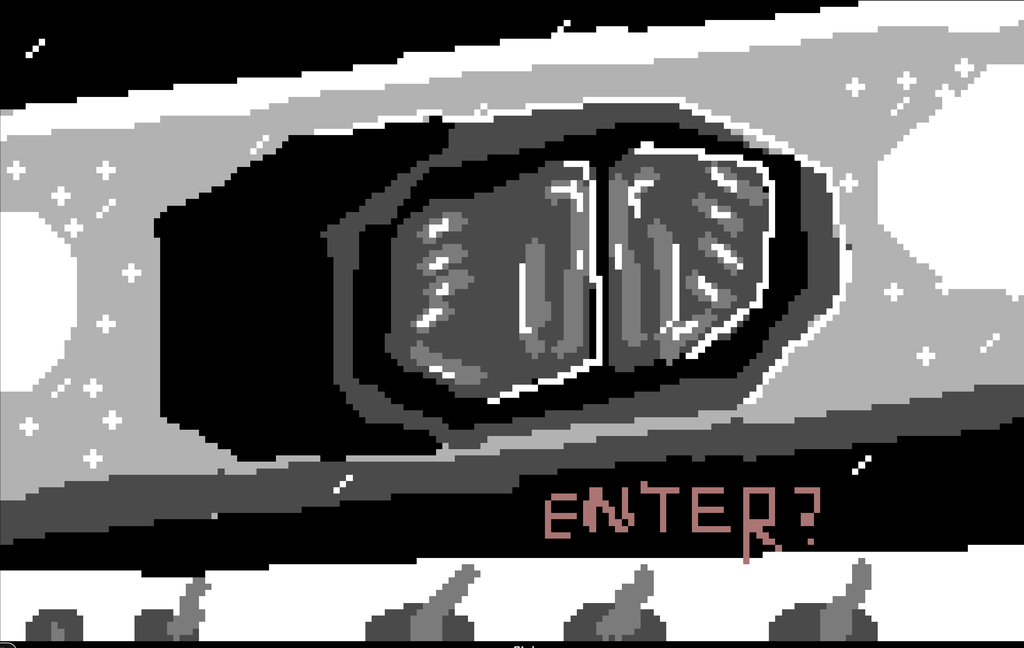
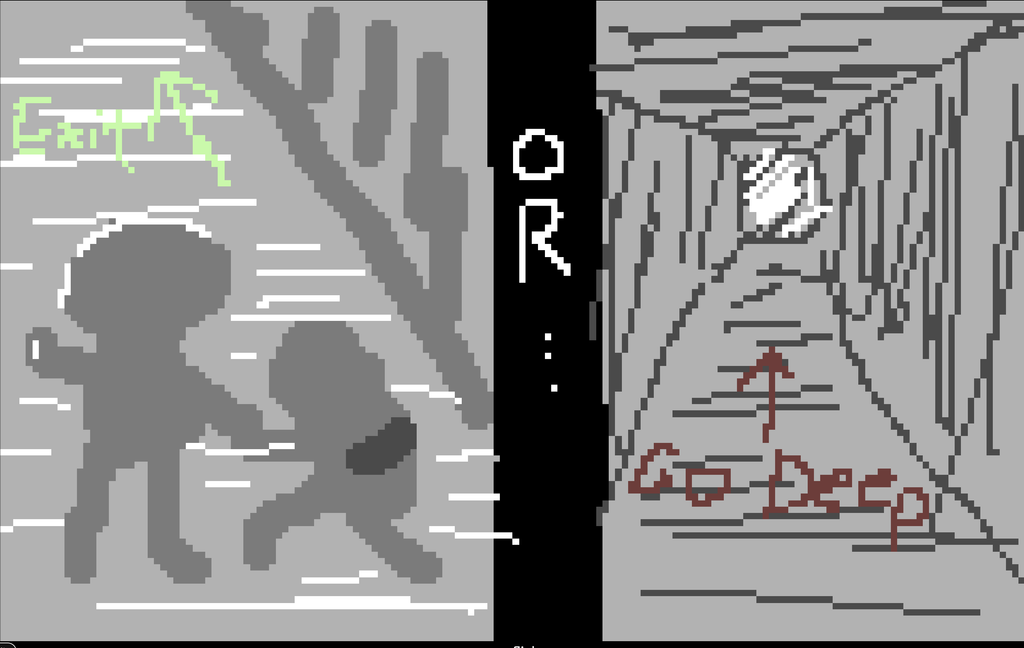
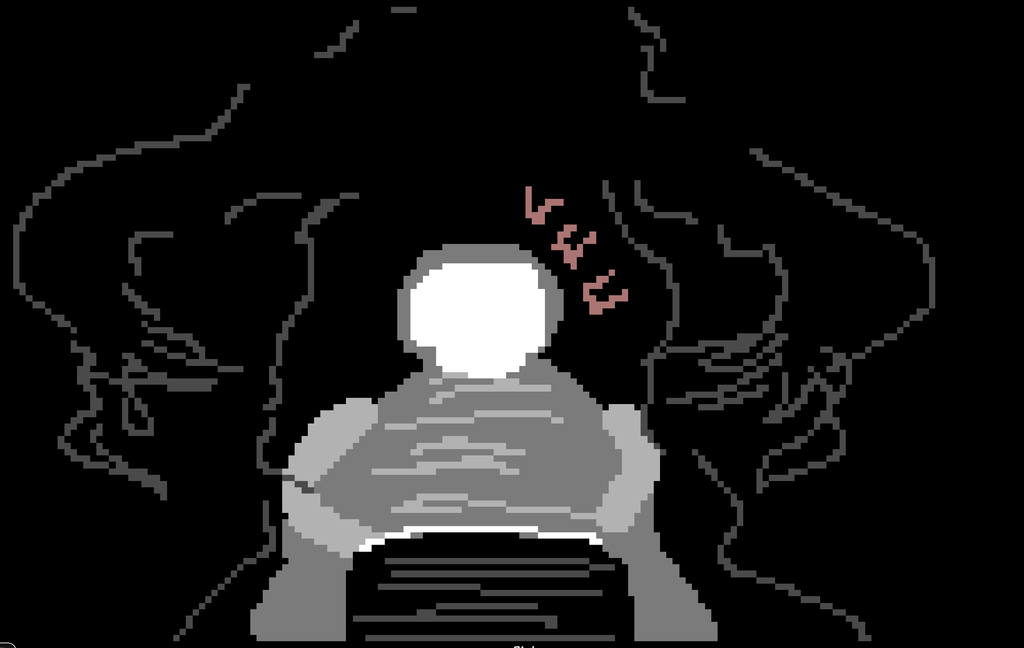
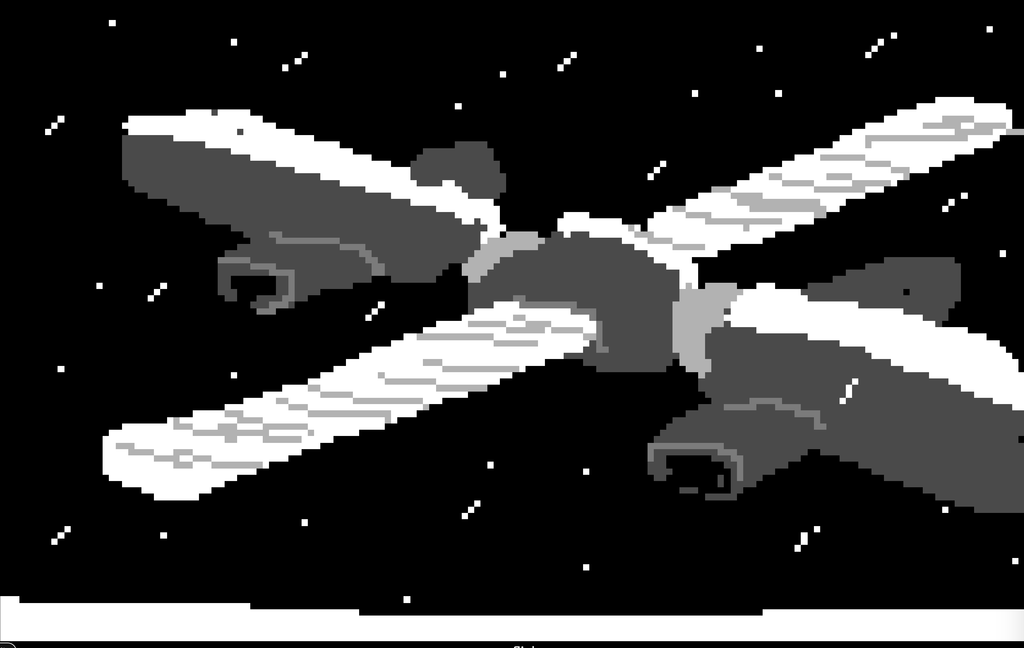
This is my first prototype using flickgame.
This prototype aims to test the initial game loop. Players are expected to follow the hints that I’ve put into the scene, and keep going with the right way. It is expected that players would feel confused at the beginning. They would feel that they’ve been driven to somewhere by a signal. They would feel what basic things they do on that place. They would eventually try to escape the station, and agree with saving a survivor. They would feel the emotional change when they got survivors rescued on the ship. And they would finally got clear in their mind what things are they keep doing.
Feedbacks I got from the testers: (from Serena, Maggie, Shirley)
All the testers are very confused at the beginning. Eventually got a idea of the game.
Two testers didn’t struggle with the time when they’re doing a desicion. They get into the room, saw the terminal, and saw the survivor. In the correct order I want.
One tester kept trying to go deep, so she is confused and asked me if this is the end of the game. But after several times of struggling, she found out she has to escape with the survivor.
Test results: Meet my expectation.
Players feel positive about the prototype. The hints are easy to understand, the feeling of ‘where I am’ is getting clearer.
So I think the core gameloop works quite good in my prototype, also it tested a little bit of aesthetics in my game, and I think it is good too.
One thing I realised is that because the limit of the platform, the testers aren’t able to imagine the actual game story, I explaind the story for two testers after they finished playing. Probably nextime use a actual 3D platform prototype.
Prototype 2: physical paper prototype
https://photos.app.goo.gl/okCQ7scb22PAPs1e9
Because the image is too big, please access the google photos album to see the pictures of my prototype.
This prototype is aiming to test whether players can make meaningful choices when collecting unknown objects, and whether analysing resources and repairing station systems encourages further exploration.
Playtest observations: (tester: Xiaolin)
Player choose to go to the shuttle bay directly and begin the travel. (expected to check around first and interact with things)
Player didn’t choose to gather floating objects.
Player picked up Broken Sensor, Optical Module, and Empty Container. Backpack amount used 5/6.
Player got back to home station. After analying the objects he got 2 optical components and 2 metal.
Player decide to go back again to pick up the remain objects. (expected to try fix a broken system first)
Player begins the second travel. Got in directly again instead of picking up floating objects.
Player choose to access the room 2. (meant to be combat or consequences but not seted in the paper prototype)
Player escaped and accessed room 3.
Player found the Wire Coil.
Player didn’t choose to fix any system before the test end.
Test Results/Evaluations:
Player did some really creative choices.
First expectation of this test has met. Player’s choices of picking up objects is clearly affected by the appearance of the objects. Because the lost of details of my object drawings, he didn’t make the right choices to pick. (he thought the empty container is the battery)
Second expectation has not met. Player didn’t get encouraged to play further, because his understanding of the world background is too missing.
This is a problem I realised of this test. I should explain more background information to the player, instead of rush them into the game. He gave me some suggestions of what the narrative of my game could be.
Player said that he would be encouraged by level up himself, like gradually get strongger on their personal value on things like weapons, ability, armour. But my game does not focus on that.
After a few more explain, player finally understood the game loop and what is he testing.
Player give highly positive feedback on the gameloop. He said it is interesting to play, if there are goals and hooks that attract players in the narrative. Next step might be focusing on the background design, the world overview.
Leave a Reply