Script for the presentation
When most people hear the word zombie, they probably think of The Walking Dead, Resident Evil, or an endless horde of flesh-eating monsters chasing survivors through a ruined city.
But what’s really interesting is that zombies didn’t start as monsters at all.
The origin of the zombie comes from Haitian folklore, where a zombie, or ‘zonbi’, was believed to be a person who had lost control of their own will. Considering Haiti’s history of slavery and forced labour, that’s actually a terrifying idea. The fear wasn’t being eaten. The fear was becoming a slave forever, even after death.
Over time, the zombie changed dramatically. Instead of representing lost freedom, modern zombies began representing society’s fears. Depending on the decade, zombies have symbolised disease, mass consumerism, conformity, social collapse, and even our fear of each other.
What’s fascinating is that the zombie constantly evolves with us. Vampires tend to stay vampires. Werewolves tend to stay werewolves. But zombies have transformed again and again to reflect the biggest anxieties of the time.
I want you to imagine walking through your old secondary school at 3 o’clock in the morning. The lights are on. Everything is exactly where it should be. But nobody is there. Most people immediately find that image unsettling.
The Uncanny Valley was proposed by a robotics professor called Masahiro Mori in 1970. He noticed that as robots become more human-like, people generally like them more. But something strange happens when they become almost human.
Instead of becoming more appealing, they suddenly become creepy. Think of realistic dolls, badly animated CGI humans, or humanoid robots. Something feels wrong, even if you can’t explain why. Liminal spaces create a very similar feeling. They’re places that should be full of activity but aren’t. Empty corridors. Airports at night. Deserted shopping centres. Places that are familiar but somehow disconnected from their purpose.
What interests me is that both ideas seem to exploit the same weakness in our brains. They sit right on the boundary between what feels normal and what feels wrong.
Every culture throughout history has created myths.
The Greeks had Zeus.
The Norse had Odin.
Ancient Egypt had Ra.
Japan has countless supernatural spirits and legends.
Even cultures separated by oceans and thousands of years often created stories that try to answer remarkably similar questions.
Where did we come from?
Why do people die?
What created the world?
It’s fascinating that myths appear almost everywhere humans appear. Which raises the question: Why? Why do human beings consistently create these stories?
To put it plainly, myths help us explain things we don’t yet understand. Before modern science, stories helped people make sense of storms, seasons, death, and the universe itself. But myths do more than explain.
They also teach values.
They preserve traditions.
They strengthen communities.
They give people a sense of meaning and identity.
In many ways, myths are some of humanity’s oldest technologies for understanding the world.
For those of you who may not know – MMA stands for Mixed Martial Arts, which means fighters combine techniques from many different disciplines. A fighter might use wrestling to take an opponent down, Brazilian Jiu-Jitsu to control them on the ground, and boxing or kickboxing while standing.
That brings me to kickboxing.
Kickboxing is a combat sport focused on striking, using both punches and kicks. Unlike boxing, which only allows punches, kickboxing incorporates the entire body as a weapon. At the same time, unlike wrestling or Brazilian Jiu-Jitsu, kickboxing takes place almost entirely standing up.
What makes it important is that it forms the foundation of modern MMA striking.
When you watch fighters a huge amount of their movement, footwork, timing, and distance management comes directly from kickboxing. Many successful MMA champions started their careers in kickboxing before transitioning into mixed martial arts.
Another reason this topic interests me is the role of women within combat sports.
For a long time, fighting sports were seen as overwhelmingly male spaces. However, women’s participation has grown massively in recent decades, especially through organisations like the UFC. Today, female fighters are some of the biggest names in the sport, helping change perceptions about who belongs in combat sports.
As someone who has recently started kickboxing myself, what interests me is how one combat sport became such a major influence on MMA, while also becoming increasingly accessible to women and newcomers.
Nodenogg.in Feedback
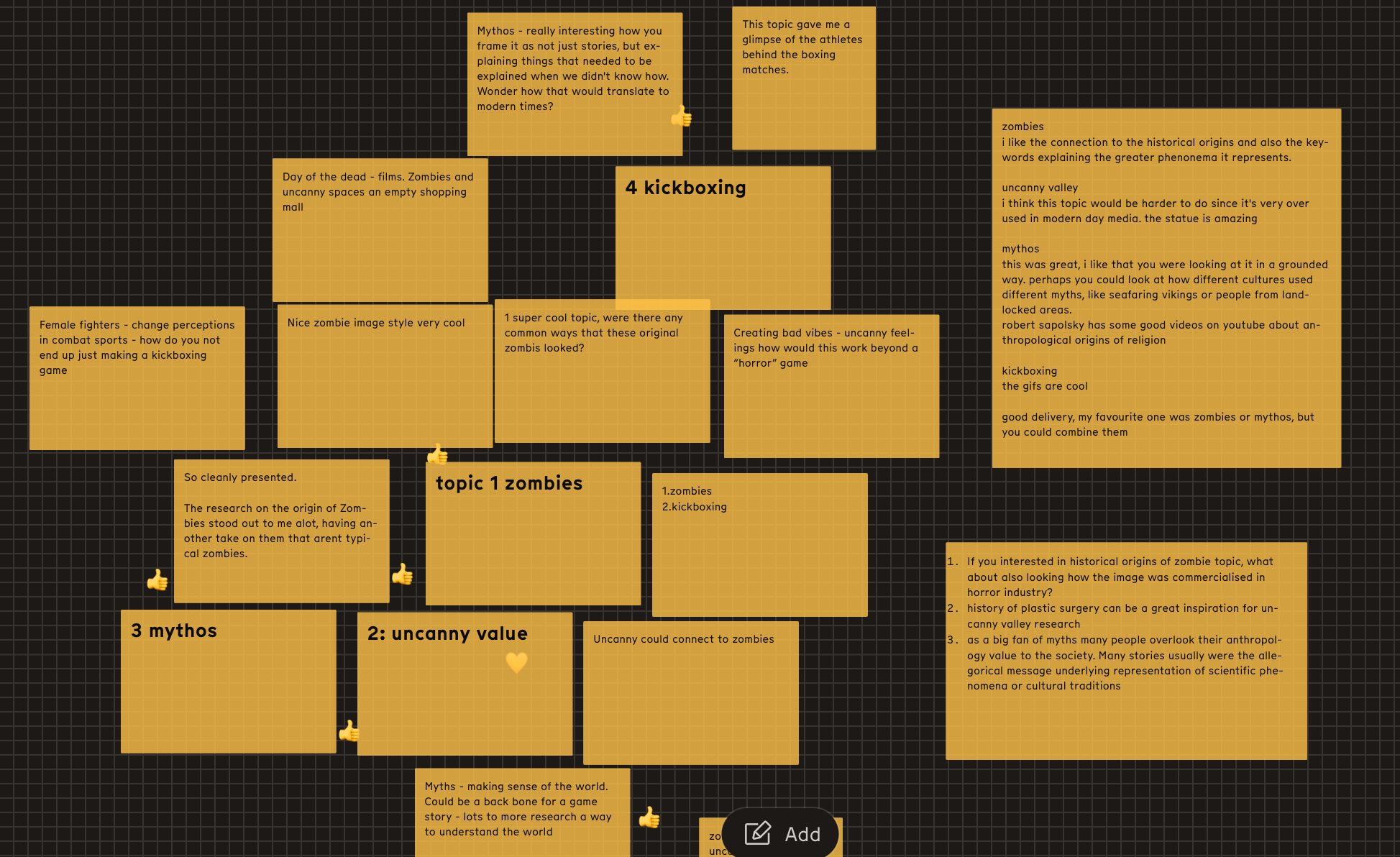
Seems like every topic got a positive reaction and any of them could have something behind them if I dug further. Zombies however, I think stood out the most because I was able to breathe a little life into them (haha) and talk about their origins. Ideas surrounding life after death and diasporic concepts could definitely be something worth diving into.
Leave a Reply