

I also continued my research to fully understand what the vaporwave style entailed as it’s the most defining aspect of Daydream‘s artistic direction. This will support my concept art and my contributions to the game in engine.
Vaporwave was born as a musical subgenre, commonly attributed to the impact after Daniel Lopatin’s Eccojams in 2011. (Han and Peters, 2016) However, previous albums such as Devon Hendryx’s Dreamcast Summer Songs contain many similar techniques, evoking a similar sense of nostalgia and uncanniness, but with slightly differing themes. After Eccojams, there was an explosion of vaporwave music and visuals. The height of its popularity was short lived and quickly began to die by the end of the 2010s. However, its visual style and music has left a permanent print on the internet and many of its offshoots still persist today.
I had created a big vaporwave playlist many years ago but I decided to return to it. The uncanny, distinct sound of Vaporwave is something I attribute to a few different things:
https://open.spotify.com/playlist/1T4t38GOf6uIQq7o65pML5
- Pitch shifting. The pitch of vocals and samples are distorted to be lower, and often slowed down. This is unsettling and slightly eerie to hear.
- Sampling. 80’s and 90’s songs are sampled and cut in different ways, “chopped and screwed” technique which builds the central premise of 80’s nostalgia. ()
- Slowness. The bpm is very slow, tracks are very long, everything is drawn out and persists like a memory.
- Fuzziness. Distortion blurs the track and adds a signature dreamlike effect that binds the other channels of the track together.
This is just from my own observations. Particular albums that I think are the best examples of this are Digital Despair by Tupperwave (below, left) and 超越愛 by Telepath. (below, right.)
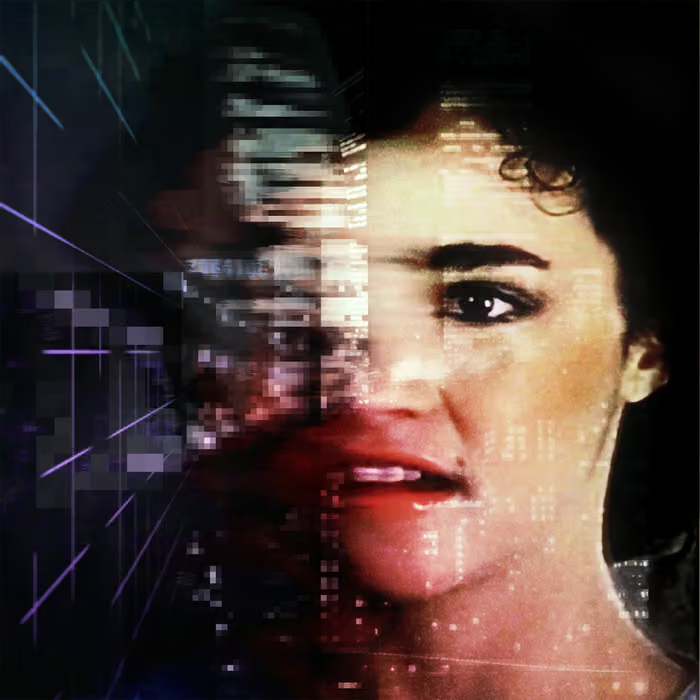

Other vaporwave tracks are more upbeat and less atmospheric but I think the eerier and slower songs are more true to the narrative and commentary on capitalism and consumerism that is communicated in the features I outlined above. Even the name, Vaporwave, is derived from “Vaporware” which is a term used for commercial products that are never released, highlighting its commentary on capitalism. However, many artists took Vaporwave in different directions, blending aspects of funk, trap beats that were sometimes the launchpad for the artist’s own vision and career.
Unlike other music genres, Vaporwave is also completely unbreakable from its visual style. It combines many different styles, building off of the distinct, bright colours of the 80’s Memphis design (Allia Luzong, 2022) in a very amateurish collage style that utilises statue busts, cityscapes, brands, old hardware and software. Drawing it back to Vaporware, it all points at an overall effect of a rift between the real and the fake, “by using objects of a bygone era it manages to create a new fantasy world which is not as related to the ’80s as it looks like. The semantic landscape of Vaporwave is a simulacrum – a copy without an original.” (Dovydaitis, 2021)
Relating this back to Daydream, this can aid us in the direction of our narrative and visuals. We can use the nostalgic yet fantastical nature of vaporwave to highlight how the protagonist works through her inner conflicts and memories by evoking something nostalgic yet unreal. For example, this could be used in the game’s level design. But we can’t just rush right into the design. It needs to be something that is approached with careful consideration.
In An Architectural Approach to Games, the bridge between real designed spaces and level design is connected to see how architecture can push the boundaries of traditional game design for more interesting games. Instead of the contents within a level, it outlines how a designer should think and consider when creating level spaces. “Great or even simply good levels shoulideas, and likewise their therapeutic importance.” This relates to the narrative aspect of Daydream, as we are using dreams to interrogate the workings of the subconscious mind and find a resolution. Freud asserts that the interpretation of dreams can be used with a “psychological technique” to understand their effect and how they reveal the inner processes of the waking mind.d be planned– not only to get an image of what the level will look like, but also to understand the kind of experience the designers hope to create for players.”
It isn’t enough to just create an aesthetically pleasing level, as Totten proposes. We need to have the player experience at the forefront of our mind. For Daydream that would be creating a space that communicates the narrative elements and feels satisfying and atmospheric to traverse.
As I have offered to work on the concept art, it’s also relevant that it goes in depth on how traditional architectural drawing practices can help the level designer. One of the things that stood out to me was the term “Axonometrics.” These are tools that help you design spatially. “They often combine plan and elevation drawings, and can combine plan and section to create sectional axonometric drawings.” Below are examples of the plan, section and elevation drawings in comparison to the axonometric. Notice how the axonometric is three dimensional in comparison.
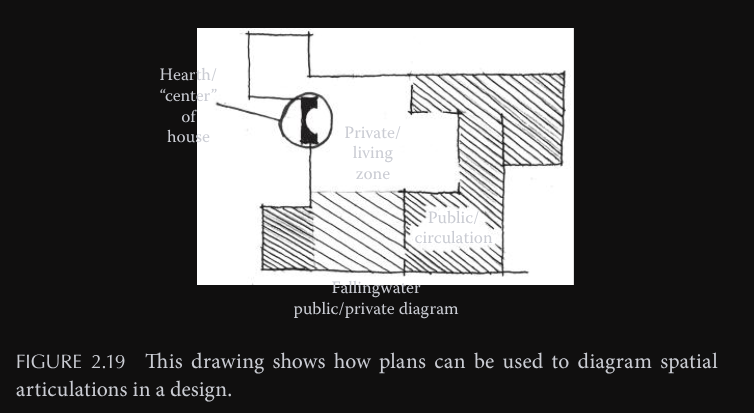
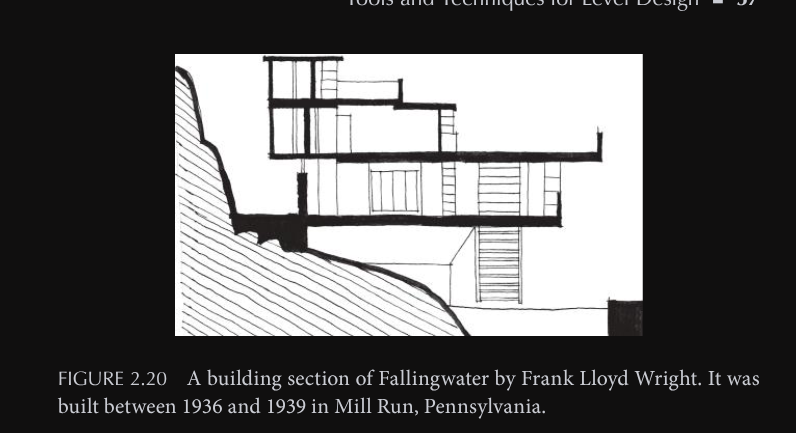
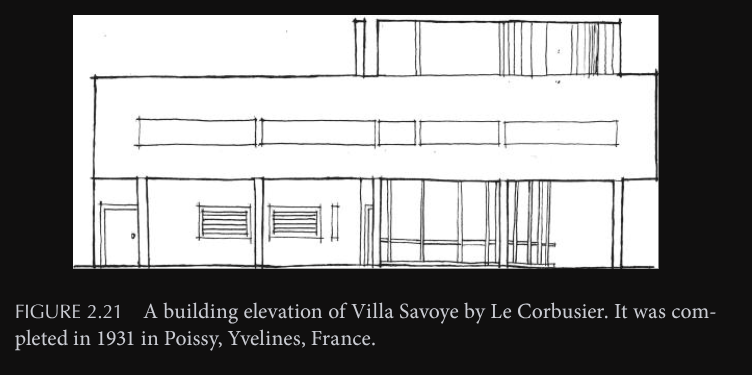
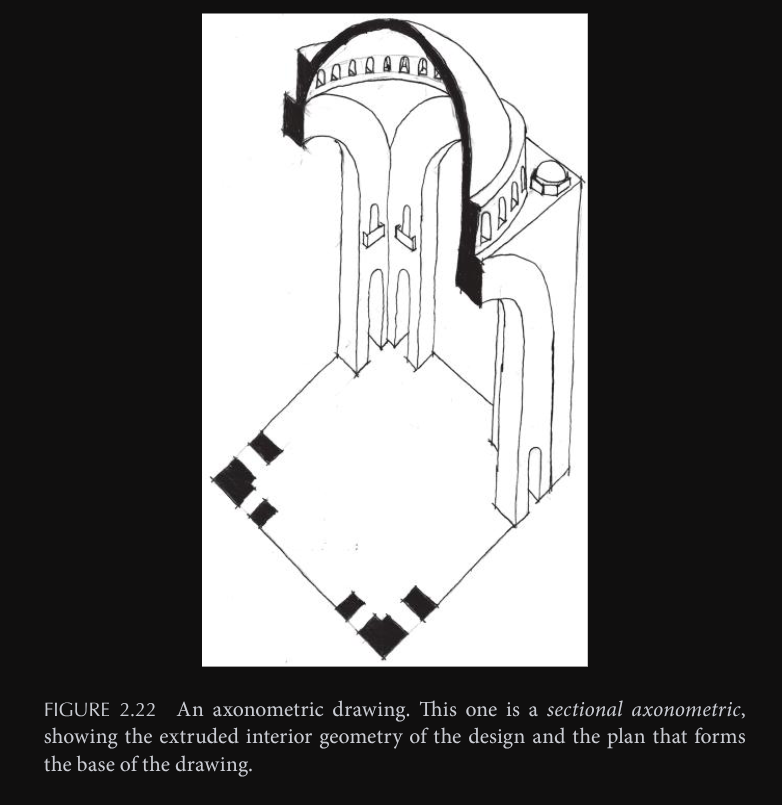
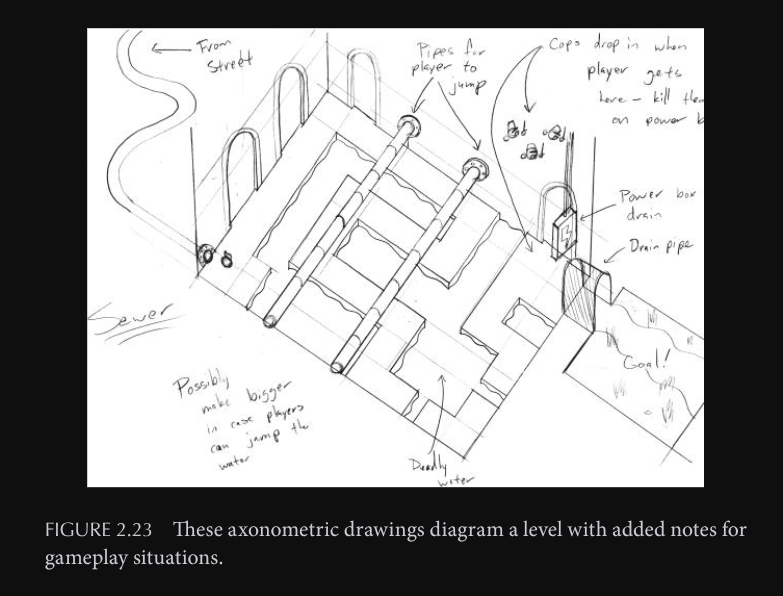
Axonometric drawings are not only for level design, they can fulfil different purposes. For example, “Valve used axonometric-like drawings of levels to demonstrate three-dimensional gameplay concepts.” It allows to map out gameplay and important aspects of the level, such as enemy spawns or hidden items. This means that it also becomes “both concept art and a game design tool.” (Totten, 2019)
I also did some reading of The Interpretation of Dreams by Sigmund Freud. While Freud’s theories have been outdated for years and have been later disproved by his successors, I thought it would be something interesting to draw from for any inspiration. With this in mind, I am taking it with a grain of salt. In the introduction, he states “one who cannot explain the origin of the dream pictures will
strive in vain to understand the phobias, obsessive and delusional ideas, and likewise their therapeutic importance.” This relates to the narrative aspect of Daydream, as we are using dreams to interrogate the workings of the subconscious mind and find a resolution. Freud asserts that the interpretation of dreams can be used with a “psychological technique” to understand their effect and how they reveal the inner processes of the waking mind. (Freud, 1995)
A lot of people take for granted our modern developments, and ignore the iteration that our species have collectively been conducting for thousands of years to lead us up to this point. This is why it’s really important to understand our past and use that to incorporate fresh concepts into our games. Nothing is wholely original, and conversely, not drawing from a plethora of sources makes your projects uninspired and boring. This is something that has really stuck with me lately and I find even the most random of things can serve as useful ideas. As our team begins to work on our levels, the more planning we do, the less bumps we’ll experience in the production process. With these fundamentals in mind, I have a clearer picture of how I can create the concept art.
BIBLIOGRAPHY
Allia Luzong (2022). The Deliciously Retro Return of the 80s Aesthetic. [online] A Little Bit Human | Lights, Camera, Progress. Available at: https://alittlebithuman.com/the-deliciously-retro-return-of-the-80s-aesthetic/ [Accessed 9 May 2026].
Colton, S. (2017). Love in the Time of VHS: Making Sense of Vaporwave. [online] The Politic. Available at: https://thepolitic.org/love-in-the-time-of-vhs-making-sense-of-vaporwave/ [Accessed 9 May 2026].
Dovydaitis, G. (2021). Celebration of the Hyperreal Nostalgia: Categorization and Analysis of Visual Vaporwave Artefacts. Art History & Criticism, 17(1), pp.113–134. doi:https://doi.org/10.2478/mik-2021-0010.
Freud, S. (1995). The Interpretation of Dreams. London: Hogarth Press.
Han, S. and Peters, D. (2016). Vaporwave: subversive dream music for the post-Internet age. [online] Bandwagon.asia. Available at: https://www.bandwagon.asia/articles/vaporwave-subversive-dream-music-for-the-post-internet-age [Accessed 9 May 2026].
Totten, C.W. (2019). An Architectural Approach to Level Design. Boca Raton, Lomdon, New York Crc Press.
Leave a Reply