Word Count – 2890 without reference list
Overview
The Professional Contexts module bridges the academic aspects of the course with industry realities, particularly through engagement with industry professionals. As students enter their final year, this module encourages them to envision their future career paths. It also prompts them to reflect on how to transition from a student mindset to a professional mindset in the industry. Throughout the module, numerous guest speakers addressed the Year 3 class, sharing insights about their specialisations, the recruitment process, workplace culture, and their industry experiences. They also offered guidance on managing expectations and mental health in light of the industry’s current state. Participation in these sessions and interactions with the guest speakers has laid a crucial foundation for students, equipping them to prepare for employment in the video game industry.
This essay seeks to analyse the insights that will influence the trajectory of my career, development, and aspirations. Our guest speakers shared their experiences across various disciplines, and their expertise has provided me with a clearer understanding of my strengths in my chosen field, areas for improvement, and, most importantly, how I fit into the industry.
By applying what I have learned from the guest speakers to my current practice, I aim to outline the next steps in my career. Additionally, this module has allowed me to explore various research methods, deepen my understanding of the industry, and enhance my digital literacy.
Networking
Before entering this module, I reached out to several smaller-scale indie studios and industry professionals to learn about their experiences as juniors and how they broke into the industry. This inquiry raised more questions than answers; some individuals strongly discouraged pursuing a career in the current state of the industry, citing the overwhelming number of aspiring entrants and the limited number of exits. In contrast, others were more supportive of newcomers trying to enter the field.
One person who strongly advocated for pursuing personal interests was Demi Mark, who works in project management and, at the time, was an animation production coordinator. I met Demi through a mentorship program, where she guided me to various LinkedIn profiles and Discord servers to start networking early. Additionally, Demi helped me create my first portfolio page, which I used to apply to the universities I was interested in. Despite her negative view of the industry, Demi emphasised the importance of pursuing personal interests and highlighted the need to stand out not just in quality but also in understanding. She pointed out that showcasing an understanding of why certain elements are included in a portfolio is crucial.
As an aspiring 3D modeller, Demi stressed the importance of correct geometry, wireframes, and beauty renders in my portfolio. While I was aware of these aspects, I hadn’t fully appreciated their relevance. I now understand that employers look for these elements to assess both the quality of my work and my fit for their team’s artistic style.

Building on my aspirations as a 3D modeller, our first guest speaker, Jamie Blacknell, discussed how university prepares us for the industry, the importance of taking risks, and the breadth of our portfolio networks. Speaking with Jamie made it clear just how many talented 3D artists there are in the industry. He emphasised the need to extend beyond mere modelling and to demonstrate a comprehensive understanding of the 3D art process, encompassing sketches and mood boards, as well as rigging, texturing, and animation.
Following this conversation, Jamie directed me to talk to Adam Mould, a colleague of his who works as a 3D artist. Adam provided valuable insights on how to differentiate myself from others. He reinforced the idea that a 3D artist should be capable of working at multiple levels, from extreme low-poly to high-poly modelling. Demonstrating this versatility shows that a 3D artist can not only perform their current role but also seamlessly transition to other teams without needing extensive retraining.
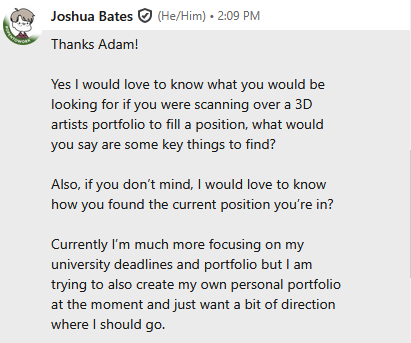
Jamie Blacknell highlighted the importance of reaching out to industry professionals during his talk. He stressed the need to be active online and in community spaces, and to attend as many events as possible to build your name and public image. Community events like “Game Jams” are crucial for demonstrating passion for your creations and diversifying your portfolio. These “Game Jams” also help expand your network as your work gains more recognition.
Olivia Gregory further elaborated on these principles, emphasising the importance of maintaining an online presence that is just as vital as a physical one. Engaging on platforms like ArtStation, Bluesky, and LinkedIn can provide graduates with essential visibility in the digital realm. Currently, the games industry is experiencing a transition, with many employers shifting from traditional studio settings to remote work. Effective communication through social media can complement face-to-face interactions with other professionals. Her experiences highlight that many opportunities arise primarily online, where recognition is often achieved.
The UK games industry faces challenges not due to the overwhelming number of applicants or the difficulty of finding talent, but rather because of its relatively small scale and the idea that “what goes around, comes around.” This phrase refers to how one negative experience or interaction can linger and affect your networking and employability.
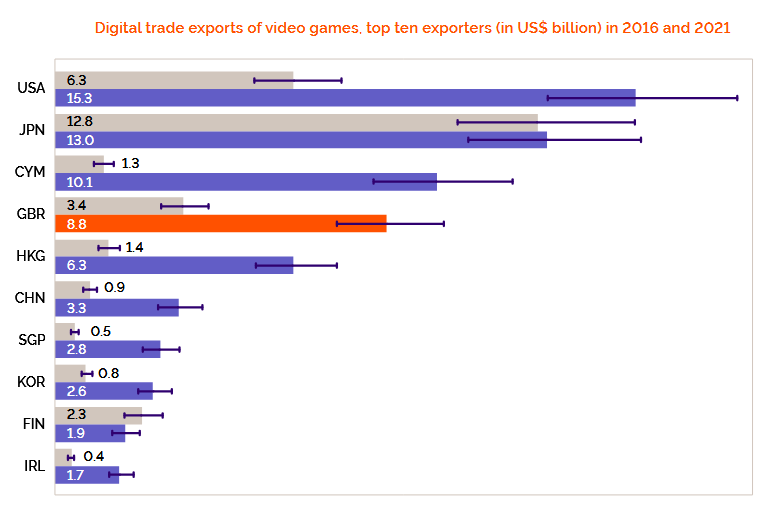
While I agree that professionalism and civility are essential in networking and business contexts, I do not follow the notion that the games industry is “small” or “closeted.” According to “UK Trade in a Global Creative Economy” (Fazio et al., 2024), the UK is the fourth-largest exporter of video games, indicating that it is not a small industry.
This is further supported by a University of Portsmouth news article stating that the UK video games industry generates £12 billion in Gross Value Added (GVA) annually. In light of this information, as shown in Figure 1, the UK video games industry is significant and a primary source of revenue for the country.
One of the key points discussed by all the guest speakers was the difference and value of soft skills compared to hard skills.
Soft skills are the more generic, everyday abilities, such as adapting to and collaborating with new team members, and effectively communicating your team’s needs and progress toward deadlines to higher management. In contrast, hard skills refer to specific technical knowledge, such as proficiency with software programs. In summary, soft skills are demonstrated through experience, while hard skills are validated through certifications.
Jamie Blacknell emphasised the significance of soft and hard skills, stating, “Soft skills take a lot more time and money for a company to develop, whereas hard skills can be acquired in a matter of weeks.” This statement underscores the importance of possessing soft skills when entering the industry. As previously mentioned, participating in “Game Jams” is an excellent way to showcase both soft and hard skills.
Reviewing this, I have really focused on building my personal portfolio and on reaching out to as many industry professionals as possible. Similarly, I also plan to start participating in more ‘Game Jams’ than I have previously. The idea of just starting a project with people I may or may not know has always been quite intimidating and has caused me some anxiety; however, I understand I need to work on and eventually overcome this.
As I plan to develop as a 3D artist, I need to improve my adherence to the correct pipelines and expand my ability to demonstrate my understanding in my portfolio. I plan to keep reaching out to industry professionals through my own spaces, as well as contacting my tutor to see if they can make connections for me to find work in the future.
The State of the Games Industry
To gain a deeper understanding of the industry, I used a variety of research methods. One approach was primary research, which included insights from our guest speakers, feedback from industry professionals, and exposure to diverse perspectives on workflows and employment. Additionally, I conducted secondary research by analysing job listings, tracking layoffs, and exploring several academic sources. Together, these methods provided a wide view of the opportunities available in the industry.
In recent years, both the UK and the global games industry have faced significant instability, with numerous studios undergoing mass layoffs. As a result, many companies have either downsized, restructured, or, unfortunately, shut down entirely. This challenging landscape has made it increasingly difficult for graduates to secure entry-level roles. Our most recent guest speaker, Jade, shared her experience of facing redundancy despite holding a senior position. On a positive note, this shift has created opportunities for remote work, affording her greater flexibility to work from home. This illustrates that while layoffs are unfortunate, they can also lead to beneficial outcomes.
A research paper titled ‘Precarity and Work in the UK Cultural and Creative Sector’ (Hancock and Tyler, 2024) argues that fluctuating contracts frequently characterise creative roles. Consequently, workers must cultivate adaptable, self-directed career paths rather than rely on traditional job security. These findings have led me to realise that, to thrive in this industry, I need to remain flexible and be prepared for unexpected challenges.
Interview Preparation
As I continue to grow in my professional development, preparing for interviews is an essential step that can not be overlooked. How I present myself to potential employers is just as important as the work I create. Interviews aren’t merely a “test,” where someone with more professional knowledge evaluates my skills; they are an opportunity to showcase who I am, what I can contribute, and my thought processes.
The guest speakers shared valuable insights into what interviewers expect based on their own experiences as interviewers. I found the advice from Bea Grove, Jamie Blacknell, and Rhys Shepard proved particularly helpful.
Jamie’s stressed that punctuality is highly valued, especially in interviews. He advised against presenting ourselves as lacking passion for gaming, as that can come off as off-putting. He also encouraged stepping outside of our comfort zones. Based on his advice, I plan to practice a mock interview with a peer who has industry experience.
Bea emphasised the importance of being specific when discussing the art we appreciate. Instead of simply stating that we “like” a piece, we should explain why it is visually compelling and move beyond vague praise. She highlighted the need to conduct thorough research into the company’s identity, values, and recent work, as this demonstrates genuine interest. Most importantly, she encouraged us to ask questions during the interview rather than remaining passive. Asking informed questions shows engagement and curiosity.
Finally, Rhys provided practical guidance by offering examples of questions we might face. He urged us to delve deeper into the reasoning behind our game design choices by asking questions like, “What’s the most important aspect of designing a game?” and “How could we approach this differently?” These questions assess critical thinking, problem-solving, and evaluative skills that extend beyond mere visual ability.
Their advice has made me rethink how to prepare for future interviews. They highlighted that interviewers value passion, professionalism, a willingness to grow, and resilience. Their experiences have given me clear guidance for my preparation. I now feel more confident and ready to approach interviews while considering the company’s values.
Recruitment
Adam Mould was an excellent mentor to consult about the recruitment process for a 3D artist and thoroughly explained the typical steps that most 3D artists need to follow.
The recruitment process for a 3D Games Artist starts with a crucial step: portfolio preparation. Before applying, artists should curate a strong portfolio that showcases high-quality 3D models, whether they focus on props, characters, or environments. Including wireframes and UV maps is essential, as are examples of texturing techniques such as PBR (Physically Based Rendering) and stylised approaches. Artists should also present renders created in real-time engines such as Unreal, Unity, or Marmoset. Each piece should be accompanied by a brief breakdown that details the tools used, polygon counts, and concept references. Studios place significant emphasis on the portfolio rather than the CV, making this step vital.
Next, candidates typically move on to the online application phase, where they submit a link to their portfolio (ArtStation is often preferred) along with their CV. Although a cover letter is optional, it can provide helpful context. For entry-level or junior positions, recruiters may also consider personal projects, game jams, or modding work.
The third step involves an initial screening by a recruiter or HR representative, who assesses whether the artist’s portfolio aligns with the studio’s art style and if the artist can work within technical constraints. Understanding the required software skills, such as Maya, Blender, ZBrush, Substance Painter, Unreal, and Unity, is also essential. Additionally, the recruiter checks the candidate’s eligibility to work in the respective country. If the applicant passes this screening, they move on to the next stage.
The fourth step involves a review by the art lead or senior artists, including the Lead 3D Artist and the Art Director. Their evaluation focuses on technical understandings, such as topology and optimisation, as well as the use of shaders, lighting, and texturing workflows. They also consider essential artistic fundamentals, including shape language, silhouette, colour, and anatomy, while assessing the candidate’s ability to follow a brief and adhere to the studio’s pipeline. If the artist’s work aligns with the team’s needs, they proceed to the interview or testing phase.
An art test, while common, is not always required. Many studios use this assessment to gauge practical skills, which may include tasks such as prop creation tests lasting 24 to 72 hours, creating an environment piece from concept over 1 to 2 weeks, or sculpting a character and producing a game-ready model within a similar timeframe. These tests often involve optimisation tasks, such as creating Level of Detail (LOD) models and managing texture budgets. Studios expect game-ready topology, efficient UV layouts, a high-to-low poly workflow, a textured final asset, and a breakdown document. Some studios may skip this testing phase for senior artists with impressive portfolios.
The interview stage usually consists of one to three rounds. In the first round, a recruiter or HR representative discusses the candidate’s background, including salary expectations, availability, and interest in the studio. The second round typically includes members of the art team, who interview candidates. This discussion revolves around the artist’s portfolio and pipeline questions, focusing on baking, texturing, and optimisation, as well as knowledge of different styles, whether realistic, stylised, or PBR-based. Candidates must demonstrate their software proficiency and discuss problem-solving scenarios, including how they handle feedback. In larger studios, there may be an optional third round that includes a technical or director interview, focusing on collaboration with other departments such as animation, design, and tech art, as well as an understanding of engine-specific processes and the nuances of shaders, lighting, and performance constraints.
Finally, if all goes well, successful candidates receive an official offer. This includes details about the contract, compensation, start date, benefits, and, if applicable, relocation or visa support, as well as NDA and onboarding documents.
Goals Moving Forward
As I look ahead, it is important for me to outline my goals and intentions for the coming year, as well as the steps I plan to take to achieve them. One of my main priorities is to develop an industry-standard portfolio that is cohesive, visually appealing, and easy to navigate. This means refining my existing work, producing new pieces that demonstrate my full range of skills, and ensuring that each project is presented with clear breakdowns and professional formatting. A polished portfolio will act as the foundation of my professional identity and serve as the first impression for potential employers or collaborators.
Alongside building my portfolio, I intend to strengthen and diversify my online presence. At the moment, I rely primarily on a single page, but I recognise the value of expanding across multiple platforms to reach a wider audience. By creating and maintaining active accounts on Instagram, ArtStation, Facebook, and other relevant platforms, I can showcase my work to different communities and stay visible within the digital art and gaming spaces. Regular posting, engaging with other artists, and sharing behind-the-scenes content will help me build a consistent and recognisable online identity.
Finally, I plan to continue reaching out to industry experts to build meaningful connections and gain valuable guidance as I progress. Networking will play a key role in establishing my name within the industry, whether through reaching out on LinkedIn, attending events, participating in online discussions, or seeking mentorship from experienced professionals. By staying proactive and open to feedback, I hope to gain insights that will not only support my growth but also help me position myself more effectively within the competitive games industry.
Conclusion
The UK games industry presents both challenges and opportunities for those who are prepared. Valuable insights from guest speakers have guided me in networking, building my portfolio, and understanding interview techniques, making my journey into this field more manageable.
As I focus on my development as a 3D artist, I aim to enhance my iterative processes and deepen my understanding of related software. I aspire to be a supportive team player, learning from my peers while contributing to creative projects.
These lessons have made the games industry feel more accessible than ever before. I am currently refining my skills and exploring whether my passion lies more in character design or environment design. With consistent practice and mentorship, I am optimistic about carving my path in this ever-expanding field.
Reference List
Fazio, G., Jones, J., Maioli, S. and Simandjuntak, D. (2024). UK TRADE IN A GLOBAL CREATIVE ECONOMY State of the Nations research series. [online] doi:https://doi.org/10.5281/zenodo.10809397.
Hancock, P., Tyler, M. (2025). Precarity and Work in the UK Cultural and Creative Sector. In: Performing Artists and Precarity. Palgrave Macmillan, Cham. https://doi.org/10.1007/978-3-031-66119-8_3
University of Portsmouth. (2025). Portsmouth academics reveal UK video games industry generates £12 billion annually. [online] Available at: https://www.port.ac.uk/news-events-and-blogs/news/portsmouth-academics-reveal-uk-video-games-industry-generates-ps12-billion-annually?utm_source=chatgpt.com [Accessed 7 Dec. 2025].
Leave a Reply