Four Research Topics


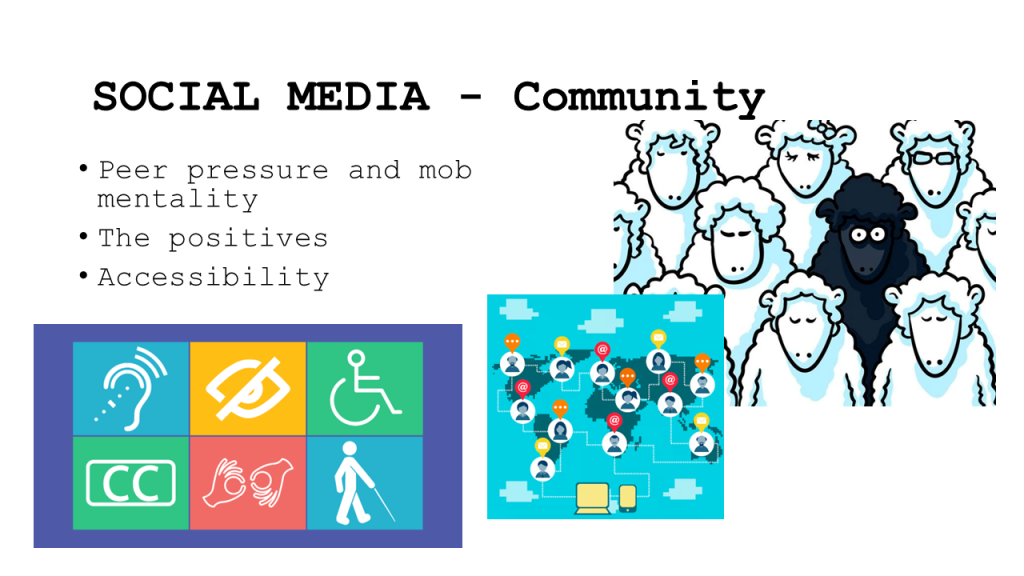
- Peer Pressure and mob mentality – psychological concept describing the phenomenon of abandoning your own ideals and beliefs in favour of the majority opinion is significant in online spaces
- The Positives – mob mentality isn’t always bad, and can help in creating a community atmosphere in harmless ways online like through fandom and streaming events
- Accessibility – while many real world events are impossible for everyone to access, physically, monetarily or psychologically, there are many events that are now streamed for free online, or uploaded later. It also allows people that might not have been able to go out and meet likeminded people in the real world, to do so online, fulfilling a human need to be social that might have been much harder before the internet.
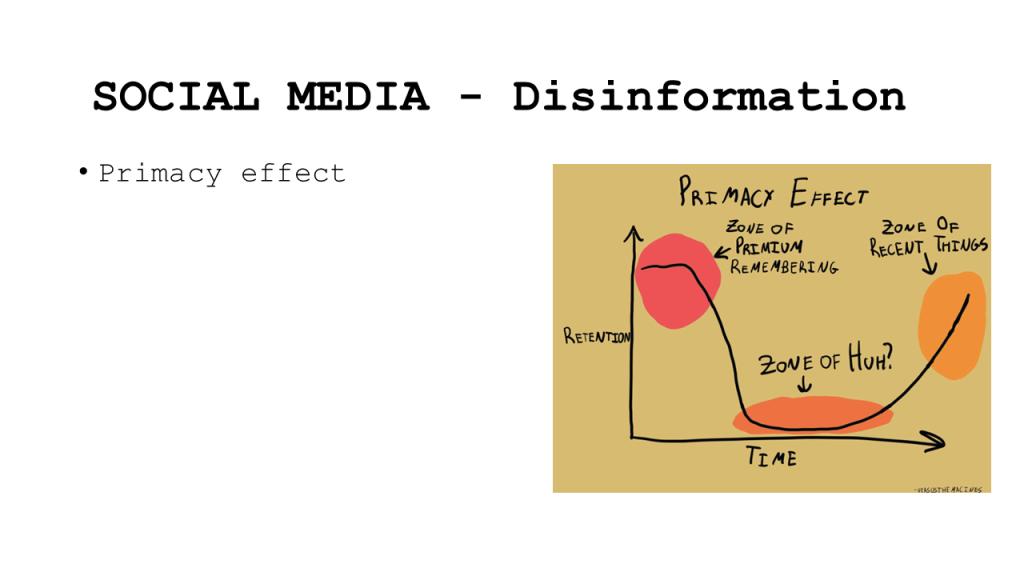
- Primacy effect – a cognitive bias, people tend to remember the first bit of information more overtly than information learned later. In the spread of disinformation, whoever is the loudest about a topic first tends to be the one people primarily think of and trust the most. The recency effect also means people tend to remember what happened most recently better, as short-term memory.
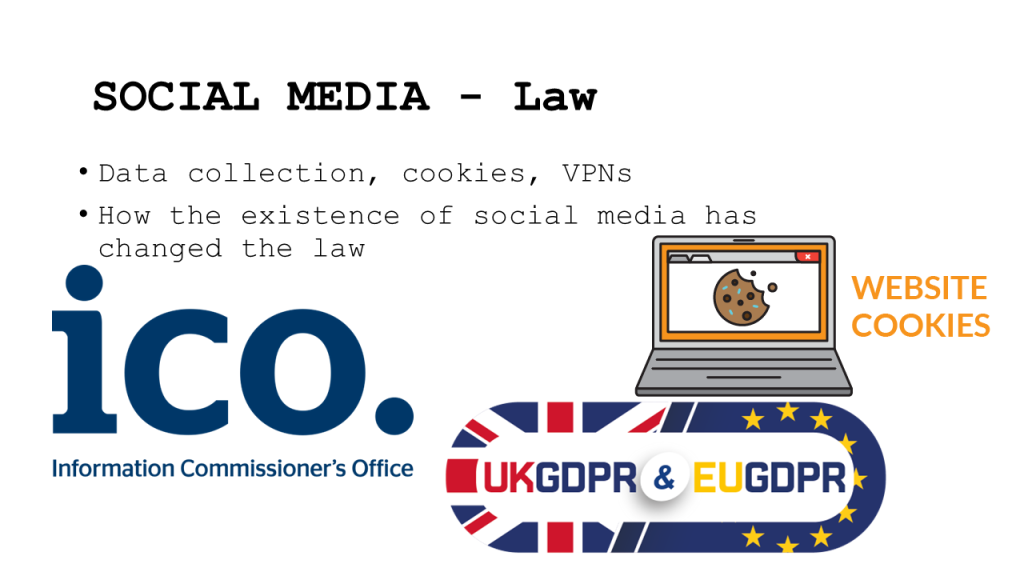
- Data collection, cookies, VPNs – first party cookies are used by websites to keep you logged in and track what you do on that website, like what’s in your basket, so that it can remember it for you. Many websites nowadays will use your cookies by sharing it with third parties and giving you personalised ads.
- How the existence of social media has changed the law – the ICO (Information Commissioner’s Office) enforces the Privacy and Electronic Communications Regulations 2003 (PECR), Data Protection Act 2018 (DPA) and UK GDPR, as well as other privacy related laws.

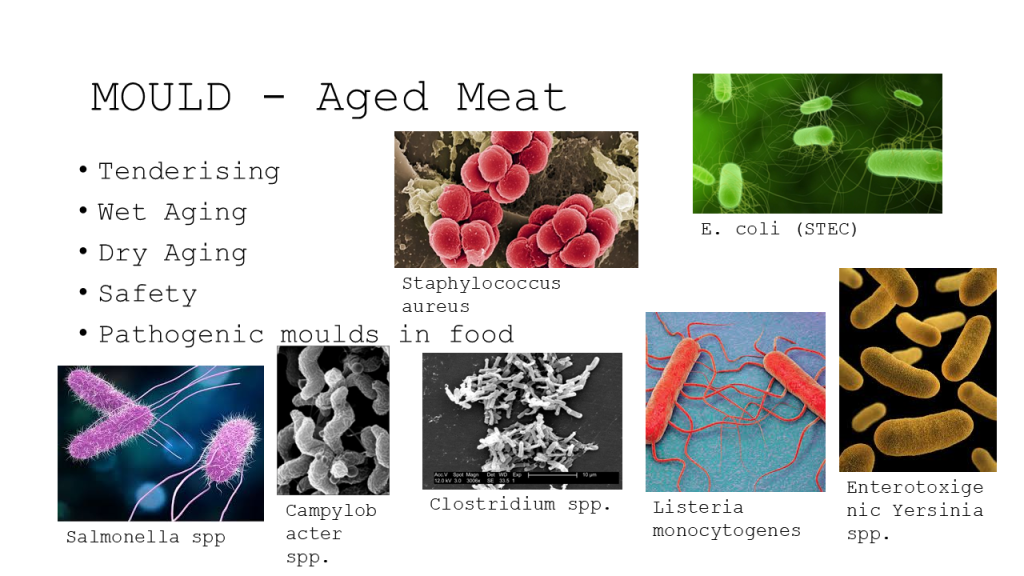
- Tenderising – the purpose of aging meat is to prepare the meat for eating by aging it, breaking down connective tissue using microbes (like mould) and enzymes (which the mould produces plus the meats natural enzymes). This process tenderises the meat.
- Wet Aging – aged in a vacuumed sealed bag and remaining wet, the most common way to age meat in the UK, while:
- Dry Aging – means that it is hung or placed on a drying rack for weeks at a very cold temperature. This evaporates the moisture, condensing the taste. Mould that has grown on the outside creates a crust which is cut off before cooking.
- Safety – aged meat is safe if done within certain parameters which are outlined by the EFSA, ‘dry aged beef can be considered as safe as fresh beef if ageing is done for up to 35 days at a temperature of 3°C or lower.’ ensuring that dangerous pathogens and spoilage bacteria can’t develop.
- Pathogenic moulds in food – some moulds are pathogenic, meaning that they can cause disease in humans through the mycotoxins they produce.
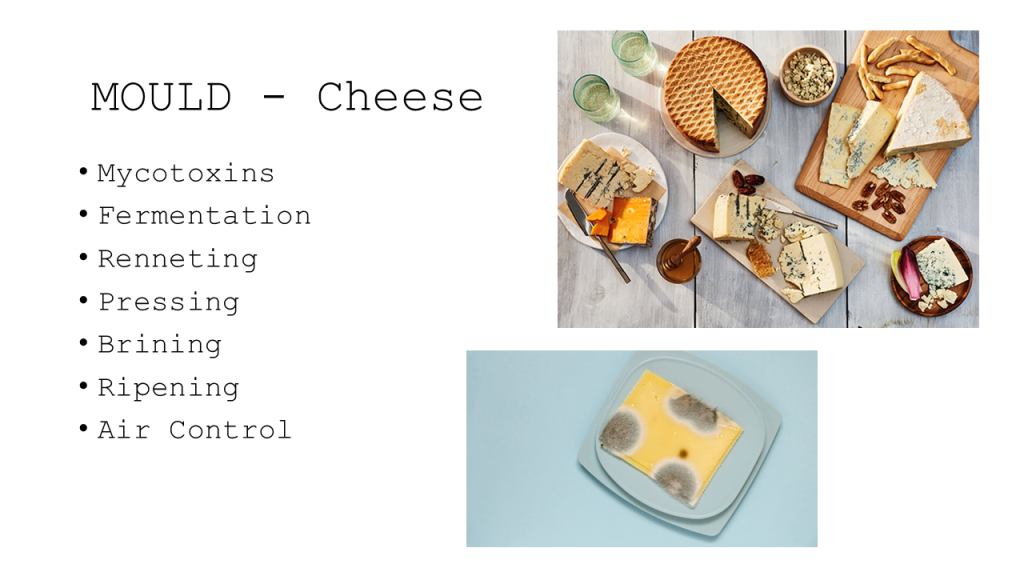
Mould can be added to cheese to enhance the texture and flavour, like an ingredient
- Mycotoxins – unwanted mould that grows on cheese can produce harmful mycotoxins
- Fermentation – bacteria is added to milk to ferment the lactose into lactic acid. Mould spores can be added here for the creation of mould ripened cheese.
- Renneting – rennet is added, causing a cheese curd to developed. Mould can also be added during this step.
- Pressing – removing most of the whey (water) from the cheese milk.
- Brining – soaking the cheese in saltwater, stopping the bacteria converting lactose to lactic acid, and developing the flavour.
- Ripening – smear-ripened, using the bacteria on a mature cheese to cultivate a new colony on a new cheese, conditions are made for the intended bacteria to develop and washed to avoid the growth of unwanted moulds. This helps develop specific flavours and smells. Surfaced-ripened, an edible white rind is created by the Penicillium candidum that it is coated in during the aging process.
- Air Control
- European Food Safety Authority
- “EFSA’s advice contributes to fill [the gap of knowledge about aged meats’ safety] and provides a solid scientific basis for food business operators to produce aged meat that is safe,” – the Chair of EFSA’s Panel on Biological Hazards, Prof Kostas Koutsoumanis.
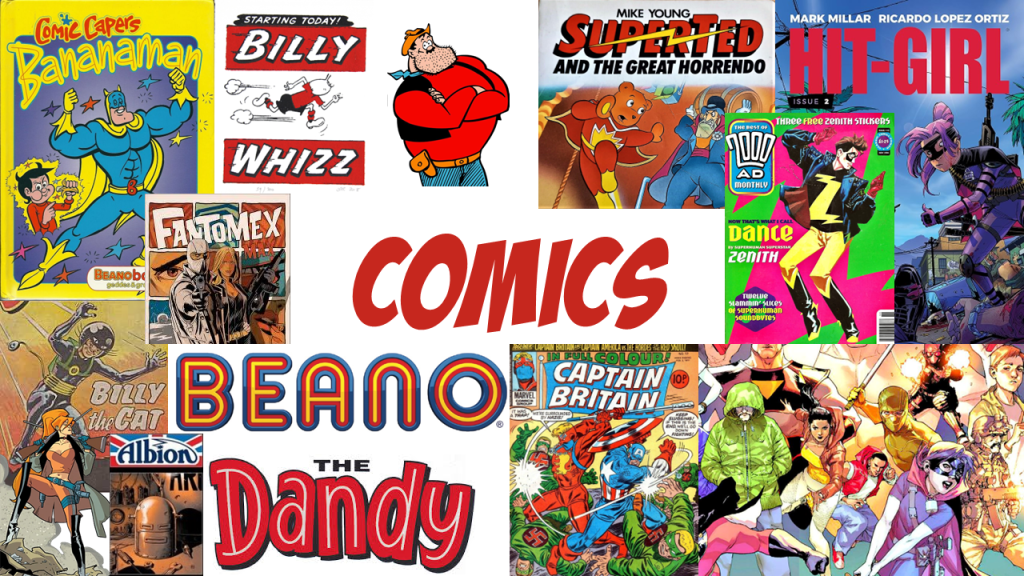
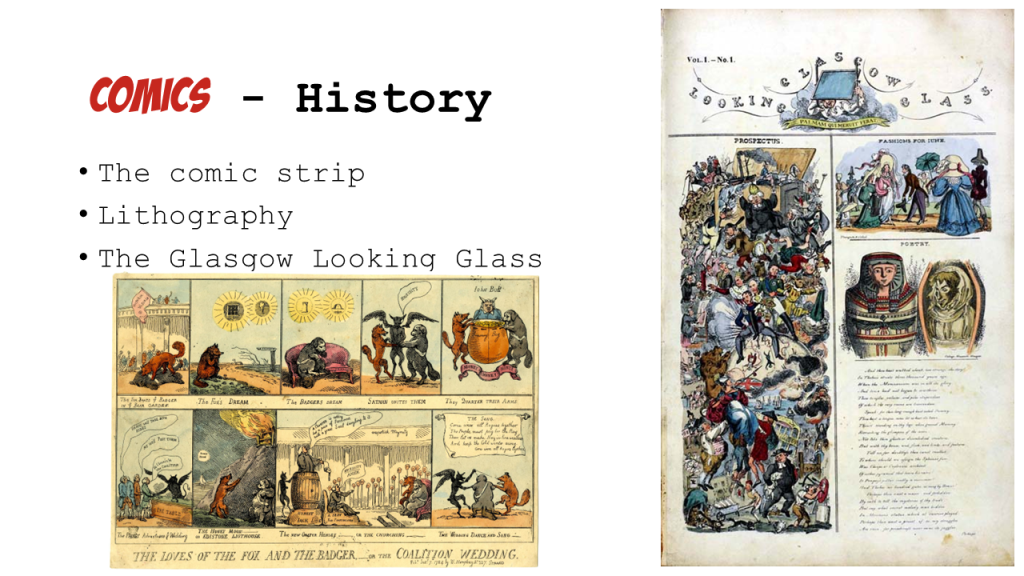
- The comic strip – a precursor to serialised comics, ‘a visual media where images interact with each other to create a narrative’ David Roach 2019. Later came the development of tools like panels, layouts and word balloons. Many of the first British comic strips were satirising the politics of the time, like ‘The Loves of the Fox and the Badger’ by Thomas Rowlandson representing the Fox-North Coalition of 1783, a Whig and Tory coalition.
- Lithography – The spread of lithography by the 1820s made comics much more accessible as they made the printing process less expensive and therefore lowered the price.
- The Glasgow Looking Glass – is an example of one the first dedicated sequential illustrative publications in the 1820s
- Atlas Comics – before the 1960s, Marvel comics was called ‘Atlas Comics’ and had been straying away from superheroes as a genre since they were become less popular and more stale in the cultural zeitgeist, until DC introduced the Justice League in 1959. Atlas Comics would re-join the superhero genre as a response to the Justice League with the Fantastic Four, created by Stan Lee and Jack Kirby. Their success would lead to the introduction to many more superheroes in the early 1960s, and a rebrand to ‘Marvel Comics’, creating “superheroes with super problems” Stan Lee 1966.
- DC comics – a big name in American Comics publishing since it was founded in 1935, bringing the first generation of superheroes.
- Superheroes – The first generation of comic book heroes were introduced in the 1930s with DCs Superman (Jerry Siegel and Joe Shuster), Batman (Bill Finger and Bob Kane) and Wonder Woman (William Moulton Marston and H. G. Peter), representing the ‘Golden Age’ of superhero comics from 1938 to 1956.
- War comics – Post WWII, War comics were very popular in both the UK and America, notably with depictions of superheroes like Captain America and Captain Britain fighting Nazis in the early 1940s. These remained very popular through the 1960s and 70s in the UK, being cheaper than the expensive American superhero comics.
- Manga – in the 1980s, manga was beginning to be exported in western countries like the US.
- British vs American – While there have been a host of British superheroes, the genre is very much dominated by America and influenced by American culture and ideals. In the UK, Sci-Fi like Judge Dredd and V for Vendetta and War Comics were more popular.

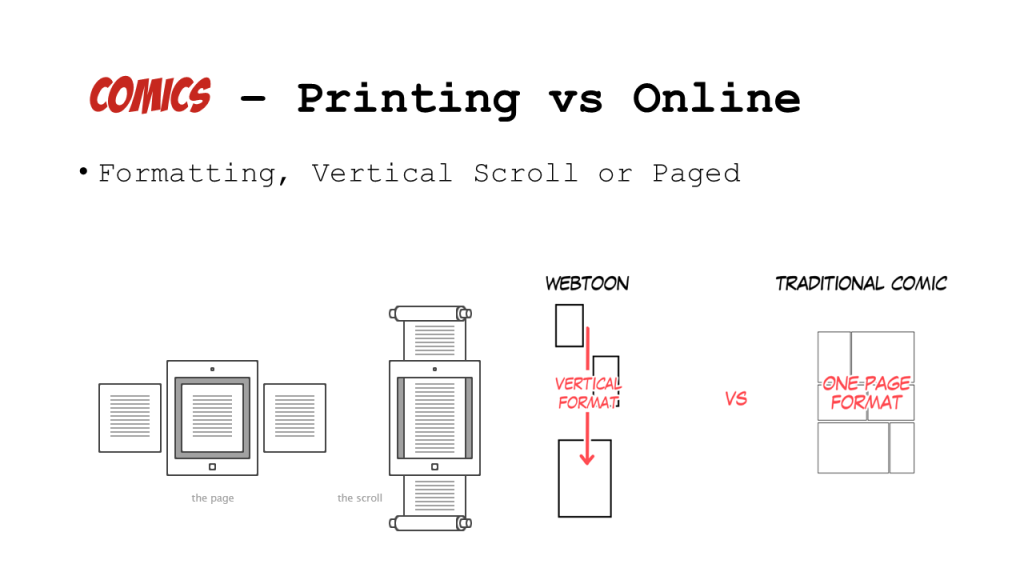
- Formatting, Vertical Scroll or Paged – modern webcomics are formatted for scrolling rather than pages. This impacts the readability, the formatted scrolling being easier to read on a small phone.

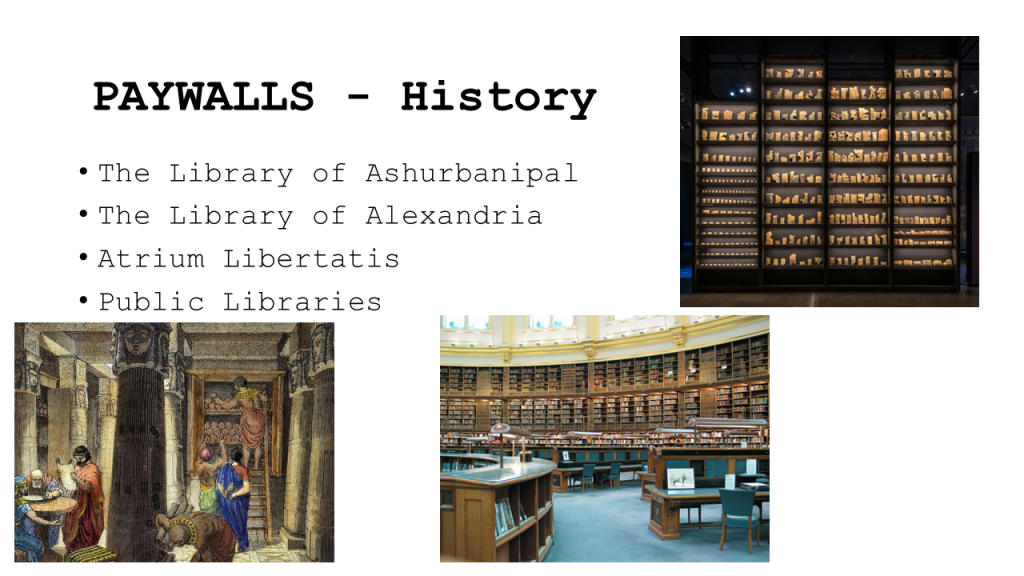
- The Library of Ashurbanipal – The oldest known library in the world, founded around the 7th century BCE, storing 30,000 cuneiform tablets rather than books.
- The Library of Alexandria – A Universal Library in Egypt founded in 332 BCE, containing a debated amount of books, ranging from 200,000 to 700,0000 total. The Library of Alexandria existed in two sites, one being destroyed in war in 48 CE while the other was destroyed in the 4th century by Theophilus, bishop of Alexandria, in bid to destroy all relics of paganism in the now exclusively Christian Empire.
- Atrium Libertatis – was the seat of the censors, public library and gallery and archive established in Rome first century BCE. Both public and Private Libraries had been in Rome since 86 BCE, but literacy was still much more common among the patrician class (ruling class families in ancient Rome), and Private Libraries were more of a status symbol than something actually used.
- Public Libraries – before the 18th century, libraries were mostly exclusive to scholars and not available to common people. However, in the UK, with the introduction of the 1850 Public Libraries Act and the 1919 Public Libraries Act made public libraries much more common, improving the literacy and education of the working class especially after WWII.
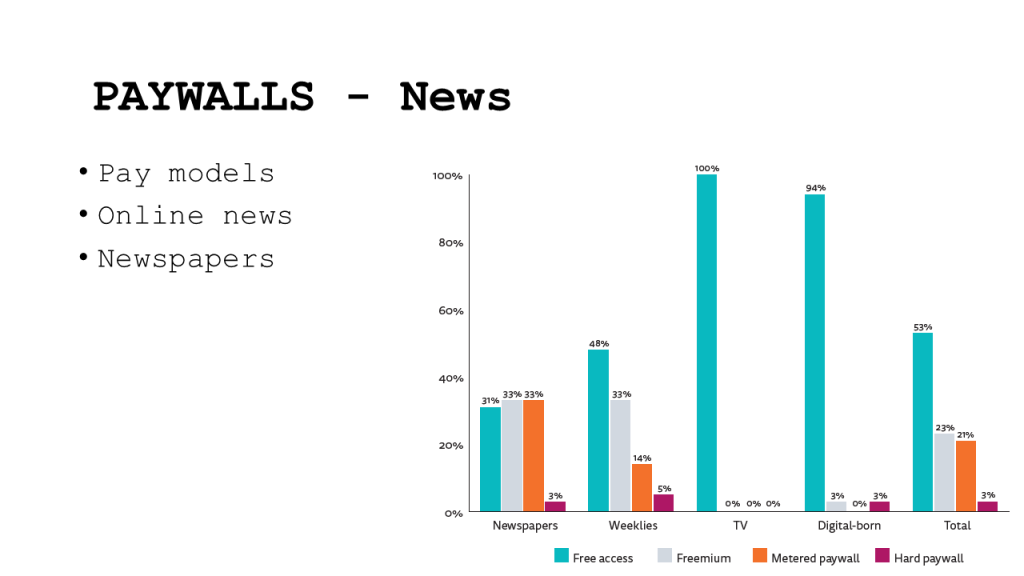
- Pay models – 97% of digital-born news media use some kind of pay model (Alessio Cornia, Annika Sehl, Felix Simon, and Rasmus Kleis Nielsen 2017) Modern news sites will have different pay models, namely:
- freemium – there is free content, but premium content is paid for, and
- metered paywalls – you have free access to a limited number of articles for a period of time before you have to pay
- “Looking only at those news organisations who operate a pay model, the average price for the cheapest available monthly subscription (without discounts) is €13.64 (£11.56). Prices range from €2.10 (£1.78) to €54.27 (£46) a month.” (Alessio Cornia, Annika Sehl, Felix Simon, and Rasmus Kleis Nielsen 2017 p.1)
- While the vast majority of online news has some kind of pay model, other forms use pay models less, 71% of weekly newspapers use pay models and all broadcasters offer free access to their digital news.
- Increased paywalls online
- Transparency
- Communicate with general public – it is important for academic works to remain public so that laymen can access resources with equal opportunity and understand the research that affects them.
- Open access journals
- Medical research
- Lobbying
- Digital segregation – a mixed model exacerbates the already existing digital segregation, “economically vulnerable people in developed regions will be unable to access paywalled content and hence will be digitally segregated getting less quality digital content, making them less informed, and less competent in general.” (Yonas Kassa 2024)
- Ethicality
- Shadow Libraries – provide freely available media that is typically paywalled, for example:
- Sci-Hub – an online repository supplying access to millions of research papers founded by Alexandra Elbakyan
- Legality – sci hub has had to pause their uploads and downloads since 2020 due to lawsuits for copyright infringement. They have been sued once in 2015 by Elsevier and again in 2017 by American Chemical Society, losing both.
- Open access movement – seeks to make scholarly research and academic articles freely available to everyone
- Aaron Swarts – as a part of the open access movement, Aaron Swartz in 2010, used the campus network at Massachusetts Institute of Technology to download around 4.8 million articles from JSTOR to make them open access, but was arrested and later killed himself in 2013 before he could go to full trial.
- Elsevier v Sci-Hub (2015) – Elsevier is an academic publishing company, Elbakyan referenced article 27 of the UN declaration on human rights: “everyone has the right freely to participate in the cultural life of the community, to enjoy the arts and to share in scientific advancement and its benefits.”, publishers exploit the copyright to make money off of authors, paywalling this content violates this right.
- American Chemical Society v Sci-Hub (2017) – American Chemical Society won $4.8 million in a default judgement.
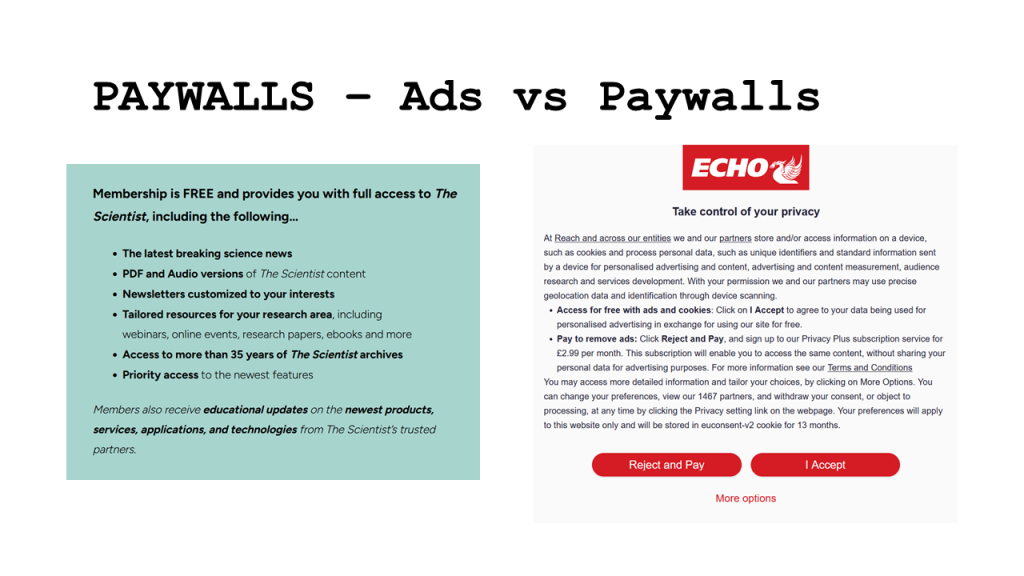
In the current landscape, it seems that if you are not paying for access to content with your money, you are paying for it with your private data and information.