Final Topic Presentation
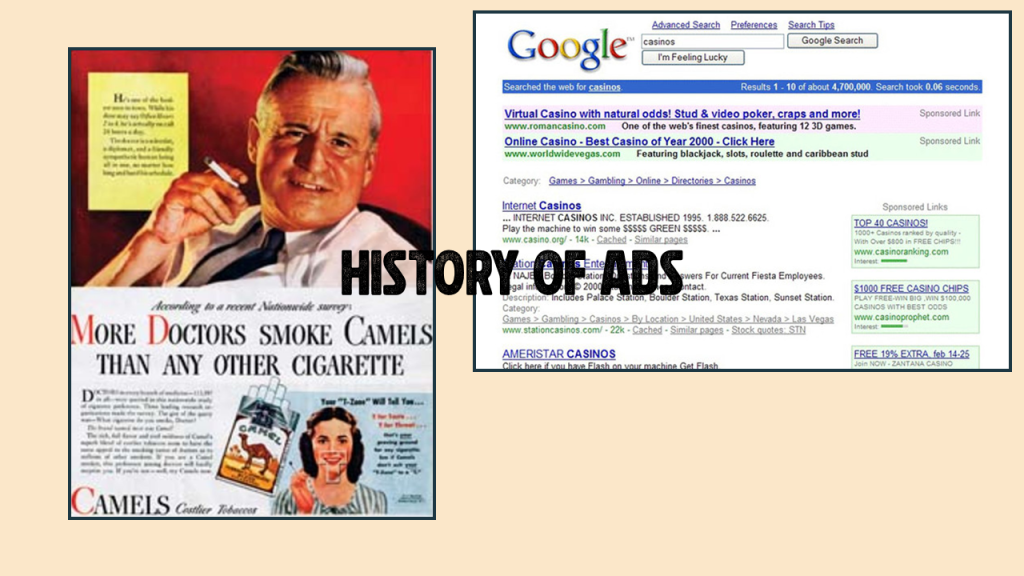
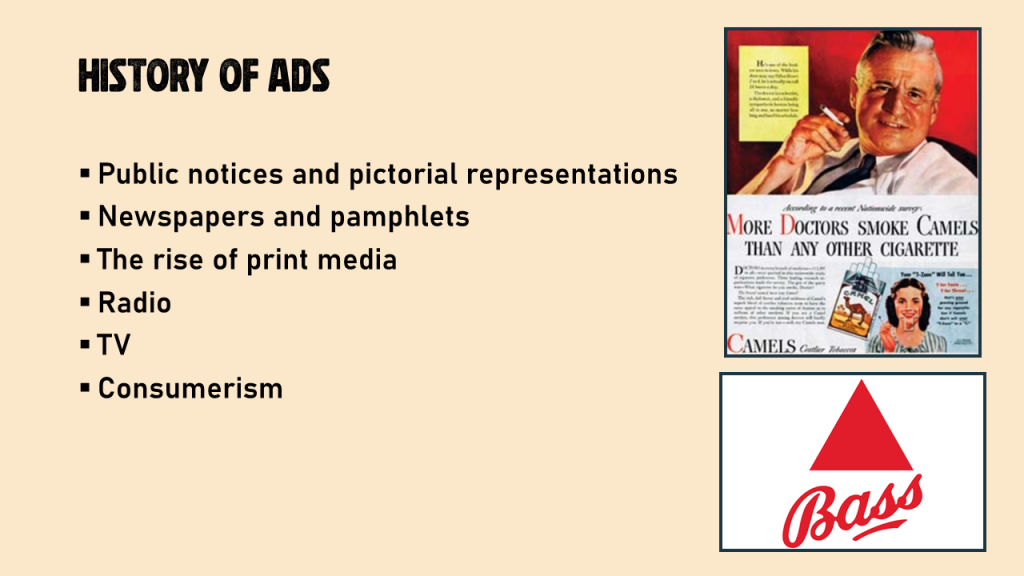
- Public notices and pictorial representations
- Newspapers and pamphlets – The first newspaper advertisement is accepted to have appeared in Samuel Peck’s ‘Perfect Diurnall in 1646’ (AdTech Juice 2025)
- The rise of print media – the first weekly newspaper in the UK was Berrow’s Worcester Journal, being regularly published since 1709 (news media association, History of British Newspapers). Adverts began appearing in print more commonly after 1841, and the first colour advert in the UK appeared in Glasgow’s Daily Record in 1936.
- Radio – radio broadcasting became more common throughout the 1920s and radio advertising would follow in the early 1920s.
- TV – The first TV ad was in the 1940s, but only became common in the UK in the 1960s, as the format was considered very American (Science + Media Museum 2020)
- Consumerism – technological advancement and mass production around the 1920s would lead to increased consumerism.
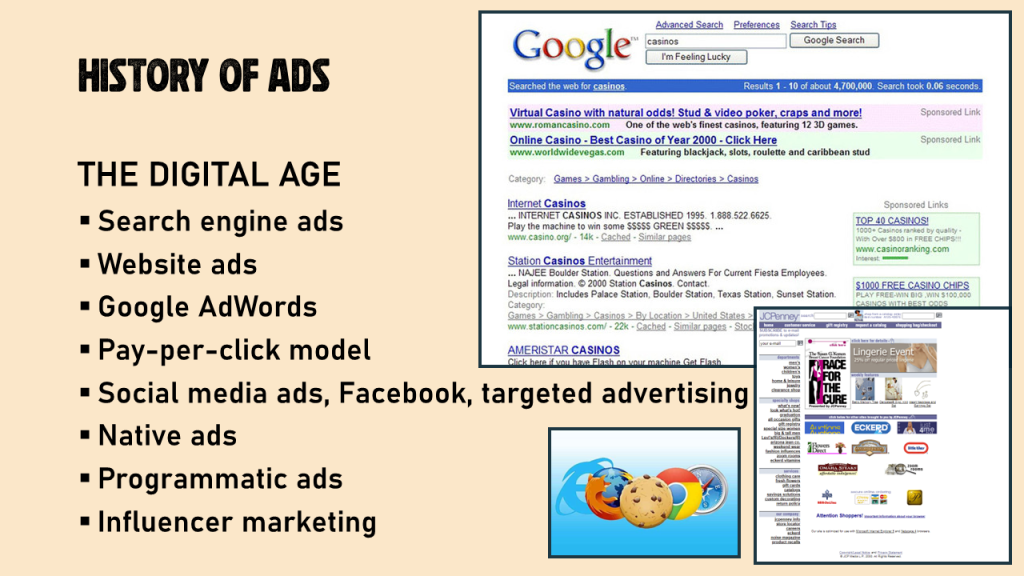
THE DIGITAL AGE:
- Search engine ads – search engines can remain free to users with the existence of sponsored search, which began in 1998 with GoTo (now Yahoo! Native) and BeFirst (now MIVA) in 1999 (Daniel C. Fain, Jan O. Pedersen 2006)
- Website ads – The first digital ad was in 1994, a AT&T banner ad on hotwired.com (AdTech Juice 2025)
- Google AdWords – released in 2000 and allowed advertisers to big on keywords so that their ads could appear in search results with those words, and used a pay per click model, which was appealing and more affordable for advertisers (Starlight Digital)
- Pay-per-click model – Ads will measure their click through rate (CRT) to gauge how successful the ad was. In a pay-per-click model, an advertiser will pay the publisher based on how many times the advert was clicked on, as opposed to cost-per-mille, paying a certain amount per 1,000 impressions on their ad.
- Social media ads, Facebook, targeted advertising – using your cookie data, a website can sell this data to third parties to serve you personalised ads.
- Native ads – an ad that blends in with the non-paid content around it, making it less disruptive than a typical ad.
- Programmatic ads – the automation of buying ad space.
- Influencer marketing – in current day, some of the most successful advertising comes from sponsored influencers on social medias like YouTube and Instagram, bolstered by the parasocial relationship they develop with their viewers, making the advertisement seem more like a recommendation from a friend.
OFFLINE:
- Falling young readership
- Rupert Murdoch – A media mogul who founded News Corporation, a parent company to many News Companies around the world, “News Corp has a 14.6% share of news consumption; Sky another 7.4% (mainly because of its position in radio). Together they are 22%” (the Guardian 2010)
- Warren Buffet
- Newspapers – Before the internet, many people would get the newspaper delivered to their house daily for a low fee. Broadcast news on TV and radio has always been free for the consumer.
- Publishers
- Tabloids
- Regional
- Magazines
ONLINE:
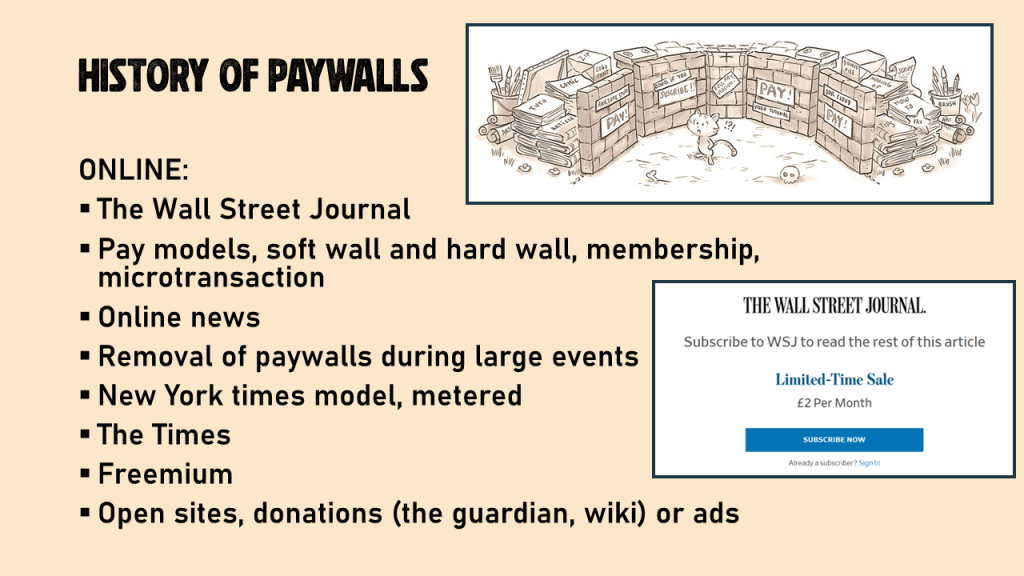
- The Wall Street Journal – the first American newspaper to introduce a subscription online in 1996 with an annual payment model, which was criticised but ultimately successful. This was a ‘hard wall’, meaning that you cannot access anyone of their articles without a subscription.
- Pay models, soft wall and hard wall, membership, microtransaction
- Removal of paywalls during large events
- New York times model, metered – The New York Times introduced their metered paywall in 2011, limiting the amount of article you could read to 20 before you then had to pay (Jeremy W. Peters 2011), an example of a ‘soft wall’.
- The Times – An example of a news site having a less successful introduction of a paywall, as it was heavily criticised especially by their competitors, the Guardian welcoming ‘former readers of the Times’ (John Grace 2010) and highlighting its loss of almost 90% of its readership following the decision (Josh Halliday 2010)
- Freemium – meaning you can access some content for free but cannot access the ‘premium content’ without payment, another example of a ‘soft wall’
- Mixed approach
- Open sites, donations (the guardian, wiki) or ads – Advertisements and donations allow some news sites to remain completely free. For example, the guardian prides itself on remaining free, having an optional subscription on £12 per month for an ad-free service.
- Barrier to essential knowledge
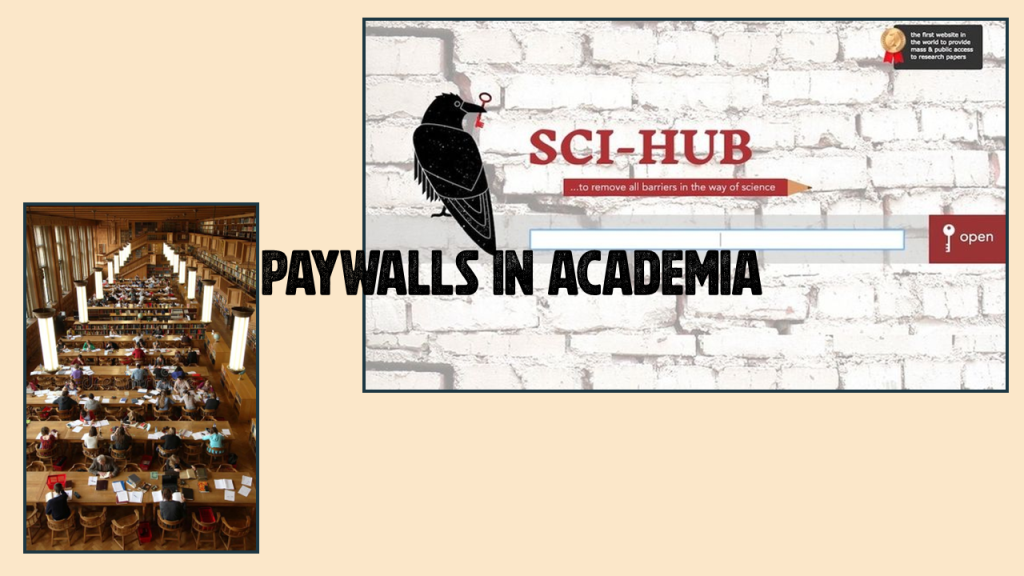
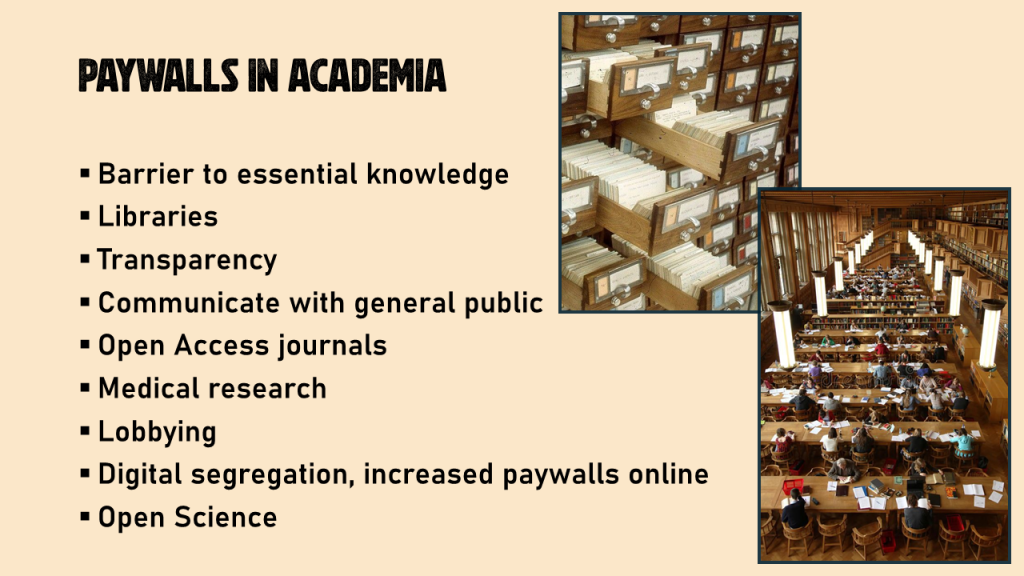
- Libraries – Public libraries are essential in giving access to the general public to both academic and fictional media, and are useful community spaces. Academic Libraries, like University Libraries, will pay a licencing fee to publications for access to their content.
- Transparency
- Communicate with general public
- Open Access journals – There are three types of journals that can offer open access article, a fully open access journal, a hybrid journal with both open access and paywalled content, and delayed-open access journals, which are paywalled for a period of time after publication before becoming open access. A publication fee to the author/their institution/their funder is needed to make academic work open access.
- Medical research – Open Access is especially important in medical research, as it is important for people to understand and have access to information that could be very important to their health and future. There are Open Access medical Journals, like the Medical Research Foundation, “The health and wellbeing of millions of people depends upon continual medical advances and we are committed to ensuring that the knowledge and discoveries which result from our funded research are available freely and immediately to everyone.” – Medical Research Foundation 2025
- Lobbying
- Digital segregation, increased paywalls online – In the real world, there is a clear separation of the poor and rich, with upper class people have much better access to better resources, improving their opportunities and good upwards social mobility (their ability to move between social classes) while the working class has little to no social mobility. This is also becoming apparent in online spaces, “Providing scientific articles to those at elite universities in the First World, but not to children in the Global South? It’s outrageous and unacceptable.” Aaron Swartz 2008.
- Open Science – “The open science movement aims to make research publicly accessible, transparent, and reusable to scientific and broader communities” – Kristen L. et al. 2025
- RCUK – The UK Research Funding Councils had proposed that all of their fundees should archive their work for free online, “in order to maximise their usage and impact.” Derek Law 2005
- ALPSP – In response, the Association of Learned and Professional Society Publishers tried to delay and block the RCUK proposal, arguing that, “Librarians will increasingly find that ‘good enough’ versions of a significant proportion of articles in journals are freely available; […] it is inconceivable that they would not seek to save money by cancelling subscriptions to those journals. As a result, those journals will die.” ALPSP 2005
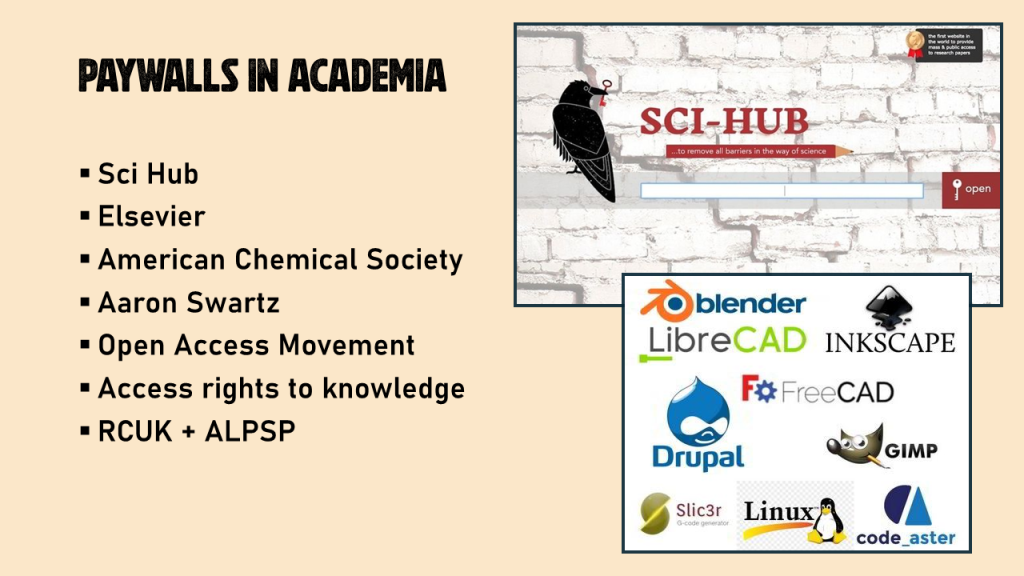
- Sci Hub – Sci-Hub is an academic shadow library that gave access to over 80,000,000 files that users could download for free, founded by Alexandra Elbakyan, a former neuroscientist, in 2011.
- American Chemical Society – ACS publications publishes over 80 scholarly journals. ACS has more than 1,700 institutional Open Access agreements all over the world as of 2026.
- Elsevier – An academic publishing company with a history of opposing Open Access and Open Science. In 2013, Elsevier “…forced Mendeley to remove its titles from its database” (Tina Amirtha 2015), Mendeley was at the time a free reference manager and a symbol of open science until it was acquired by Elsevier.
- Aaron Swartz – A big supporter of Academic Open Access as a part of the Open Access Movement.
- Open Access movement
- Access rights to knowledge
- Legality
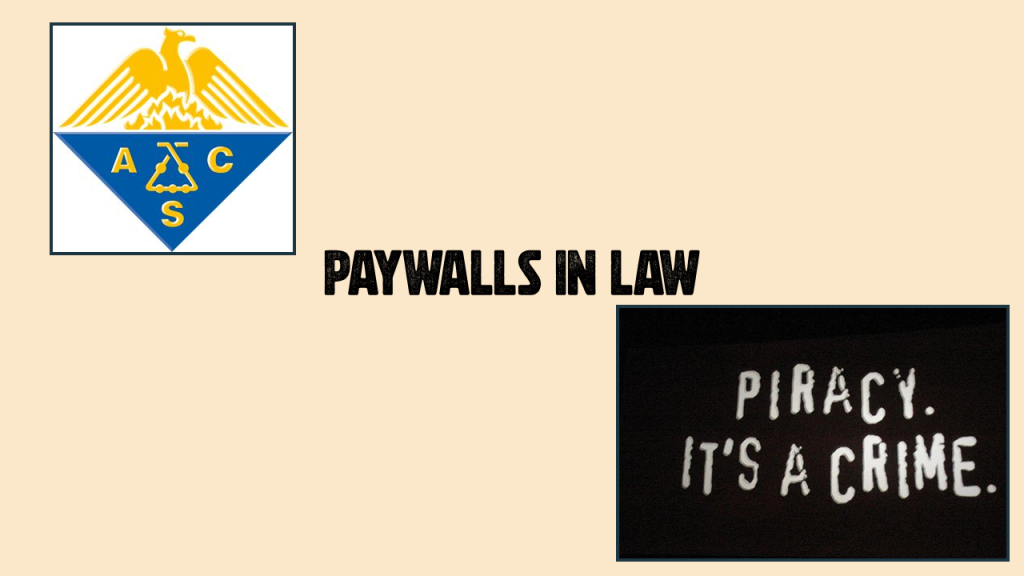
- Napster – Napster was the first example of a peer-to-peer file sharing application in 1999, but was brought down two years later in 2001 due to copyright infringement. It was known mostly for it’s ability to share music for free, causing Metallica and Dr. Dre to file lawsuits, as well as a lawsuit from several major record labels.
- Napster II – It was due to these lawsuits that Napster proposed a subscription to their service ‘Napster II’, in order to help settle their lawsuit payments. With this model, Napster would licence music to distribute amongst their users, a ‘basic subscription’ using a metered model of limited downloads, and a ‘premium subscription’ with unlimited downloads, not unlike modern online music distributors like Spotify and Apple Music.
- Universal Music – However, this was dismissed by labels like Universal music at the time as a failure to consider the protections of artists and copyrights,
- Spotify – although today Spotify is criticised for the same issues.
- Apple Music
- Sci Hub – Sci-Hubs sharing of copyrighted content for free is illegal. Over the years, both the domain name and IP address of the website has changed multiple times.
- “…the fact that [Sci-Hub] is so immensely popular, inside and outside academia, is a symptom of many people’s frustration with the status quo in academic publishing.” – Stephen Curry 2015
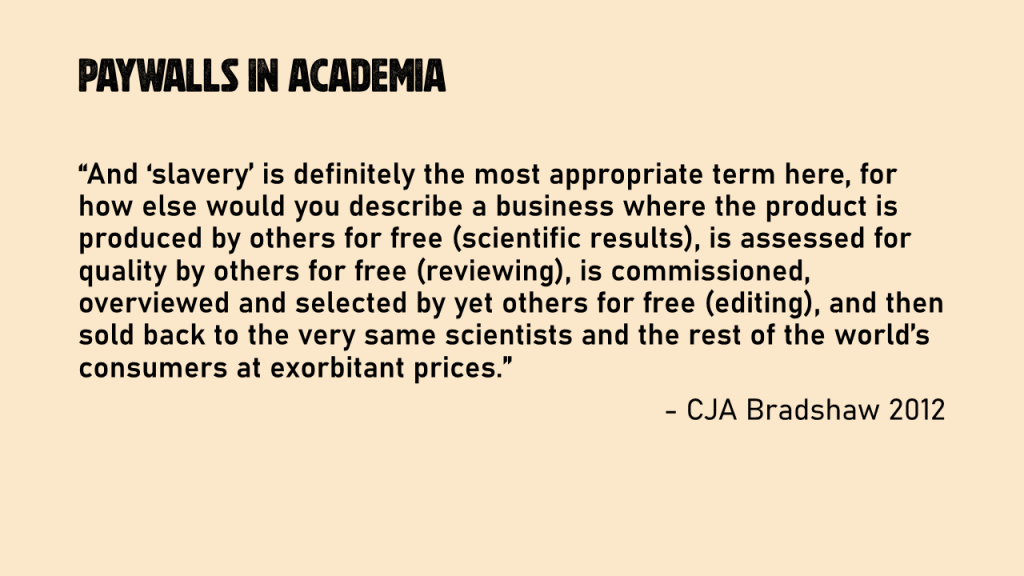
- Legality – Elbakyan strongly believes in the open access movement and the right for the public to have access to academic research although the site does infringe on the copyright of academic publishers like Elsevier, Springer Nature, Wiley-Blackwell and the American Chemical Society. Elsevier and the American Chemical Society both ended up suing Sci-Hub in the 2010s very successfully.
- Extensions – There are extensions available to bypass paywalls on browsers, but these are often taken down from official extensions stores by the browser due to DMCA Takedown Notices.
- Elsevier v Sci Hub 2015 – Elsevier was awarded $15 million in damages from Sci-Hub and Library Genesis for copyright infringement, ruling without the presence of Elbakyan or her lawyers.
- American Chemical Society v Sci Hub 2017 – American Chemical Society won $4.8 million in a default judgement.
- Procedural fairness and distributive fairness – assesses the fairness in the method vs the fairness in the outcome. While pirating academic papers in, in method, illegal since it infringes copyright, the result is beneficial as public access to academia increases public awareness, but also aids scientist since the cost of the licencing fees can be exorbitant for institutions to pay.
- Piracy – “It’s called stealing or piracy, as if sharing a wealth of knowledge were the moral equivalent of plundering a ship and murdering its crew. But sharing isn’t immoral — it’s a moral imperative. Only those blinded by greed would refuse to let a friend make a copy.” – Aaron Swartz 2008
- Morality
- Torrenting – using peer to peer file sharing, you can download parts of a torrent file from multiple sources to increase the speed of the download.
- Seeders – Seeders, the ones that upload the copyrighted material for leechers online, are much more likely to prosecuted for copyright infringement as they are distributing the material
- Leechers – downloading a torrent file makes you a ‘leecher’
- Legality – Shadow Libraries like Sci-Hub violate copyright laws
- Copyright – the Copyright, Designs and Patents Act 1988 outlines that, someone who, without license or permission, distributes in the course of a business or “distributes otherwise than in the course of a business to such an extent as to affect prejudicially the owner of the copyright, an article which is, and which he knows or has reason to believe is, an infringing copy of a copyright work.”, which effect distributers, ‘seeders’, although those downloading pirated content can be still be criminally prosecuted as a common law offense.
- Anonymity – With the use of VPNs, many people can pirate content online without issue, without a VPN rerouting your internet traffic, your ISP will see your activity and can send you letters and warnings. The anonymity can also change the perceived ethicality for the consumer as, without seeing the creator that you may be harming, the act of pirating becomes impersonal and easier to commit.
- Computer Fraud and Abuse Act (CFAA) – A US law that Aaron Swartz protested against. After his death, ‘Aaron’s Law’ was proposed and presented in 2013 but not passed. It is argued that the CFAA is too vague, causing overcharging.
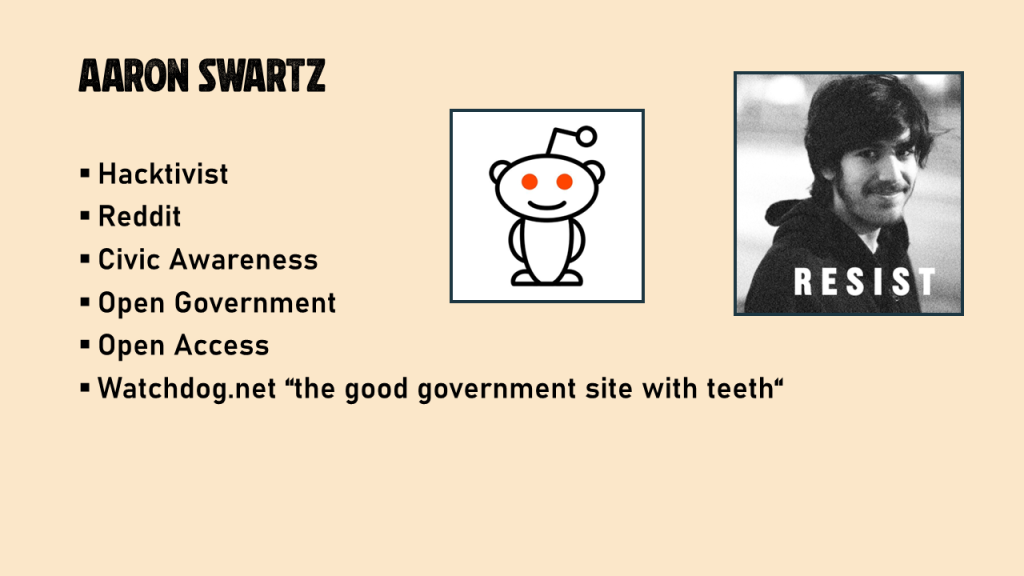
- Hacktivist – Aaron Swartz was an American programmer and internet hacktavist, which in this case refers to his use of hacking as an act of civil disobedience focused on civic awareness, open government and open access.
- Reddit – He was also the co-owner of Reddit, which he left in 2007.
- Civic Awareness
- Open Government
- Open Access
- Watchdog.net “the good government site with teeth“ – Later, in 2008, he founded Watchdog.net, “the good government site with teeth“, which would compile information about current American politicians and where their money came from.
- Demand Progress – He founded Demand Progress, a non-profit political advocacy group, and the Progress Change Campaign Committee in 2010.
- Stop Online Piracy Act – Demand Progress campaigned against the proposed ‘Stop Online Piracy Act’ which was introduced in 2011,
- PROTECT IP Act – they also campaigned against the PROTECT IP Act’ proposed in 2010 and the ‘Cyber Intelligence Sharing and Protection Act’ proposed in 2011.
- 2010, used MIT network to download 4.8 million JSTOR articles with intention to distribute for free – In late 2010, he used the campus network at Massachusetts Institute of Technology to download around 4.8 million articles from JSTOR to make them open access.
- Keepgrabbing.py
- Political activism
- Arrested 6th Jan 2011 – On January 6th 2011, MIT police arrest Swartz,
- Charged for wire fraud, computer intrusion and reckless damage – and he was indicted on charges for wire fraud, computer intrusion, unlawful obtaining of information and reckless damage to a computer, violations against the Computer Fraud and Abuse Act (1986).
- 13 felony counts – He would face 13 felony counts,
- Looking at 35 years – the maximum penalty for which would be decades in prison and large fines.
- Committed suicide in 2013 before he could get to full trial – He committed suicide in 2013, before he could go to full trial. This act would cement his place in public consciousness as a martyr for public access to knowledge and government transparency.
- Neither JSTOR (civil charges) or MIT wanted to escalate to federal prosecution – According to the prosecution: He circumvented term-of-service constraints, used a hidden laptop in an MIT networking closet, spoofed MAC addresses, and evaded attempts to block his access. MIT did not request federal prosecution, claiming to be neutral, which is debated.
- He returned the material once confronted – Since he returned the material once confronted, JSTOR did not want to press civil charges and considered it settled.
- Terms of service – People argue that the terms of service did not suggest that Swartz’s use was excessive,
- Publicly funded knowledge should be freely available – and many believe that publicly funded knowledge should be freely available to the public.
- Overcharging – It was also considered ‘over-charging’, 35 years over downloading academic papers is unwarranted.
- CFAA Is outdated – The CFAA, having been introduced in 1986, should also be considered very outdated in the modern day, the internet having developed significantly in the decades since.
- Libraries subscribe to digital services
- What constitutes authorised access – JSTOR’s statement: They considered the access “unauthorised” and “significant misuse” of their system.
- Digital rights
- Uni Library licensing
- Research access – While this case never reached full trial, it has brought attention to many issues around academia, university library licencing, digital rights and research access, as well as how institutions respond to massive downloads.