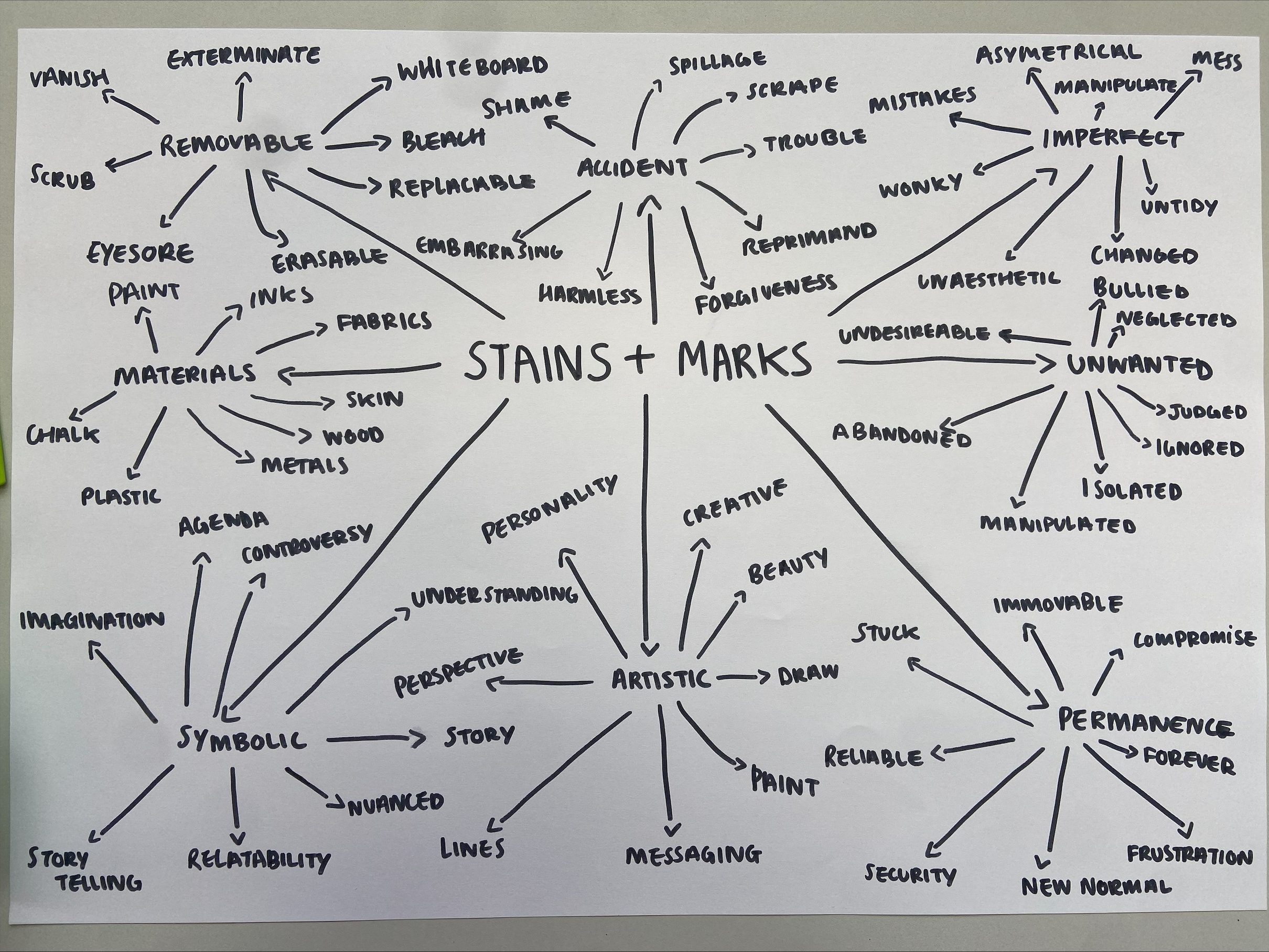
I decided to start off my research into stains and marks by getting a closer look at my mind map. There are 8 sections:
- Removable
- Accident
- Imperfect
- Permanence
- Artistic
- Symbolic
- Materials
I think I will guide my research by looking into each of these things with stains and marks as the context. For example:
For removable, I would look into stain removers, or white boards. Instances where stains and marks can be removed.
For symbolic, I would look into instances where stains or marks have been used as symbolism for something – usually bad things.
If I find anything else to research then I will go down the rabbit hole, but for now I feel like these are good places to start.
Removable
Stain removal:
“There are two basic approaches to removing spots and stains. You can use a chemical stain-removal agent , or you can physically remove the stain from the surface. Many stains require both chemical and physical treatment. In this chapter, we discuss eight physical stain-removal techniques: brushing, flushing, freezing, pre-soaking, pre-treating, scraping, sponging, and tamping.
Which technique to use depends upon both the nature of the stain and the type of surface stained. For example, a stain may be wet or dry, semisolid or hardened. Don’t scrape or tamp on a delicate surface. A stain may be flushed more easily from a loosely woven fabric than from one that is tightly woven; but a tightly woven fabric can withstand a treatment such as tamping more successfully.
Whenever you use absorbent pads (when you flush or sponge a stain) you should change the pad as soon as any of the stain is deposited. This will prevent reapplication of the stain to the treated article. Remember, too, that to avoid fabric damage you should never apply heavy pressure when using techniques such as brushing, tamping, or scraping.“
Scar removal:
“Medical treatments, like laser therapy or topical ointments, may help reduce the appearance of scars, depending on the type. Natural remedies, including aloe vera, may help.
Treating an older scar can depend on its type and appearance. For example, treatments to flatten raised scars likely won’t help pitted scars. The most effective treatment can also depend on your skin color.
Scars form as part of the natural healing process following an injury. When the dermis (the second layer of skin) is damaged, your body forms collagen fibres to repair the damage, resulting in a scar.
The severity of a scar often depends on the severity of the injury or damage. Scars form differently on different parts of the body and based on the age of the injured person.
Methods of scar removal:
- Silicone gels or sheets
- Steroids
- Laser therapy
- Dermal fillers
- Chemical peels
- Subcision
- Punch excision
- Micro needling
- Medicated creams
- Over-the-counter creams
- Aloe vera
- Vitamin E
- Honey
- Coconut oil
- Apple cider vinegar
- Lavender essential oil
- Lemon
- Potato?
- Rosehip and Frankincense”
Documentation:
One of the earliest recorded artworks, dating all the way back to 39,000 BC was found in the cave of El Castillo in Spain, amongst paintings of horses, bison, goats, deer and mammoths, as well as some rare images of dogs, and hand prints. These cave paintings depict one of humanity’s first known explorations into creation and documentation. From just a painting, scientists were able to figure out when each piece was created, the methods used to create them and even discover that the majority of the hands in the paintings belonged to women.
When we think of stains and marks, we might think of something unsightly, or something to get rid of. Like a spillage or a scratch. But if we think back through human history, stains and marks have defined who we are as a species. We use them to create beautiful artworks to decorate our homes, clothes and bodies, to document important events, transactions, successes and failures, to write stories, communicate and record knowledge for future generations, the list goes on. I’m interested in exploring the history of mark making and how it evolved into the pillars of human knowledge and culture, as well as how we can view something seemingly insignificant, in a different light.
References:
AncientHistoryLists. (2019). Top 10 Oldest Art Ever Discovered. [online] Available at: https://www.ancienthistorylists.com/pre-history/top-10-oldest-art-ever-discovered/.
artst (2023). Art History Timeline – Artst. [online] Artst. Available at: https://www.artst.org/art-history-timeline/.
Corbett, R. (2014). A journey deep inside Spain’s temple of cave art. [online] Bbc.co.uk. Available at: https://www.bbc.co.uk/travel/article/20141027-a-journey-deep-inside-spains-temple-of-cave-art.
Frothingham, S. (2018). How to Get Rid of Old Scars: Top 10 Remedies. [online] Healthline. Available at: https://www.healthline.com/health/how-to-get-rid-of-old-scars.
Google Arts & Culture. (n.d.). Why Did Prehistoric People Draw in the Caves? [online] Available at: https://artsandculture.google.com/story/why-did-prehistoric-people-draw-in-the-caves-grotte-chauvet/TwVhKr1gnrB2LQ?hl=en.
http://consumerguide.com (2006). Stain Removal Techniques. [online] HowStuffWorks. Available at: https://home.howstuffworks.com/stain-removal-techniques-ga.htm.
Phoenix-studios.co. (2025). phoenix-studios.co/news. [online] Available at: https://www.phoenix-studios.co/news/making-our-mark [Accessed 11 Jan. 2026].
Sriram Gopalaratnam (2025). The history of documentation. [online] Substack.com. Available at: https://lifeandtech.substack.com/p/the-history-of-documentation [Accessed 11 Jan. 2026].
Staff, S. (2024). Different Types of Scratches on Cars and How to Fix Them. [online] Synchrony.com. Available at: https://www.synchrony.com/blog/automotive/different-types-of-scratches-on-cars-and-how-to-fix-them.html [Accessed 11 Jan. 2026].
The Science Desk (2025). Prehistoric Cave Paintings: Messages from Our Ancestors. [online] Science News Today. Available at: https://www.sciencenewstoday.org/prehistoric-cave-paintings-messages-from-our-ancestors.
Visual-arts-cork.com. (2012). El Castillo Cave Paintings: Red Ochre Disks, Hand Stencils. [online] Available at: http://www.visual-arts-cork.com/prehistoric/castillo-cave-paintings.htm.
Wikipedia. (2021). Cave of El Castillo. [online] Available at: https://en.wikipedia.org/wiki/Cave_of_El_Castillo.
Reply