⋅─⊱✧✧✧⊰─⋅
Essential Experience:
My essential experience is challenge without stress or distraction. I want to highlight the games sensory experience for players using beautifully simple game art, subtle environmental sounds, fluctuating difficulty levels, adjustable accessibility settings, and intuitive puzzles with multiple solutions. The game should feel like a form of art, each level should be visually pleasing and screenshot worthy. Players should be able to play in whatever time they have, and not need to dedicate time for play. They can progress at their own pace and enjoy simplified gameplay, with no long menus to navigate and no complex controls to learn. The game should make players feel fulfilled, using (adjustable) haptics and sound when interacting with objects, collecting items, or finishing levels. Puzzles should never have one solution, players shouldn’t feel frustrated when a creative solution isn’t rewarded. Game progression from dark to light will help players to feel a sense of accomplishment, and the addition of colours and light in the end scene will make reaching the end feel satisfactory and worth while. Attentive players are rewarded with snippets of environmental storytelling, but are given the freedom to create their own narratives. To summarise, Torchlight is a game designed for people who feel like games aren’t made for them.
Essential Elements:
- No long menus (quick start)
- Minimal controls
- Puzzles with multiple solutions
- Haptics and sound to create sense of accomplishment
- Subtle environmental storytelling
- Game world progression
- Satisfying ending
- Diegetic sound
- Adjustable settings
- Fluctuating difficulty levels
- Simple but beautiful, glowing game world
⋅─⊱✧✧✧⊰─⋅
Target Audience:
To determine my target audience, I first looked into the sort of people who play games like Torchlight.
Who uses mobile for gaming? Mobile is currently the most popular gaming platform claiming 78% of all gamers. Its main player base consists of Gen Z (14-29 year olds) and Gen X (46-61 year olds), however, 52% of Gen X’ers list mobile as their primary gaming platform, compared to just 29% of Gen Z’ers.
Rees, L. (2023). 78% of gamers play on mobile, with 44% considering it their primary device.
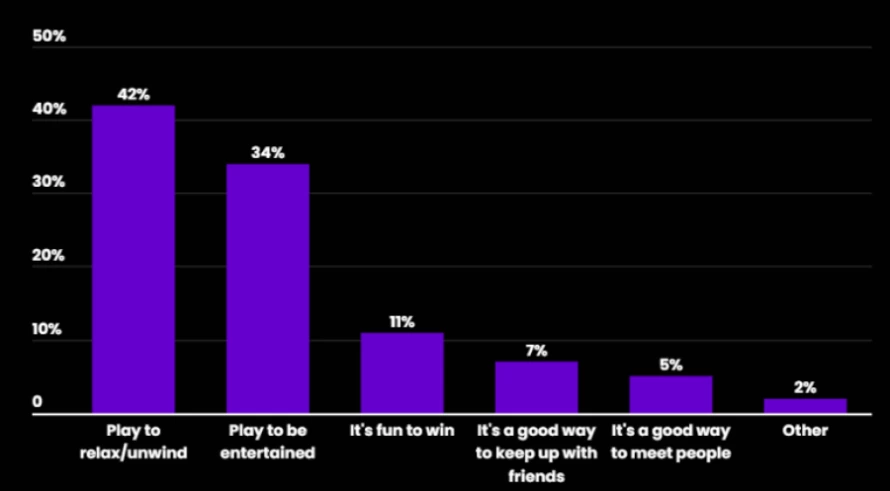
Why do people choose to play? The most popular primary motivation is to relax and unwind, however this motivation is more common amongst the older generations, with 51% of baby boomers claiming this as their primary goal. Younger gamers tend to prefer more competitive and social gaming.
Rees, L. (2023). 78% of gamers play on mobile, with 44% considering it their primary device.
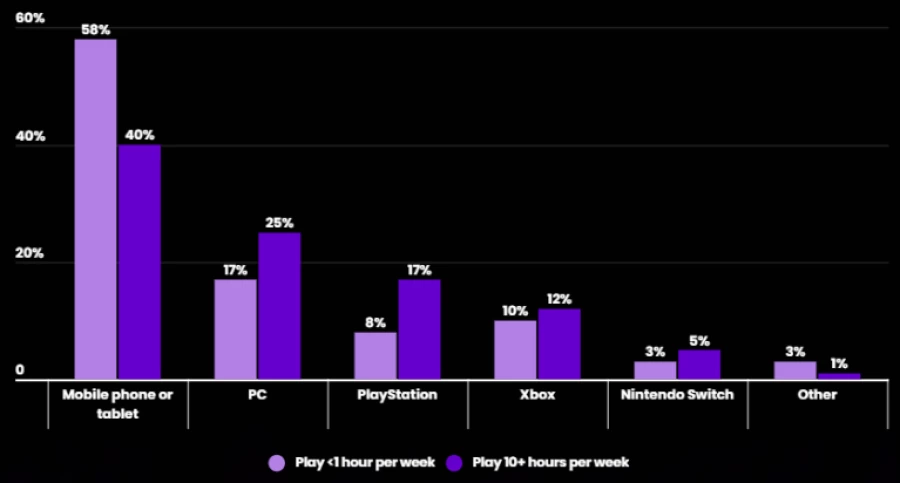
How do people spend their time? With 58% of its players spending less than an hour per week gaming, mobile attracts many more causal gamers than other platforms. People who play on other platforms tend to be willing to devote more time to gaming, whereas most mobile gamers probably don’t have this free time to spare, or the motivation to do so. Data suggests that what makes mobile gaming so popular is its accessibility and broad appeal.
Belfiore, F. (2025). Mobile Gamers Demographics: Data by Gender, Age and GEO.
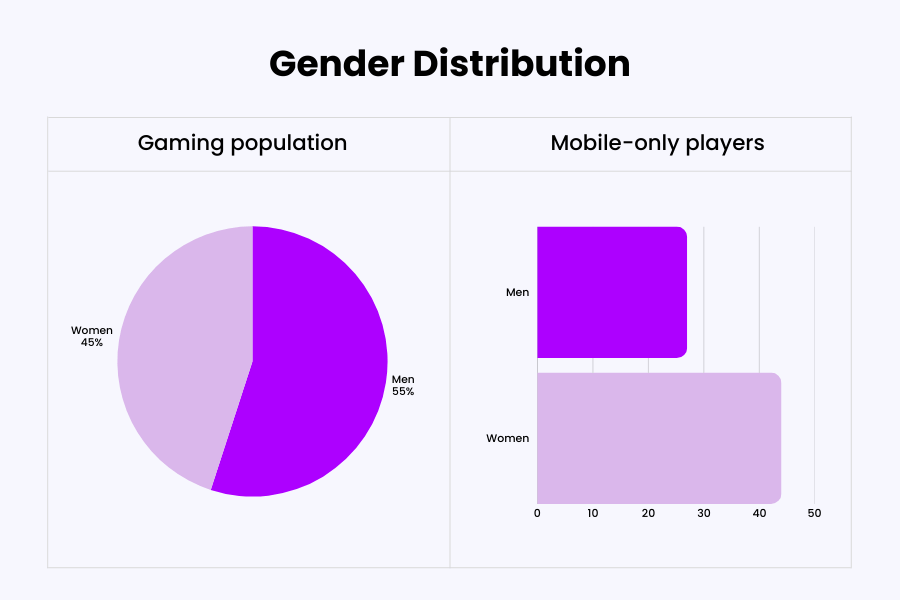
What is the mobile player gender distribution? While the worlds player base is nearly evenly split between men and women, 44% of all women who game play exclusively on mobile, compared to just 27% of all male players. 44% of female players also identify as casual gamers compared to 28% of male players.
What is player spending like in the mobile industry? Mobile players spend the least on games compared to all other sectors, with 71% choosing free-to-play games. As everyone owns a smartphone, gaming is more accessible for all regardless of income. Mobile gamers are likely less willing to invest in expensive games, as they haven’t gone out of their way to invest in a console or PC to play on.
What genres do people enjoy? Female gamers and older generations have a preference for puzzle games, with the genre receiving the most downloads in every country. Male gamers and younger generations prefer fast paced action games, and players between these age ranges usually prefer a bit of both genres.
Sundararajan, A. (2022). The Evolution of Video Game Culture.
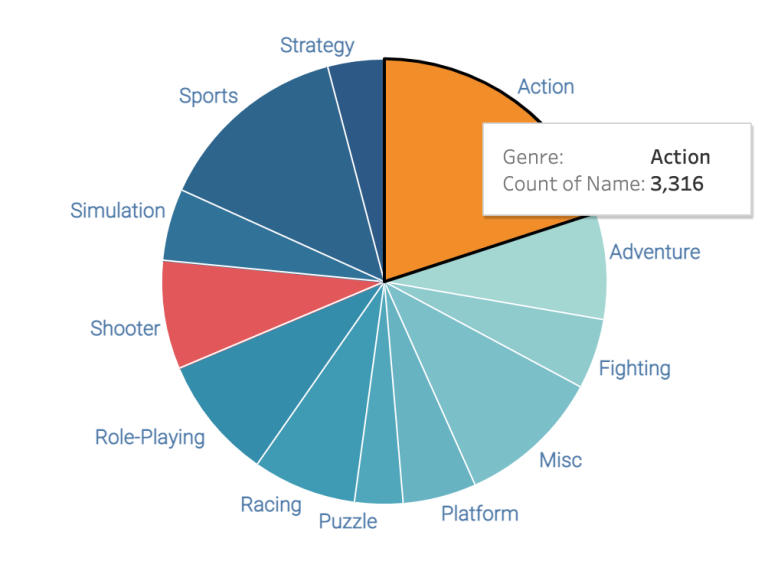
Genre with most saturated market? Over the decades since video games were first invented, the genre with the most releases action, making up almost 20% of all titles. The puzzle and platform genres have seen much fewer releases, however this is likely due to many action games including puzzle and platform features within them, meaning there are fewer stand alone games in those genres.
Market Summary:
This summary represents my predicted player base, based on my research on the mobile platform and puzzle genre.
| Age range | Mostly Gen X’ers (46-61), with some Gen Z’ers and baby boomers. |
| Player commitment | Casual players, less likely to spend money. |
| Gender distribution | More female players. |
As I said before, Torchlight is a game designed for people who feel like games aren’t made for them. Older or casual players may often feel as though games controls and menus are too complex to navigate, or feel as though games aren’t often marketed to them. They may feel as though games aren’t something they can get involved with as the market is always pushing fast passed action to younger generations. It is also important to me that people who are disabled or have extra accessibility needs feel as though they can engage with a game without limitations, and without feeling like it wasn’t designed for them. Casual players might not even view themselves as gamers, only playing to relieve stress or to pass time. Hopefully by introducing them to a game catered to their interests and lifestyle that also exhibits unique puzzles and with eye-catching aesthetics, they may be more open to trying games outside their comfort zone.
My Target Audience:
- Older players
- Casual players
- Players with extra accessibility needs
⋅─⊱✧✧✧⊰─⋅
Competitors:
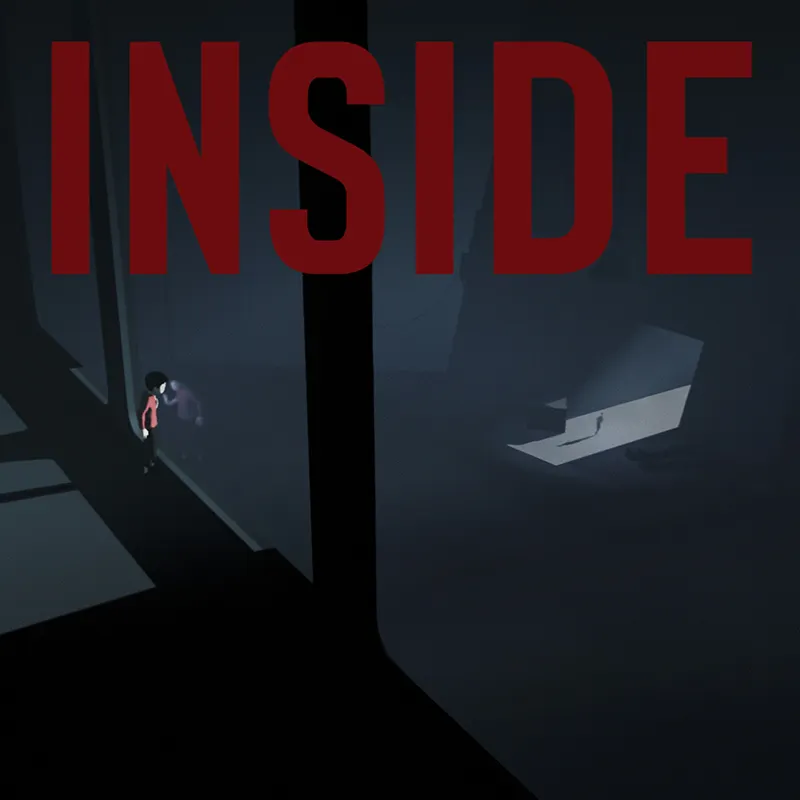
INSIDE:
Summary: Play as a boy in a dystopian world and discover the secrets of a dark project, while facing challenging puzzles and escaping enemies. Published by Playdead in 2016, INSIDE has received critical acclaim for its moody art style, ambient sound design, and unsettling atmosphere. I played INSIDE a long while ago and really enjoyed it, but interestingly enough it was my mum who introduced it to me. It was really interesting to see my mum actually enjoying something that seemed like a real and serious game, as she was mostly just interested in candy crush at the time. This inspired me to recreate this experience for other people like my mum in my current project.
Gameplay: To progress and complete puzzles, the player character can walk, run, swim, climb, and use objects to overcome obstacles. They also gain the ability to control bodies to complete certain puzzles, which highlights the games focus on horror.
Aesthetics: The games visual style is simple but gloomy, which is heightened by the striking horror elements incorporated throughout gameplay. Its polished look distinguishes it from other games of the genre, almost guaranteeing good quality and serious gameplay to the audience.
INSIDE offers casual mobile players a taste of something new, a polished, narrative-driven puzzle game with simple controls. However it may lose players due to its focus on horror aesthetics and its intense chase sequences, which definitely aren’t for everyone. The main puzzle mechanics themselves also don’t add much new to the genre, but still suit the game and make it easy to play. INSIDE has inspired me to make my game look polished, but also not feel too intimidating for new players, while offering a unique collection of puzzle types.
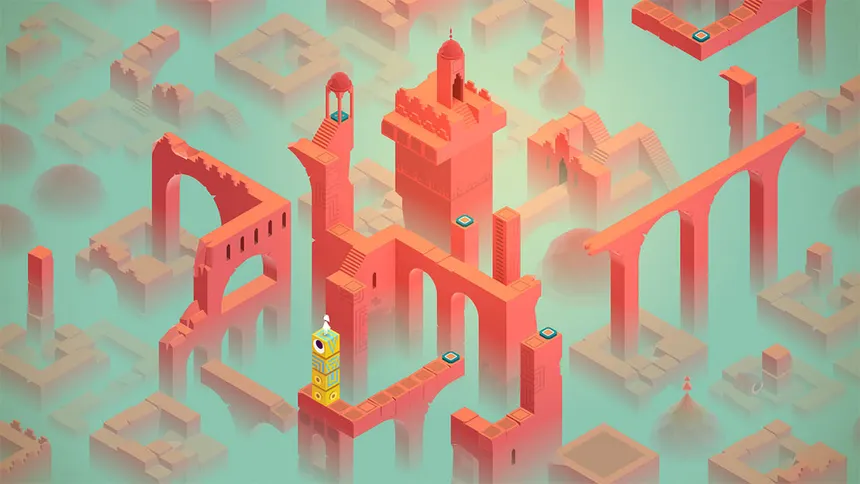
Monument Valley:
Summary: Play as Princess Ida and make your way through mazes of optical illusions by manipulating the world around you. Monument Valley was developed by Ustwo Games in 2013, the gameplay and style based on concept drawings by Ken Wong. It received positive reviews on its art and sound design, however many critics noted that the game lacked difficulty and was very short. We were recently visited by Megan, an alumni from WSA who is now working on Monument Valley 3. She shared how they now design the games difficulty to fluctuate throughout, rather than steadily increasing in challenge. This allows players to enjoy moments of increased challenge, and moments of downtime, creating enough challenge without players becoming fatigued by it. This inspired my level design and level difficulties for Torchlight.
Gameplay: Move platforms and pillars and create bridges to form a path for Ida to progress. Cues are provided through colour and NPC’s who walk around and block pathways.
Aesthetics: Monument Valleys art style was designed for each frame to be worthy of public display, which demonstrates the importance of the game’s eye-catching visual aesthetics. It uses a simple style with pastels and bright, complementary colour pallets. Its style was inspired by minimalist sculpture, Japanese prints and other indie games.
Monument Valley brings art to life and offers a unique gameplay experience. Players can experience a world focussed on beauty over function, with fluctuating level difficulty to ensure gameplay stays fun. However, as Monument Valley’s gameplay focusses solely on moving platforms to create new paths, the level design needs to feel unique and creative and the limited gameplay mechanics could hinder this. Monument Valley has taught me the importance of aesthetics, how to keep players engaged, and the importance of variation in puzzle types.
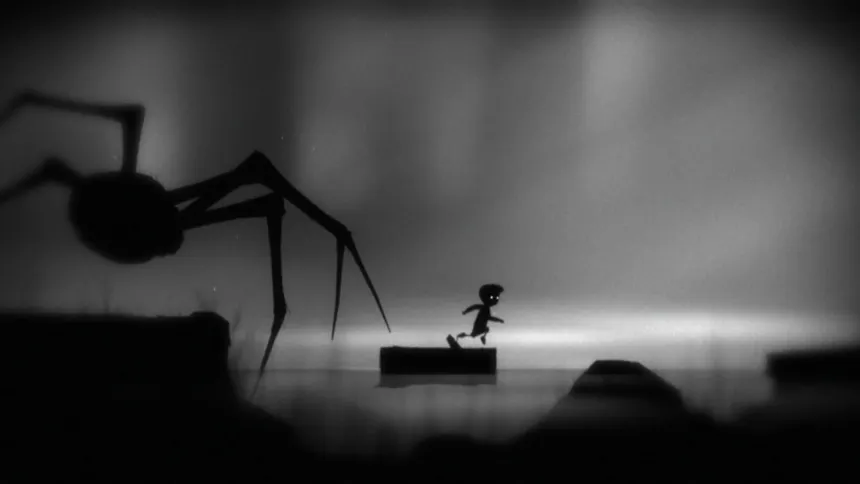
Limbo:
Summary: Avoid traps and monsters as you guide a tiny boy through murky environments as he searches for his sister. Limbo is a 2D side-scroller developed by Playdead in 2010, and has received critical acclaim for its aesthetics, however some criticised that it lacked plot and real meaning. Despite this, many still think the minimal story and its length suit the game, with some listing it as one of the greatest games of all time. I think too much exposition in simple and eerie games like Limbo would take away from its charm and aesthetic focussed experience, which is why I have chosen a minimal story and zero dialogue for my game.
Gameplay: Limbo incorporates a physics system that governs environmental objects and the player character. The game’s puzzles were built intending for the player to fail before finding the correct solution. Playdead called the style of play “trial and death” using gruesome imagery to steer the player from unworkable solutions. As for the general puzzle solving mechanics, the player can run, jump, climb and push or pull objects. The second half features mechanical puzzles and traps using machinery, electromagnets, and gravity.
Aesthetics: Limbo uses lighting, film grain, monochromatic tones and ambient sounds to create its bleak atmosphere, solidifying it within the horror genre. It has been compared to film noir and German Expressionism, which were also influences for Torchlight. The darkness is used to conceal traps and monsters, playing into the human fear of the dark. Due to its aesthetic focus, Limbo has been classed as an example of video games as an art form.
Limbo allows players to explore art as a game, and provides them with minimal exposition to enhance its aesthetics and experience. Its dedicated focus to the game style has solidified it in the minds of many players years down the line and given it a timeless look. However, Limbo’s use of trial and death puzzles could be off-putting to some players who might get frustrated with the harsh design and constant failure. Some players may also feel barred from enjoying a more serious game like Limbo, due to its dark themes and horror focus. Limbo has inspired my aesthetic focused game world and the power of minimal exposition in storytelling. I have also learnt to consider that a lack of horror elements in my game might make it more accessible for a wider range of players, especially children.
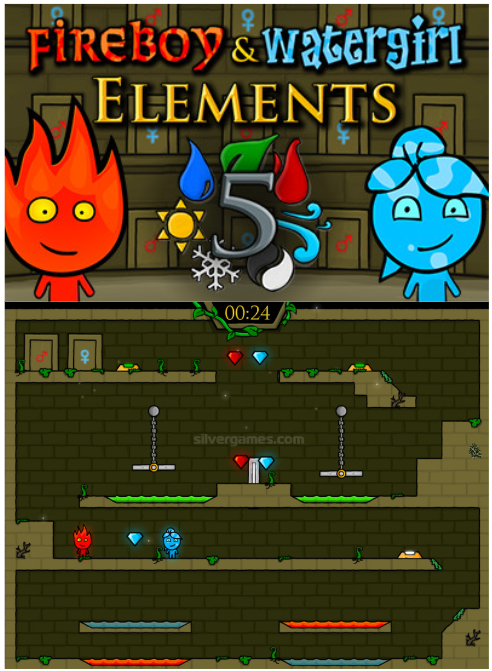
Fire boy and water girl:
Summary: Play with a friend or alone and navigate Fire boy and Water girl through the rooms of a temple, solving element based puzzles and parkour challenges while collecting jewels to progress. Fire boy and Water girl was one of the first games I looked into as it heavily related to my research on dualism for my game Torchlight. The game is inspired by the philosophy of Ying and Yang, where both characters are opposite, but rely on one another to progress. This concept is prevalent in my game, where the shadow can only exist within the light. I also took inspiration from Fire boy and Water girl in my mechanic of collecting embers to progress, as it creates an added level of challenge that I felt was missing from my game. Today, the game is very well known to serious and casual players alike, despite first being released in 2009.
Gameplay: The series emphasizes teamwork and strategic character control, Fire boy and Water girl can be played with two people, or alone for an extra challenge. Players must navigate intricate levels while using the unique abilities of both characters, and avoid mixing elements. Movement is simple, only requiring the player to run and jump, using the characters body to hold down buttons, flip switches or weigh down platforms. Players can only advance to the next level by collecting jewels, and they must be the correct type (fire or water) to be collected by the character.
Aesthetics: The games environment fits the style of Fire boy and Water girl, the simple but identifiable temple design reminding players of the ancient history of elements. The simple style makes assets easily reusable, and its cartoonish look helps newer players feel more open to trying it out, where more polished games might seem beyond their ability. Despite this, the visual style definitely serves function over beauty.
Fire boy and Water girl is a classic and has mastered the basics of the puzzle-platformer genre, offering a variety of puzzle designs, and various new mechanics within its sequels. However, it lacks narrative, polished visual style and explores simple puzzle features. Players may view it fondly, but will likely want to expand their horizons with games that offer something new. Fire boy and Water girl has been essential to the design of Torchlight, but it has reminded me of the importance of strong visual style while maintaining its function. I am also keen to expand on the genre with puzzles that play into existing mechanics while offering something fresh.
What does Torchlight bring to the table?
Torchlight offers puzzle-platformer enjoyers what they love, while aiming to create a unique player experience. It offers a polished, visually striking style without feeling off-putting to newer players by replacing darker/serious elements with a light hearted and inviting game world. It creates challenge without punishment, pushing players while being forgiving when things go wrong, with easy level resets and fluctuation between difficulty levels. It expands upon basic puzzle mechanics, offering different variations (moving objects, interacting with light) and combinations, creating endless puzzle possibilities. The ease of gameplay and accessibility accommodations opens up opportunity for more players to participate. The focus of games as an art form will hopefully inspire casual players to view games in a more serious light, and expand their horizons to other games and genres.
⋅─⊱✧✧✧⊰─⋅
Next post:
Return to section:
⋅─⊱✧✧✧⊰─⋅
Reply