Overview
Game Title:
The Fool’s Journey (working title)
Genre:
Point-and-click, puzzle, adventure game
Project Roles:
Since I am solo-developing my game, I am in charge of the art, programming, design, and sound.
My Goals:
Project Goals:
I want my game to be an accessible form of learning about or being introduced to some of the concepts within tarot. Throughout my blog, I’ve noted that potential players and audiences can be put off from playing a game about a topic they know nothing about or have misconceptions about. I want to utilise the visuals and interactions with characters in my game to get across the symbolism and meanings of the cards, rather than players being explicitly told. Players should still be able to enjoy the game regardless of whether they understand the tarot concepts, as the cards themselves are only collectables.
Personal Goals:
This project would be the first time I solo-develop a game. Going into this, I had no prior experience in the other disciplines that go into making a game. Being able to push through to the end with a finished, objectively good game would help me strengthen my technical and soft skills, have a strong project in my portfolio, and make any future contributions to a team more valuable. My main goal is to learn/improve my programming skills in Unity and other industry-standard software, as well as to build confidence in working independently.
Abstract:
While planning my game, I knew it was going to need a strong and compelling storyline as well as detailed game components, which I had to be prepared for. With all the different archetypes in the cards, there was potential to create a whole world for these characters, which I knew audiences would also be interested in, based on feedback from one of my presentations. One of my strengths is 2D art, which is a major part of the game, so I felt I would be able to deliver on this.
Your Hook:
You play as The Fool through phase 1 of The Fool’s Journey. They begin their story with nothing but curiosity and unwavering potential, falling off a cliff into a new world. The Fool wakes with no memory of a name, place, or community, and so begins their path to self-discovery. During their journey to enlightenment, they meet 7 different archetypes, each with its own lessons.
Story Overview:
Point-and-click adventure game focused on puzzle-solving and exploration. You play as The Fool, the first card in the Major Arcana, assigned the number zero. After falling off a cliff and waking in an unfamiliar world with no memory of your past, you find companionship in a dog and set out to discover who you are and where you belong. You meet several different characters, but none of them can give you the answers you’re looking for. Instead, each of them has a puzzle or lesson, bestowing you with an item once these are completed that will aid you in your journey.
The Appeal:
For players who are interested in:
- Surreal, dream-like worlds
- Branching narratives
- Tarot-inspired stories and characters
User Experience
Core Gameplay Loop:
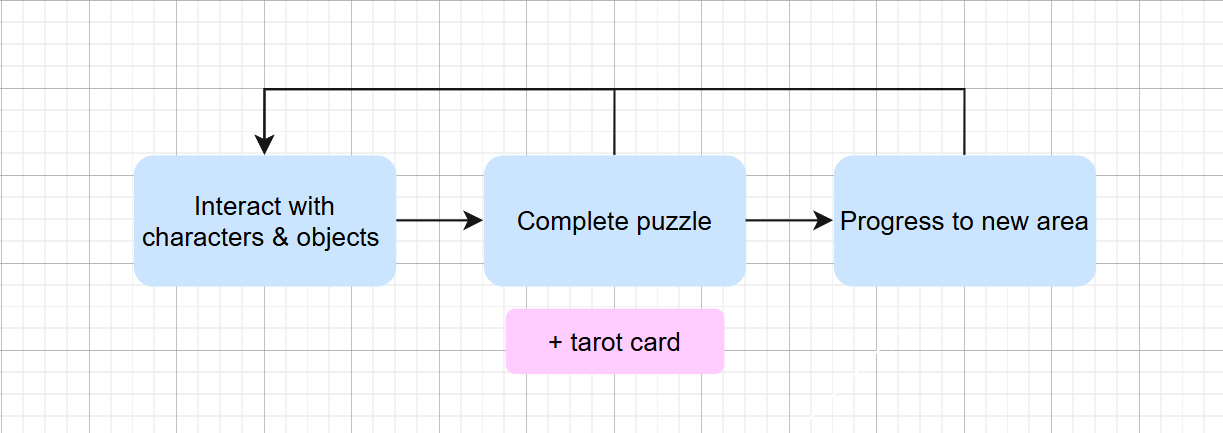
The Mechanics:
- Puzzle-solving & minigames – Puzzles are unique to each character/environment
- Exploring– Interact with items in the environment
- Collecting – After completing a puzzle, you gain a tarot card
- Dialogue – Interact with each character
The Essential Experience:
The player should feel engaged and compelled to play the puzzles, even if some of them are intentionally open-ended or vague. It’s an unfamiliar and fantastical world that is vast and uncertain, but gives players a feeling akin to childlike wonder. Although the inspiration for my game is tarot, the story is far enough removed that players who are not familiar with tarot don’t feel alienated from the themes. My game is based heavily on environmental storytelling and interactions with characters, so players are able to understand the concepts of tarot but in a more accessible form. With so many questions, players purposefully venture through the world in the hopes of finding the one person who may have the answers. They obtain tarot cards that, supposedly, once all are collected, are the key to what they’re searching for.
Levels/Puzzles:
Secondary puzzles will be played depending on the choice the player makes – only one can be played. See more in Narrative & Levels.
| Puzzle Type | Description | Example |
| Hidden object/exploration | Player searches an environment to find a required item, often with subtle visual or contextual clues | Finding a hidden tarot card in a room |
| Inventory | Player collects items from the environment and combines them to solve a problem | Building/patching up a boat to progress to the next area |
| Open-ended/narrative | Player observes/examines an image to reflect on its meaning | Examine an abstract image |
| Environmental/exploration | Player uses items in the environment or inventory to solve a problem | Feed and tame a wild horse |
| Minigame (Secondary) | Player moves left/right to avoid obstacles | Dodging rocks in a boat |
| Minigame (Secondary) | QTEs | Climb the mountain side |
| Spatial/tile-sliding | Player moves tiles to align image | Fix a mismatched picture |
| Riddle | Players read and answer a riddle | Use the riddle’s answer to change the environment and go through the correct gate |
Win/Fail State:
Win State:
- Completing a puzzle (and gaining a tarot card) to progress to the next area
Fail State:
- Being unable to complete a puzzle, however, the player will have to keep redoing it until they complete it to progress. (By the end of the game, the player will have all the tarot cards)
- Minigames: Too many missed QTEs or collisions means a fail, and restarting the minigame
Controls:
Input: Mouse and Keyboard
Movement: AD or arrow keys
Interact: E/spacebar or Left mouse click
Dialogue/choices: WASD or Left mouse click
Market Research
Target Audience:
- PEGI 12: Contains mildly frightening scenes and violence.
Although the more suitable rating on paper would be PEGI 7, the subject matter and existing audience for games with these themes and genres are slightly older. - For those completely unfamiliar with tarot, to people more knowledgeable, as it is a more accessible avenue into understanding the concepts of the Fool’s journey and the first phase of the Major Arcana.
- Players interested in fantasy worlds and scenarios far removed from reality.
- Players who delight in completing puzzles
Competitors:
Title: Fran Bow
Genre: Point-and-click, puzzle, horror, adventure game
Steam reviews: Overwhelmingly positive
“Fran Bow is a creepy adventure game that tells the story of Fran, a young girl struggling with a mental disorder and an unfair destiny.”
Gameplay: Puzzle-solving, exploration, narrative-driven
After researching other games and forms of media, I found that Fran Bow would likely be my main competitor as it is puzzle-oriented, narrative-driven, and has whimsical visuals. Players seem to be drawn in by the “creepy vibes” as well as the beautiful visuals. Many players who enjoyed the game also had a soft spot for similar games: Sally Face, Little Misfortune, Alice: Madness Returns, etc. These games all feature a psychological horror aspect, which seems to be a very popular choice for point-and-click games. Fran Bow manages to blend darker themes with emotional scenes and a whimsical art style through a compelling plotline, characters, and atmosphere (Mr. Midnight, Fran’s cat, was a popular character – animal companions always seem to do quite well).
Some voiced that minigames and puzzles could sometimes be quite frustrating or confusing, which would take away from the enjoyment. Either because they didn’t have much experience with puzzle games or because of the level of difficulty. Also, in many of the reviews, players would have preferred voice acting.
Fran Bow and other games with a psychological horror or creepy element did quite well, so I considered adding more creepy elements to my game. The visuals in my game were set to be whimsical yet a little uncanny, but possibly adding characters such as shadow-selves (a concept in tarot that refers to our bad habits and mindsets) in the environment could add a layer to the world-building. Furthermore, Fran Bow‘s first release in 2015 was only on PC, but later releases have been on mobile as well as console. Other point-and-click games are also available on multiple platforms, which increases accessibility and community, so I may consider being able to play the game on a console.
Critical Analysis:
To write a narrative and create characters, first, I had to understand the fundamentals of tarot decks as well as the archetypes within the cards. My game is heavily inspired by the Fool’s journey, which is shown through the first 22 cards of the deck: the Major Arcana. the cards are split into 3 groups of 7, with the Fool card being the protagonist. Rather than making a game with all the archetypes of the 22 cards, I decided to focus my game on the first phase, known as the self, personal awareness, or conscious.
Content
Components:
- Finished Unity game (Point-and-click, puzzle, adventure game)
- Promotional material (e.g. posters)
Functional Specs:
- Unity
- Trello
- Procreate
- Photoshop/Krita
Project Structure:
Since I was solo-developing my game, which meant I had to do everything myself, I needed an appropriate schedule that would keep me motivated and prevent overwhelm and burnout. The Agile methodology seemed to be the most suitable as it works if:
- Your project is liable to change.
- You’re not sure at the outset what the solution will look like.
- You need to work quickly, and it’s more important that you see speedy progress than perfect results.
It focuses on small, testable features and frequently playable builds.
Schedule:
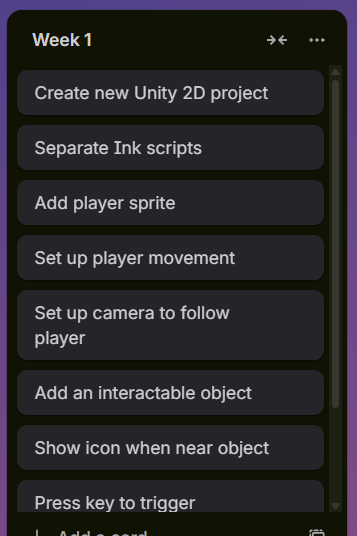
This is an example of a week for the foundation of my game. I’d be experimenting with the Inky tutorials for integrating into Unity first. This schedule assumes I work around 5 days a week for at least 3-6 hours a day, which seems feasible and gives plenty of time to spare.
Dedicating weeks solely to coding, art, or dialogue can result in certain components not working with each other. To combat this, doing a bit of everything, but with one focus, will work more effectively (e.g Coding will be the main focus, with a bit of making the art and writing the dialogue).
Design Appendix
Presentations:
My final presentation that was shown to the music students.
Prototype:
See more in Game Idea 1.
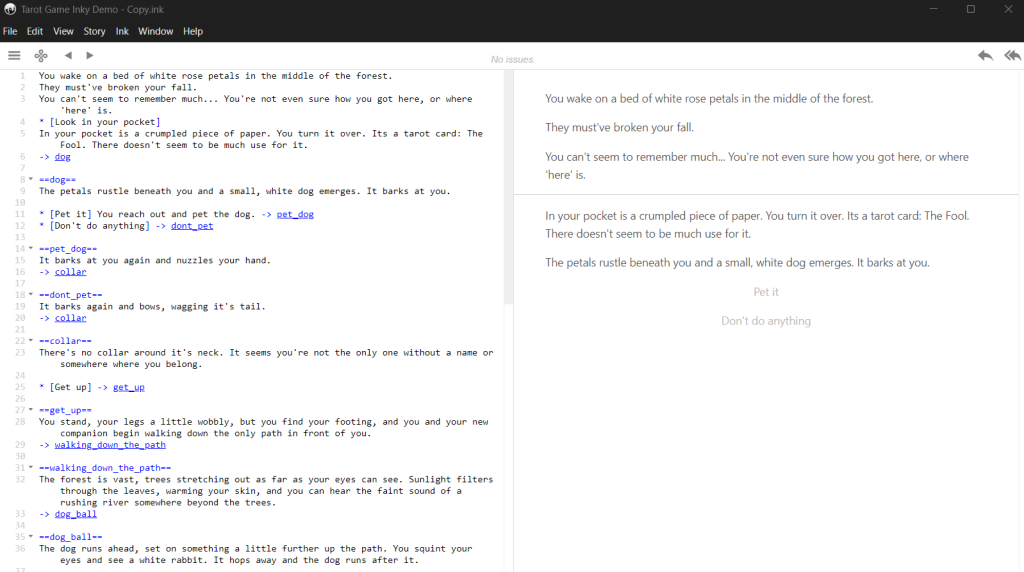
Concepts:
World Design:
See more in Art Direction.
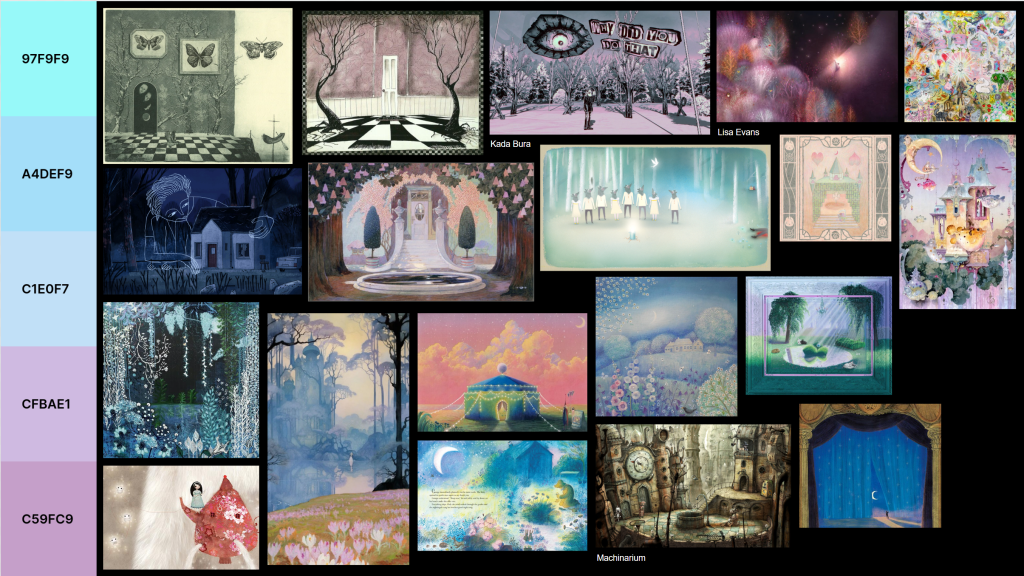
Character Design:
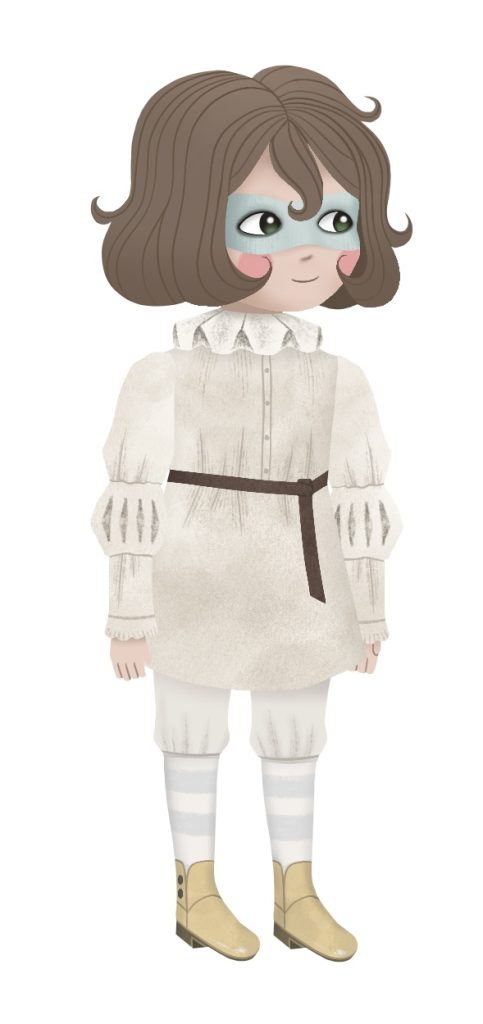
This is an example of the protagonist in the game’s art style. See more in Characters.

Screen Layout:
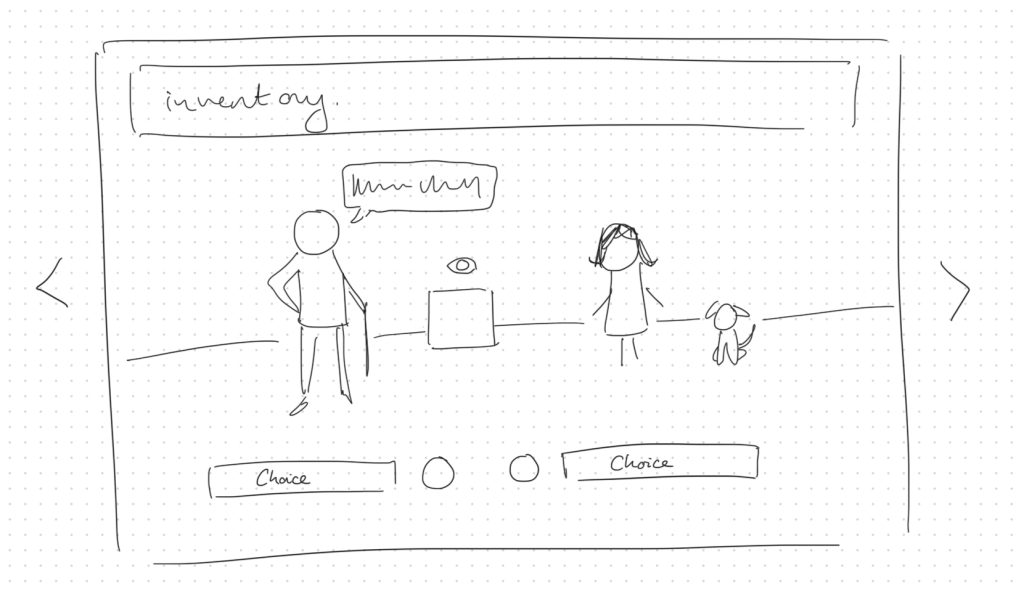
Similar to other point-and-click games, dialogue and choices will be at the bottom of the screen. The inventory will always be accessible, and collected items will automatically be at the top of the screen. An icon will appear over interactable items in the environment when the player goes near.
Music & Sound:
Music:
To match the whimsical and slightly uncanny visuals, I created a playlist for inspiration. Keywords to describe the playlist:
- Ethereal
- Dreamlike
- Ambient
- Melancholic
- Hazy
Since I don’t have much experience with music production software, I may look into using royalty-free music and home recording.
Sound Design:
Ambient sound is also integral to the game as it is used as cues, atmosphere, and realism. Some examples include:
- Water (ocean, river, etc.)
- Footsteps
- Doors
- Birds chirping
Reply