
Project Proposal – SooDuel
Solo project by Xane El Deen Rashad
Project title – SooDuel
Goals
With this game, I hope to increase my proficiency as a game designer, technical artist, artist, and programmer. I want to be much more proficient in Unity and Aseprite by the end of this project. I also want to highlight an interesting aspect of my own culture and portray it in a way that it is often not; with respect and understanding.
Professional Goals
The main role I want to get into after graduation within the games industry is that of a technical artist. Technical art will be integral to this game as it will use procedural movement and will require a very specific aesthetic to be captured. These may be achieved through the use of the Unity engine and knowledge of Aseprite. Utilising different tools and a specific game engine, like Unity, to create a unique art style will develop my skills as a technical artist. Technical artists need to be able to create interesting art beyond just their artistic skills; they need technical knowledge, and this project will force me to develop that and improve my technical art skills overall.
Cultural Goals & Ethical Considerations
Egypt and the Arab world as a whole are often either poorly portrayed or portrayed via very specific lenses. This game will aim to portray Egypt in a more interesting and accurate manner than it often is. As an Egyptian, I have a good understanding of my own nation’s culture. However, I am not the ultimate authority on every aspect of Egyptian culture, which is why I will (and have) conduct extensive research on the aspects I wish to portray before I do so, just in case I have a misunderstanding of a niche part of my nation’s culture, which is always possible. My knowledge of Arabic equips me to consult native sources and not just foreign commentaries on specific cultural practices and the like. I can make this game without fear of engaging in Orientalism.
Abstract
SooDuel is a local multiplayer rhythm fighting game based on the Ancient Egyptian martial art, still practised today, called Tahtib. It is inspired by folkloric Egyptian aesthetics. The aesthetic and the chosen genres will allow me to showcase my artistic and game design skills. It is also a unique idea and combines two genres in an unorthodox way while portraying an overlooked aspect of Arab & Egyptian culture.
The hook of the game is that it is a rhythm fighting game based on an ancient Egyptian martial art.
The anchor of the game is that it is a couch multiplayer rhythm game that incorporates fighting game elements.

Genre
- Rhythm
- Fighting
- Couch Multiplayer
These genres were chosen as they reflect the martial art on which the game is based. Tahtib is performed with music and resembles a duel. It also emphasises camaraderie and community, so making it a multiplayer game, especially a local multiplayer game, keeps SooDuel in the spirit of traditional Tahtib.
Aesthetic
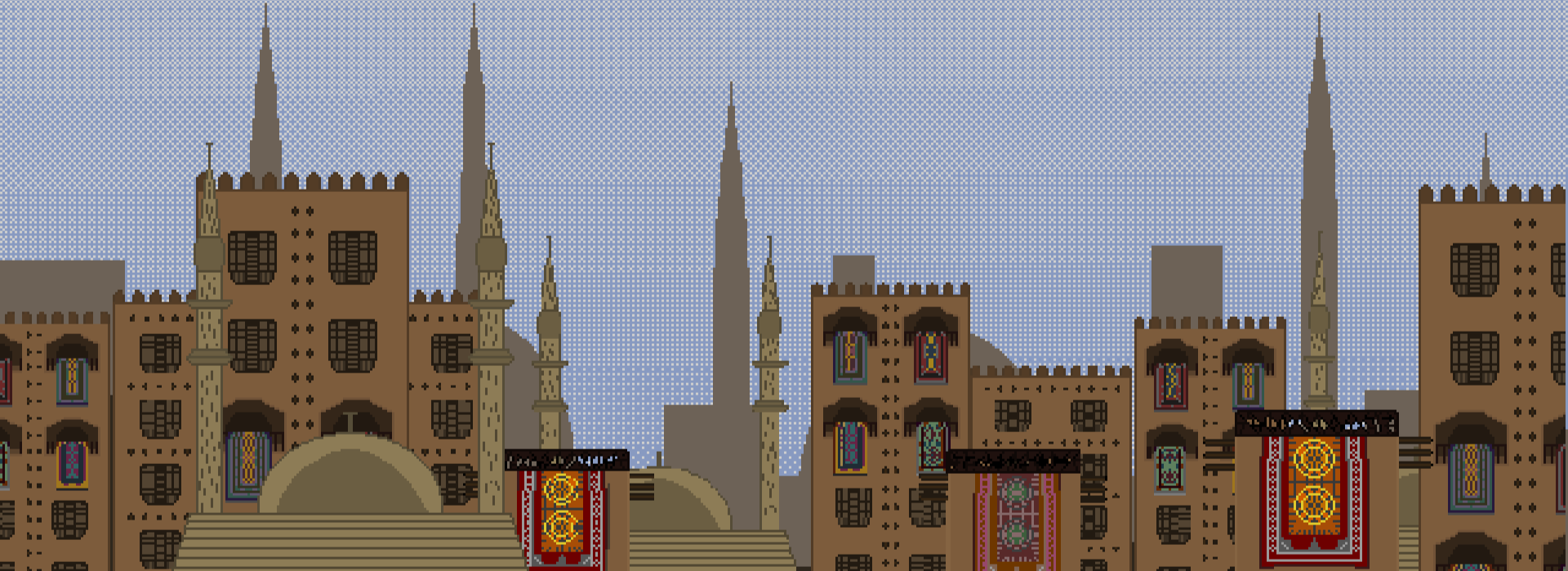
I am using pixel art inspired by traditional art for the aesthetic of this game.

Inspiration
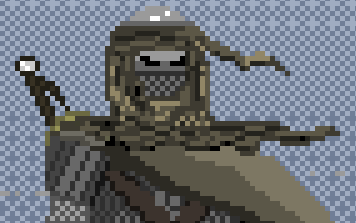
Inspired by Egyptian art, particularly folkloric tapestries and ancient Egyptian wall paintings. This blog post and this blog post showcase the inspirations for the art style and some concept art I made accordingly.
Eras
This game will have different maps and skins depicting different eras of Egyptian history, from the ancient Pharaonic era all the way up to the contemporary Arab Republic era. Accordingly, I am using artistic depictions from each era as a reference for how the characters and settings should look, rather than real-life examples of weapons, clothes, or locations; putting an emphasis on the traditional cultural styles rather than on realism.
Rationale
The reason I am using the pixel art medium is that pixel art is for games what Egyptian art is for the arts as a whole, that being a traditional and somewhat limited style that, despite its simplicity, can render beautiful images. I am also proficient in pixel art (as can be seen here, here, and here), so I believe I can depict the art style and feeling of traditional art well in pixel art. I have experimented with several art styles and ways of recreating traditional styles, which may be accessed (embed link here) here.

User Experience:
Core Gameplay
The game has one screen with two players on it.
There is a bar at the top that depicts the notes of the music playing, specifically the heavy beats, which are moving towards the centre of the bar.
When these heavy beats appear in the top bar, targets appear around the players that the players must then hit before the heavy beats hit the centre of the bar.
Every couple of beats, there is a fight beat that appears in the bar. When the fight beats hit the centre of the bar, the players must either defend or attack.

Win/Fail States
- If a player successfully hits their opponent’s body, they gain a point.
- If they successfully block their opponent, they get a point.
- If a player misses 3 beats, they lose the game.
If neither player hits the other, the game carries on until the next target appears.
Mechanics
- Free movement of the character’s weapon.
- Attack and block stances – Attack stance extends the stick and allows for faster mobility, but makes it so the player will attack on the fight beat. Block stance retracts the stick and creates slower mobility, but will allow the player to guard on the fight beat. These stances may be switched at any moment before and after the fight beat.
- Inputs to hit the rhythm targets
My prototypes show rough examples of how the movement of the player’s weapon would function.
Controls
- The players will use controllers and use the left joystick to move the stick around. They can also use the left and right lower triggers to change their stance, and their upper triggers as inputs for the rhythm beats and the fight beat.
Experience & Fun
Core Experience:
Tense and fast-paced.
The game is all about maintaining rhythm and positioning yourself to be in a more advantageous position compared to your opponent.
The experience of playing the game should be somewhat similar to the experience of playing the martial art it is based on, Tahtib, which is all about respecting your opponent, having fun, and showing off your skill. The game will support each of these three facets through its mechanics and animations that emphasise respect.
Fun:
The fun is in moving the character’s weapon to the rhythm and timing the character’s movement to be able to attack the opponent. The fun comes from the thrill of keeping up the rhythm while putting yourself in an advantageous position for when the time comes to attack each other. The tension felt when preparing to attack or defend and the satisfaction felt from successfully performing either an attack or a deflection, will create a feedback loop that the players will be engaged in. If a player fails, they will have another chance to beat their opponent throughout any given match/session, which will keep them engaged and enjoying the game.
Audience
The audience for this game is people looking for a social game to play with friends and/or family. The age range would be E for everyone, or PEGI 3, as the game (as of now) is not particularly violent, although it may be a bit difficult for younger players; thus, the main target demographic would be teens and young adults. This is the audience that appears to like couch multiplayer games the most, as seen in this study.
I would also try to target a niche subset of Arab and Egyptian gamers, as there are rarely games focused on their cultures, especially ones by members of that culture, such as me. I may do this by adding an Arabic language feature if the time constraints allow me to. Arab and Egyptian gamers may still be inclined to the game just by virtue of its content, even if I do not include an Arabic language feature, as most Arabs are used to games not including such features and are generally bilingual.
Competitors
The main competitors for this game would be other local multiplayer games such as Nidhogg, Bopl Battle, and Stick Fight the Game. These games stand out as they are 2D fighting games with unique mechanics and aesthetics. SooDuel stands out still due to its combination with the rhythm genre and its unique aesthetic, but it would still have to compete with these sorts of titles.
Critical Analysis
Cultural Research
As an Egyptian, I already had much knowledge of the cultural aspect that the game depicts. However, admittedly, I was ignorant of Tahtib and the exact ways it’s played; so I did do extra research, some of which may be accessed here.
Game Design Analysis
I spent a lot of time ideating on this game until I came up with the final concept. I also researched and reflected on couch multiplayer games and on what makes them appealing.
Design Challenges
There are potential challenges for the game’s design as the game has yet to be fully play-tested. Particularly in terms of balancing with regard to how the players win or lose. How many failures for the rhythm aspect should result in a loss? How many successful attacks/deflections should result in a triumph over your opponent? All of these design considerations will be addressed once a few prototypes of the game have been made and it has been play-tested a few times.
Also, the exact way the different stances of the player affect the movement of their stick and how that then affects the way rhythm targets around them is something that still needs work. As well as whether there should be an input for hitting the targets, or if it should just be the player moving the stick into them. These questions and challenges will be answered during the early part of the development.
Content
Components

- Character assets
- Background assets
- UI assets
I have experience creating UI assets, background assets, and character assets in Aseprite. I am especially adept at art, thus I believe I can effectively produce the art assets necessary for this game as a solo developer.
- C# scripts
- Unity game
Last year, I worked on Lament and did a lot of work in the Unity engine as well as some programming. As a result, I am confident I can make a functional game as a solo developer. I will note that I may need to utilise AI models such as ChatGPT to assist me in coding, as I am not the most adept programmer. I will also seek the assistance of Ross when he is available in order to ensure my game’s code is robust and effective.
- Music
This is a facet I may need to outsource, as I have no experience in music production or playing musical instruments. I already know some people from Egypt that I may be able to utilise to outsource the music aspect of the game. I have the resources to be able to adequately afford some music produced for the game, however even still I may still attempt to produce my own music. If I am unable to produce any music of an adequate nature, then I will resort to outsourcing it, but even before I make any attempts, I will already be in communication with these musicians to ensure that they can make the music in the allotted time I will give them.
Platform
The game will be made for PC, though it may require at least one controller and one mouse, unless, during development, different controls can be designed to accommodate one keyboard and mouse.
Project Structure & Scheduling
Below is a rough Gantt chart for the way in which this project’s development will be structured and scheduled. I will start by focusing on mechanics and functionality for the first month before spending more time on other assets. However, even in the first month, I will work on assets, and this is for my own mental endurance, knowing myself, I need to alternate between different aspects of development to maintain a consistent pace, particularly as a solo developer.

This Gantt chart is not completely fixed, but it captures the general structure I would ideally aim for. The essentials of the game come first, so mechanics, functionality, assets, etc. Then the polishing comes afterwards, such as adding UI, bug fixes, etc. Fully editing the documentary would be lower on my priority list, which is why it is the last task on the chart; I have experience in editing and am confident that I could fully edit the documentary in the last few weeks of the development.
Further Links
Art Experimentation:
Character Designs
Photoshop Filters
Ideation:
Game Ideation
Ideation & Presentation
Presentations:
Presentation 1 – Four Topic Proposals
Presentation 2 – Game Proposals
Presentation 3 – Upper Egypt
Presentation 4 – SooDuel Proposal