From Experience to Game Structure
01 — Guest Lecture: Game Design Fundamentals

Guest lecture introducing key principles of game design.
On Monday, we attended a guest lecture focusing on three important aspects of game design: game overviews, game pillars and game loops.
The lecture explained how these elements can help communicate a game concept clearly, establish a consistent design direction and organise the actions players perform throughout the experience.
Key Takeaways
Game Overview
A game overview should communicate the core concept clearly and concisely, focusing on what the player actually does rather than only describing the setting or story.
Game Pillars
Game pillars are the central principles that guide design decisions. They help maintain a consistent vision and determine which ideas or features are most relevant to the game.
Game Loops
Game loops describe the repeated actions that form the player’s experience. These actions should contribute to progression, whether through gameplay systems, resources or narrative development.

Guidelines for communicating a clear and concise game overview.
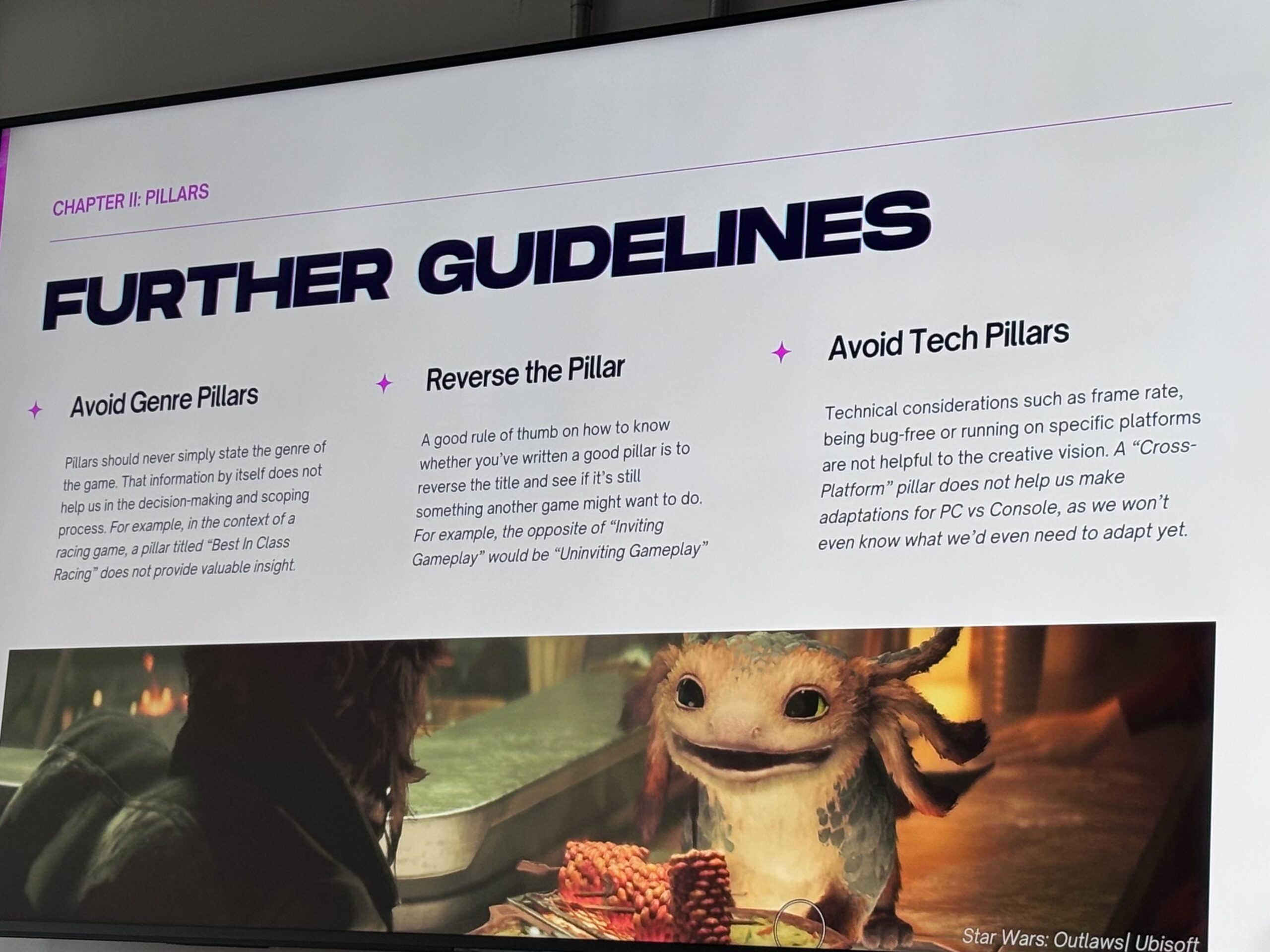
Further guidance on defining meaningful game pillars.
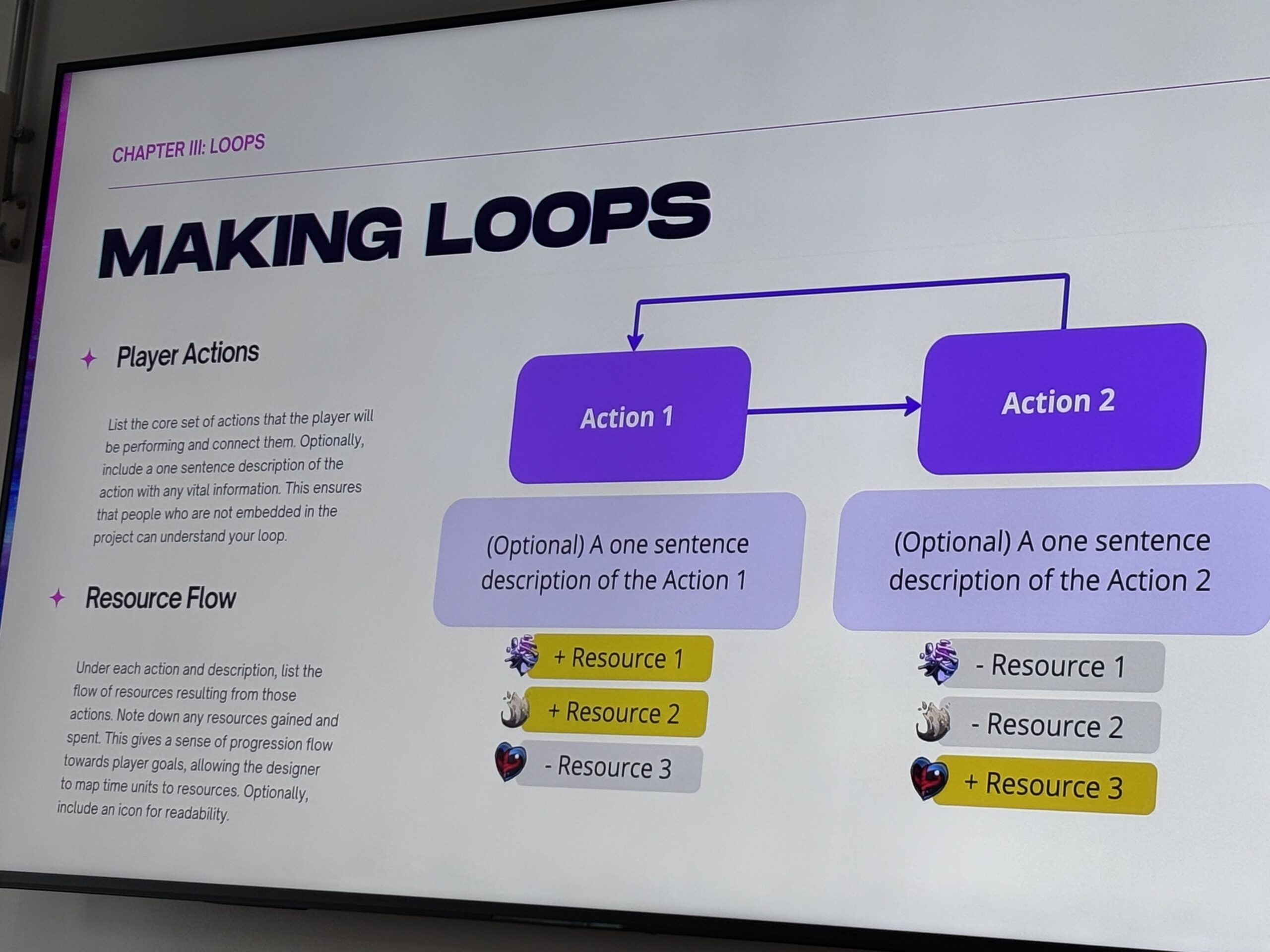
An introduction to structuring player actions into game loops.
Developing My Initial Game Pillars
Following the lecture, we were asked to apply what we had learned by developing a set of initial game pillars for our own projects.
I used this exercise to identify the main experiences I wanted my game to communicate. Building on the previous week’s exploration of everyday routines and unsettling atmosphere, I developed three initial pillars focusing on uncertainty, discovery and the changing emotional meaning of food.

My initial three game pillars, developed during the in-class exercise.
01 — Unease Beneath the Ordinary
This pillar focuses on creating an unsettling atmosphere through familiar routines. Rather than introducing horror immediately, small inconsistencies and unusual details would gradually encourage players to question their surroundings.
02 — Discovery through Service
Everyday tasks such as serving customers, preparing orders and cleaning the restaurant could become opportunities for exploration. This connects the player’s routine responsibilities with the discovery of clues and hidden information.
03 — From Appetite to Apprehension
Food would initially appear comforting and appealing, but gradually become associated with uncertainty and discomfort. This emotional contrast could help reinforce the game’s underlying sense of unease.
Reflection
The lecture helped me understand the importance of defining a game’s core structure before developing too many individual features.
During Week 02, I had mainly focused on the atmosphere, setting and emotional experience I wanted to create. However, I was still uncertain about how these ideas would translate into actual gameplay.
Writing the three initial game pillars helped me identify a clearer direction. I began to see how everyday restaurant tasks could support both the narrative and the unsettling atmosphere, rather than existing as separate gameplay elements.
However, these pillars were still an early draft. I had not yet established a complete game loop or decided exactly how the player’s actions would lead to narrative progression. My next step was to explore how these ideas could be developed into a simple, playable structure.
02 — One-to-One Session: From Planning to Making
On Tuesday, I had a one-to-one tutorial to discuss the progress of my project. At this point, I had mainly completed the research and early concept development from Weeks 01 and 02, but I had not yet started building the game.
Vanissa pointed out that although I had explored the setting, atmosphere and possible narrative elements, the overall game concept was still unclear. I needed to demonstrate more clearly what the player would actually do and how the experience would work.
Choosing a Development Direction
I was still deciding whether to include restaurant management mechanics or focus on a more traditional visual novel.
Vanissa suggested that I could use Ren’Py if I wanted to develop a visual novel. Rather than trying to make every design decision in advance, she encouraged me to start experimenting and see what was possible.
She also reminded me that some things might be easier to achieve than I expected once I actually tried making them.
Key Takeaway
This conversation changed how I approached the project. I realised that continuing to plan without testing anything was not helping me make a decision.
Instead of waiting until I had a complete design, I decided to begin with a small practical experiment. By making something first, I could better understand the technical possibilities and decide which direction was realistic for the project.
03 — First Steps in Ren’Py
This was my first practical experiment with Ren’Py. Following my one-to-one tutorial on Tuesday, I wanted to test whether I could create a simple interactive narrative rather than continuing to plan the game without making anything.
I created a short suspense scene in which the protagonist is woken by knocking at the door at two in the morning. The player is presented with two choices: looking through the peephole or remaining quiet. Each choice leads to a different sequence of events before returning to the same ending.
Through this experiment, I explored several basic Ren’Py functions, including displaying dialogue, defining a character, creating player choices and writing branching narrative sequences.
Although the test used only text and a black background, it helped me understand how interactive storytelling could be structured within the engine.
The scene was not intended to be part of my final restaurant game. Instead, it was a small technical exercise to test the engine’s basic narrative functions before attempting to develop my main concept.
This experiment gave me a more practical starting point and helped me understand how a visual novel could be built through a combination of dialogue, choices and scripted events.
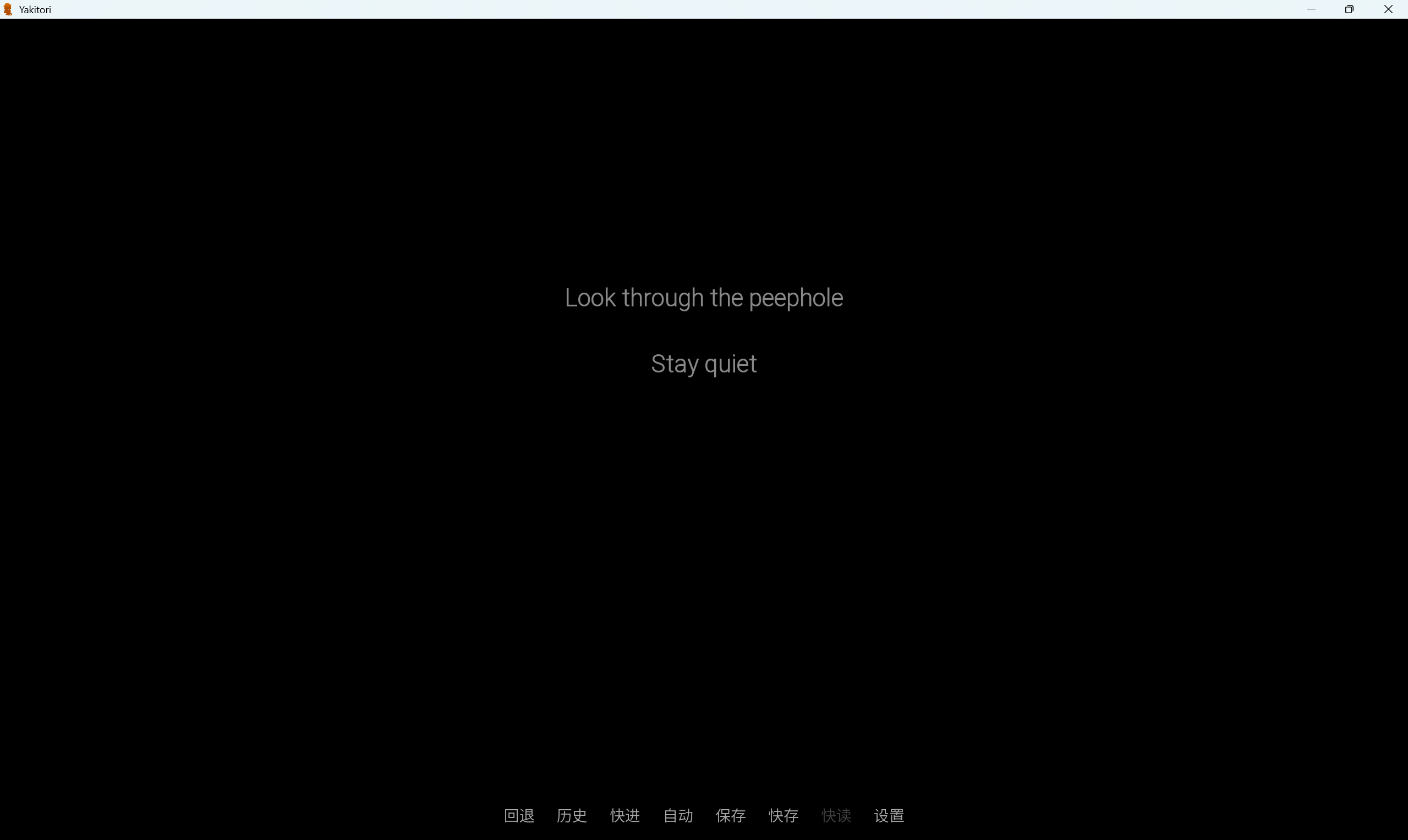
My first interactive narrative test in Ren’Py, featuring a simple branching dialogue sequence with two player choices.
Download the Very First Try →The pin is 11112222
04 — Initial Character Designs
Alongside my first Ren’Py experiment, I began exploring the visual designs of two main characters: the protagonist and the restaurant owner.
At this stage, my focus was not on producing finished character sprites, but on establishing their personalities, visual identities and potential roles within the story.
I wanted the protagonist to appear ordinary and approachable, while the restaurant owner would initially seem friendly and trustworthy, despite the unsettling nature of the game.
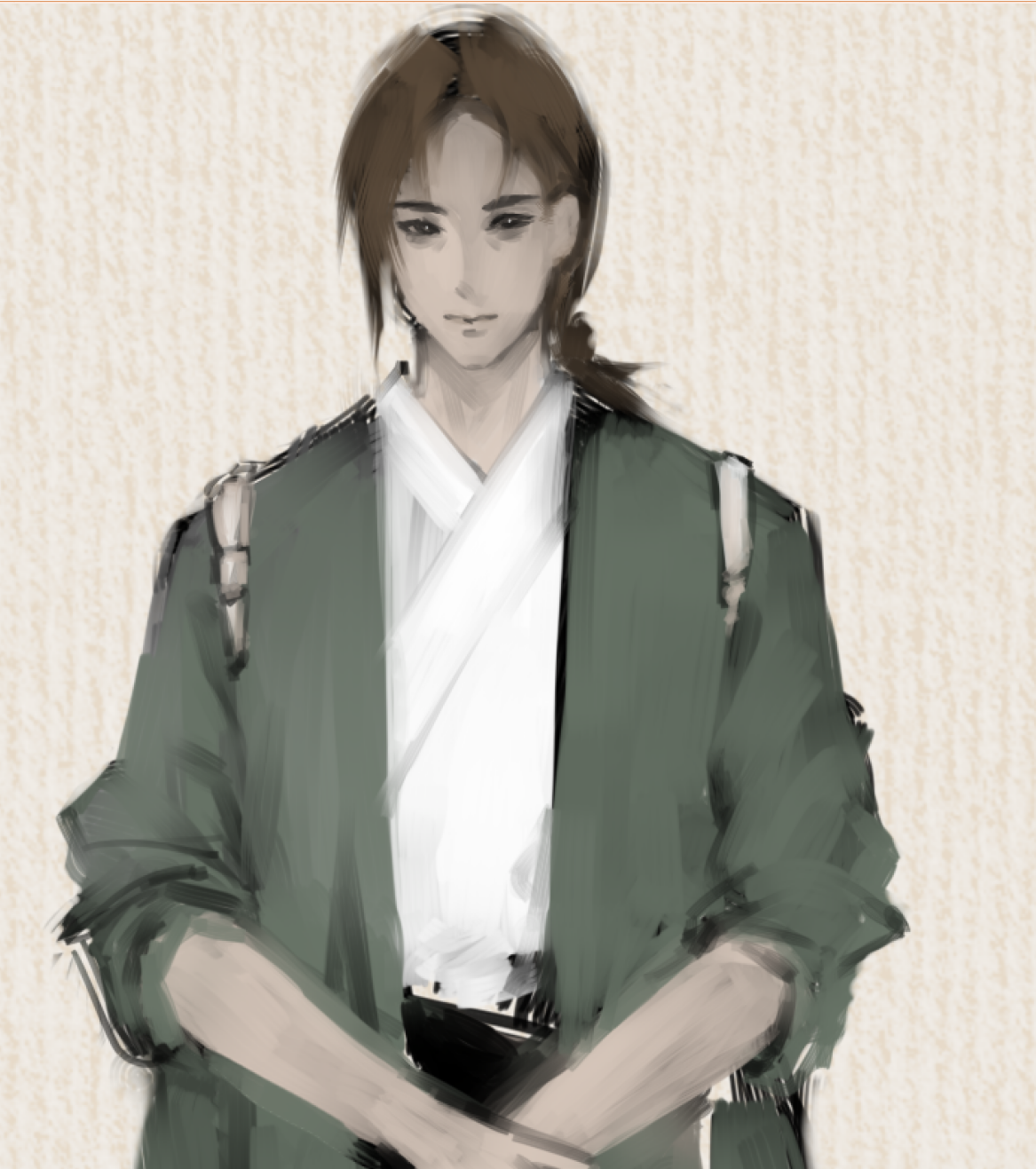
Protagonist — Initial Concept
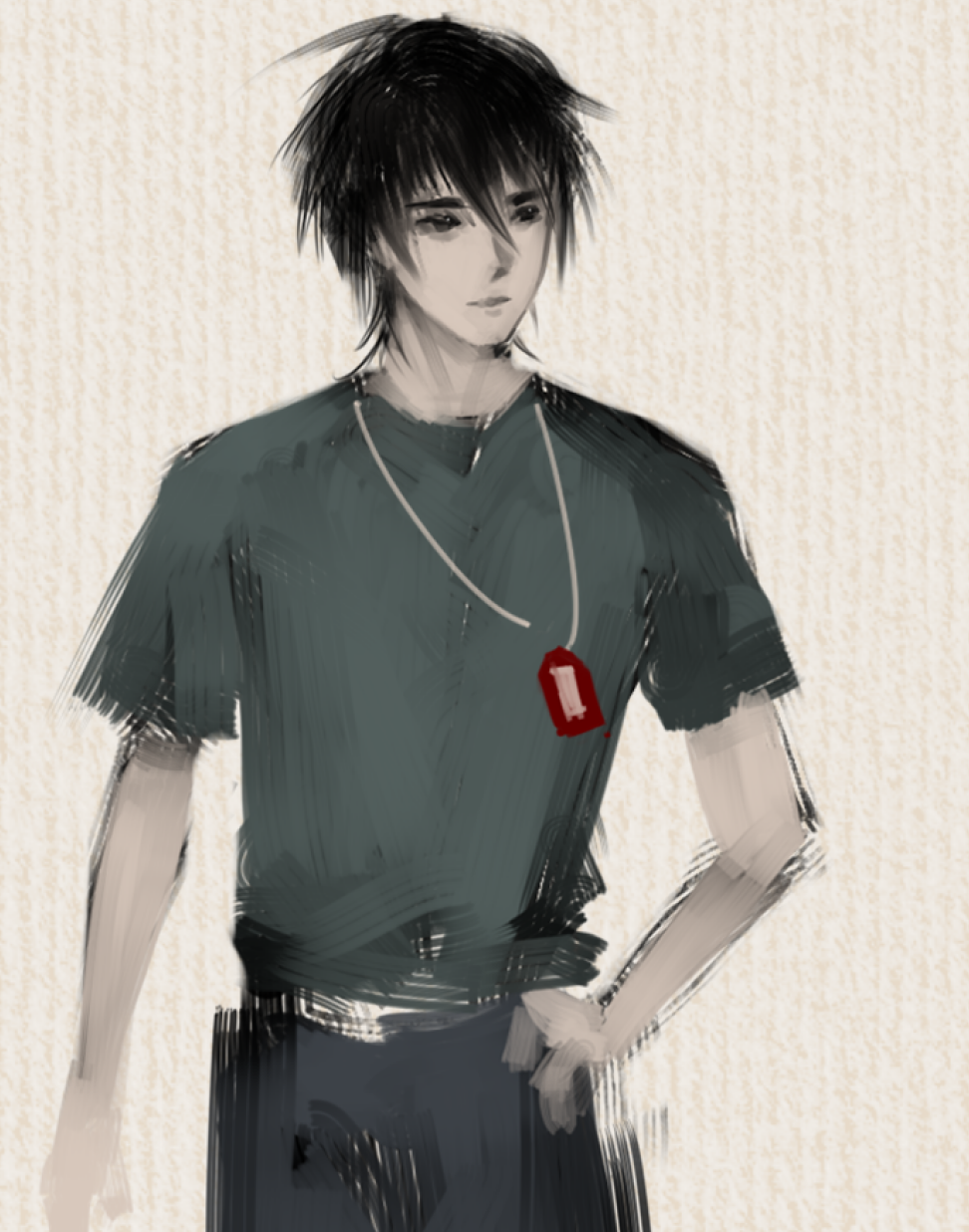
Initial character concept for the protagonist, featuring a muted colour palette and a red omamori as a symbol of protection.
The protagonist is an ordinary high school student with black hair and a quiet, reserved personality. I deliberately kept his appearance relatively simple, as I wanted him to feel like a normal person rather than a typical horror game protagonist.
I chose a muted, cool-toned shirt to reflect his calm and introverted personality while also supporting the darker atmosphere of the game. The subdued colours help him fit naturally into the unsettling environment I want to create.
One important detail is the red omamori hanging around his neck. Unlike the rest of his clothing, the charm uses a stronger and warmer colour, making it stand out visually.
I wanted the red omamori to represent something positive and protective. Although I had not yet decided exactly how it would function in the story, I considered it an important object that could later connect to the protagonist’s experiences and the supernatural elements of the game.
Overall, I wanted his design to remain understated, allowing his personality and the events around him to become more important than his appearance.
The Owner — Early Design Exploration
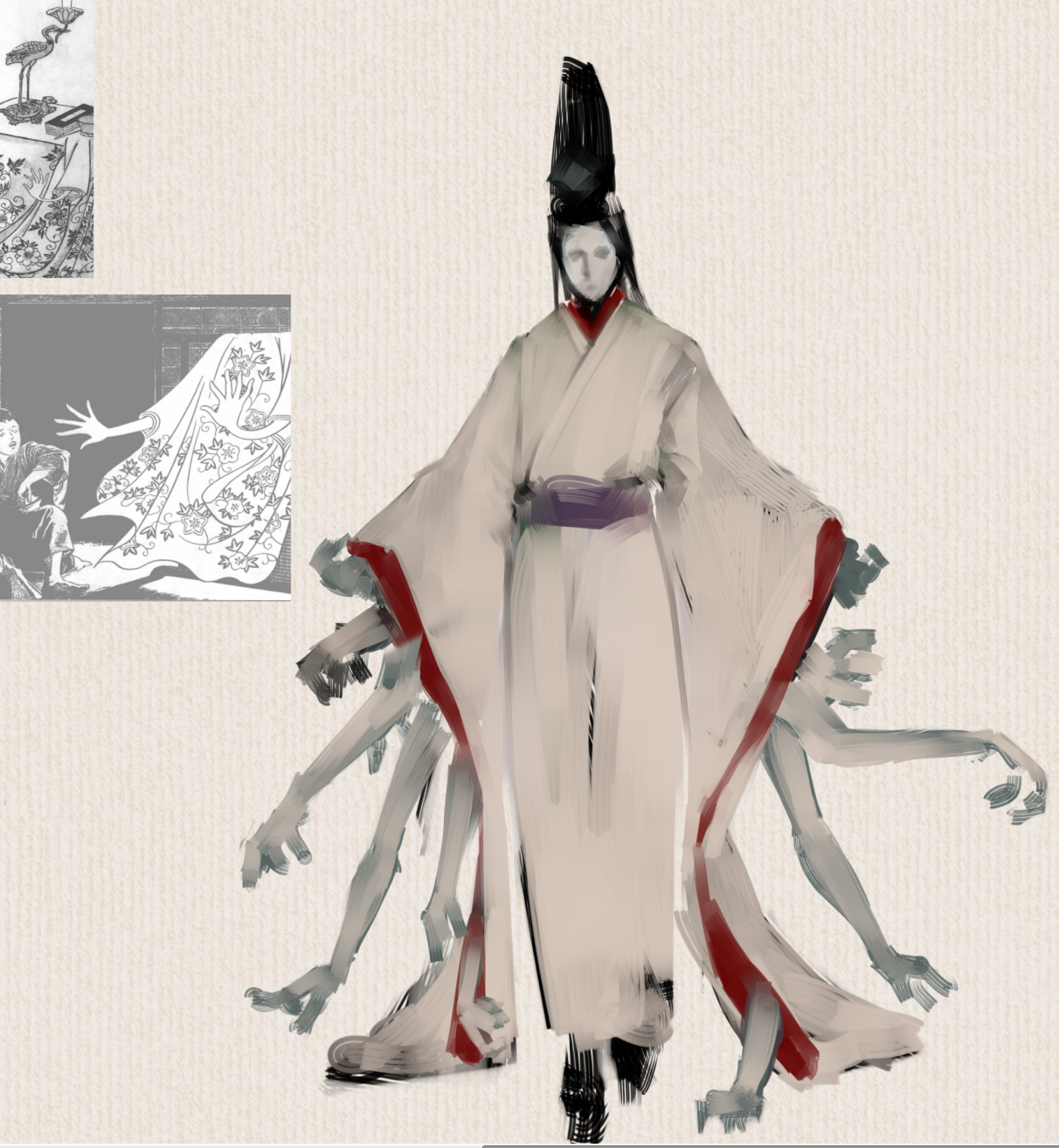
Initial character concept for the restaurant owner, exploring a welcoming human appearance alongside subtle hints of his supernatural nature.
For the restaurant owner, I explored the contrast between a welcoming human appearance and a potentially disturbing supernatural identity.
My initial idea was to present him as a friendly and attentive restaurant owner. His behaviour would appear caring and ordinary, making the protagonist feel comfortable in the restaurant before gradually discovering that something was wrong.
I also considered how the owner’s relationship with the protagonist could become part of the horror. Rather than relying entirely on sudden frightening events, I was interested in creating unease through excessive kindness, subtle control and the gradual loss of personal freedom.
During this exploration, I looked at several possible inspirations from Japanese supernatural folklore, including the tsuchigumo, kitsunebi and the hand emerging from a sleeve motif.
I became particularly interested in the idea of combining the owner’s human appearance with an unnatural number of arms or hands. This could create a visual connection between his role as a restaurant owner, his ability to perform multiple tasks and his hidden supernatural nature.
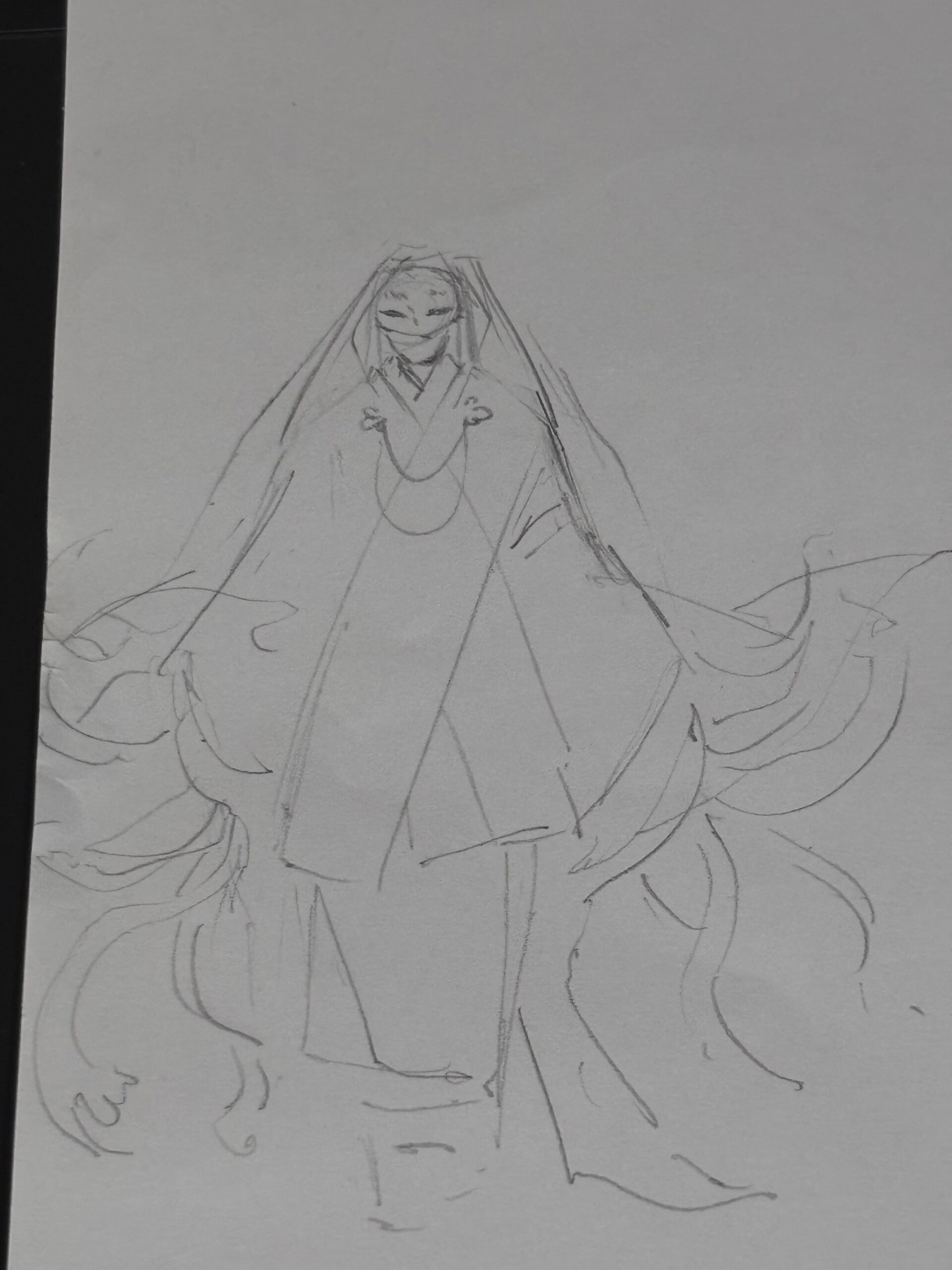


I initially wanted to avoid showing the owner’s face in his supernatural form. I experimented with several ways of concealing it, including a Japanese Noh mask, layers of fabric and even a single enormous eye.
One idea involved four additional arms emerging from the collar, with each hand holding the wrist of the next to form a square. An eye would appear on the back of each hand positioned on either side. Eventually, I chose white fabric to conceal his face, creating a simpler and more mysterious silhouette.
In the earliest digital sketch, I also considered giving the owner dark green skin, but later changed it to an unnaturally pale tone closer to human skin.
For his clothing, I researched traditional Japanese garments, including the long and short forms of the kappa raincoat. However, I decided not to use them after learning more about their original purpose. I eventually chose the chōken, a traditional theatrical robe that could be worn by both male and female performers. Its long, flowing shape suited the character’s supernatural appearance.
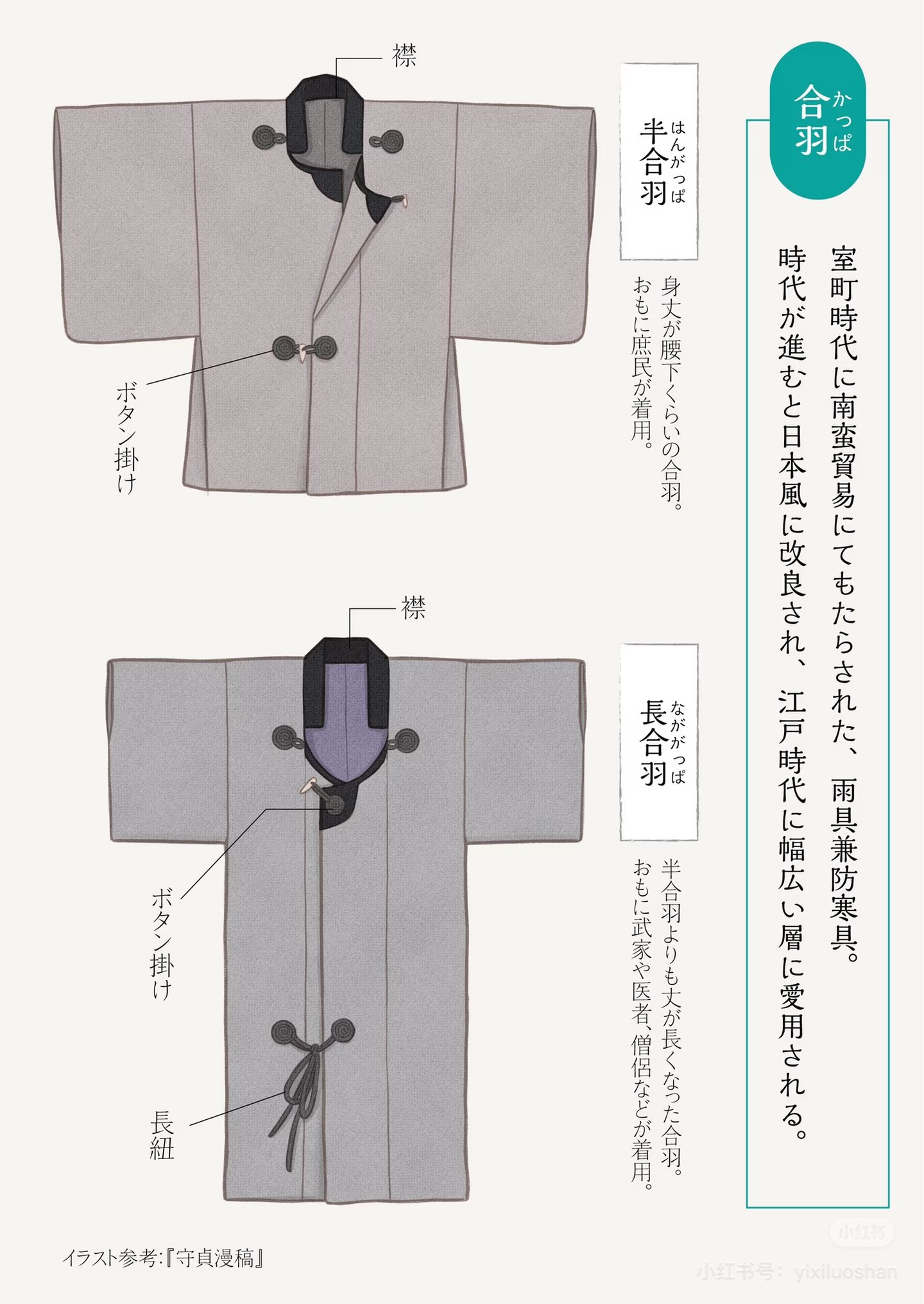

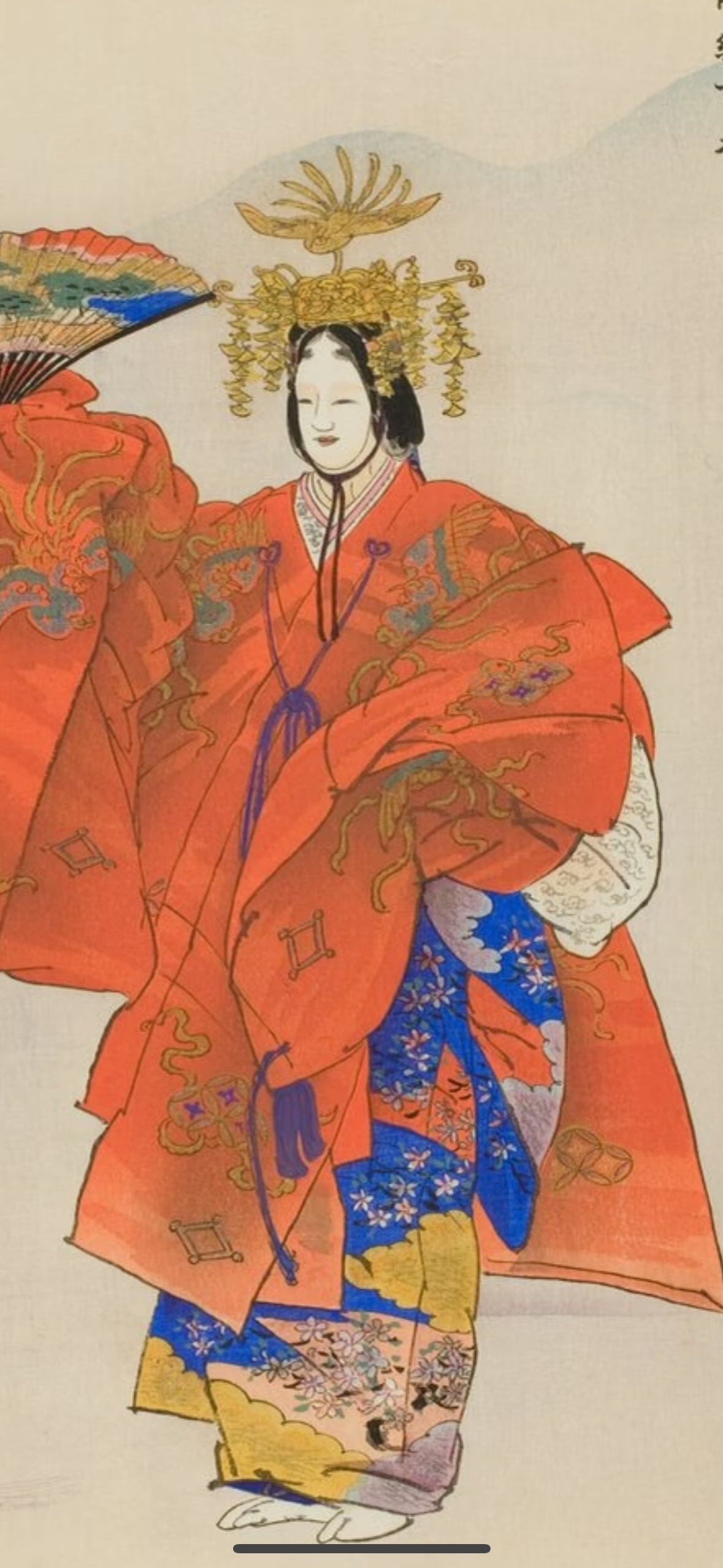
Another idea involved the restaurant uniform itself. I considered whether the clothing could become a symbol of the owner’s influence over the protagonist, particularly if wearing the uniform gradually restricted the protagonist’s movements or decisions.
However, the exploration helped me identify a direction in which character design could contribute directly to the game’s atmosphere and narrative.
Reflection on Character Development
These early character concepts helped me think more carefully about the relationship between visual design and storytelling.
For the protagonist, I focused on simplicity, restrained colours and a single meaningful accessory. For the restaurant owner, I began exploring how an ordinary and welcoming appearance could conceal something increasingly disturbing.
I also started to realise that character details could potentially become part of the gameplay. Objects such as the omamori and the restaurant uniform might serve a narrative purpose rather than existing only as visual decoration.
Although the designs were still at an early stage, this process gave me a clearer starting point for developing the characters further.
05 — Friday Presentation & Peer Feedback
On Friday, I presented the current progress of my game to the class and received feedback from my peers.
During the presentation, I introduced three main gameplay pillars: Serve and Observe, Investigate and Take Risks, and Choices and Consequences. These were intended to explain the relationship between the restaurant setting, player interactions and branching narrative.
I also presented my initial character designs for the protagonist and the restaurant owner, explaining how their contrasting appearances and personalities could contribute to the atmosphere of the game.
Alongside the presentation, I demonstrated a small Ren’Py prototype based on the protagonist’s first night working at the yakitori restaurant. The prototype included a temporary AI-generated background and an early version of the customer-serving narrative. The visuals, story and gameplay were all experimental rather than final.
The feedback was generally positive about the character artwork and the narrative concept. However, several classmates questioned how the game would distinguish itself from other visual novels. They suggested introducing more meaningful player interactions, such as investigating the environment, discovering clues or completing small tasks alongside dialogue choices.
Other comments highlighted the importance of making the player’s main objective clearer, developing the branching narrative, and ensuring that the environment and character artwork shared a consistent visual style.
This feedback helped me recognise that, although the story and characters were beginning to take shape, I still needed to define the player’s experience more clearly. In particular, I needed to consider how observation, investigation and decision-making could work together to create an engaging gameplay loop.
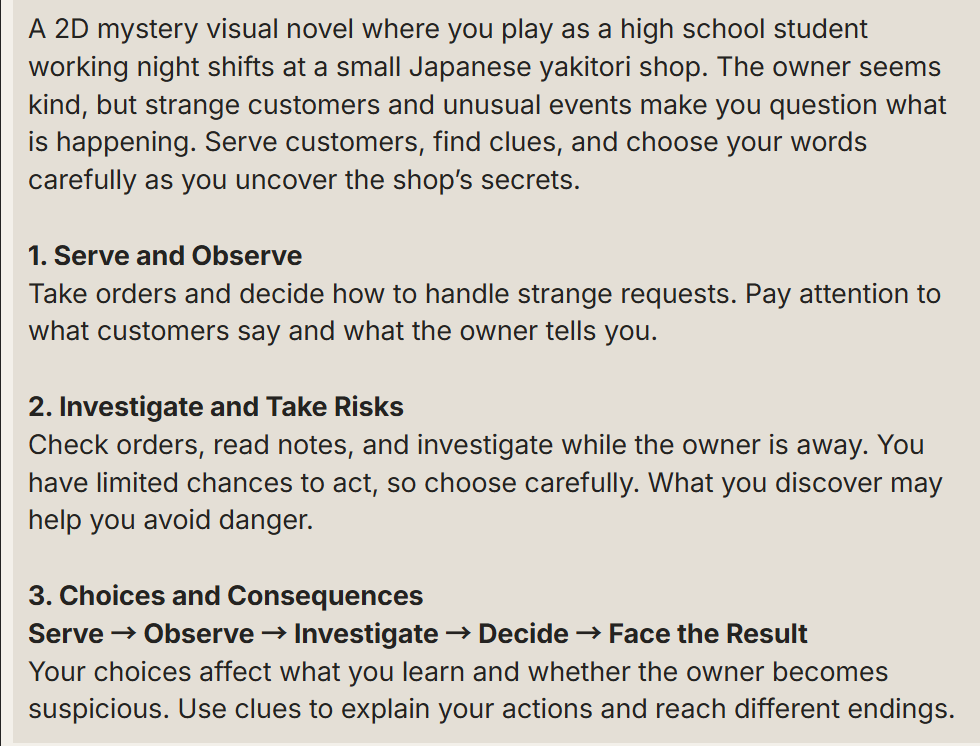
Three gameplay pillars presented during Friday’s class presentation, outlining the intended player experience.
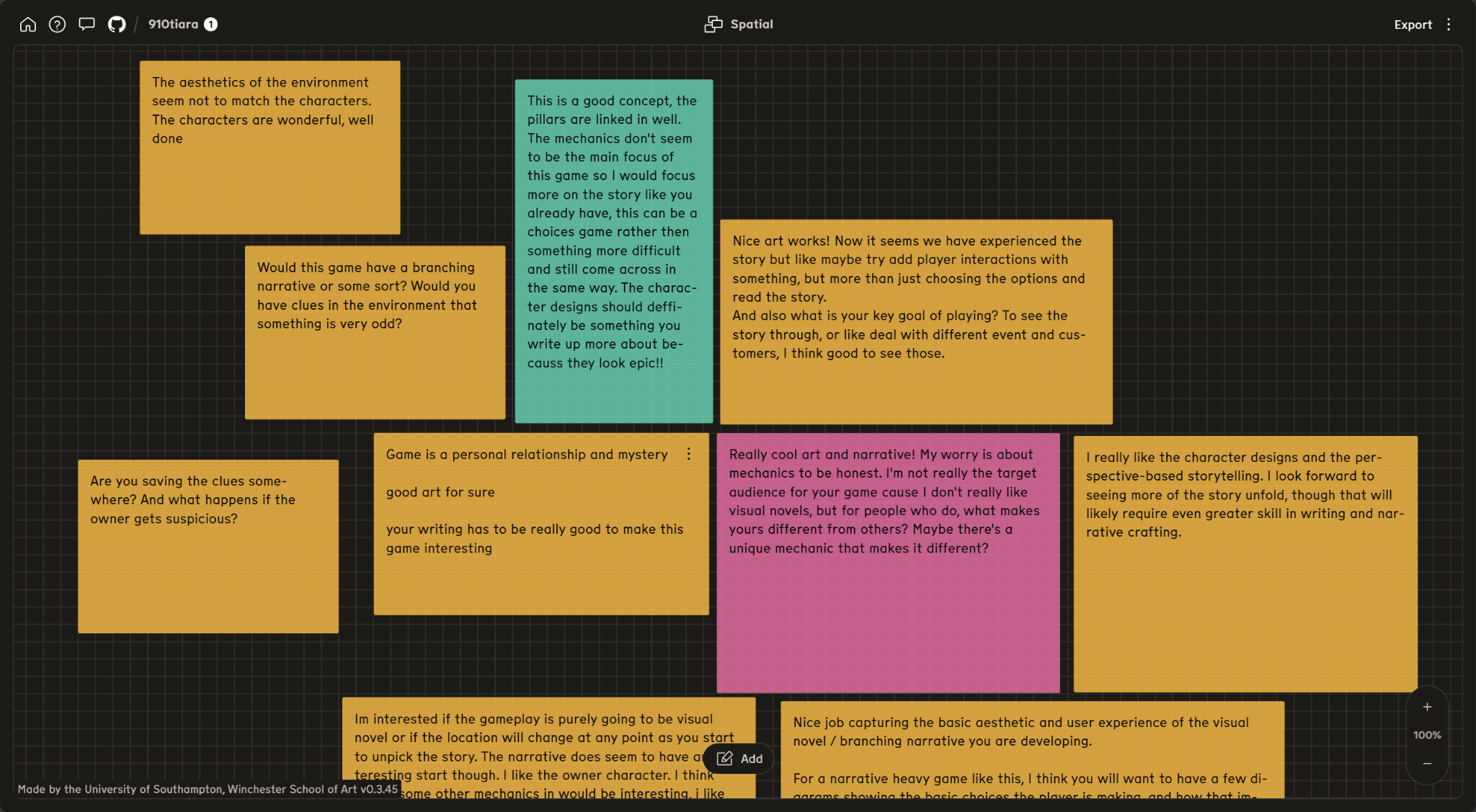
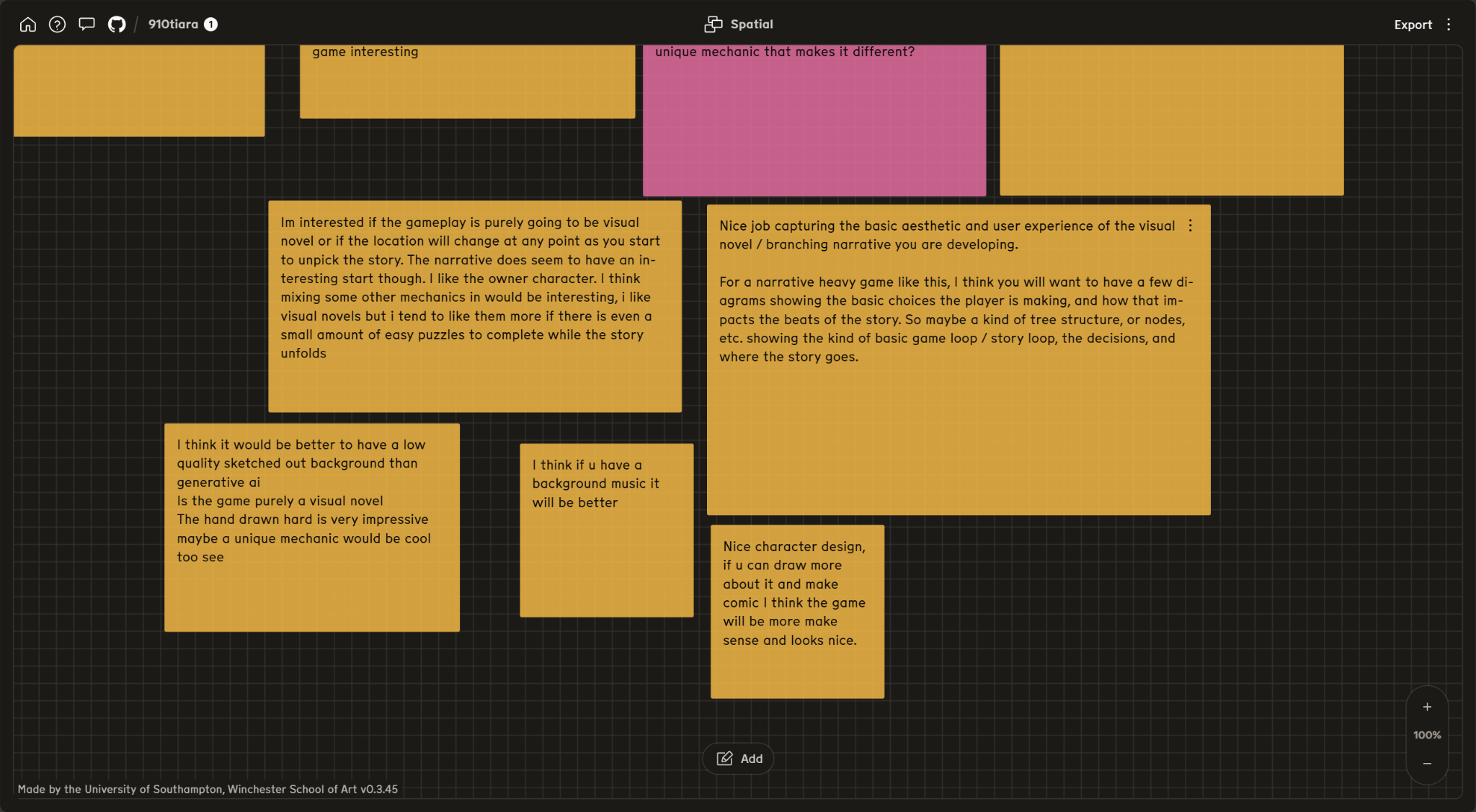
Peer feedback collected after the presentation, highlighting strengths in character design and areas for further gameplay development.
Download the Week 03 Prototype →The pin is 11112222
06 — Reflection & Next Steps
This week was an important turning point in my project. After discussing my ideas with my tutor, I began experimenting with Ren’Py instead of trying to resolve every design question through planning alone.
Creating the early prototypes helped me understand the possibilities of interactive storytelling and gave me a clearer idea of how the game might work in practice. Developing the character concepts also allowed me to explore how visual design could support the mystery and atmosphere of the restaurant.
Friday’s presentation made me realise that having an interesting story and appealing characters was not enough on its own. I also needed to communicate what the player would actually do and how their actions would influence the experience.
The peer feedback encouraged me to think more carefully about the balance between visual novel storytelling and interactive gameplay. Rather than committing immediately to a full restaurant management system, I want to explore smaller interactions that support the narrative, such as serving customers, observing unusual details and making decisions based on discovered clues.
Moving forward, I plan to develop the first-night restaurant sequence further, experiment with more meaningful player choices, and improve the visual consistency between the characters and their environment.
Although many elements are still subject to change, this week’s experiments and feedback have given me a clearer direction for the next stage of development.