01 — Understanding Gameplay Loops
Gameplay Loop Lecture
During Monday’s session, we explored the concept of gameplay loops and how repeated player actions form the core experience of a game. We discussed how a gameplay loop helps define what players do throughout a game and how these actions contribute to the overall experience.
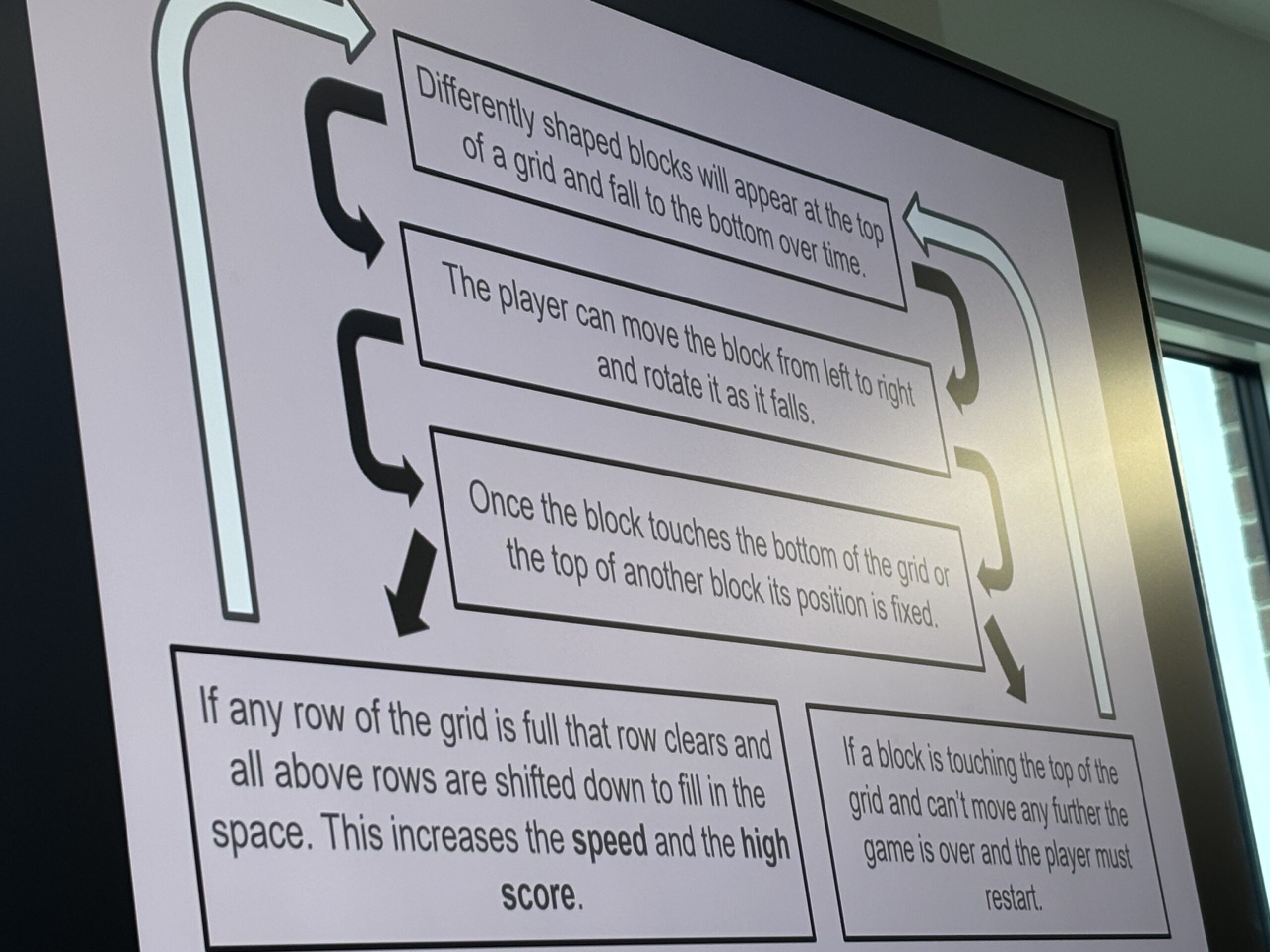
Lecture material introducing the concept of gameplay loops.
Group Activity: Google Dinosaur Game
As part of the session, we were divided into small groups and given familiar games to describe through their gameplay loops without revealing their titles. The other groups then had to guess which game was being described.
I worked with Alice and Jimmy, and our assigned game was Google Chrome’s Dinosaur Game.
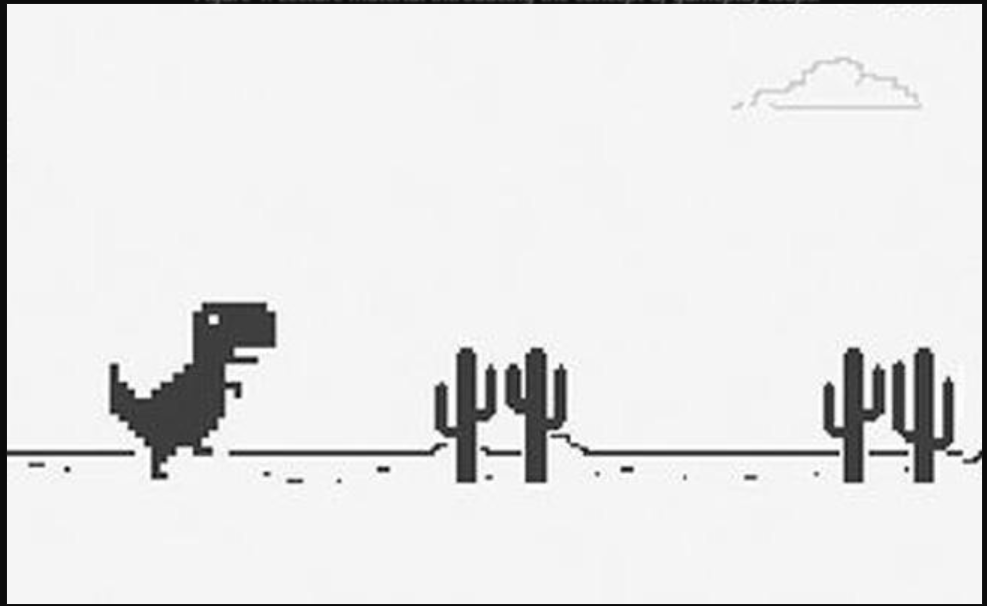
Google Chrome’s Dinosaur Game, which our group analysed during the classroom activity.
We identified the game’s core loop as continuously running, avoiding obstacles such as cacti and birds, and trying to survive for as long as possible. When the player fails, the game restarts and the loop begins again.
The activity demonstrated how a relatively simple game could create an engaging experience through a clear and repeatable sequence of actions.
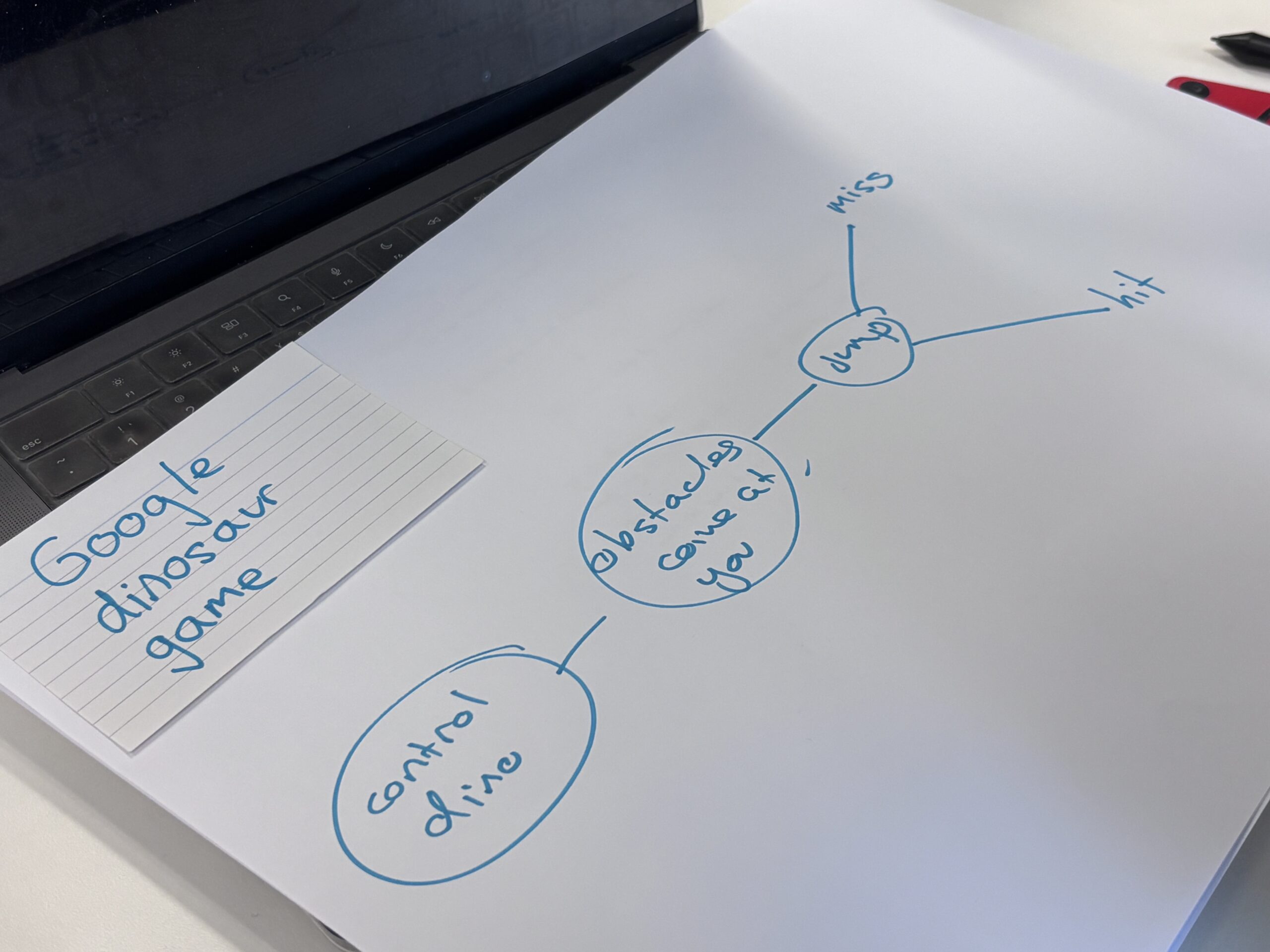
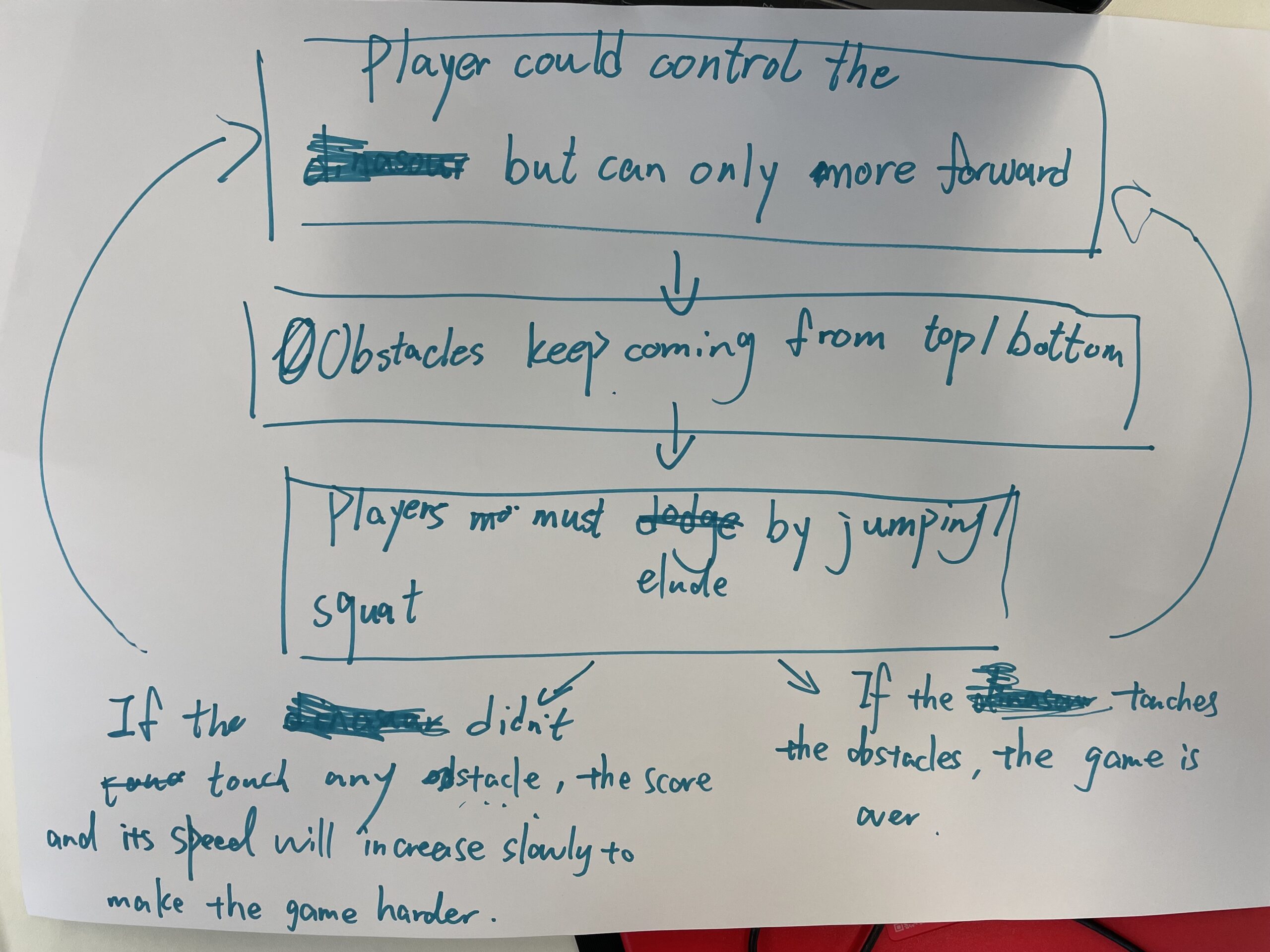
A simplified gameplay loop of Google Chrome’s Dinosaur Game, reconstructed from our group analysis.
Applying Gameplay Loops to My Project
This exercise encouraged me to consider the repeated actions within my own game. Although my project is primarily narrative-driven, I realised that it still needed a clear gameplay loop to connect dialogue, investigation and player decisions.
02 — Elevator Pitch & Scope Refinement
Understanding the Elevator Pitch
During the same session, we were introduced to the concept of an elevator pitch: a short and engaging explanation of a game that communicates its main idea within a limited amount of time.
The exercise encouraged us to identify the most important elements of our projects and explain them clearly without relying on lengthy descriptions.
My Elevator Pitch
For my project, I developed the following elevator pitch:
A 2D mystery visual novel about a high school student working night shifts at a small Japanese yakitori restaurant, gradually uncovering the truth about the shop and its seemingly friendly owner.
Refining the Project Scope
By this stage, I had made an important decision regarding the scope of my project.
My original concept included restaurant management mechanics alongside the narrative. However, I decided to remove the management system and focus entirely on creating a visual novel.
This allowed me to concentrate on storytelling, character interactions, investigation and meaningful player choices.
Although this decision reduced the number of gameplay systems, I believed it would help me create a more focused and achievable experience within the project’s limited timeframe.
It also helped me clarify the central appeal of the game: discovering the mystery behind an ordinary-looking restaurant through dialogue, observation and player decisions.
03 — Game Design Canvas
On Thursday, our tutor asked us to work on a shared Miro board, where each student completed a game design canvas for their individual project.
The canvas encouraged us to consider several aspects of our games, including the core gameplay loop, themes, tone, visual style, worldbuilding and visual references.
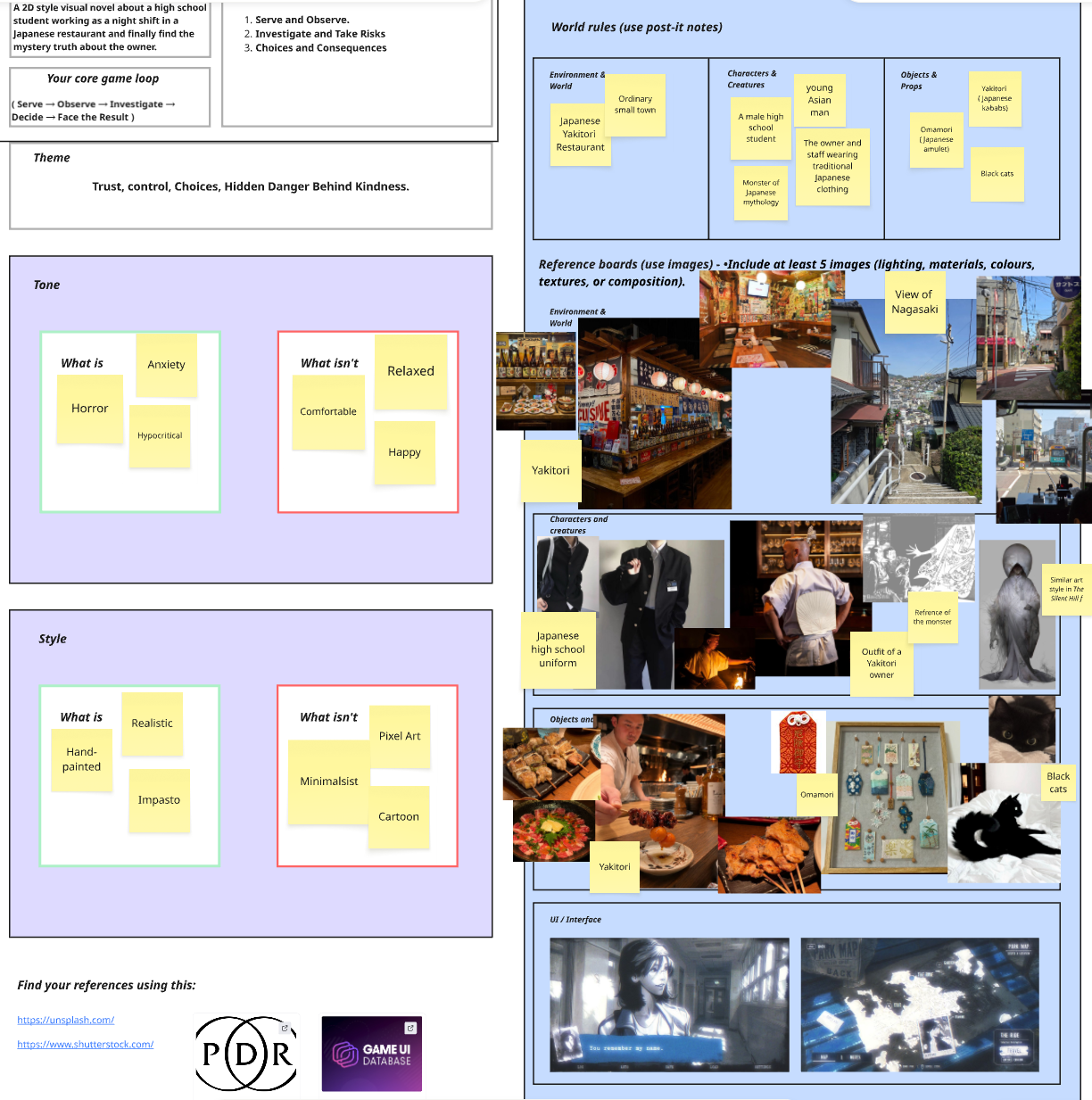
My game design canvas completed during Thursday’s Miro workshop.
Three Gameplay Pillars
I organised the player experience around three main pillars:
1. Serve and Observe
Interact with customers, follow conversations and notice unusual details.
2. Investigate and Take Risks
Explore suspicious events, examine clues and decide when to act.
3. Choices and Consequences
Make decisions that influence what the protagonist discovers and how the story develops.
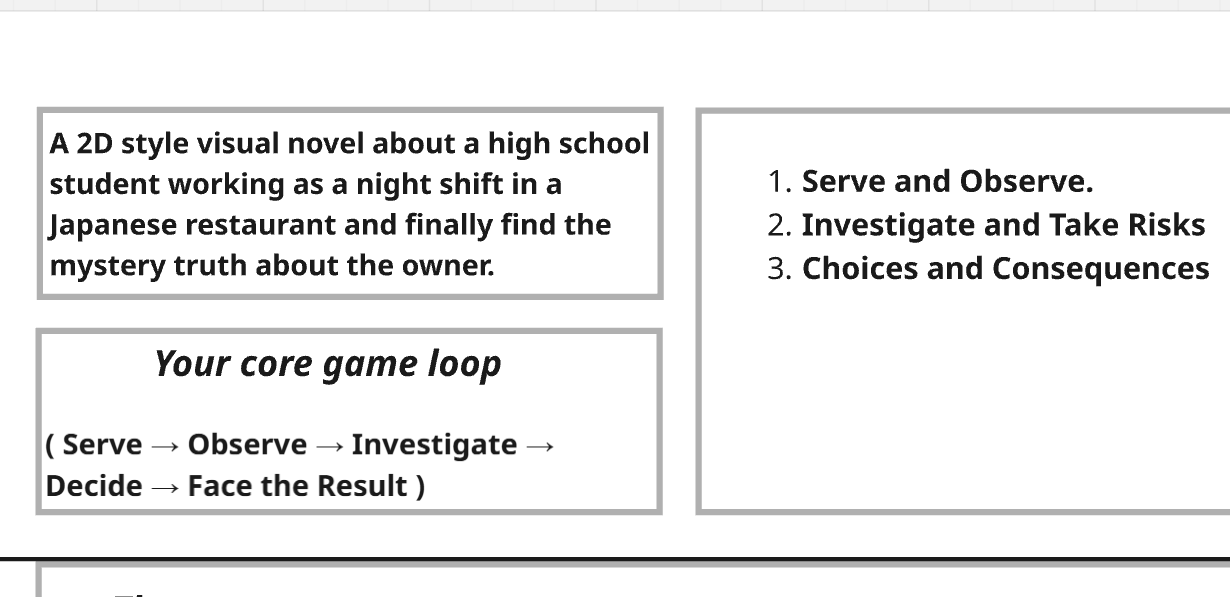
The three gameplay pillars and core loop developed for my visual novel.
Defining the Core Gameplay Loop
Based on these pillars, I defined the core gameplay loop as:
Serve → Observe → Investigate → Decide → Face the Result
Rather than functioning as a traditional restaurant management game, serving customers would become a narrative interaction. The player would encounter unusual situations, gather information and make decisions that affect the progression of the story.
This helped me connect the game’s narrative concept with the actions that players would actually perform.
04 — Visual Direction & Worldbuilding
Themes & Atmosphere
The Miro exercise also helped me establish a clearer visual direction for the project.
I identified trust, control, choices and hidden danger behind kindness as the main themes. I wanted the atmosphere to feel unsettling and anxiety-inducing, creating a contrast between the restaurant’s ordinary appearance and the disturbing events taking place within it.
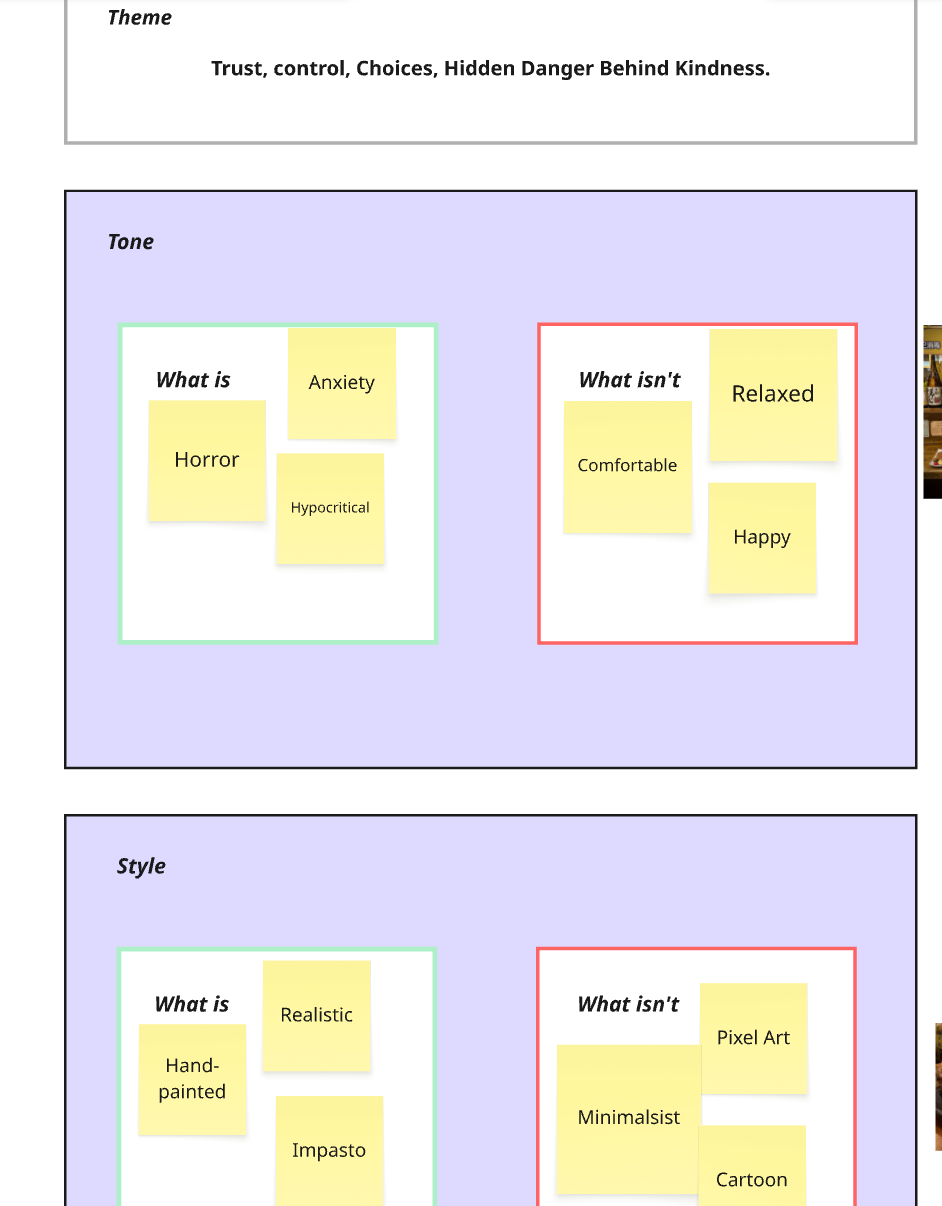
Exploring the intended themes, atmosphere and visual style of the game.
Visual Art Style
For the visual style, I explored a realistic, hand-painted approach with visible painterly textures.
I wanted the environments and characters to feel grounded in reality while maintaining a distinctive illustrated appearance. I therefore moved away from pixel art, minimalist graphics and overly cartoon-like designs.
Environmental References
For the environment, I collected references of Japanese yakitori restaurants and small-town streets.
I was particularly interested in the warm lighting, crowded interiors and everyday details of traditional restaurants. I wanted the restaurant to initially appear welcoming and familiar, allowing the unsettling elements of the story to emerge gradually.
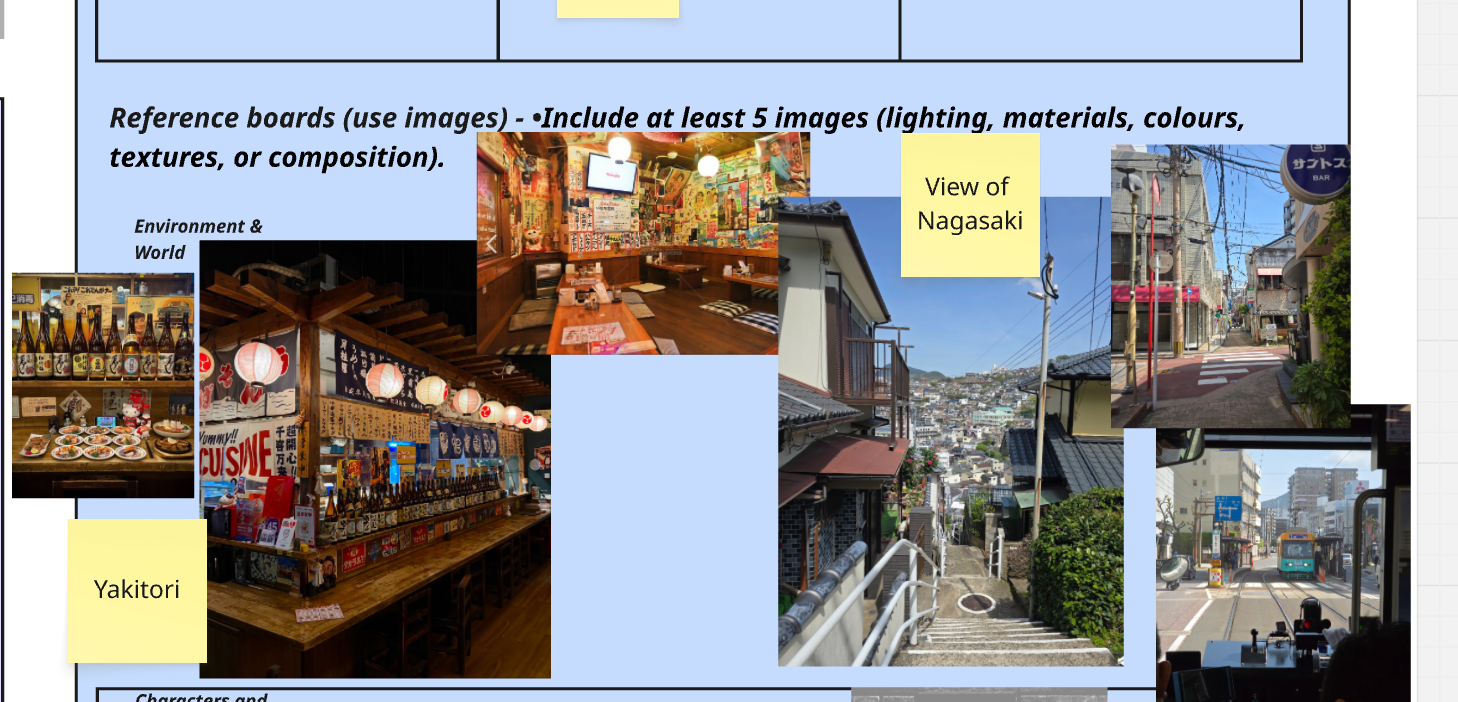
Environmental references exploring Japanese yakitori restaurants and small-town streets.
Character & Prop References
I also gathered references for the protagonist, the restaurant owner and several objects that could contribute to the game’s atmosphere.
These included Japanese school uniforms, traditional restaurant clothing, omamori charms and black cats.
I considered how these visual elements could support the game’s themes and suggest connections to Japanese folklore.
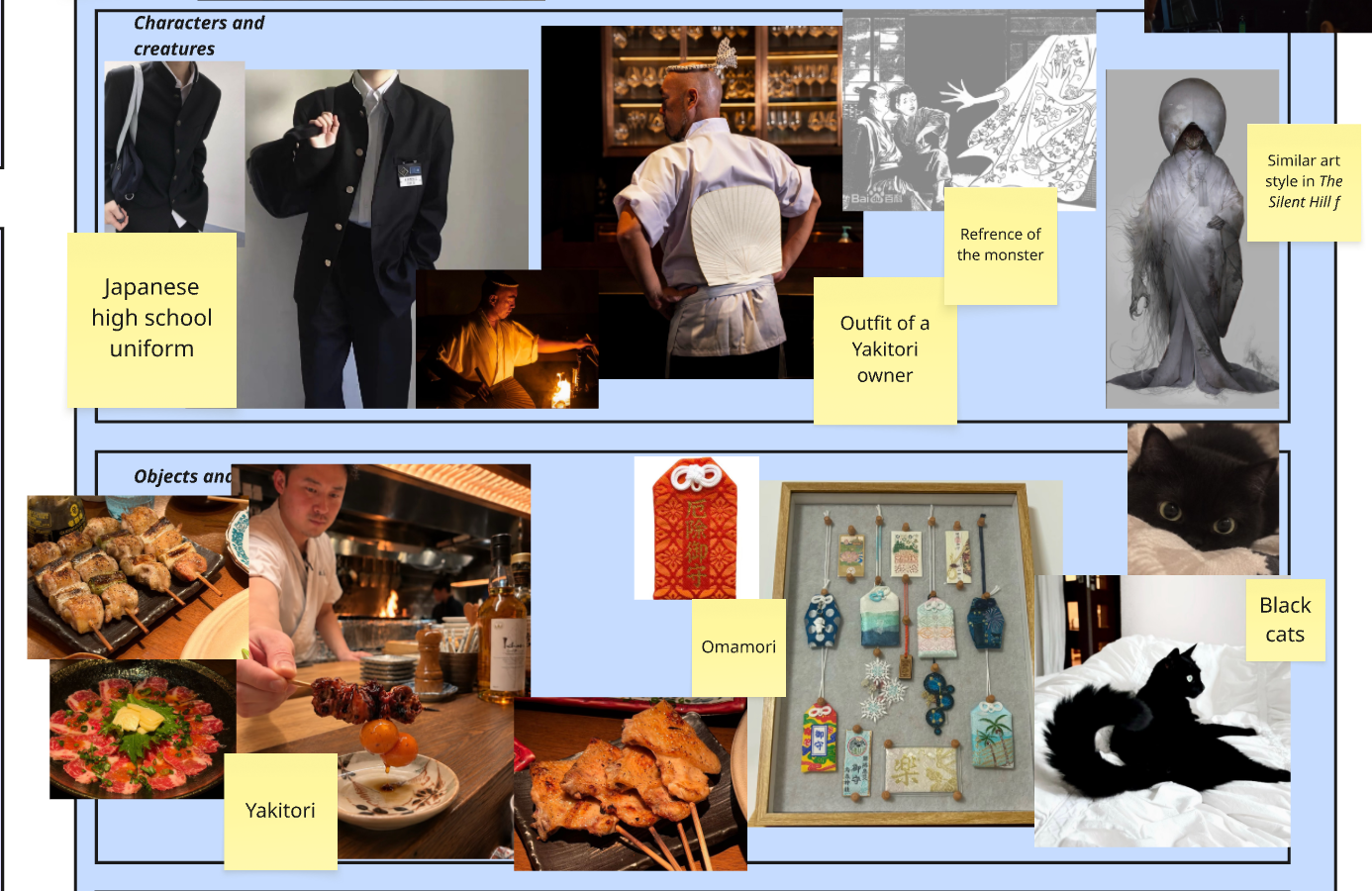
Character and prop references collected to support the game’s worldbuilding.
UI & Interface Inspiration
Finally, I collected visual novel interface references to explore how dialogue, choices and other information might be presented on screen.
At this stage, these references represented possible directions rather than final design decisions.
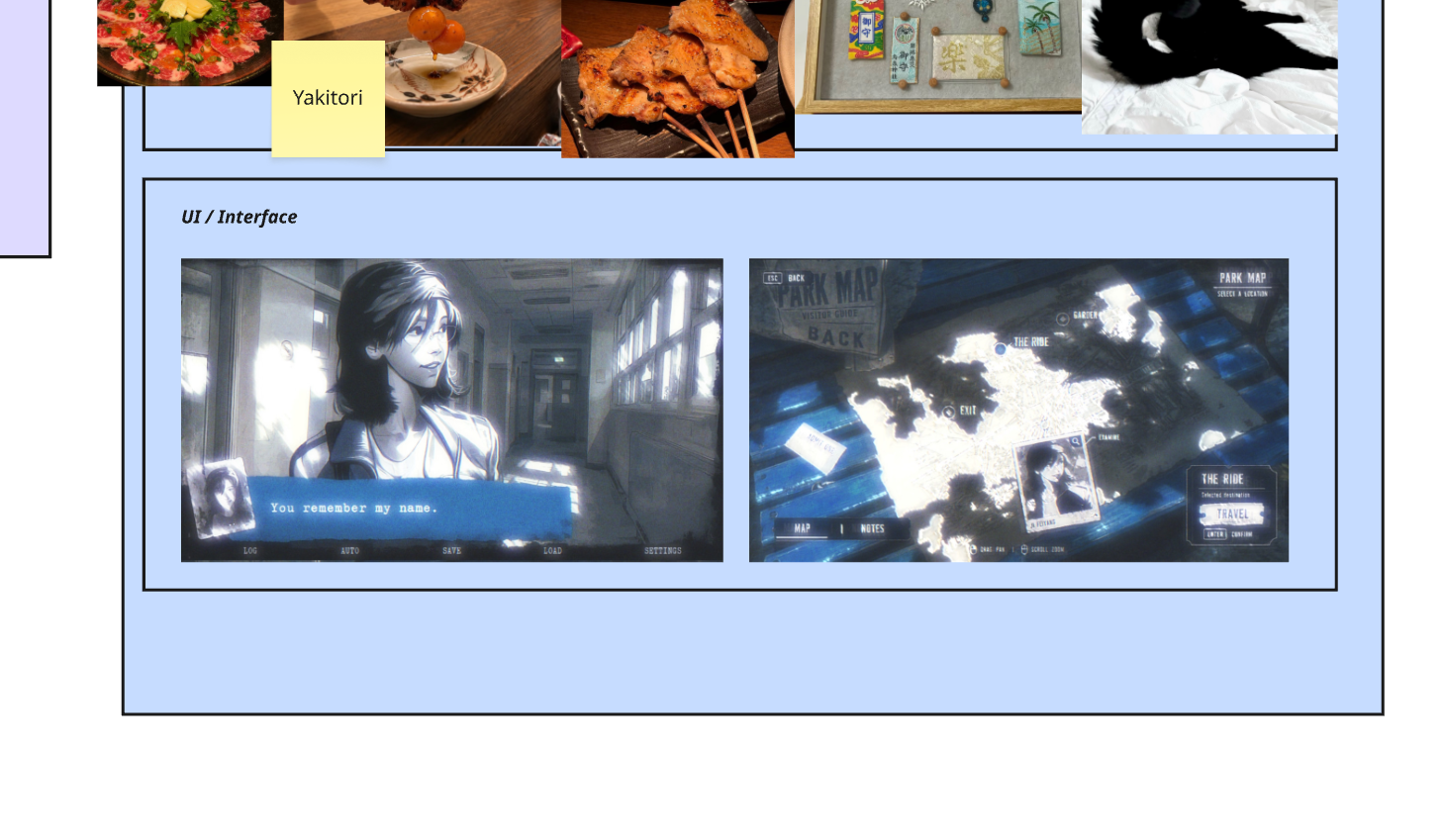
Visual novel interface references collected during the design process.
05 — Narrative Structure
During Week 04, I also worked on developing a branching narrative flowchart for my game.
I wanted to organise the story into a sequence of scenes while identifying where the player could make decisions and how those choices might influence later events.
The flowchart was divided into two parts: a more detailed opening sequence and a broader outline of the later story.
The First Night: Introducing the Mystery
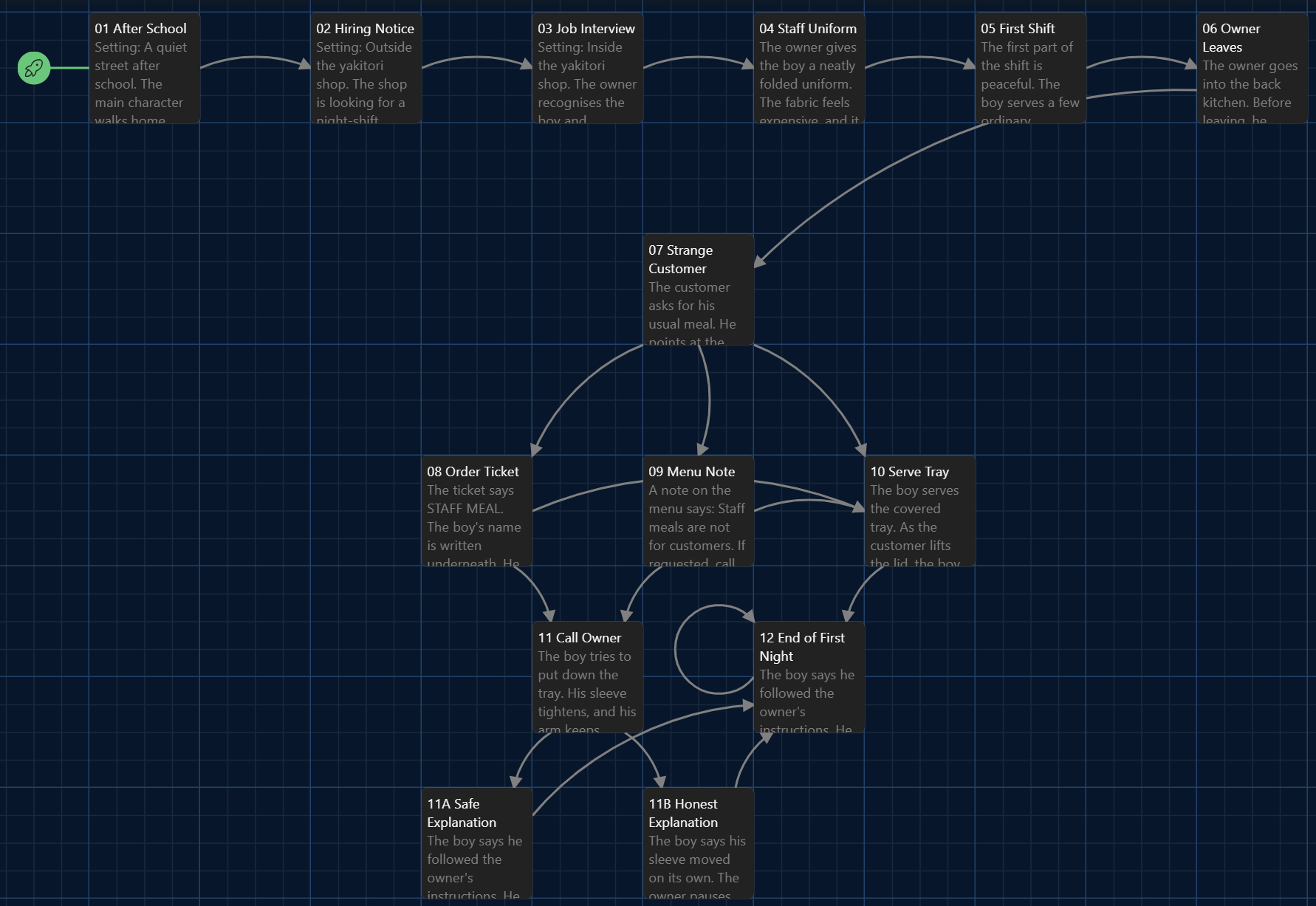
Detailed narrative flowchart showing the introduction, first night shift and early player choices.
The opening section introduces the protagonist, a high school student who takes a night-shift job at a small yakitori restaurant. The first night begins with ordinary tasks before an unusual customer introduces the first major mystery.
I explored several possible player responses involving an order ticket, a menu note and the restaurant owner’s instructions. These branches were intended to encourage observation and create tension through seemingly minor decisions.
Expanding the Story & Possible Endings
The second part of the flowchart outlines the later stages of the narrative.
It introduces further mysteries during the second night, including unusual customers, clues connected to the protagonist’s uniform and questions about the restaurant owner’s identity.
I also began exploring how the story might lead towards different endings depending on the player’s actions and understanding of the situation.
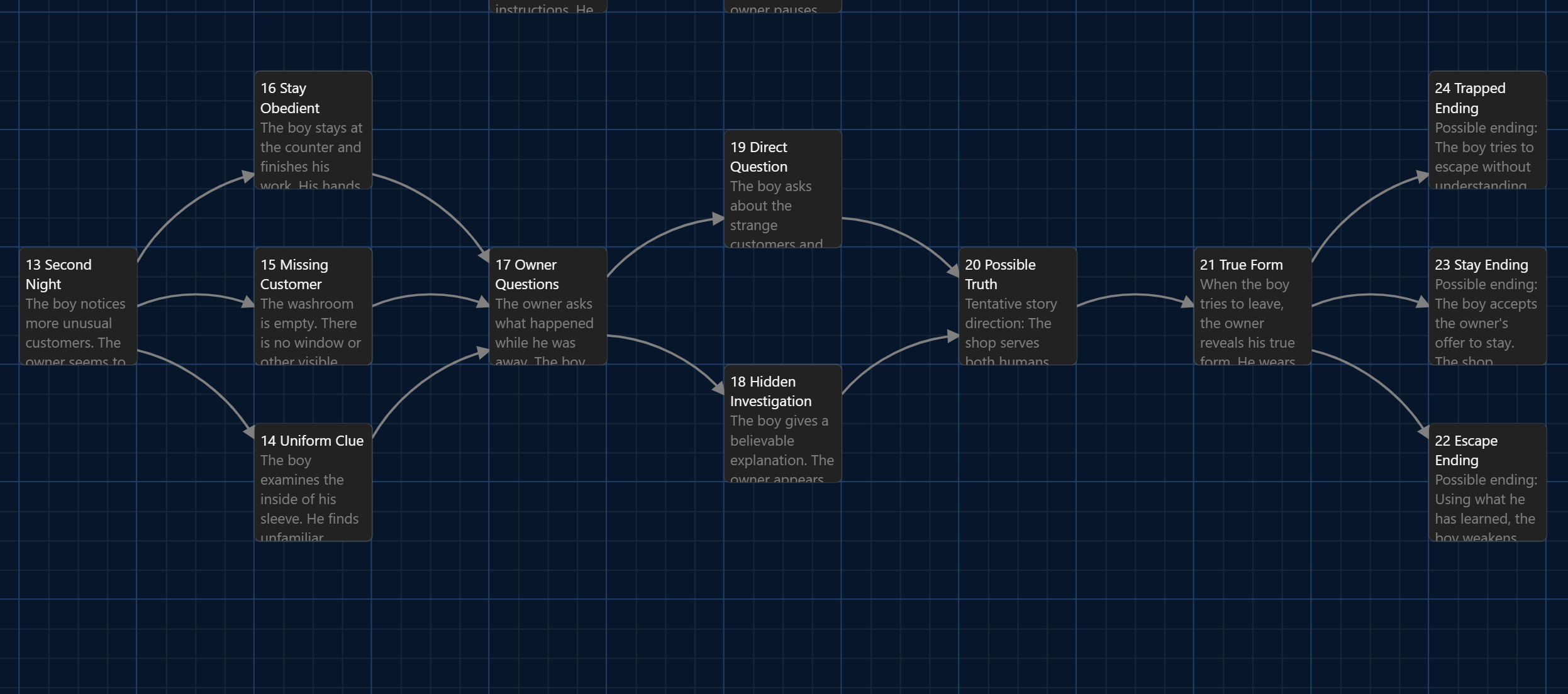
Narrative outline exploring later investigations, the story’s central mystery and possible endings.
Creating these flowcharts helped me visualise the overall narrative structure and identify connections between individual scenes.
However, the story was still in development. Many details, including dialogue, branching conditions and endings, would need further refinement before being implemented in Ren’Py.
The flowcharts served as planning documents rather than representations of a finished game.
06 — Reflection & Next Steps
Key Learning & Design Decisions
Week 04 helped me establish a clearer direction for both the gameplay and visual identity of my project. The gameplay loop activity encouraged me to think about repeated player actions, while the elevator pitch exercise helped me communicate the game’s central concept more effectively.
One of the most important decisions I made was to remove the restaurant management system and focus on developing a narrative-driven visual novel. This helped me narrow the scope of the project and concentrate on dialogue, investigation and player choices.
The Miro design canvas helped me organise my ideas for the game’s atmosphere, worldbuilding and visual presentation. Meanwhile, the branching narrative flowcharts provided a clearer overview of the story and its possible outcomes.
However, these elements were still in the planning stage, and further work would be required to translate them into a playable experience.
Moving Forward to Week 05
Unfortunately, I was unable to attend Friday’s prototype presentation and peer feedback session due to illness.
This meant that I missed an opportunity to present my progress and receive further feedback from classmates.