
Point and Click Mechanics
As my game will be a point-and-click game I have compiled a list of the actions you can do in those games.
- Use – use items, either on NPC’s or on the environment
- Talk To – start conversations with NPCs
- Give –give NPC’s items
- Push – push items in the environment
- Pull – pull items in the environments
- Combine Items – This makes a new item from two items
Another key element of point-and-click games are the long winded puzzles, which I will be creating.
Week 6
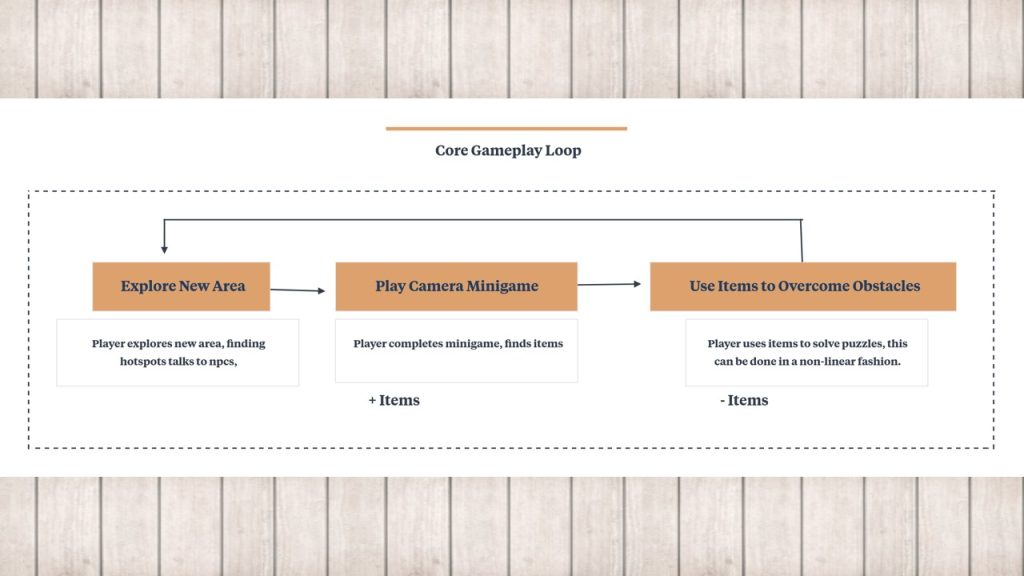
This is a preliminary core game loop, though it serves better as a meta game loop. A core game loop for point-and-click would look like this.
| Explore | Interact | Overcome obstacle |
| Click around the environment | Interact with NPC’s and hotspots | Either gain knowledge of what to do, or overcome an obstacle, this could be as simple as learning to choose the right dialogue options |
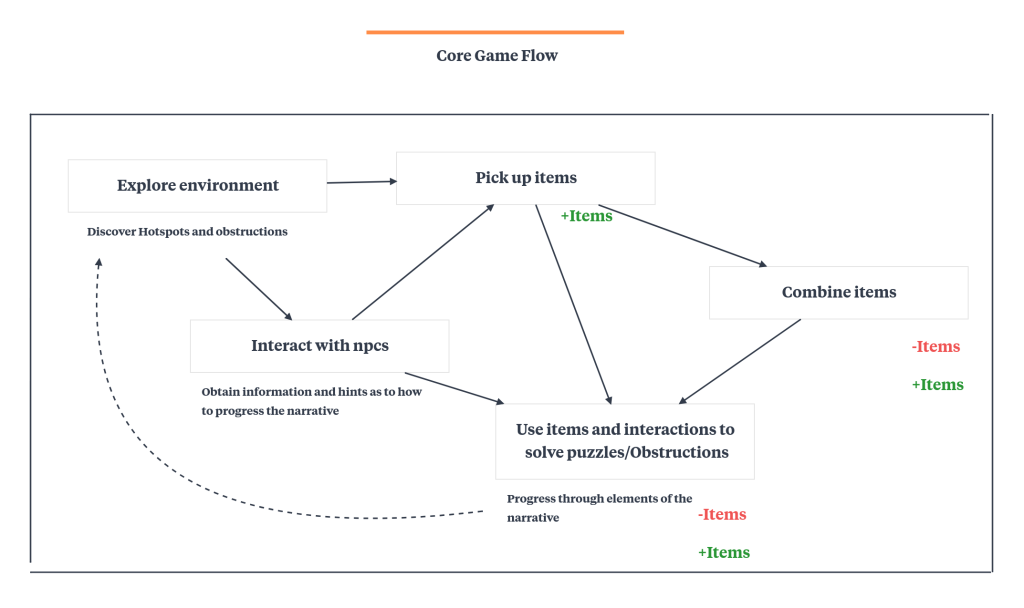
For the GDD I created this game flow diagram to better capture how point-and-click games function, as there are constant obstacles that you overcome through a variety of ways.
Minigame –
I do not have a clear idea of what the minigame will be so I am going to look at some different games for inspiration.
Shutterbug
This is a free to play on the web itch.io game. I found it last year and I love the unique camera mechanic where you resize the tab to zoom in and out.
Eastshade
During week 6 I was recommended this game, where you play as a travelling artist the paitning mechanics works like taking a photo, lining up the lanscape.
Around week seven and eight I had done further work on my narrative and I had begun my puzzle dependency graph.
Working further on these and getting feedback from my lecturer I decided to stop pursuing the idea of this minigame as my narrative now involved the player recovering the pieces of the camera to rebuild it.
In week ten once I had overhauled my narrative I found myself developing a different kind of minigame about photo development.
Leave a Reply