This perspective from non-aggressive small and weak creatures made me choose the road of “survival” games from the beginning.
Primary Mind Map

After I positioned the project as a “survival game”, I referred to some examples that came to mind when I thought of these games: Spore/The Forest/Grounded. These references made me automatically turn the goal and style of the game to the traditional open-world survival game, so I naturally considered adding common abilities such as construction/collection, but I later found that these abilities were not suitable for the core experience of small and weak creatures, so I converged on the “base construction” game.
Island Zoning Map

After making the first change of direction, I began to try to start from the original habitat of the dumplings, so I got this island zoning map.
In this zoning map, I used to draw it into different ecological areas, so that players can go to different ecological environments and experience different survival modes.
But in the testing, I found that the small and weak creatures will basically be in a circular action of hiding-foraging-resting-hiding in this original environment, which it do reflect the living environment of these small creatures, but for the players, this lifestyle is too lacking in exploring goals and variables, which is boring for playing.
So I tried to change the environment that the Blobs in more variables, and it was not involved in their habits from the beginning.
City & Town


Commercial street and market area
These places are the space types that I focus on in urban scenes. This kind of area is rich in resources, but at the same time it is accompanied by dense people flow and frequent interference, which means higher exposure risk.


Narrow streets and building corners
Narrow streets and building corners provide short-term shelter and path selection space for small and weak creatures, but similarly, few people also mean lack of resources.


Park areas and natural reserve
Park areas and natural reserve (especially those with dense trees) are the closest to the original environment of dumplings in ecological structure. Although these areas are not completely risk-free, their spatial organization, visual occlusion and environmental rhythm are more in line with the customary way of life of Blobs.
In the process of studying urban scenes, I did not simply classify all spaces as “safe” or “dangerous”, but paid more attention to the ecological significance carried by different regions.
For example, compared with the streets and commercial districts that are completely artificially built, there are obvious differences in risk structure and spatial perception between green space and semi-natural areas in cities.
Human-intensive areas, such as streets and business districts, are a collection of high risks and high returns, while semi-natural areas are not just ordinary transition or rest spaces, but more suitable as stage end nodes, which indicates that players are gradually approaching “home-like environment” in the current exploration stage.
This structure does not rely on clear mission guidance, but naturally guides players to understand the survival value represented by different spaces through ecological proximity and risk changes.
Scene Research

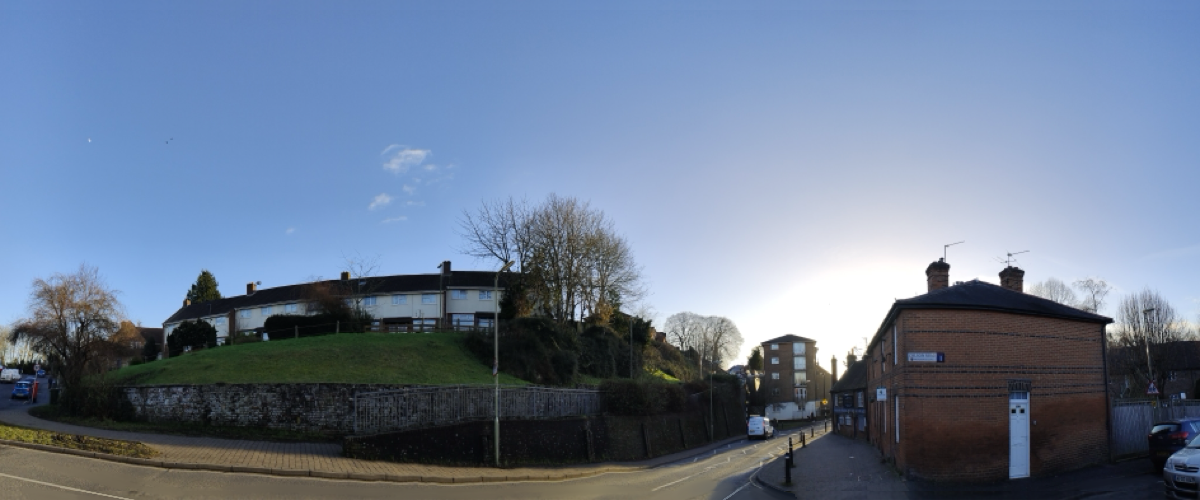
- Winchester on google map
This satellite map helped me to make the urban space from “imagination” to “structure”, so I drew a “satellite map” as a draft to imitate this feeling.

- “Satellite Map” Draft


This is a 3D top-down structural diagram. I use it to visually observe this scene, and whether it can naturally produce the effect of “let players want to explore, but at the same time know that they must move in a certain direction”.
At present, this diagram is not for showing the final architectural details.