
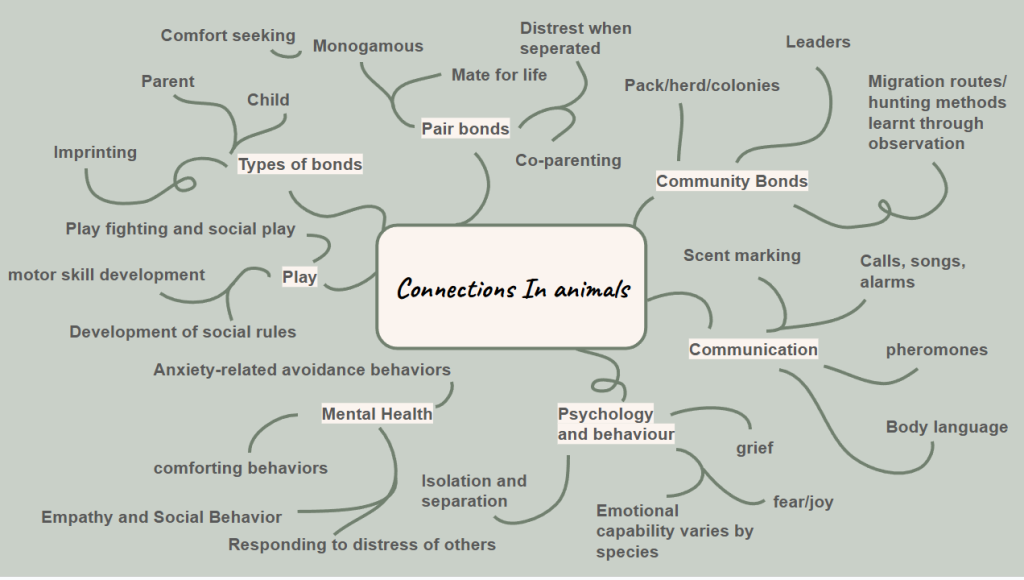
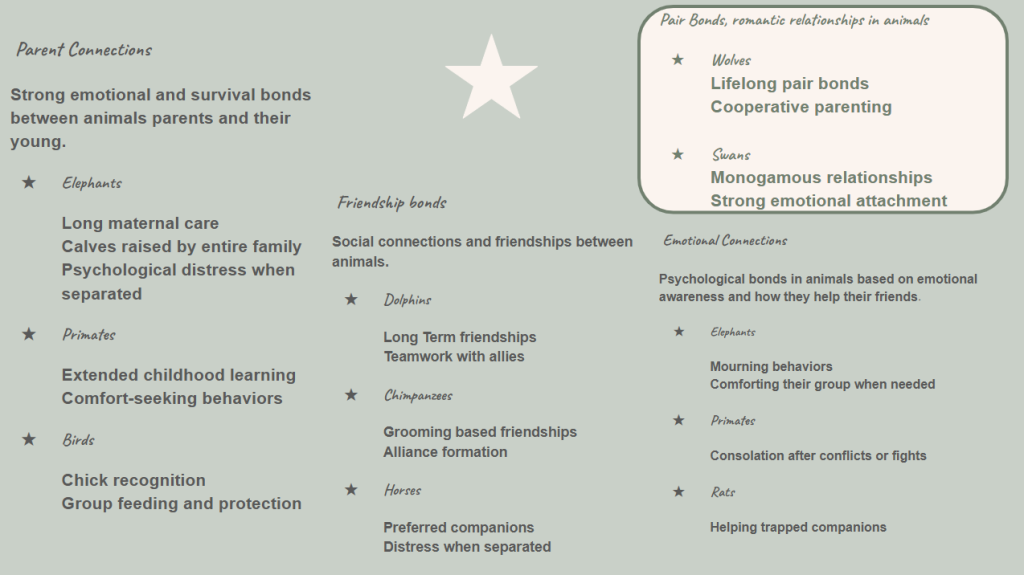
The topic I have chosen to continue researching is connections in animals. Not only was this one of the topics my peers found to be the most interesting during the phase one presentation feedback, it is also an area I personally find to be fascinating. Different species of animals have more capabilities to form connections compared to others, but the ability to form these social bonds are more common than I had originally presumed. In phase one I learnt how even small animals such as rats, form these strong social bonds that have the capability to significantly affect them and their livelihood.
Although these animals might not be aware of how or why these bonds affect them, the impact on their physical and mental health is clearly there. Social connections in animals is pure instinct and plays an important role in their survival and emotional regulation. In some ways these connections and the impact it has on certain species somewhat resembles human connection. Social bonding is not simply a human trait.
Fertility
A lack of social interaction affects an animal’s fertility by disturbing its hormones, behaviours and development. In many species of animals social contact and normalcy helps to reduce stress, whereas in isolation or in a negative environment their cortisol levels raise, this suppresses fertility and causes irregular ovulation or low sperm production.
Many animals also rely on social cues to trigger mating, without them normal reproductive behaviours are hard to establish. Isolation in younger animals can affect the development of mating but also their parental instincts.
Behaviours
A lack of or distorted social interaction can seriously impact an animals behaviour and development. Most animals rely on social contact for emotional stability, hormonal balance, and learning. Isolation often leads to stress, anxiety, and abnormal behaviours, including:
- Aggression
- Withdrawal
- Impaired cognition
- Self directed behaviours like pacing, rocking, or over grooming
Younger animals are especially vulnerable, as poor socialisation can disrupt play and their understanding of social hierarchies. Distorted social interaction also affects hormones. In social species, positive interaction helps maintain healthy levels of oxytocin, dopamine, estrogen, and testosterone, which shape how animals think, feel, and interact. Chronic hormonal imbalances can also impair their growth, immune function, and overall well being.
Animals can also have a powerful impact on a human’s mental and physical health. Interacting with pets can reduce stress, anxiety and overall loneliness. It also boosts our mood, social connection and cognitive engagement. Animals are very similar to humans in this way, most living beings at their core are social beings and almost everything breathing needs some form of connection.
Depression
Animals as I’ve already stated are capable of experiencing depression, their mental health is strongly influenced by their social connections. Without emotional stability and companionship animals can withdraw, lose their appetite and lose interest in their regular behaviours. Grief within animals can cause depression like symptoms including changes in their sleep, overgrooming and anxiety similarly to humans.
A study on coyotes has shown that the loss of a mate leads to changes within their brain chemistry, they show elevated levels of CRF receptors in areas associated with a stress response. This mirrors human grief and often includes increased levels or cortisol which ive already discussed can have adverse reactions to an animals mental wellbeing.
Another study on Prairie voles shows that social isolation can lead to depression symptoms within animals. Prairie voles are known for their pair connections and strong emotional bonds with each other. They showed a reduced sucrose preference and hormonal changes when grieving. ( disinterest in sucrose is an indicator of anhedonia which is basically the inability to feel pleasure in something that would typically be defined as pleasurable ).
Bibliography
Impact of social environment on female chimpanzee reproductive cycles, 2006. Hormones and Behaviour, 50(1), pp.126‑131 https://www.sciencedirect.com/science/article/abs/pii/S0018506X06000316?utm_source=chatgpt.com
Chronic social isolation, crowding, and instability distinctly impact reproductive function in adult female Wistar rats, 2025. PubMed. Available at: https://pubmed.ncbi.nlm.nih.gov/41075564/
Social isolation induces sexually aggressive behaviour in male Wistar rats, 2025. BMC Neuroscience, 26:15. Available at: https://link.springer.com/article/10.1186/s12868-025-00932-0
Neurobiology and consequences of social isolation stress in animal model—A comprehensive review, 2018. PubMed. Available at: https://pubmed.ncbi.nlm.nih.gov/30021357/
Evaluating the stress system of the grieving brain: corticotropin‑releasing factor receptors and partner loss in coyotes (Canis latrans), 2025. PubMed. Available at: https://pubmed.ncbi.nlm.nih.gov/40930902/
Smith, A.S. & Wang, Z., 2008. Depression‑like behaviour and stress‑induced neuroendocrine activation in prairie voles exposed to chronic social isolation, PubMed. Available at: https://pubmed.ncbi.nlm.nih.gov/17289829/
Evaluating the stress system of the grieving brain: corticotropin‑releasing factor receptors and partner loss in coyotes (Canis latrans), 2025. Neuroscience, 584, pp.412–417. Available at: https://www.ibroneuroscience.org/article/S0306-4522(25)00833-4/abstract