The guests lecture this week was focused on character design and how it influences and is being influenced by the narrative and other elements of design.
Colour
- association: what associations do different colours have? red – anger/passion; green – nature; blue – calm/melancholy
- colour theory: how do colours work together? think contrast/complementary; rule of 3 – main colour, secondary, accent colour
- progression/change: change of colour throughout story can reflect change transformation of character; levelling up/new powers/narrative development
Shape
- association pt2: what associations do different shapes have? accentuate a character’s personality. e.g. square – solid, heavy; circle, curves – soft, feminine
- silhouette: if your character was reduced to a solid silhouette, would you still know it was them?
Narrative
- objects of importance: are they wearing/carrying items that are relevant to their current objective/backstory?
- scars/tattoos: how did your character get scars if they have any? do their tattoos mean anything? if not, why?
- physical condition: are they buff? dirty? drenched in blood? can you justify these choices through narrative design?

The first activity was to put our favourite characters into Venn diagram, where the sections were named colour, shape and narrative. Essentially, it helps to understand how these three aspects can be brought out through character design, and how merging them together properly can result into a great character in the end. I chose to put Shadow the Hedgehog in the middle for this very reason — I think his backstory, along with the the design intentions work out just great. And, well, he is the Ultimate Lifeform, after all. Character like Bakugou from My Hero Academia doesn’t necessarily has links between his narrative and shape/colour choices in his design. Sure, his hero costume represents his ability and its connection with explosions, but thinking about him as a whole, the narrative plays a big part in his character development and we get to see him change throughout the series, which influences and is being influenced by other characters in the story.
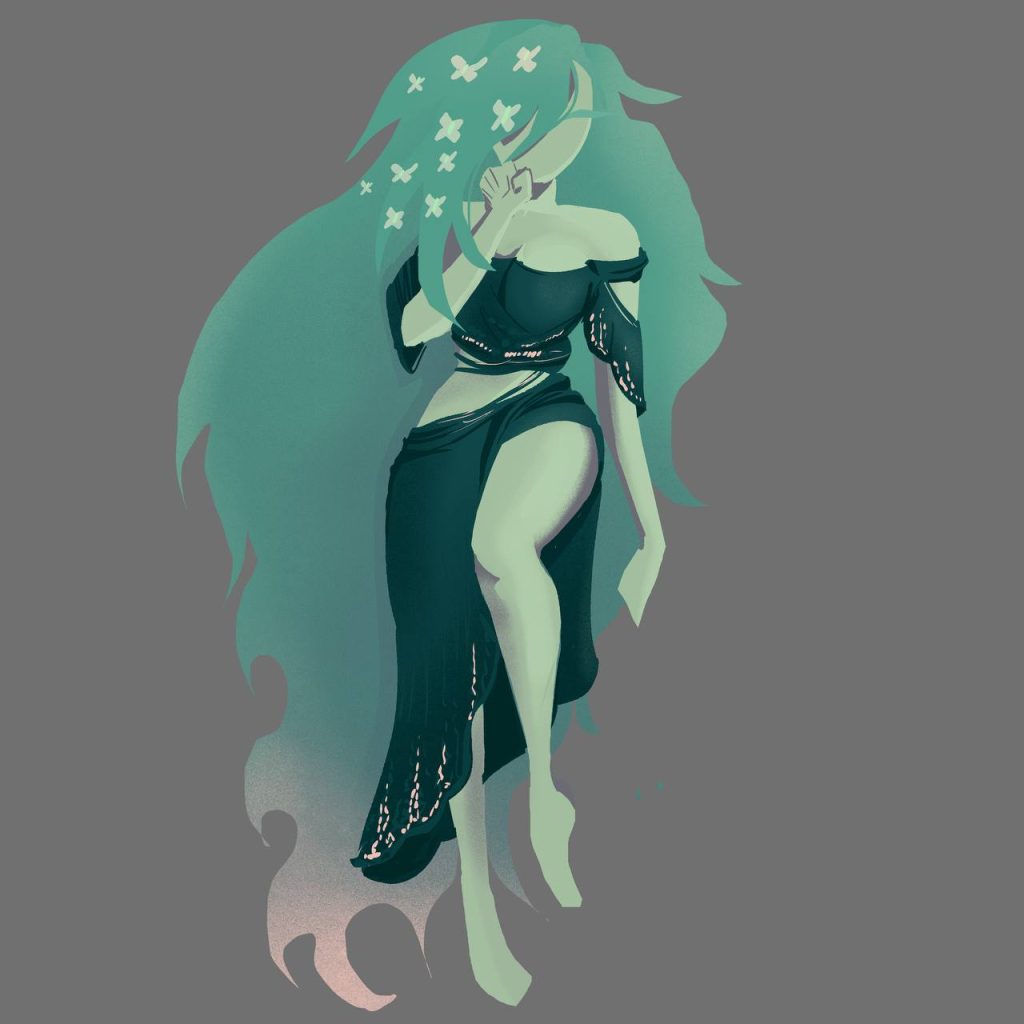
The second activity was creating a character design based on the knowledge we retained from the lecture, and it was my first attempt at creating the design from the main character for my game. To read more about the design choices and colour combinations, visit Sketches section.
The lecture on Monday was dedicated to getting familiar with the concept of art bible and other artistic that could help to develop our ideas.
What is an art bible?
- Aligns expectations
- Communicates aesthetic intent
- Evolves over time
- Clarifies the thinking and vision
- Builds up for the team, with more depth
What is a reference board?
- An annotated collage of images, textures, and other
visual elements used by artists to establish and
communicate the visual rules of your game. - Why is this different from a moodboard = moodboards
are generic and just give a tone to your game. - Reference boards are specific and you should have a
reference board for each element of your game.
How colours paint our perception of a cosy game
- Colours can affect everyone differently
- What do you think of when you envision a soft orange colour?
- Emotions triggered by colours are also dependent on personal experiences
- Cosy games are full of less saturated pastel colours, which are softer and less harsh on the eyes than their bolder, more saturated counterparts.
I think my game falls under the “cosy” criteria, so it would be good to look into soft colour combinations, as well as research art styles that focus on saturated colour palettes and soft concepts
Reference materials
- If UI heavy, you should have a UI reference board
- Typography
- Colour palettes.
- Animation board
- VFX board
Best practices
- Add commentary: Don’t just use images, but also add little captions that explain the images.
- Include URLs: if using reference from other films, games or from the internet, include the names of the films or URLs
- High Res Originals: As well as including the final mood board, include all of the original reference images that you used.
What to consider when doing visual research:
- Have you used specific software?
- Have you created custom brushes?
- What is your colour palette for characters/environment /etc.?
- What are the HEX/RGB values of those colours?
- Is the line-art consistent throughout the design?
- What scale is your character to your environment?
- What scale is your character to other characters?
- Have you created the turnarounds needed for the animators/3D modellers?
- Are there specific technical limitations you need to impose on your designs?
- Do your final assets require any pre- or postprocessing?
- Do you require a proportions guide for your game world?
- How smooth will your animations be?
- What will be the frames-per-second rate?
- Will animations be consistent throughout all characters/environments?
- Have you considered the different camera positions of your game for your designs?
- Will detail be needed or lost based on those positions?
- Are your designs appropriate for the historical setting?
- Are your designs appropriate for the geographical setting?
- Are your designs appropriate for the activities of the character?
- Are the emotional responses of your characters represented effectively?
- Are all elements of your design in keeping with the tone of your game?
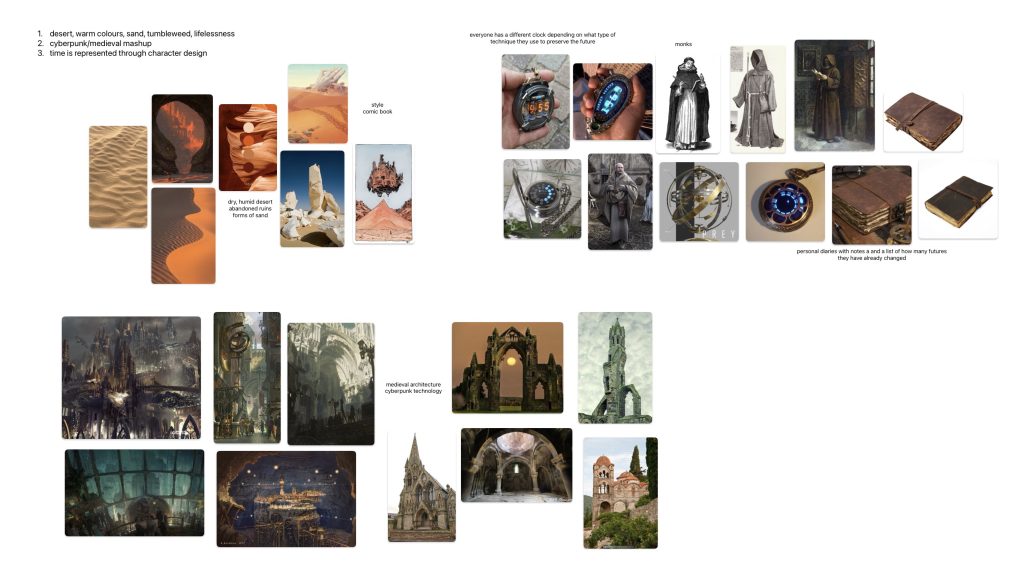
The task of this lesson was to create a reference board for the setting we were provided with.
Our synopsis was:
In a sprawling desert archive, players act as “future-keepers” tasked with recovering fragments of possible futures people abandoned. Each fragment carries emotional weight and clues. By sorting, restoring, or remixing them, players reshape imagined worlds and confront the tension between innovation, fear and hope.
Razor: All mechanics revolve around interpreting, combing, or reimagining fragments, no unrelated systems.
X-Statement: We build tomorrow from the futures we choose not to forget.
The pillars we came up with were:
- Desert, warm colours, sand, lifelessness
- Cyberpunk/medieval mashup
- Time is represented through character design
We focused on three elements off the setting: environment, architecture and character design.
Leave a Reply