White Stag

A white deer from species such as fallow deer, roe deer, or rusa, is instead referred to as a “white buck” or “white doe”. The all-white coloration is the result of leucism, a condition that causes hair and skin to lose its natural pigmentation. The white deer has played a prominent role in the mythology of many cultures.
They are considered to be messengers from the otherworld in some Celtic mythology; they also played an important role in other pre-Indo-European cultures, especially in the north. The Celts believed that the white stag would appear when one was transgressing a taboo, such as when Pwyll trespassed into Arawn’s hunting grounds. In English folklore, the white hart is associated with Herne the Hunter.
The White Stag has a message for you. Hunters of old pursued the miraculous stag, not because they expected to kill it, but because it led them in the joy of the chase to new and fresh adventures, and so to capture happiness. You may look on the White Stag as the true spirit of Scouting, springing forward and upward, ever leading you onward to leap over difficulties, to face new adventures in your active pursuit of the higher aims of Scouting.
— Baden-Powell’s farewell speech to the Scouts
Great Egret

The great egret, also known as the common egret, large egret, great white egret, or great white heron, is a large, widely distributed egret. The four subspecies are found in Asia, Africa, the Americas, and southern Europe. Recently, it has also been spreading to more northern areas of Europe. Distributed across most of the tropical and warmer temperate regions of the world, it builds tree nests in colonies close to water.
With its striking white plumage, great egret symbolises purity, grace, patience, and balance across many cultures, often seen as a divine messenger or spiritual guide, linked to creation myths like Egypt’s Bennu bird (Phoenix precursor) and revered by Maori as “kotuku,” representing ancestral spirits and enlightenment, while Native American tribes see them as mediators of peace and wisdom.
Arctic Wolf

The Arctic wolf, also known as the white wolf, polar wolf, and the Arctic grey wolf, is a subspecies of grey wolf native to the High Arctic tundra of Canada’s Queen Elizabeth Islands, from Melville Island to Ellesmere Island. Unlike some populations that move between tundra and forest regions, Arctic wolves spend their entire lives north of the northern treeline.
White wolves in mythology symbolise power, wisdom, and the spirit world, appearing as divine ancestors (Ainu), shapeshifting guardians (Native American), or powerful deities (Slavic). They represent purity, courage, and guidance, often linked to the moon, nature’s balance, or as messengers between realms, differing from dark, chaotic wolves like Fenrir in Norse myth.
Peacock

Half-white peacocks, often called “pied” or leucistic peacocks, have patches of white and normal colour due to a genetic condition (leucism) that reduces pigment in some feathers, not true albinism, making them beautiful and distinct from pure white or fully coloured birds.
The white peacock in mythology symbolizes purity, spiritual awakening, resurrection, and divine connection, representing a cleansed or illuminated soul, nirvana in Buddhism, or the Holy Spirit in Christianity. It’s seen as a rare, blessed creature associated with higher consciousness, good fortune, divine protection, and the goddess Kuan Yin in Asian lore, embodying purity, beauty, and new beginnings across cultures.
Cormorant

Cormorants nest in colonies around the shore, on trees, islets or cliffs. They are coastal rather than oceanic birds, and some have colonised inland waters. After fishing, cormorants go ashore, and are frequently seen holding their wings out in the sun.
Cormorants symbolize duality in mythology, representing both good fortune for fishermen (as guides/spirits) and greed/deception, linked to their voracious appetite and dark appearance. They often embody resourcefulness, adaptability, and connection to the spirit world, with Norwegian lore seeing them as lost souls visiting kin, while some cultures view them as soul conveyors. Their “sea raven” name and cruciform wing-drying pose further connect them to death, sacrifice, and the underworld.
Gypsy Horse
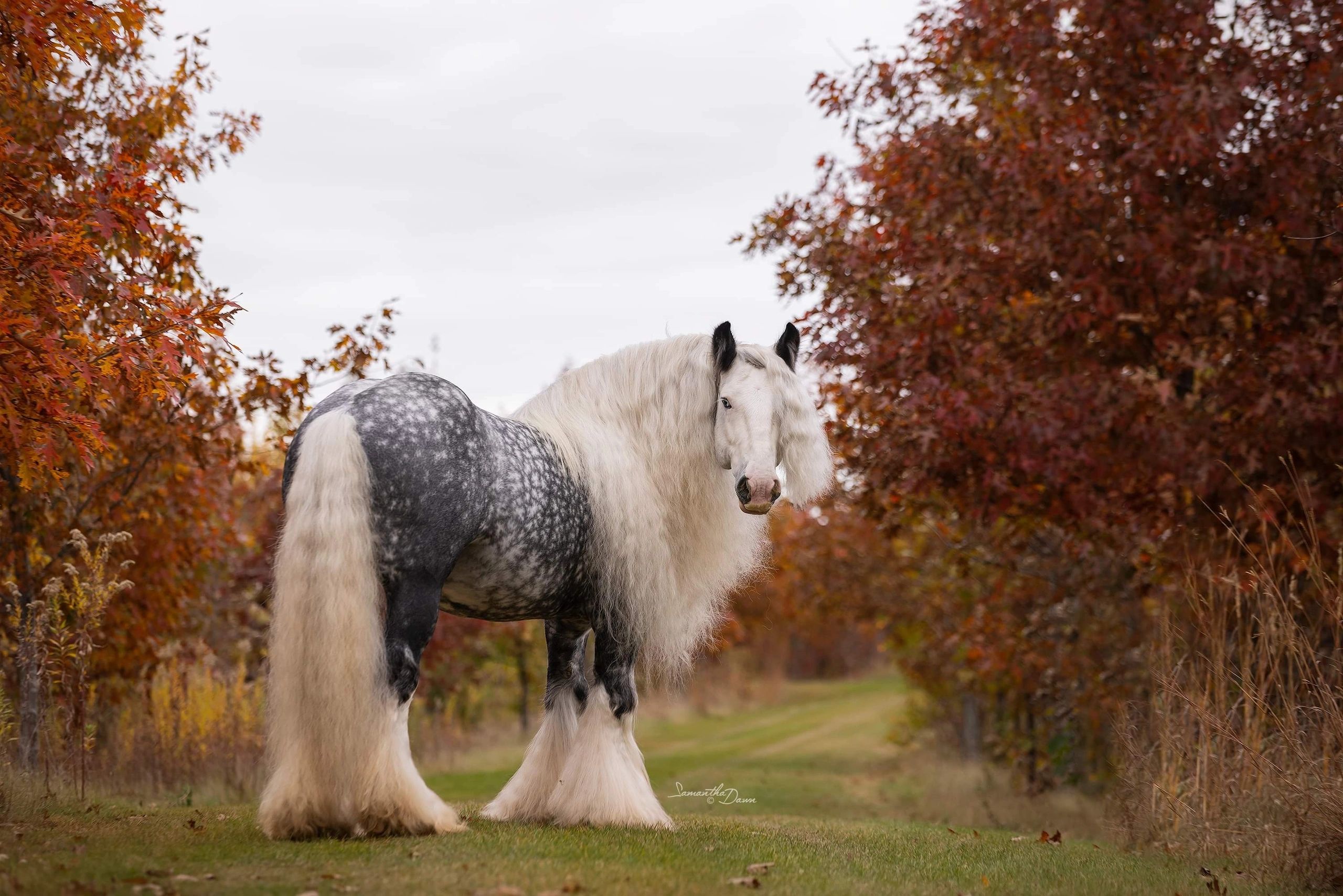
Gypsy Vanner is a small, solidly-built horse of cob conformation. The Gypsy horse is usually, but not always, piebald. It may also be skewbald or any solid colour; a solid-coloured horse with white splashing on the underbelly is called “blagdon” or “splashed”. Feathering, long hair on the legs, is considered a “characteristic and decorative feature of the Irish Cob.”
In mythology, horses symbolize power, freedom, journey, and spirit, connecting worlds; they represent strength, speed, nobility (white horses), war (Mars), the sun (Helios’ chariot), fertility (Celtic goddesses), and often act as spiritual guides or psychopomps (Sleipnir, Pegasus) for gods and souls, bridging the earthly and divine realms.
Sources:
White Stag https://en.wikipedia.org/wiki/White_stag
Great Egret https://en.wikipedia.org/wiki/Great_egret
Arctic Wolf https://en.wikipedia.org/wiki/Arctic_wolf
Peacock https://www.treehugger.com/albino-and-half-albino-peacocks-are-simply-stunning-photos-4858413
Cormorant https://en.wikipedia.org/wiki/Cormorant
Gypsy Horse https://en.wikipedia.org/wiki/Gypsy_horse https://en.wikipedia.org/wiki/Horse_symbolism