Why do people usually only think of danger, blood, when they see bright red or scarlet colors, rather than anything else? Why do people always regard warm light as dawn, safety?
I used to take these phenomena for granted until I started designing games. Then I began to think about why these colors and light carry such meanings?
Firstly, regarding colors, why are they divided into cool colors and warm colors?
In 1666, British physicist Sir Isaac Newton discovered seven spectral colors through a prism experiment and formally used the color wheel to explain the relationship between colors in 1704’s work “Opticks”.
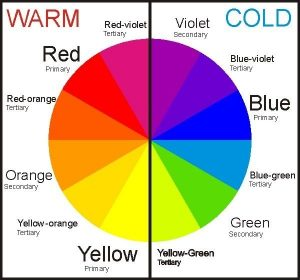
As we can see, the color wheel is formed by combining the three primary colors (red, blue, and yellow) to create secondary colors such as green, purple, and orange, while the colors filling the rest of the wheel are tertiary colors obtained by mixing the primary and secondary colors.
The longer wavelengths of the spectrum are called warm colors (red, yellow, orange), while the shorter ones are cold colors (green, purple, blue).
They are called cold and warm colors because psychologically, people have different feelings when looking at these colors. Red, orange, and yellow can be seen in flames and the sun, all of which are warm. Conversely, cold colors are often associated with cool or cold things, such as ponds, oceans, and grass.
Some studies also suggest that cold and warm colors come from human’s primitive instincts. Human ancestors needed to warm themselves around fires and cook food with flames, so humans subconsciously think these colors are warm, while cold colors often bring them coldness.
Then there is the topic of light. Light often appears in combination with colors, such as yellow light, red light, blue light, etc. These lights can also affect people’s emotions under different colors and intensities.
Some studies have shown that low-saturation light sources usually can stimulate neutral emotions (such as relaxation and calmness), while high-saturation light sources often trigger negative emotions (such as tension, fear, irritability, tiredness, listlessness and apathy). As for medium saturation, warm-colored lights usually can generate positive emotions (such as: happiness, excitement, vitality, satisfaction and romance), while cold-colored lights mainly stimulate neutral emotions (such as relaxation and calmness).
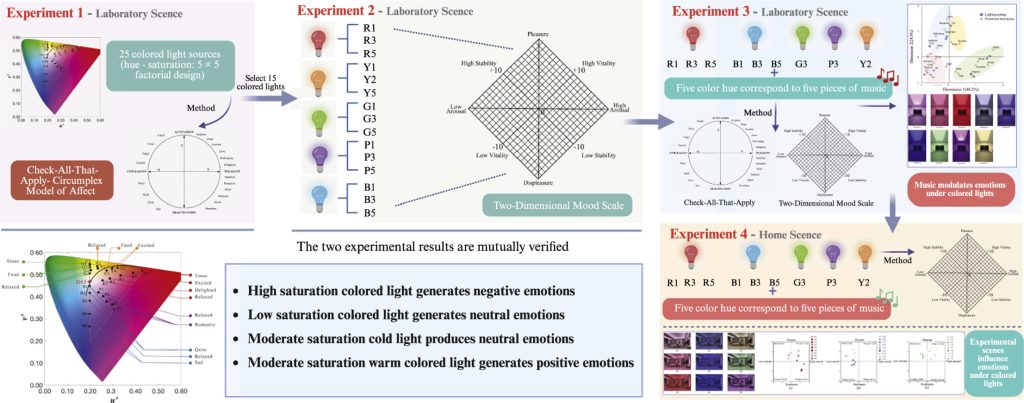
As for why bright light often represents positive emotions and darkness often represents negative emotions, it is related to night and day. Because humans are not nocturnal animals, and many predators like to hide in darkness, humans have an instinctive fear of darkness. During the day, people can do almost everything they can, and the probability of being attacked by predators is also reduced. In many novels and films, dawn is often a sign of hope, while darkness often fills with despair, which also has a certain impact on people’s perception of light and darkness.

sources:Frontiers | Color and psychological functioning: a review of theoretical and empirical work