Since the mechanism design was developed on UE5, and I have already completed the construction of the level white box and migrated it to the UE5 engine, so that the mechanism designer can apply the mechanisms they have developed to the level white box in the same engine environment. At the same time, we also created a GitHub repository to improve version control and enable team members to share project files more efficiently.
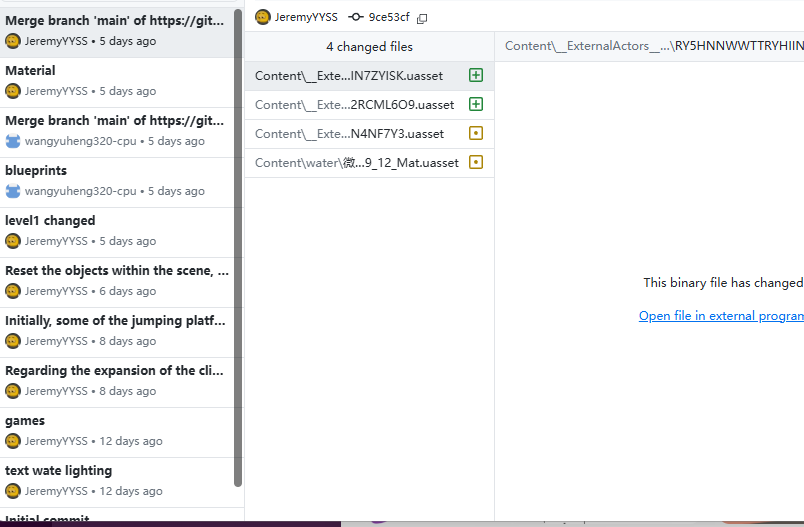
Git Hub repository
During the first game test, a communication issue arose. Due to the incomplete development of the game mechanics, environmental resources, and puzzle-solving system, the white-box version I created contained more temporary jump challenges than originally planned. This led to some confusion within the team, as the prototype did not fully align with the puzzle-solving direction we had discussed before.
In my opinion, this situation occurred because the level design was largely dependent on other parts of the project, such as game mechanics, textures, and interaction resources. Due to the lack of these elements, I could only maintain the playability of the prototype by creating a large number of temporary space-jumping challenges, this caused some confusion within the team because the prototype did not fully represent the puzzle-solving direction we had discussed.
Looking back, At that stage, I focused too much on maintaining a playable prototype and used temporary jumping sections as a quick solution.I also realized that I should have explained this more clearly to the team, so that everyone could understand which parts were temporarily needed and which were the core elements.
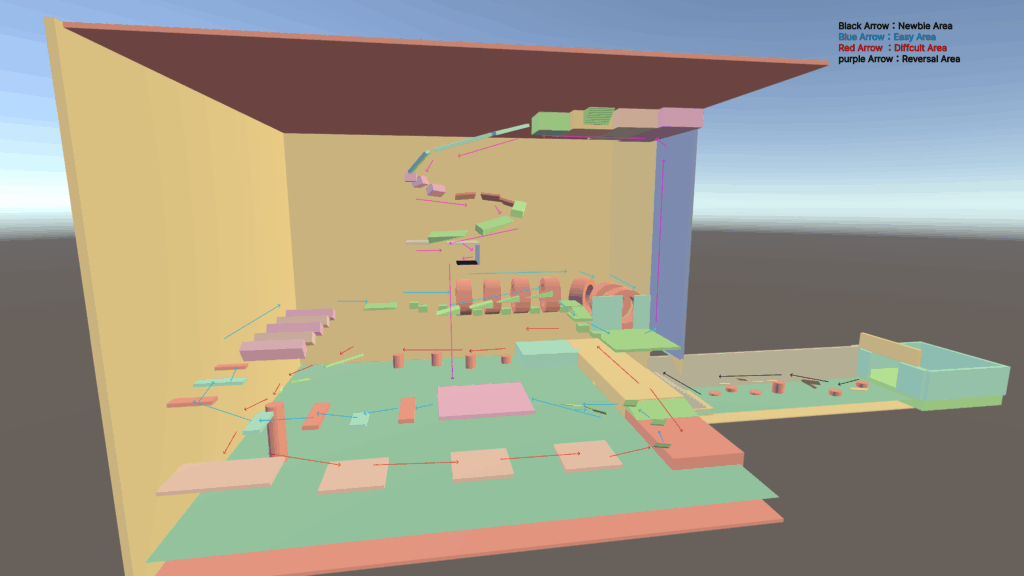
The first version of the game level flowchart before the game testing in the week 5
Unfortunately, our team had a disagreement on the direction of the prototype. To properly address this issue, I sought advice from Professor Marrie and agreed to have a face-to-face meeting on the afternoon of the sixth week.
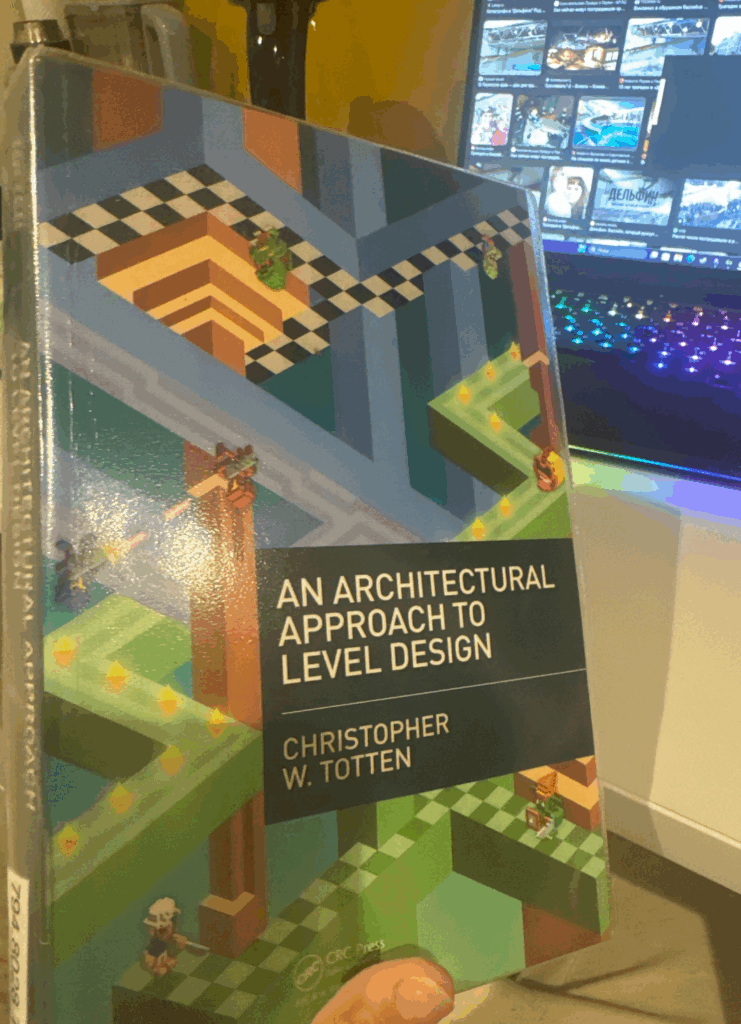
At this stage, I also began reading “An Architectural Approach to Level Design”. This book was very helpful as it taught me to think about level design from an angle that I had never encountered before – architectural principles, rather than just the obstacles and barriers in the game. It encouraged me to consider spatial flow, spatial hierarchy, player movement paths and methods, as well as how the architectural layout guides attention.
The discussions in the book about spatial hierarchy and the relationship between the main space and the secondary areas profoundly influenced my design approach. For instance, I intended to make the swimming pool the central element of the entire room. Therefore, I designed multiple smaller spaces around the main swimming pool area and connected these areas through a clear spatial layout. This not only provided users with a more reasonable exploration path but also enhanced the visual coherence of the environment.
This research is closely related to my white-box design because in the early versions, there were multiple platforms and temporary jumping paths, but the overall spatial logic was not clear. After reading this book, I began to think more deeply: how can the pool room play a central role in the space, how can the side rooms connect to the main path, and how should players understand their progress through the layout itself, rather than relying solely on text or game mechanics.
Reflection
This week, I realized that the playable prototype is not only a way to conduct testing, but also a means to evaluate whether the overall level design effectively conveys the intended experience.
The initial playthrough indicated that although the levels were well-designed in terms of playability, the temporary jumping areas made the design direction unclear. Through this feedback, I realized the importance of spatial structure, player guidance, and internal communication within the team.
Reading “An Architectural Approach to Level Design” also changed my understanding of level design. I began to pay more attention to spatial flow, hierarchical structure, and how the environment itself guides the players, rather than mainly relying on game mechanics or textual instructions.