This week saw another round of game testing. My main task this week was to do my best to advance the level design of the game to prepare for this test. Because only after I completed the design could the mechanism designers and environment artists apply their mechanisms and texture assets to the latest version of the levels.
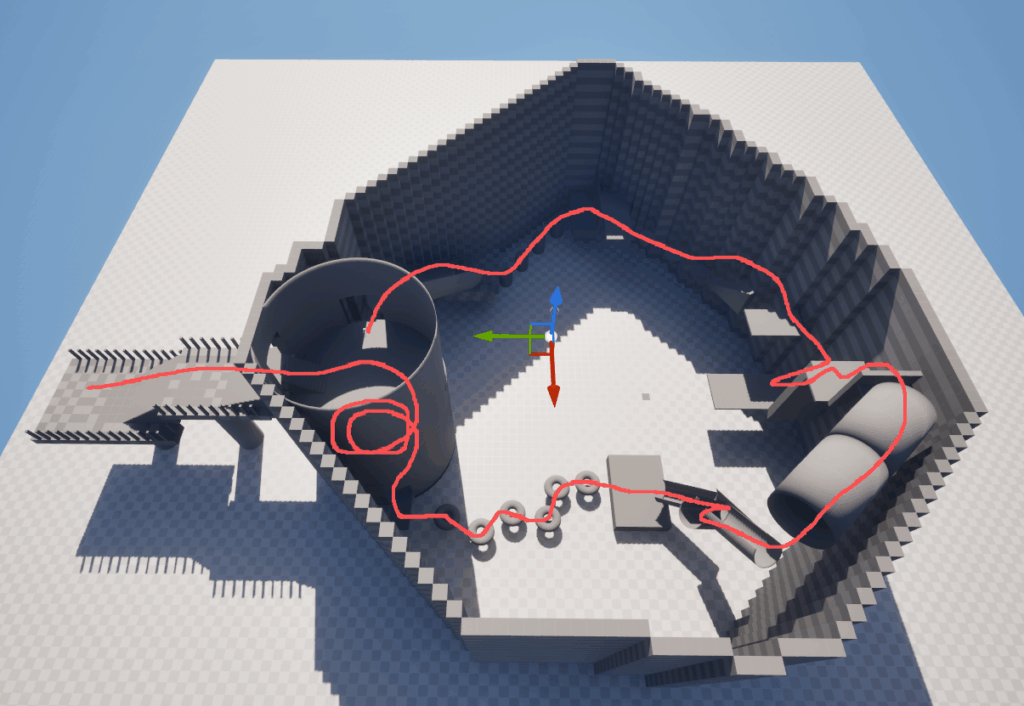
Updated Level 1 whitebox with the intended player route marked in red. This route was used to check whether the level had a clear circulation path before the playtest.
At the same time, I also asked Erik about the appearance of the 1.5 level. He drew two diagrams for me and I followed his instructions to build the 1.5 level. In this level, our puzzle-playing method will be applied.
Our game consists of two levels, the 1 level and the 1.5 level. The player will start from the platform at the top of the cylinder, passing through several slides, jumping structures and climbing structures before returning to the cylinder, which is the starting point. During this process, the player will collect three collectibles. These collectibles are the key items to open the door to the 1.5 level. In the 1.5 level, we plan to place a jigsaw puzzle with a butterfly theme.
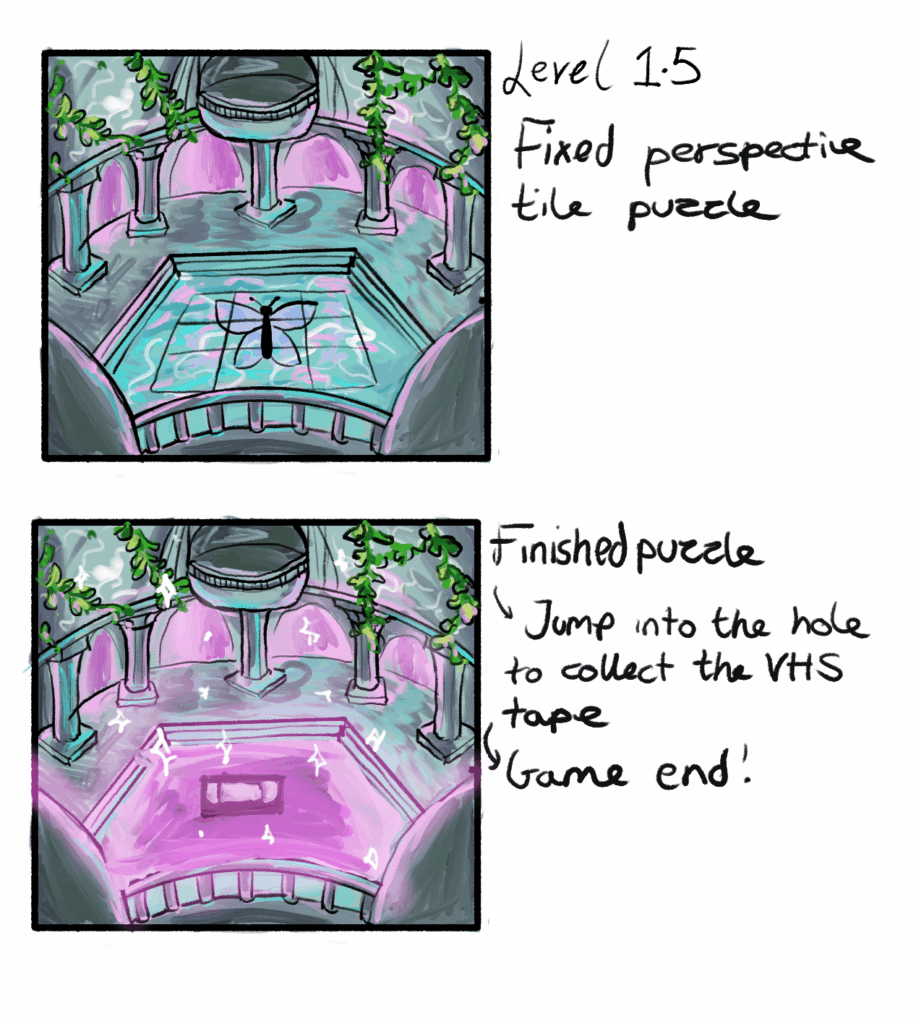
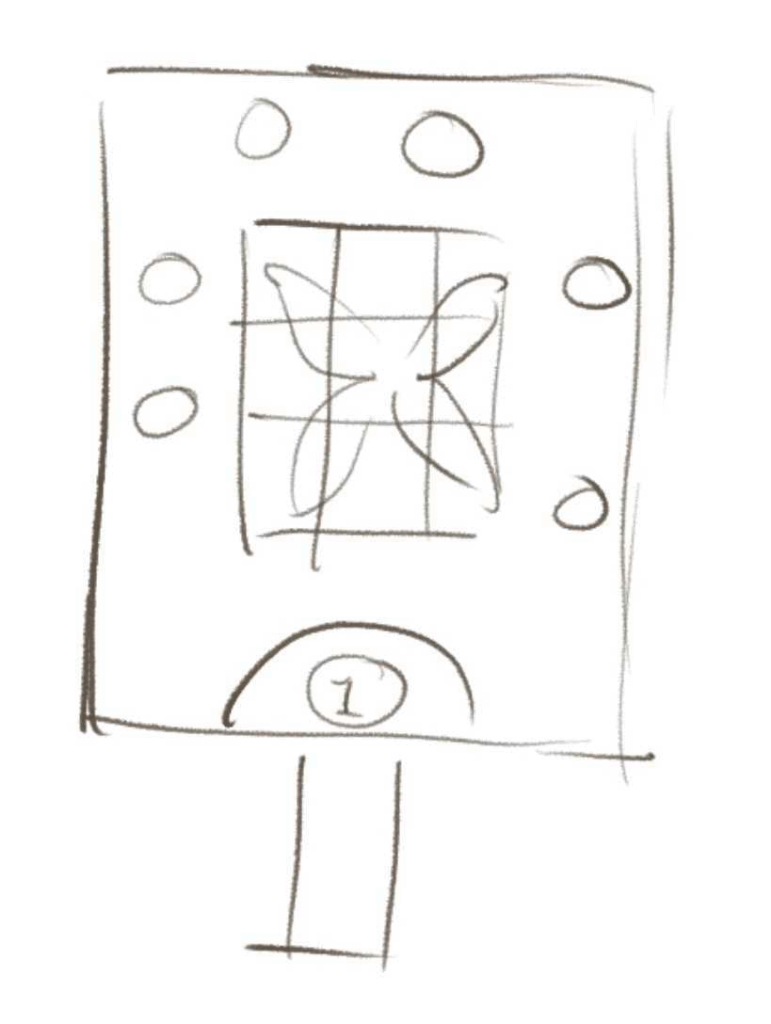
Diagram of Level 1.5
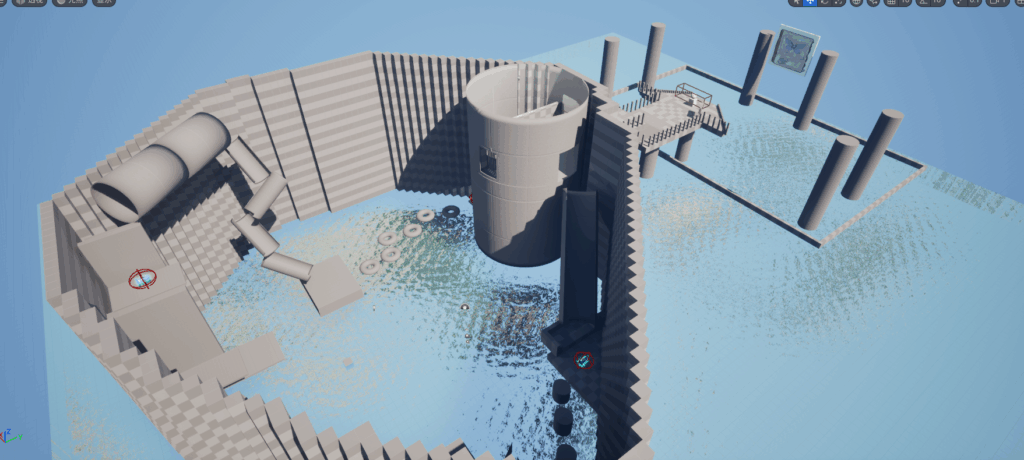
The schematic diagram of the entire game level (as of this test)
According to the requirements of the mechanism designer, I placed many vertical boards in the scene where the player needs to pass through. These boards are not obstacles like walls that prevent the player from moving forward. Instead, they are “paths” that the player needs to use the “climbing” mechanism to cross and continue moving forward. After activating this mechanism, the player will be able to move along the walls like walking on the ground, scaling and navigating around them, providing a unique gaming experience.
This is already the third version of the game’s white box that I have iterated. Unlike the previous two versions, this one is not based on my personal experience. Instead, it was constructed according to the opinions and requirements of the team members. Therefore, it is the version that is closest to our goal.
By the time of this test, the basic structure of Level 1 and Level 1.5 had been completed, and the main mechanics, including wall climbing and puzzle-solving, had been implemented in a testable form. The next stage was for the environment artist to apply more textures and materials, and for the team to refine the mechanics based on playtest feedback.
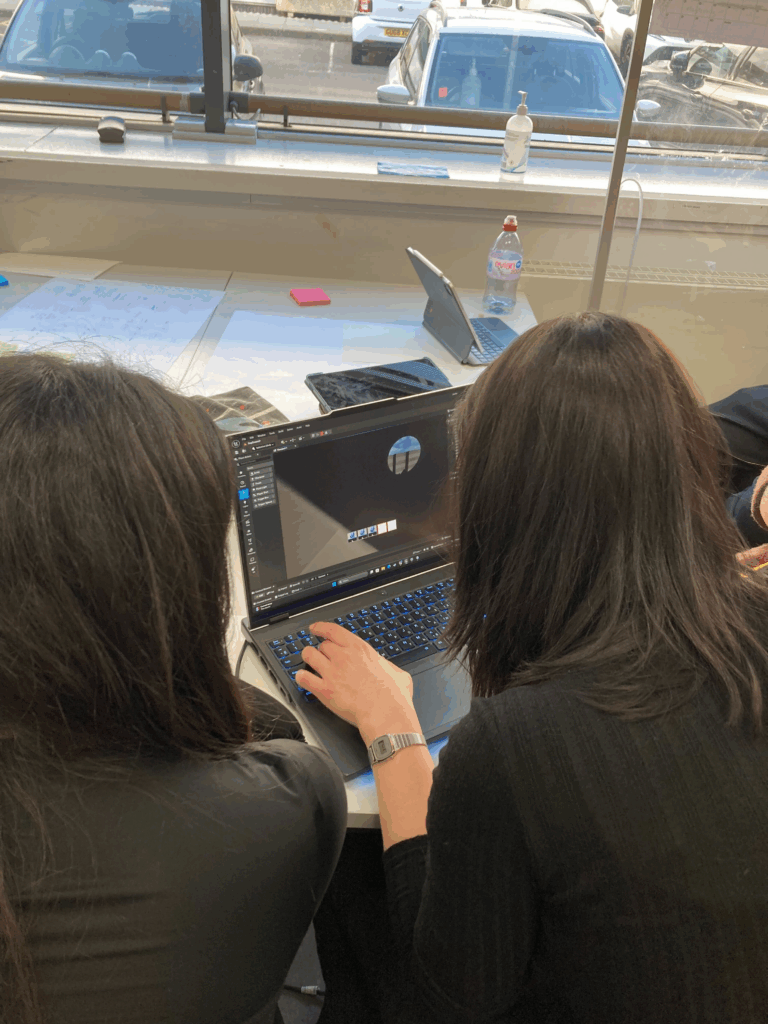
On the game testing day, some students were playing our game for the first time.
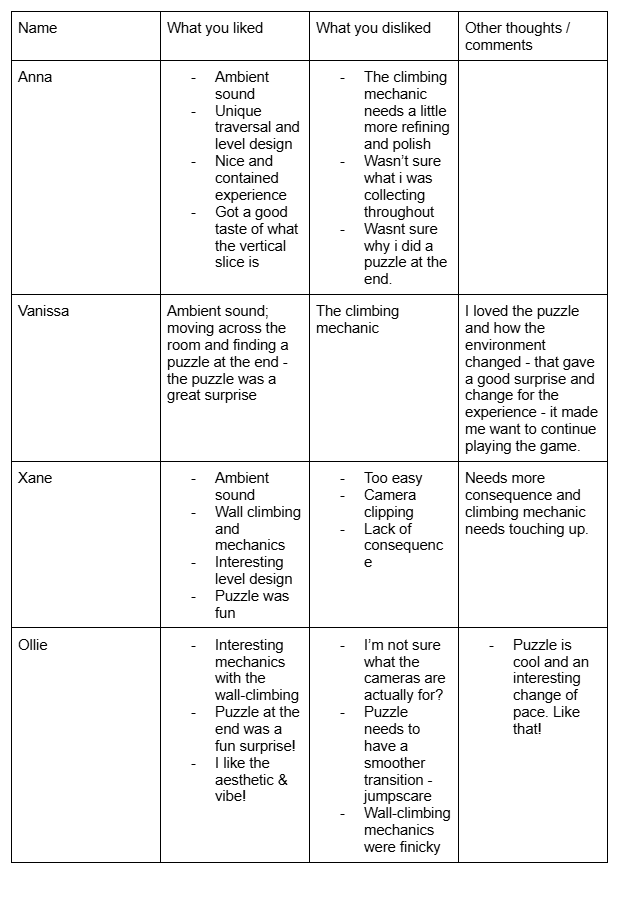
The playtest feedback indicates that the overall design direction of the levels is effective. Many players have responded positively to the environmental sound effects, the climbing mechanism, the enclosed vertical slices, and the surprising effect of the final puzzle. This suggests that the core concept of creating a dreamlike puzzle-solving space through exploration and environmental changes is effective.
However, the feedback also revealed several issues. Firstly, players are not always clear about the purpose of collecting items. Some players do not understand what they are collecting and do not know why they need to complete the final puzzle. Secondly, the climbing mechanism still needs further optimization, especially in terms of reliability and camera editing. Thirdly, some players think that the transition of the puzzles should be smoother, and the game needs stronger consequence feedback or clearer prompts after the completion operation.
Based on these feedbacks, my design improvement for the next stage should focus on clearer player guidance, stronger visual communication, and a smoother transition between levels 1 and 1.5. For instance, it is necessary to make the collectible items more visually distinguishable, add more explicit environmental cues to explain why players should collect them, and optimize the path between the main pool area and the puzzle area, providing players with more game guidance so that they know what to do in the game and why they should do it.
And some innovative puzzle concepts proposed during the early stage of development, such as “Cutty”, were removed during later iterations. Although these ideas provided interesting possibilities for the narrative and puzzle experience, implementing them required additional interaction systems, technical development, and testing time that exceeded our current production scope. Therefore, the team decided to prioritise the core exploration, climbing mechanics, and existing puzzle experience, ensuring that the final version could be completed with a higher level of polish.
Reflection
This trial play made me realize that even if a level is technically playable, if the goals, feedback, and transition sequences are not clearly communicated, players will still feel confused. Although the overall structure of the level is more stable than the previous version based on jumping, players still need clearer reasons to collect items and complete the final puzzle. Next, I need to address these issues.