Character artist role
Character designers visualise and create the look of individual characters. They do this off descriptions given to them by the director which include things such as personality, physical traits. They may also take inspiration from scripts. Through these they will then be able to understand the characters and work out the best way to communicate their personalities through clothing, facial expressions, poses and body language.
They will carry out research into the anatomy of the character and relevant fashion styles, etc. from which they will create multiple iteration of the characters. They are then presented to the director whose feedback will be addressed to achieve a result they’re most happy with.
Once approved, model sheets are made to show the character at different angles. This is to ensure that animation is “on model”. Storyboard artist will also look at these designs to incorporate into their work as they progress.
Role and responsibilities of a character artist:
- Working with scriptwriters, designers and developers on the loo and style the character will be drawn in.
- Researching the look, style and genre of the game
- Developing various versions of the character looks
- Infusing personality, visual cues, expressions, and distinctive body language into the characters
- Make the characters humanly relatable to engage the audience
- Understand the character and draw accordingly
- Revise artwork according to feedback
- Adhere to production schedules.
A good character design is one where you’d be able to tell the characters story and role through the use of purposeful colour palettes in which the colours support each other with a clear hierarchy, clear distinctive silhouettes utilising shape language, exaggerated characteristics to elicit emotional and psychological responses from an audience such as how they stand or walk, etc.
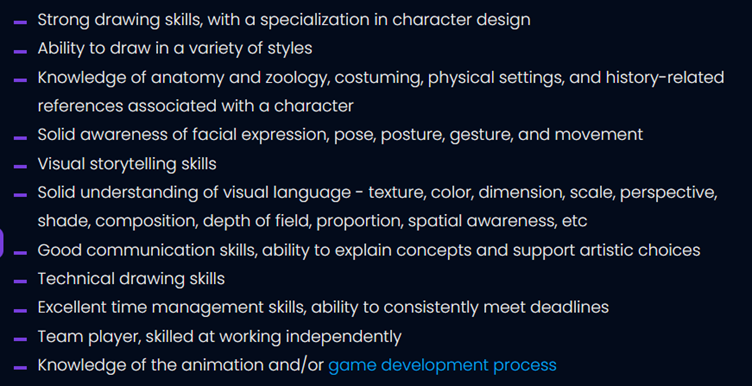
To do this, the artist needs a range of skills:
https://www.cgspectrum.com/career-pathways/character-designer
https://www.screenskills.com/job-profiles/browse/animation/pre-production/character-designer
https://www.studiobinder.com/blog/what-is-character-design-definition
Background artist role
Create immersive environments that set the tone for animation, videogames, etc. they are essential for narrative storytelling and ensure that the story is enhanced and immersive.
During storyboarding and style development, they create a list of the backgrounds needed, then they create designs that fit the style of the animation or game, considering colour schemes, texture and light, from which they will create rough layouts. Background artists also make it so that no object in the foreground or background isn’t too distracting unless it’s to be interacted with to ensure seamless integration when working with layout artists, storyboard artists, and animators. the backgrounds are fine-tuned for effective depth perception, etc.
These designs are presented to the director, addressing any feedback to create better designs to get approved. These designs will then be painted better and refined for 2D, and for 3D, the artist collaborates with modelers and texture artists to create the 3D environment. Placeholders are also often used to ensure scale consistency and ensure proper composition, layouts and visual flow.
In post-production, the backgrounds are combined with the characters and visual effects in the composing stage.
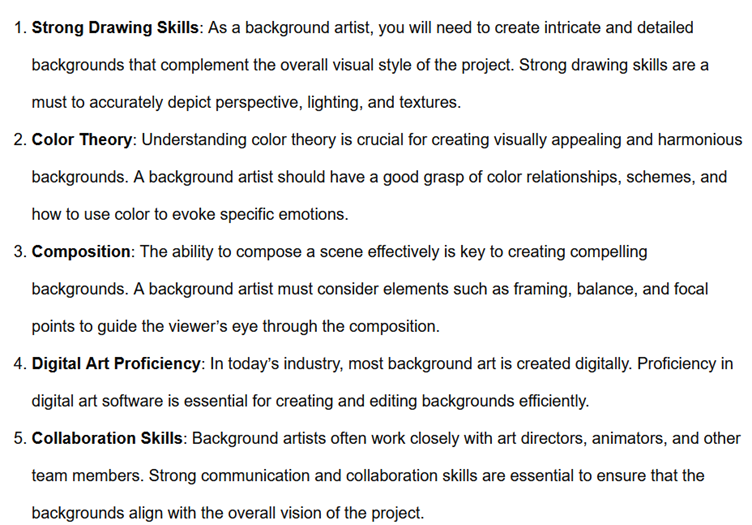
A combination of artistic, technical and professional skills are needed to create concept art, sketches and compelling environments for animation, videogames or films. A background artist must have a strong eye for detail, a strong sense of perspective, and the ability to evoke the right mood and atmosphere through their art.
https://www.screenskills.com/job-profiles/browse/animation/pre-production/background-designer
https://garagefarm.net/blog/background-artists-the-masters-behind-visual-worlds
https://www.yellowbrick.co/blog/animation/the-path-to-a-successful-background-artist-career