
At the start and end of each level the player will be at home in their room, where they get to talk to themselves in the mirror (the character you play as). There they will follow the simple linear narrative, get ready, read the list and leave, then come back home after shopping to receive a performance evaluation of whether they got all list items.
When speaking to herself:

During animations: Character sprites appear within mirror frame. Text bubble disappears any time a core animation plays, it does not disappear during casual expression changes.


When dialogue finishes: options like “Get Ready”, “Present”, “Move” and “Talk” should appear.

When pressing Get Ready, the player initiates a dialogue regarding it and gets options on how they want to appear. Some options will lead to poor or better performance. This part can be skipped, leading to the character just putting on her standard wear in no time.
E.g. Clothes that stand out lead to poor performance, hair down lead to poor performance, standard clothes and tied hair lead to better performance.
(Poor performance would be something like increased sensitivity to encounters. The point is that the player will always go for the safe options.)
When pressing Present, you can present stuff you find around the room, such as Comfortable Shoes, Earbuds, Snack or Medication, which initiate new dialogues that will lead to a new powerup, unless it’s a random object, then the character will simply comment on it. The options should show up similarly to this.

When pressing Talk, the player can initiate conversation about how she feels, favourite snacks, etc.
E.g. Maybe her favourite snacks or foods are something that will almost always be on the list, therefore making it easier to remember and especially disappointing if forgotten.
When pressing Move, the player can leave this portion of the game, move around the house and leave to the supermarket. They can re-enter by interacting with the Vanity.
When finding objects around the room: An icon of the item appears on the screen and fades. A comment regarding the item appears in a dialogue box.

In this room you can find ear buds, comfortable shoes, and “food for thought”, etc. which are some perks/power-ups the player can use while shopping.
- Ear Buds – To become immune to NPCs for more than 15 seconds (to be checked in testing)
- Comfortable shoes – To increase max walking speed
- “Food for thought” – Random found snack to multiply how many hints you can get at the quiet zones
Stealth
Avoid NPCs and hide in plain sight by acting like an NPC.
Derivative mechanics
Peeking over corners – allows player to see if anyone is coming over a corner
Camouflaging by shaded shelves – must play a minigame to stay hidden and not be exposed. Failing the minigame leads to the NPC attacking you. There are multiple of these places at each isle and will de-spawn after use and re-spawn somewhere else.
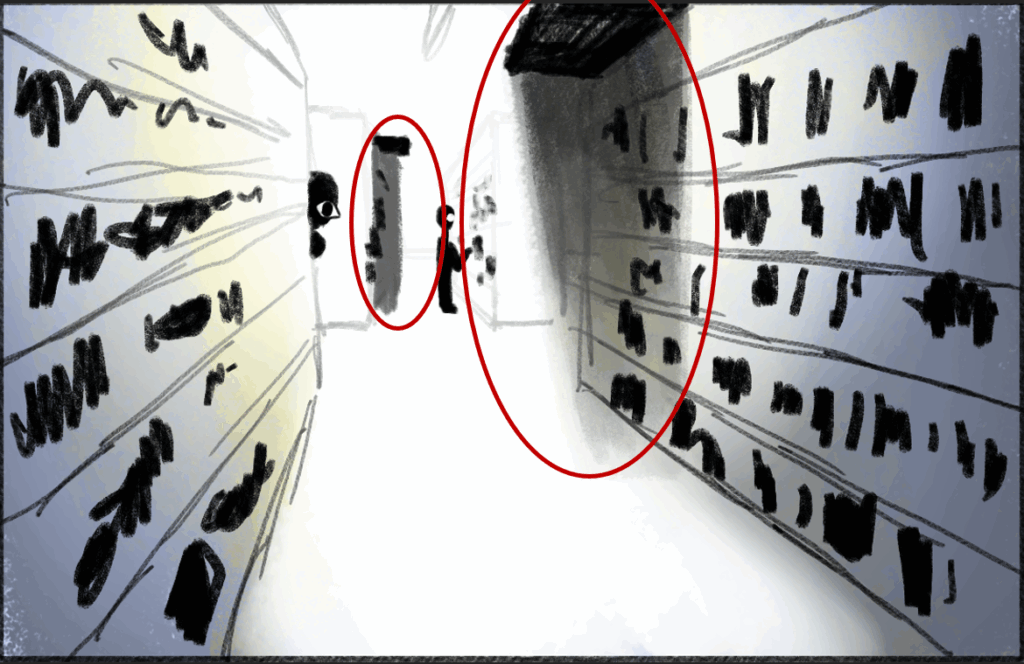

Keep it moving – Can’t be seen at the same spot for longer than 7s, must circle back to it if needed.
NPC mechanics
Anything that could make the player stand out in any way will trigger the NPCs. Once they see you doing any of the following, they will “attack”. I’ve noted down how long the action can be performed for before the attack.
- Making eye contact, (0s)
- Bumping into them, (0s)
- crouching down randomly, (0s)
- tripping, (0s)
- running, (0s)
- looking over isle corner, (1s)
- looking way further up, (2s)
- looking way further down, (2s)
- crouching down by a shelf, (7s)
- standing in front of a shelf for too long, (7s)

Example of the range at which they can affect you:

Range should be adjusted in testing.
The “attacks” consist of the NPCs saying a random mean comment you can’t fight or asking you random mean questions or just ask random things that need to be answered in time.
e.g. They tell you have terrible taste in food or ask a random math or trivia question or ask why you left the house looking like that
Answer wrong > NPC is weirded out or insults your intelligence = anxiety increases by 10%, answer well and you’re okay, no ability to answer = anxiety increases by 5%, however this needs to be experimented with.


Store Progression
The store arrangement changes each level, and the number of NPCs increases, but progressively getting more perks at your disposal.
At some levels some new types of NPCs appear:
e.g. child playing in the store with the cart can ram into you throwing you onto the ground, making the player lose some of the items in their cart + increasing the anxiety.
e.g. kind NPC smiles at you depleting anxiety slightly
In-level progression – The store changes in appearance according to anxiety levels, making it brighter and bleaker, and the shadows darker. Some pathways will be blocked forcing the player to find other pathways to get to the items and the quiet areas.
Quiet spaces
Quiet spaces appear as spaces where the lights don’t work, giving the player a space to relax by removing the nearby NPCs, de-plead anxiety and receive a hint (e.g. isle location, type of food, if it’s a drink, etc.) for the items on the list. There can be more than one available at the same time, and will de-spawn with the lights flickering back on after use, and re-spawn somewhere with a flicker off. When the lights flicker back on, the space goes back to how it was originally,
e.g. the window, table and foliage in the image below disappear.

Systems
Scoring is dependent on how many correct items are gotten, and if those correct items are good quality (e.g. making sure you check if the tomatoes are rotten in any way, or if a pasta bag is slightly open, if there’s any broken eggs in the egg container, etc.).
Getting all the correct items but poor quality could get the final score from an S to a B.
Constraints
Player cannot use more than one or two perks/power-ups each level
Player should avoid taking a picture of the list for the experience, however there’s nothing that can stop them from doing so.