This week we had to make a playable prototype. Because we were unable to come to any conclusive mechanics, we decided to follow the advice from one of the guests and make a paper prototype. Cindy and I thought about how we could make the word puzzle and we both agreed that printing it out and cutting the words would be the best way to do it. Nam also sketched out more details to his mechanic.


The second one is the first, except leaves cover the interface, concentrated onto the puzzle pieces, the player would have to sweep them away and form the puzzle in time, or things that have influence on the senses manifest by covering up the interface like a smell.
In the third one you have to match the colours, which is to catch the player off guard by switching up the pattern of gameplay they were following.
I liked this idea so I suggested a way to complicate it slightly by making the player to figure out that, for example, if the colour yellow and magenta come up, they would have to use the colour red in their answer and not just the same colours back, however I had to also keep in mind colour blindness which may change hoe a player plays this minigame. Nam liked this idea as well.
We agreed we were going to meet up Thursday morning to make the paper prototype, but I decided to get a head start and decided I would go in on Wednesday to set up everything and make sure the word puzzle existed, and on Thursday Nam and Cindy would make the additional parts of the shapes prototype.
I began by going into Slack to get the script for day one written by Cindy and typed it back out so I could add or remove words, print it and cut apart the word puzzles on Thursday morning.

After I did this, I began setting up the playing area for the shapes prototype. I realised the white shapes would be hard to see against the white paper, so I added some beige journal paper behind it, hoping it wouldn’t confuse anyone as I couldn’t find any coloured paper.

On Thursday Cindy and I began colour coding each line and cutting up the words for the word puzzle, we also drew some of the pieces, and after we were she worked with Nam on the shapes prototype.


I didn’t because I realised the paper was way to flimsy to be played with and had to stick all the cut-up pieces onto card paper for easier handling and recolour the back too, which wasn’t the best, but way better than before.

We then arranged Tyler’s lines and added the jumbled word pieces to match ready for playtesting. We timed how long the players spend on each puzzle as well.

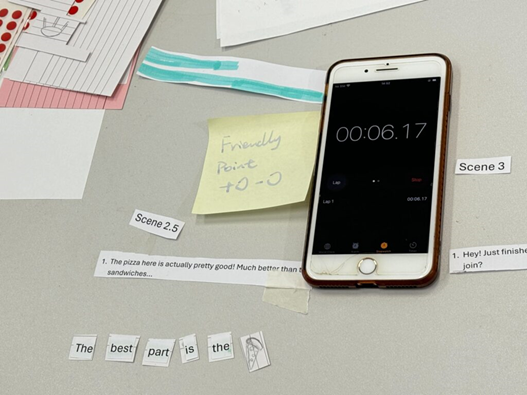
We had to somewhat split into two groups for the playtesting as we had two prototypes, so I took notes for the word puzzle one, and Cindy alternated between the two.
Marie:
- The first mini game means that there will Always be trick words
- Crust looks like sparkles
- Language contrasts some countries use different words for some things (soccer/football)
- Sentences should feel full through the mini game and not only make sense when completed or the player might not pick the correct dialogue option and just try to form a coherent sentence.
- Game suggestion: The golden idol
Comment on merging mechanics:
- Since we’re already friends with Tyler, the game could start off easier, so here we could use the shape matching game for Tyler, and it should be a harder mini game for the other character we don’t know. It would get easier the more (more friendships points) you get to know them, and we could also make it so that even with Tyler the game could get harder if you lose friendship points.
Shape game:
- Add more shapes to add difficulty because it was really easy
Game tester 2:
- Maybe have words be different colours as a way to merge the mechanics too.
- Says overall he liked the gameplay, I’m not sure if he actually enjoyed it as watching him play seemed like it was more frustrating than fun. He did say the frustration plays into the themes of the game.
Vanissa:
- Should consider adding more blunt negative options
Comment:
- Having no direct yes or no adds some depth where the player has to think about how they want to structure the sentence to say what they want to say.
- Some dialogue options are too long
- The drawings came off as a thought or nonverbal options, making the player think it’s not a dialogue option when just putting it in on its own
- Is no answer a response? Sometimes players feel like they don’t have to respond.
- More people drawings to symbolise answers as well. Ex drinking drawing, thinking drawing.
Ollie, the GDD creator of Backchat:
- Some drawings are better as words like the pizza crust
- First player to get pretty much every single answer right to a tee.
Comment from outside play test:
- To reduce the number of possible answers, make some words be combined with other words. Ex. [I like] instead of [I][like]
Conclusions:
Players put together shorter answers even though they were not on a time limit.
Players often didn’t include certain options like the pictures because they couldn’t interpret them, so they made sentences avoiding them.
Overall players liked the gameplay but felt it was too hard and one found the shape mechanic more fun.
Players rarely put together the sentences the “correct way” or the same exact way as each other, meaning we will have to have either multiple possible answers or force the player to only be able to combine certain pieces.
In conclusion, even though players found it to be more engaging than the shape mechanic, they did find it too hard to form the correct sentences (which was our exact worry as there were always too many possible sentences to form and every player thinks differently) and wished it was more like the shape mechanic. They all wished they was a way to merge them.
Following this playtest, I decided to sit and start writing down every single possible sentence a player could create, but I quickly stopped and realised it just wasn’t going to work. I decided to start working on something that includes both shape mechanic and dialogue through reworking the UI, so the player no longer pieces sentences together, but instead forms the shape puzzle and once completed the sentence appears in the dialogue bubble according to whether you used the right pieces.

The original shape idea as I understand is would be kind of weird? The player completes the shape and then the sentence appears in the dialogue box which would feel disconnected with the current UI design which is set for first-person gameplay. Makin the dialogue appear after inputting shapes wouldn’t feel like you’re actually conversing with the character. Or we just see how the characters react emotionally without dialogue, which would also feel disconnected because of the current UI design.
Because there’s no words in the shape puzzle, it doesn’t feel complete to me, especially because I perceived what my teammate said as removal of dialogue all together and just showing the NPC reacting accordingly same as if something was visibly said to the player, which I realised was not the actual gameplay my teammate had in mind after I began brainstorming a way to merge the mechanics and shared it with the group.
Because the game Florence was referenced a lot for the shapes mechanic, I assumed my teammate wanted Backchat to have minimal dialogue as well, which is why I came up with this specific way of merging the mechanics, so we wouldn’t have to get rid of dialogue.
My issue with the UI from the GDD is that I somewhat didn’t like how there’s a character on both halves of the screen, sized the same, but one is lower down, making it look like both characters are supposed to be aligned, so I think to fix it would be best to:
Make them take up different amounts of space on the screen, so that the MC appears to be more unified with the UI, so a mix of 1st and 3rd person
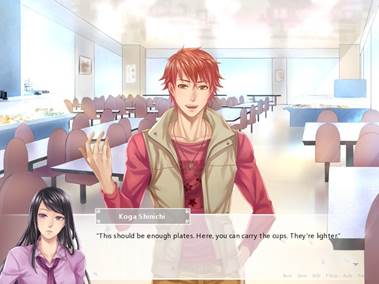

Or to make him take up as much space by making him visibly appear to be interacting with the NPCs, so fully 3rd person.


As at this point we had decided as a team that the word puzzle mechanic needed far too much work to be done, I gave it up momentarily for the shape mechanic and sketched something that would both include dialogue and the puzzle.
Evaluation: This is just really ugly and poorly designed. The shape reference takes up way too much unnecessary space and is too obvious to the player, additionally there is no space for the puzzle pieces, and there’s too much space between the characters. Since I still want the game to be somewhat challenging, I would prefer to have the shape reference be somewhat hard to follow or notice such as in the NPCs speech bubble, but I was afraid it would look odd and so I didn’t do this and focused on experimenting with placement of the components over gameplay.

I liked this one more, space usage is more optimised. The characters are brought closer together on one side where we see the sentences being spoken, and on the other side there’s space for the puzzle pieces and the reference is, so it doesn’t cover the characters. The NPC sprites will emote together with their responses. This version would make the player feel responsible for the MC over being the MC. The player acts more as a helper(?), or as someone with control over his life, kind of like in The Sims.

These ones have terrible composition, the screen is filled up too much unnecessarily, or major UI elements are missing.

I sketched some more and the last one with the square window looks quite nice as the square is the MC’s head, however it’s also kind of boring and doesn’t give much of a change for abstract UI décor from the GDD.
At the end when I shared a few on the group chat and Nam told me it was exactly what he was envisioning, which I was surprised about as I had assumed he wanted dialogue gone, so that’s when I realised we had a misunderstanding on my part.