class notes:
Making pillars:
Guiding Light
Design pillars should act as the primary reference for all design decisions.
For every new feature, always ask:
“Does this design serve at least one pillar?”
3–6 Pillars (Controlled Quantity)
The ideal number of design pillars is three to six.
Too many pillars dilute focus.
A well-scoped set of pillars helps to:
* Align the team on priorities
* Maintain consistency in decision-making
Concise & Specific
Each pillar should:
* Have a clear, memorable title
* Be supported by 1–2 concrete sentences
Every sentence should deepen the understanding of the game’s core experience.
Avoid vague, slogan-like statements.
Adaptive & Evolving
Design pillars are not static.
As the team progresses through:
* Prototype testing
* Mechanic iteration
* Shared learning
The pillars should be deliberately reviewed and refined.
KEY TAKEAWAYS:
1.Pillars are Guiding Lights
Pillars are pivotal for setting out and staying true to the vision for the game. They help ensure every feature is aligned with what the game is trying to say as a whole. Great pillars are concise, but informative.
2.Map Actions and Resources in Loops
Game Loops are the crucial in mapping out the player’s action from the most repetitive, to the highest-level goals. Ensure the taps and sinks for all resources are clearly noted in the diagram.
3.Meta Systems are for the Long Haul
Meta Systems are invaluable in setting up long-term systemic goals,adding layers of game depth,providing various forms of progression, and maintaining player motivation.
Class activities:
We need to choose a game that we have played and like, summarize its core pillars and looping mechanics, and write it down.
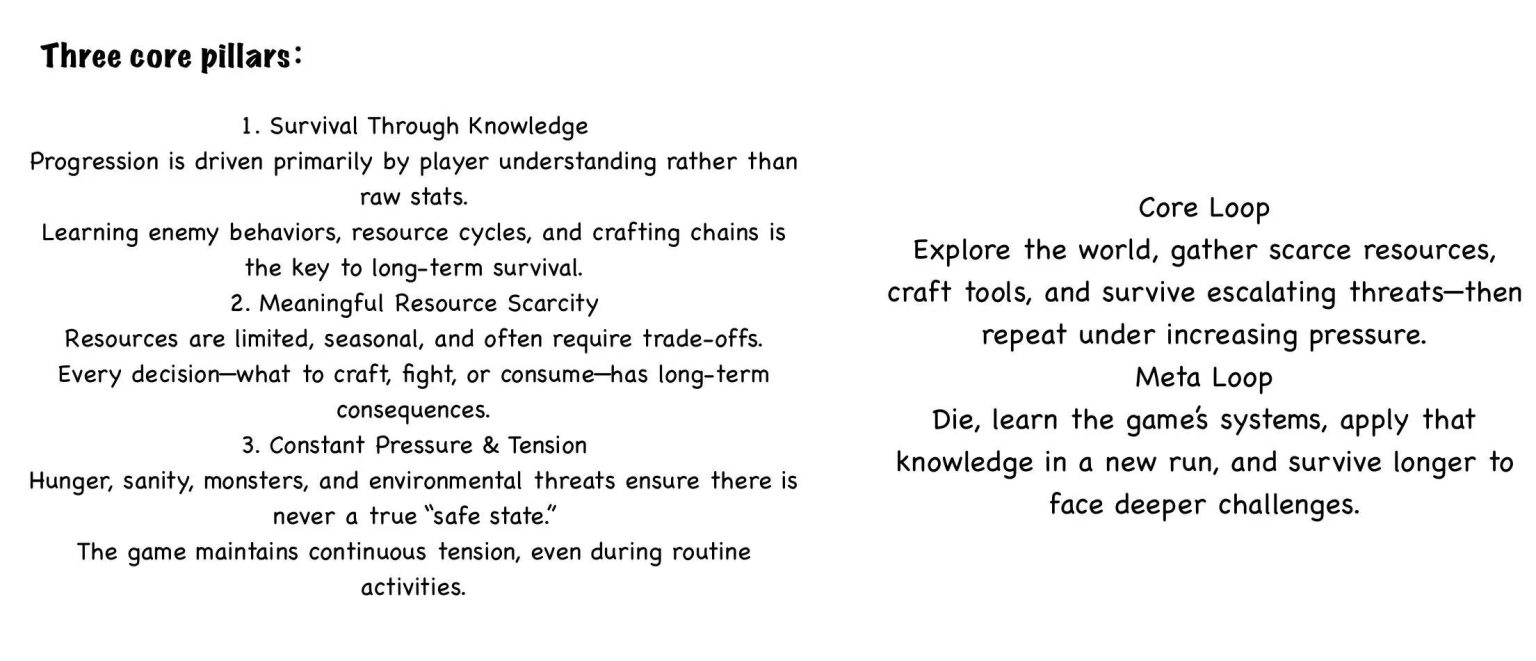
I choose the game 【Don’t Starve】
Key Player Actions:
In Don’t Starve, players explore the world to discover resources and threats, gather scarce materials to survive, craft tools and buildings to prepare for future risks, and continuously manage survival pressures such as hunger, sanity, and enemies. These behaviors require players to constantly make trade-offs and risk assessments, reinforcing a survival experience centered on knowledge, planning, and adaptability.
Resource Flow:
Resources are obtained from limited worlds through exploration, transformed through the crafting system, and continuously consumed for survival needs such as hunger, sanity, and combat. As time progresses and seasons change, the difficulty of obtaining resources increases and the consumption accelerates, creating a gradual escalation pressure that forces players to make trade-offs and long-term planning. This flow of resources reinforces the constant tension of survival experience and highlights the design philosophy of knowledge rather than accumulation.
Key Player Actions:
In Don’t Starve, players explore the world to discover resources and threats, gather scarce materials to survive, craft tools and buildings to prepare for future risks, and continuously manage survival pressures such as hunger, sanity, and enemies. These behaviors require players to constantly make trade-offs and risk assessments, reinforcing a survival experience centered on knowledge, planning, and adaptability.
Resource Flow:
Resources are obtained from limited worlds through exploration, transformed through the crafting system, and continuously consumed for survival needs such as hunger, sanity, and combat. As time progresses and seasons change, the difficulty of obtaining resources increases and the consumption accelerates, creating a gradual escalation pressure that forces players to make trade-offs and long-term planning. This flow of resources reinforces the constant tension of survival experience and highlights the design philosophy of knowledge rather than accumulation.
Thursday presentation
Feedback:
A:I really like the mood and theme, but I’m still a bit unclear about what I actually do moment to moment.
What does a typical loop look like in terms of player actions?
My Answer :
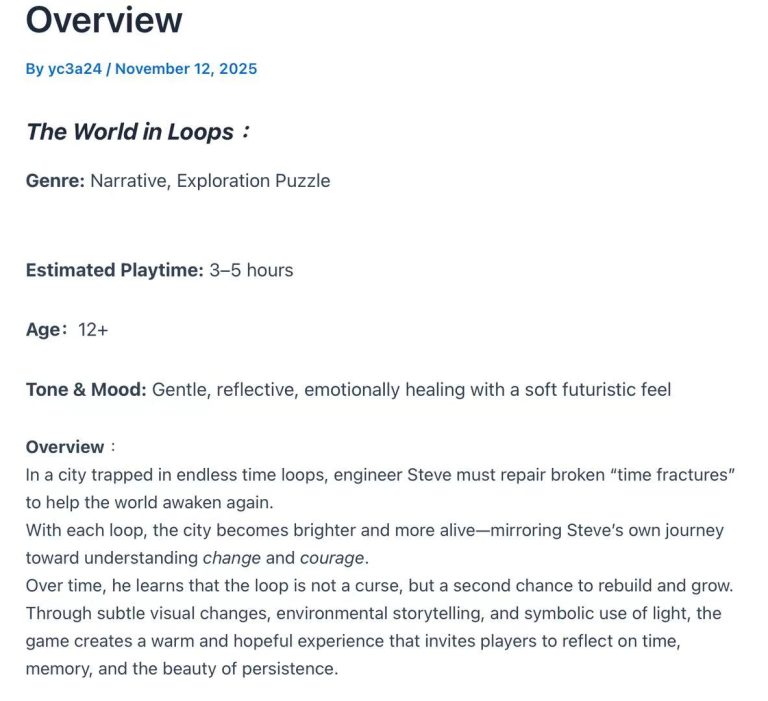
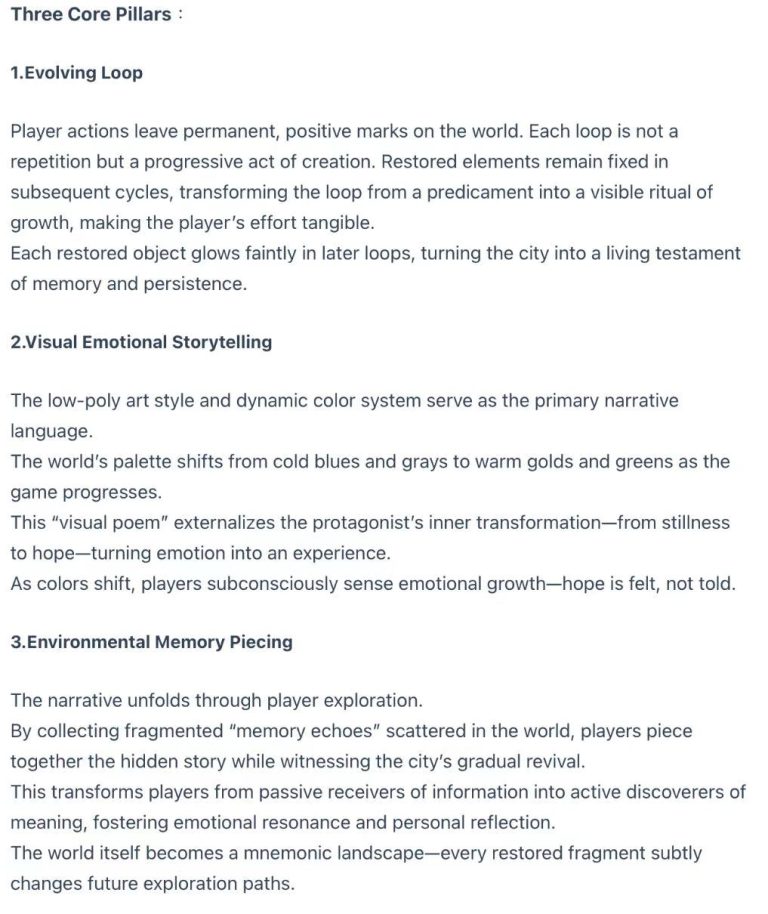
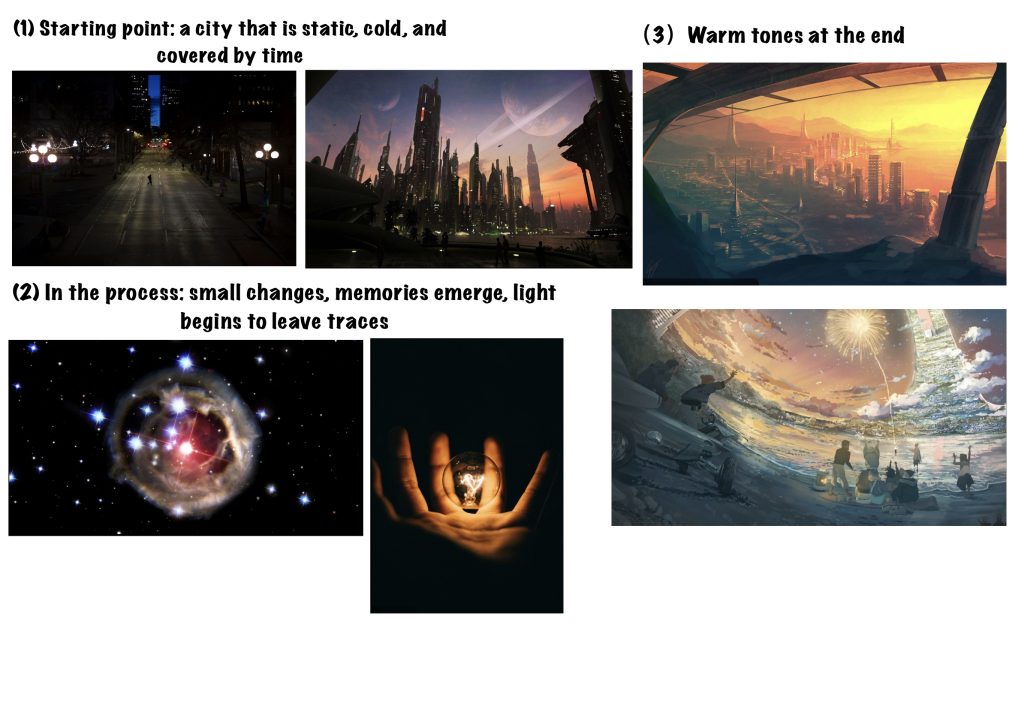
That’s a fair point. In each loop, the core activity is exploration and observation rather than fast-paced problem solving.
The player moves through the city, notices subtle environmental inconsistencies, and uses light spatial puzzles to stabilize time fractures.
So the loop isn’t about repeating tasks, but about gradually learning how to read the world better.
B:The pace sounds very slow and reflective. Are you worried some players might feel lost or bored?
My Answer :
I think that risk exists, but the game is designed to clearly communicate that slowness is allowed.
Players are not constantly pushed forward; instead, the world gently invites attention.
The target experience isn’t constant engagement, but sustained presence.
Improvement Summary
1. Clearer Moment-to-Moment Gameplay
Based on feedback, the moment-to-moment player experience has been clarified.
Each loop is now defined around exploration and observation, where players move through the city, identify subtle environmental inconsistencies, and resolve them through light spatial puzzles.
Rather than repeating tasks, progression comes from gradually learning how to read and understand the world.
2. Slow Pacing Reframed as Intentional Design
The slow and reflective pace has been reframed as an intentional design choice rather than a risk.
The game clearly communicates that slowing down is allowed and meaningful; players are not constantly pushed forward but gently invited to pay attention to the environment.
Engagement is defined by sustained presence and emotional immersion, rather than continuous action.