Research into the Original GDD
Before starting my mission, I first studied the original GDD of last semester, because our current project is an adaptation of the game concept. The game is called “Developing memories”, which is a 2D click adventure game that tells the story of childhood imagination, old photos and memories related to the player’s grandmother. The main experience of the game revolves around the nostalgic design, using the old-fashioned click style, eccentric characters and exploration-based puzzles.
The following is a brief summary of my next work. This part is just a basic overview of the work I want to complete. Through the study of the old GDD, I will summarise the content to be retained and the parts to be modified, as well as some of my ideas about the next work to be completed.
About the game mechanism and gameplay:
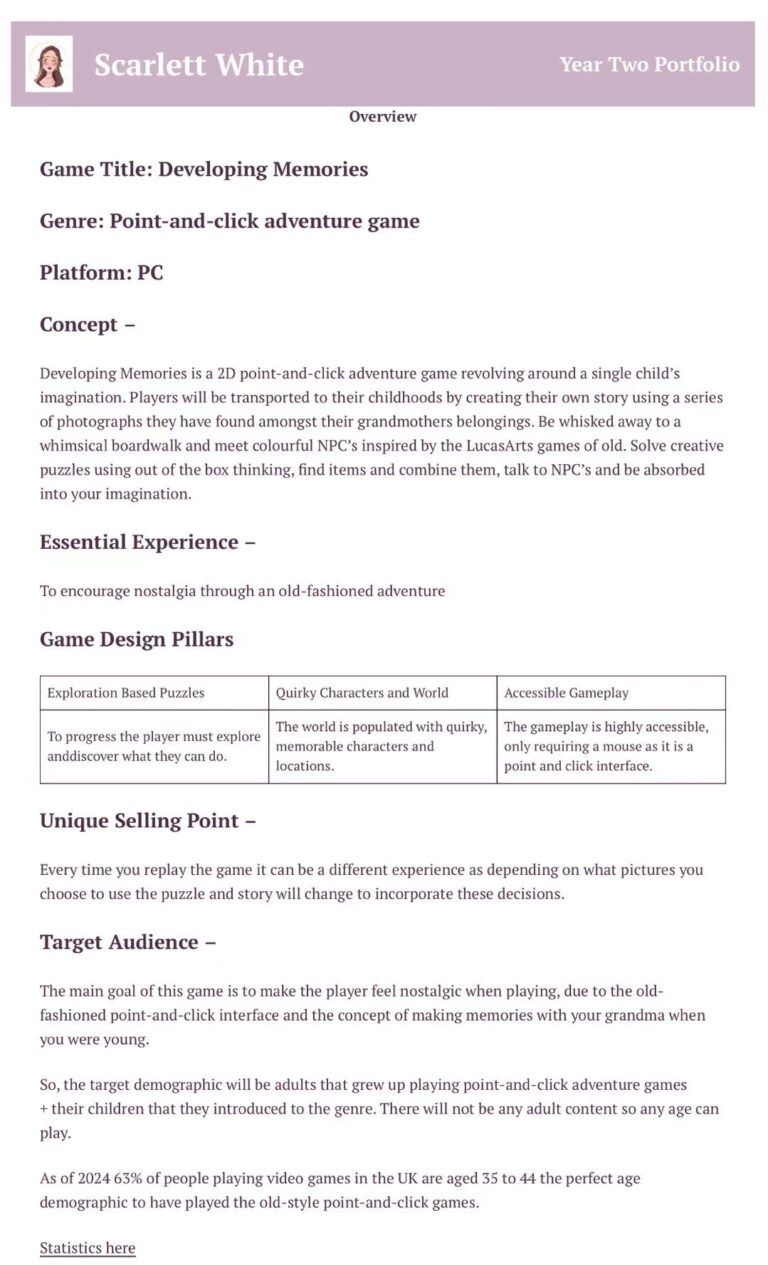
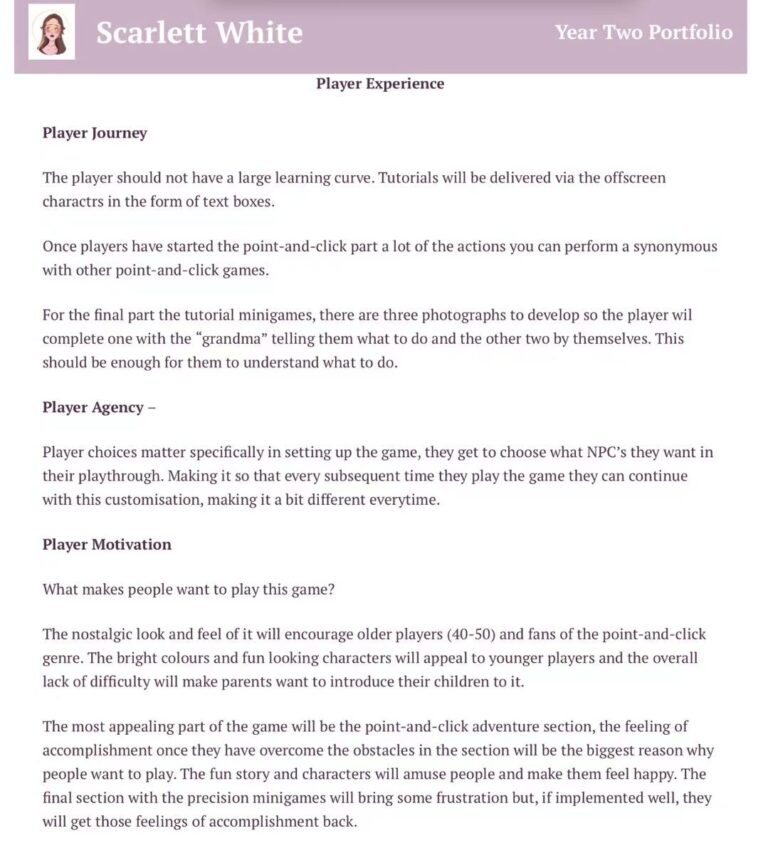
One of the most important things I noticed from the initial GDD is that this game is not just about solving puzzles. This is also about creating memories and the feeling of childhood imagination. The original design wants players to feel nostalgic through the old-fashioned adventure game style. This is shown through the idea of clicking the interface, colour NPC, boardwalk settings and the idea of building a story with old photos. Because of this, I understand that visual design should not feel too modern or too serious. It needs to feel more playful and relaxed.
The original GDD also has three clear design pillars: exploration-based puzzles, eccentric characters and worlds, and barrier-free gameplay.
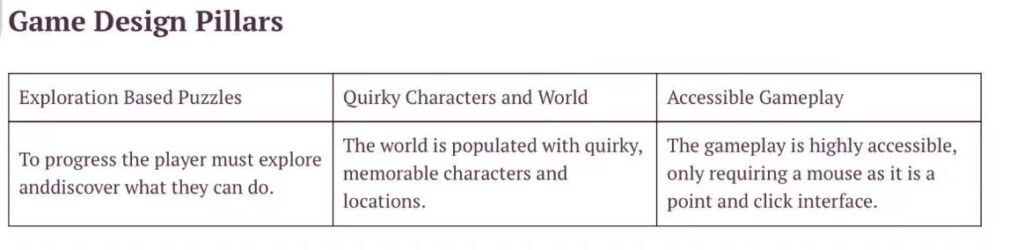
These pillars helped me understand the expected player experience. Players need to explore the environment, talk to NPCs, collect items, combine objects, and solve problems through observation rather than complex control. Since the game only needs one mouse, the gameplay is designed to be easy to understand and suitable for the general audience. This study helped me think about how our current version should remain clear and accessible, especially because we work as a student team and need to maintain the feasibility of the game.
Another useful part of the original GDD is the puzzle structure. The original version contains many click operations, such as “Use”, “Talk”, “Give”, “Push”, “Pull” and “Combine Items”. The sample puzzle sequence is very detailed. Mabel talks to different characters to find items, trade items, and gradually collect lost camera parts. From this, I learned that the original game was designed around the chain reaction, and a small action led to another action. However, for our current version, some of these steps need to be simplified so that the game is easier to manage our group project.
After analysing the original GDD, I realised that our current version needs to balance two things. We hope to keep the strongest ideas in the original game, such as Mabel, camera, memory theme, 2D adventure style and playful world. At the same time, we also need to redesign some parts to suit our own version. This includes simplifying some game steps, making the visual style more exquisite, adding more details to the current story, and adjusting some mechanisms to adapt to Elina’s updated narrative.
Art part
I also noticed how important the camera was in the initial GDD. In the story part, Mabel looks for the missing part of her camera around the boardwalk. This makes the camera more than just an ordinary object. It serves as a symbol of story equipment, game goals and memories. Because I am responsible for drawing the camera project, this part of the research is very useful. I need to design a camera, and I need to divide it into three parts: lens, body and button. So that we can use the material in the later stage.
The above are some preliminary ideas generated by reading the original GDD. I will write the iterative content of the ideas in the next part separately, which looks more convenient.