Gameplay research: object repair, memory feedback and low-pressure puzzle-solving interaction
Research Objectives
The gameplay research of The World in Loops focusses on how to repair interactions through simple and clear objects to support the emotional expression of a gentle narrative puzzle game. However, the game rules in the GDD I originally formulated require players to repair the more abstract “time rift”, but this concept is not clear enough, and it is difficult for players to immediately understand what they are going to do. Therefore, I now need to simplify the core gameplay into a more specific process, such as the player clicking on the broken object, completing a small repair puzzle, restoring the object to its original state, and obtaining a Memory Echo. ( Later, I changed the name of the game to “Echos of Luma”. I will mark the reason for the modification in the game name development section, so I will use the modified name directly below)
In order to modify and formulate the rules and gameplay more clearly, I have listed the following four issues that need to be studied:
- How can object repair become an emotional way of playing?
- Due to lack of time, the cutscene animation cannot be completed. How can objects and spaces convey the story without long cutscene or a lot of dialogue?
- How can simple puzzles remain clear and low-pressure while still making players feel satisfied?
- When the player is stuck, how can the game help without destroying the overall atmosphere?
Research Direction I: Object repair as an emotional way of playing
Assemble with Care
https://store.steampowered.com/app/1202900/Assemble_with_Care/

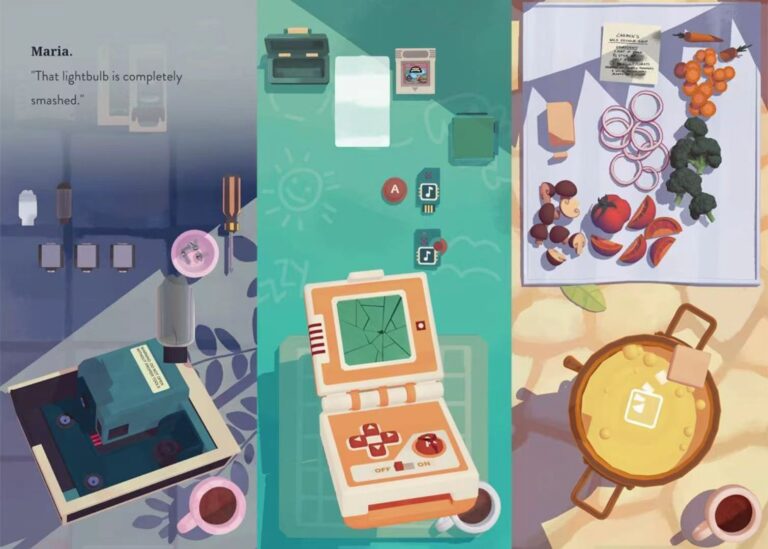
I chose “Assemble with Care” as one of the main references, which is a plot puzzle game produced by ustwo games (the developer of the Monument Valley series) and will be released in 2020. The player plays the role of Maria, an antique restorer, repairing various old objects (cameras, radios, game consoles, projectors, etc.) in a seaside town, while helping residents repair their relationship with each other. Because it designs the “repair object” to understand puzzle behaviour and emotional narrative behaviour at the same time. In this game, players repair damaged items, but repair behaviour is not only a technical operation, but also related to character relationships, memory and emotional repair.
This provides a very important inspiration for the development of Echos of Luma, because Steve is an engineer, and the core gameplay of the game is also the object of repairing the city affected by time failure. I hope that the repair process is not only to complete the task mechanically, but also to make players feel that every object has carried the life and memory of the city Luma.
I have been thinking for a long time about how “Assemble with Care” can make ordinary objects emotional. I think the reason is that the objects in the game are not just puzzle-solving props, but are related to the characters’ experiences, relationships and memories. While repairing objects, players also understand the meaning of these objects to others.
This made me realise that the key to whether the repair gameplay is emotionally infectious is not how difficult the puzzle is, but whether the repaired object has emotional value. If the player only repairs an object because of the system requirements, the gameplay will be more superficial. But if there is a memory or emotion behind this object, it will be more meaningful to repair the behaviour.
The core design principles I extracted from this case are:
Repairing an object can also mean restoring an emotional connection.
Repairing puzzles does not necessarily require high difficulty. The player’s satisfaction can come from “understanding why this object is important”.
However, its inspiration also has limitations. “Assemble with Care” mainly focusses on individual characters and their personal belongings, while “Echos of Luma” focusses on the whole city of Luma and urban memories trapped by the cycle of time. Therefore, I can’t copy its character relationship structure directly. My game does not allow players to repair things for specific NPCs, but allows players to repair Time Fault Objects in the city. These objects belong to Luma itself and are part of the city’s memory.
Therefore, now I have decided that the player will no longer repair the abstract “time rift”, but replace it with repairing specific visible objects, such as:
Fountains that stop flowing, withered trees, broken street lights or asynchronous clock towers and disconnected energy bridges, and after each object is repaired, it will not only be visually restored to its original state, but also release a Memory Echo, that is, a fragment of memories about these objects, about a few seconds, so , repair behaviour is connected with narrative and emotional feedback.
For example, after repairing the fountain, players will see the memory of children making wishes by the fountain; after repairing the tree, players will see the memory of someone planting a seed under the tree; after repairing the street lamp, players will see the memory of two people waiting for each other under the lamp.
In this way, the originally abstract “repair time crack” has been changed to a clearer gameplay flow:
Click on the broken object → Complete the repair puzzle → Restore the object → Memory Echo → Change the environment
This modification makes the player’s behaviour easier to understand, and also makes every repair have emotional consequences.
Research direction 2: How not to rely on a large number of dialogues or traditional plot cutscene, which can also convey the story well.
Reference Case: Unpacking
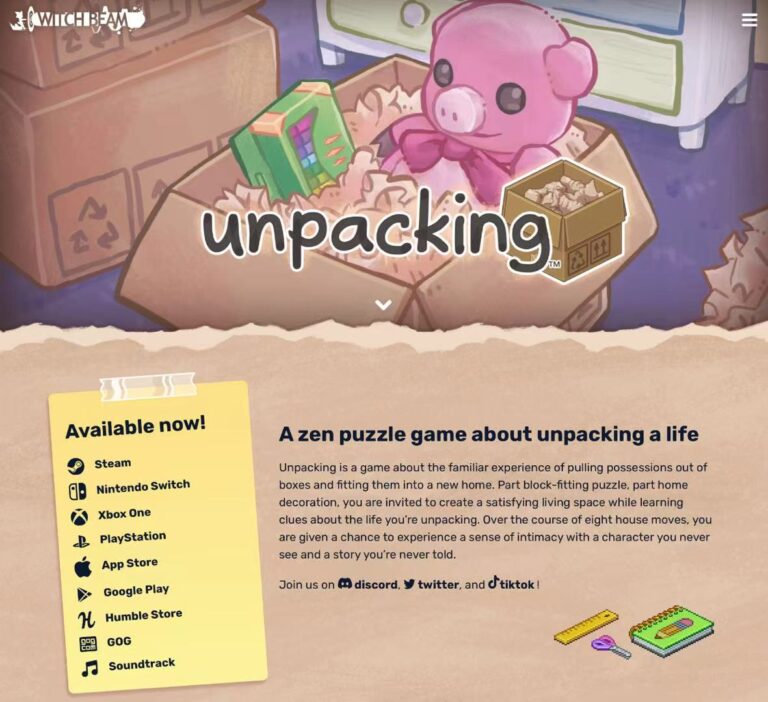
I chose Unpacking as a reference for the narrative of the object. It gradually understands the changes in a character’s life by allowing players to organise and arrange items. The game does not rely on a large number of dialogues or traditional plot cutscene, but conveys the story through objects and space itself. Because my game also wants to tell stories in a quiet and restrained way. I don’t think my game should rely on long explanations, but should let players gradually understand Luma’s past through repaired objects, Memory Echo pictures, short sentences and environmental changes.
I analysed how Unpacking allows players to understand the life of a character through everyday objects. Players do not need to hear a large background story directly, but can also feel what the character has experienced through the placement, repeated appearance or disappearance of items.
This made me realise that small objects can carry a strong narrative function. Just like I thought at the beginning: a fountain, a tree, a street lamp, a bell tower or a bridge, as long as it is connected with specific memories, it will no longer be just an environmental decoration, but a part of the city story.
Limitations
Unpacking allows players to interact with a large number of daily objects, while Echos of Luma has a smaller project scope and is not a game of organising rooms or placing items. If I completely copy the method of Unpacking, my game will deviate from the core gameplay of “Repair the City”.
Therefore, I only extracted its design principle of “object carrying memory”, but did not copy its large number of object placement gameplay.
In order to control the scope of the project, I did not design Memory Echo to grow animation or complex cutscene, but fixed it in the form of a picture + a short sentence, so that it can not only express emotions, but also prevent the production volume from getting out of control.
I thought of a simple example, for example:
Fountain’s Memory Echo: Picture: Two children are throwing coins by the fountain. Text: “I wished tomorrow would come.”
Memory Echo of the tree: Picture: A citizen planted a seed under a tree. Text: “If I forget, let this grow for me.”
Street lamp Memory Echo: Picture: Two people stand under the lamp and wait. Text: “Same place, tomorrow.”
Design results
Memory Echo has been modified from a more abstract concept of “memory fragments” to a fixed, clear and madeable form of expression:
A static memory picture + a short text
This makes the system easier for players to understand, and it is also more suitable for the project scope of the two-hour game.
Research Direction 3: Readability of Simple Puzzles
Reference Case: Monument Valley
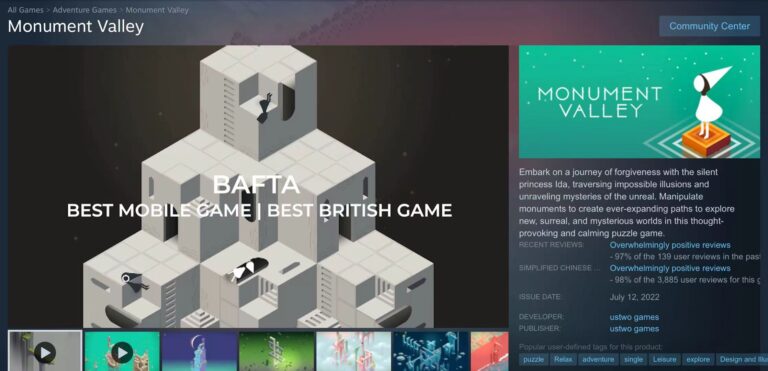
I chose Monument Valley as a reference for low-stress puzzles and visual readability. Its puzzles are usually based on clear visual rules, and players advance the game by observing and manipulating the spatial structure. Although its core is visual illusion and spatial structure, it is very worth referring to in terms of “clear interaction rules” and “low-pressure puzzle rhythm”.
This is very important for Echos of Luma, because my game is not a difficult puzzle game. The function of the puzzle is not to let the player get stuck for a long time, but to let the player participate in the repair process and get emotional feedback after completion.
I analysed how Monument Valley allows players to understand puzzles with simple interaction. It does not allow players to manage many complex systems at the same time, but allows each puzzle to revolve around a clear visual rule.
This made me realise that in a gentle narrative game, puzzles must serve the overall emotional rhythm. If the puzzle is too complicated, players will focus all on logical reasoning, so as to get out of the original reflection and healing atmosphere of the game.
The core design principles I extracted from this case are:
Low-stress puzzles should have clear visual rules and clear interaction focusses.
Players may need to think, but they should not completely know what they are operating.
Limitations
The puzzle of Monument Valley is based on the illusion of impossible architecture and perspective, while the gameplay of Echos of Luma focusses on restoring urban objects. Therefore, I will not directly copy its spatial illusion mechanism. What I draw on is its design principle: the rules of the puzzle should be simple, the visual expression should be clear, and the interaction goal should be clear.
Applied to Echos of Luma, in order to avoid that each object has completely different puzzle rules, I control the puzzles in the game in several simple types:
Sequence puzzle Players need to click on symbols, switches or patterns in the correct order.
Connect puzzles Players need to rotate or arrange parts to reconnect electricity, water flow or light.
Synchronised puzzles Players need to make two or more time elements reach the same state. ( Repair the part of the bell tower)
Optical Road Puzzle Players need to connect the light or energy path to let the energy flow back to the target location.
These puzzles all appear in Steve’s Loop Lens repair interface. In this way, the puzzle will not look like a random game, but Steve is using engineering tools to repair the time failure in the city.
In this way, the repair puzzle is simplified into a clear puzzle language, which makes my gameplay more unified, and also avoids the game becoming abstract or difficult to understand again.
Research Direction 4: Player Support and Prompt System
Reference case: Celeste
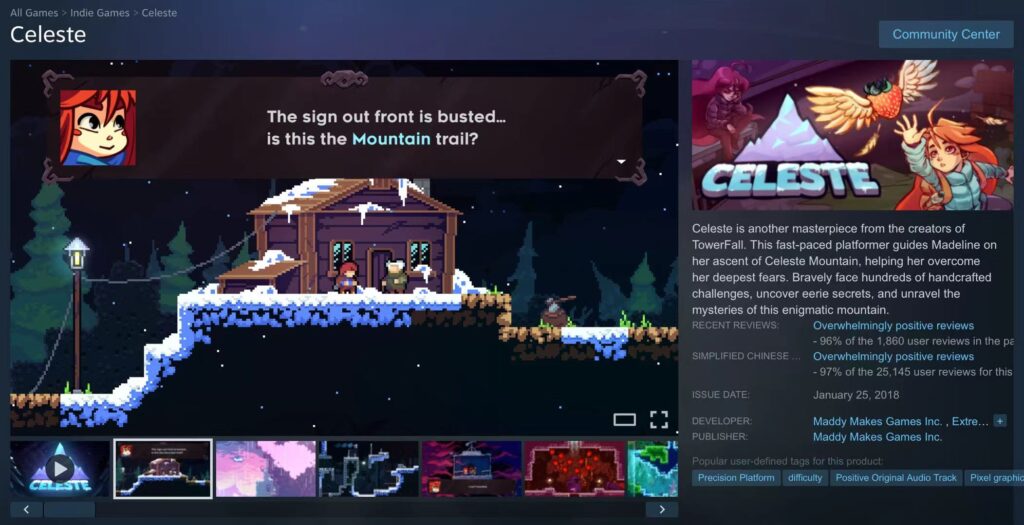
I chose Celeste’s Assist Mode as a lightweight reference because it embodies an important principle: helping players is not the same as weakening the game experience. Although Celeste is a difficult platform jumping game, and Echos of Luma is not an action game, it has reference value for the design idea of “how to respect players and help”.
In my game, the main problem encountered by players is not the difficulty of operation, but the possibility of being stuck in the puzzle. Because the overall atmosphere of Echos of Luma is gentle, reflective and healing, if players don’t know what to do next for a long time, the emotional rhythm of the game will be destroyed.
I analysed how auxiliary design can reduce frustration without making players feel defeated. The prompt system should not make players feel that they are “wrong” or “not capable enough”, but should gently draw the player’s attention back to the key clues. This is very important for Echos of Luma, because the game does not use complex HUDs and does not want to rely on obvious mission arrows. If there is no prompt, players may not know what to click or how to continue.
The core design principles I extracted from this reference are:
Player support should reduce frustration, but should not deprive players of their initiative. And the hint should help the player move forward, instead of completing the puzzle for the player immediately.
So the solution I can come up with is that when the player does not move for a long time, does not interact, or stays in the same puzzle area for too long without progress, the system will give a short prompt, and at the same time, the relevant objects or clues will emit a slight light.
The prompt system is only divided into two levels:
Level 1: Light tips If the player does not move or interact for about 45 seconds, the system will give a gentle hint.
Example sentence: “This place is still holding a broken memory.”
Level 2: Clear tips If the player still has no progress in the same puzzle area for about 90 seconds, the system will give a clearer hint.
Example sentence: “The valve order is hidden on the old wall.”
Design results
The prompt system is simplified into a clear structure:
A short hint + the key object glows slightly
This avoids complex UI, task arrows or long tutorials. The system will not directly solve puzzles for players, but gently remind players of the clues that the city is displaying.
Research the impact on design
In the original version, players need to repair the abstract “time rift”. But this design is not specific enough, and it is difficult for players to understand what their actual operation is. Through the study of object repair games and object narrative games, I realised that if the player restores visible, specific and emotional objects, the gameplay will be easier to understand and connect with the narrative.
Therefore, the gameplay is modified to: players repair specific objects in each area. The player clicks on the broken object, completes the small repair puzzle, restores the object to its original state, and obtains Memory Echo.
This modification allows players to better understand the rules of the game, not in the abstract “repair time” but in the repair of the objects that are still preserved in the city.
This study also affects the scope of the project. Memory Echo is simplified to a picture and a short sentence, making it more suitable for the production scope of a two-hour game. The puzzle system is limited to several clear types, which makes the gameplay more unified and easier for players to understand. The prompt system has also been simplified into short sentence prompts and key objects to avoid excessive UI design.
Research and summary
The core conclusion of this study is that the gameplay of the game should remain simple, visible, and directly connected with the emotional meaning.
Therefore, the finalised gameplay structure is:
Click the broken object → complete the small repair puzzle → restore the object → memory echo appears → continue to repair the next object
This structure not only supports the game’s themes of memory, repair and healing, but also makes the player’s behaviour clearer.
Compared with letting players repair the abstract concept of time, Echos of Luma now allows players to repair the specific visible parts of Luma.