Class Note:
Narrative Designer:
- Bigger picture narrative decisions
- May be more senior (not always)
- Overlap with game designers
- Works a lot with other departments
- Might be developing characters, mechanics, setting, lore, overarching plots
Narrative is important:
- Provides stakes and context to mechanics
- Engages players
- Sometimes it’s the main point
Writing Tips:
Maximising Impact for Choices
- emotional impact of the choice
- Introduce choices and consequences early
- Not all choices have to change the plot
Limiting Scope
- Draw out your branches
- the impact of splits
- Look for opportunities to merge branches
- Reuse what you can
Dialogue Tips:
- Make sure you know limits
- Review the pacing in the format of the game
- Awkward dialogue is hard
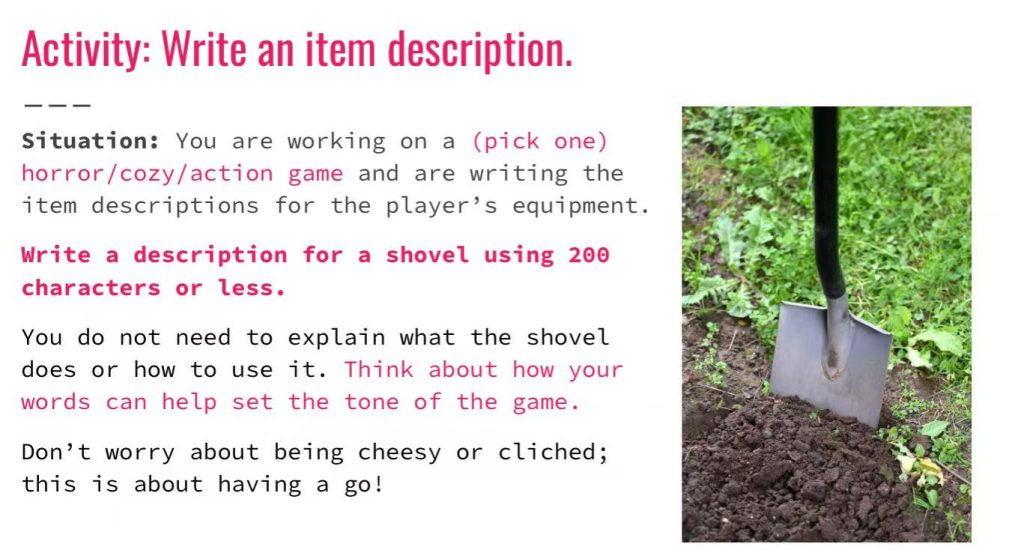
The wooden handle has been polished by the years, and it is warm and reassuring in the hand. The iron blade still has dry soil, with rain, grass and the tranquility of the morning. It often leans against the door, listening to the birds chirping and the slight rustling of the house at dusk. Scratches and dents record small efforts and careful care, each of which is a fragment of calm life. Holding it, it is as if you are being reminded to slow down, take a deep breath, and feel the calm and gentle rhythm of life.
word count:98
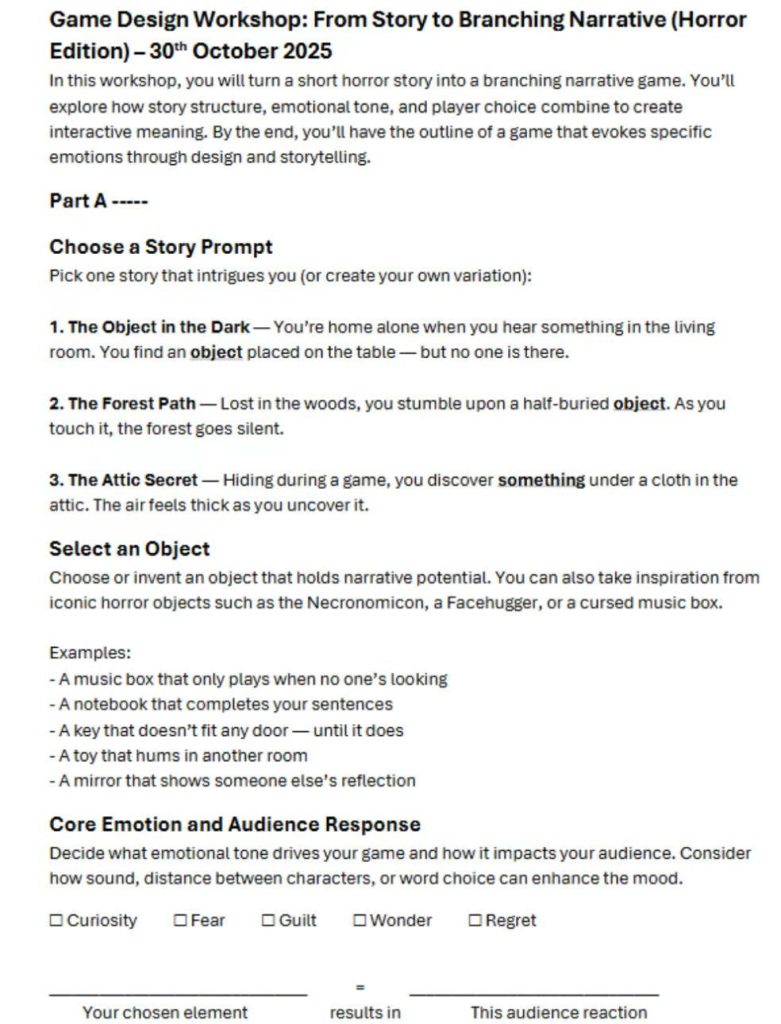
Part A:
Game Concept Overview:
Working Title: The Door That Fits
Core Premise:
You are home alone when you notice something new on the living room table: a key. It looks ordinary, yet it doesn’t seem to belong to any door you know — until you start noticing doors that were never there before.
Core Emotion: Curiosity
Not immediate fear, but a quiet pull toward the unknown. The game encourages players to lean into unease, driven by the desire to understand rather than escape.
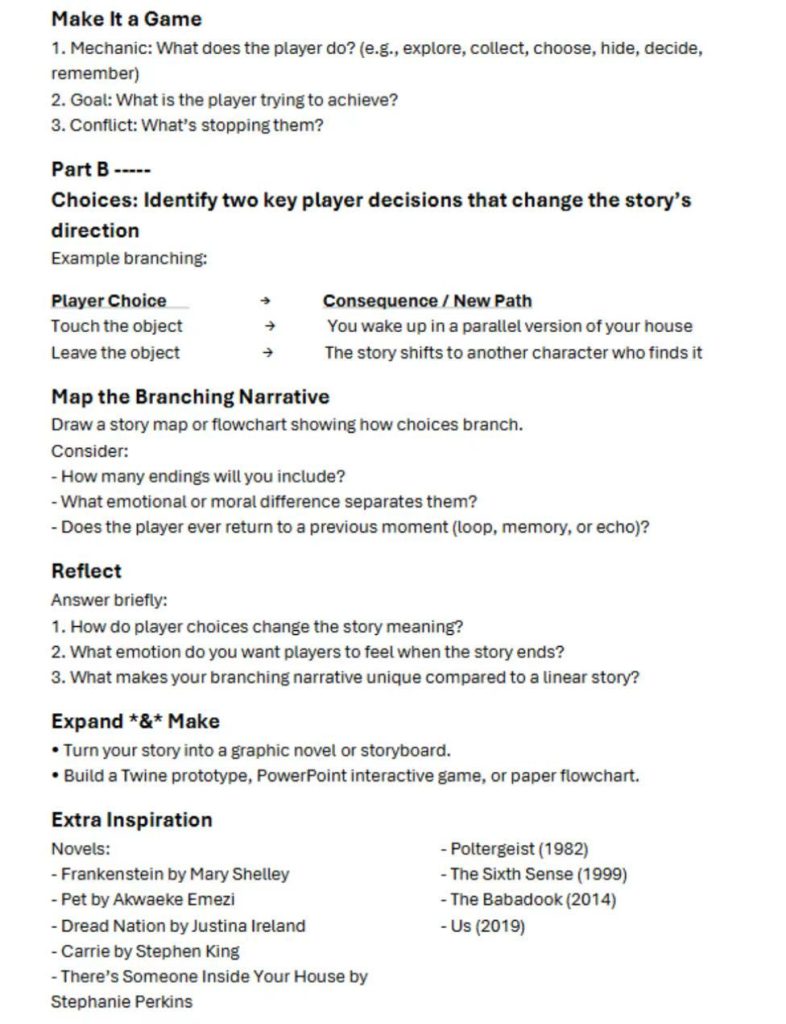
1. Mechanics
* Explore
Move through a familiar home that slowly becomes unfamiliar. Subtle changes in layout, lighting, and sound reward careful observation.
* Collect
Gather memory fragments — photos, notes, recordings — that reshape the story and the player’s understanding of the space.
* Choose / Decide
Decide whether to test the key on certain doors, trust specific memories, or press deeper into the house.
2.Player Goal
Discover where the key came from and what it opens.
Reconstruct lost or suppressed memories to understand whether this is truly your home — and whether you were ever truly alone.
The player is not trying to escape, but to understand.
3. Conflict
* Environmental Resistance
The house shifts: doors appear where none existed, familiar rooms become unreliable.
* Psychological Conflict
Collected memories contradict one another, forcing the player to question their identity and perceptions.
* The Cost of Choice
Each attempt to use the “right” door closes off other possibilities, leading to multiple endings: acceptance, denial, or remaining forever on the threshold.
Part B:
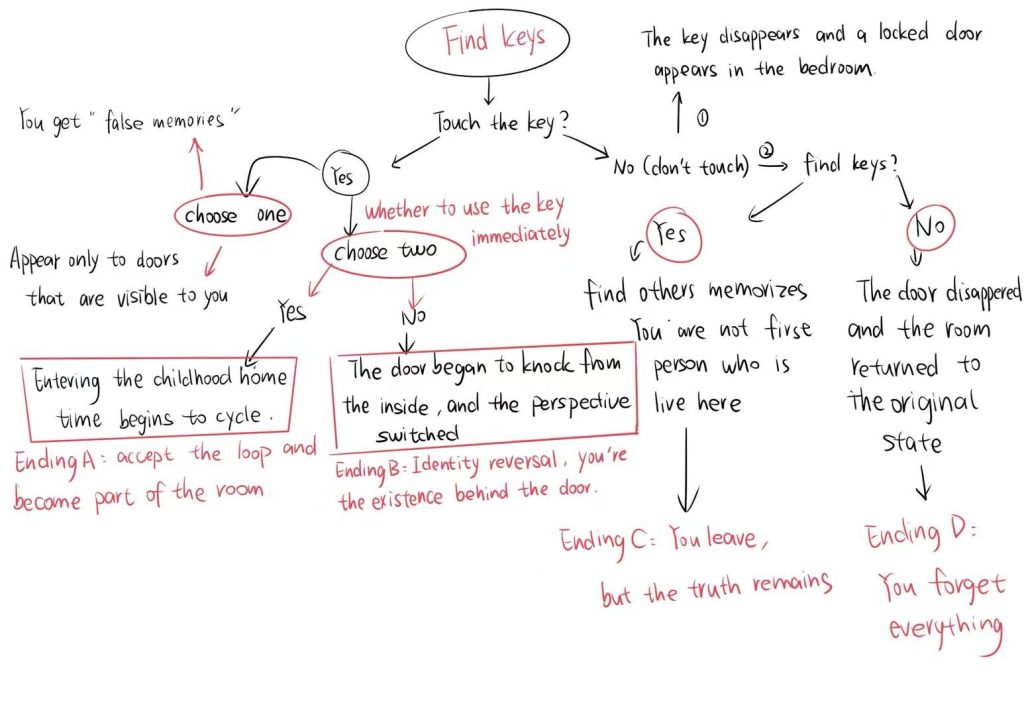
Decision One:
Touch the Key or Leave It
Choice A: Touch the Key
When you touch the key, a brief but intense sense of weightlessness washes over you. The room remains unchanged, but you remember events that never happened. From now on, doors appear that only you can see, leading into suppressed memory spaces.
Choice B: Leave the Key
You leave the key untouched. When you wake the next morning, it is gone. In its place, a locked door stands in your bedroom — and you do not have the key. The story shifts from discovering the object to being pursued by it.
Decision Two:
Use the Key or Refuse the Door
Choice A: Use the Key Immediately
The key turns perfectly. Beyond the door is not another room, but your childhood home. You realize this is not the first time you have made this choice, and time begins to reorganize itself around memory.
Choice B: Refuse to Open the Door
You place the key back on the table. The door begins to knock — from the inside. The narrative perspective slowly shifts, and you begin controlling another character: the one waiting on the other side.
How Many Endings
4 major endings:
Ending A: Accepting the Loop
Ending B: Identity Reversal
Ending C: The Observer
Ending D: Denial and Forgetting
Emotional & Moral Differences
Curiosity vs Safety
1. Is the truth worth sacrificing a stable reality?
Self-Acceptance vs Avoidance
2. Is the player willing to confront uncomfortable memories?
Active Responsibility vs Passive Survival
3. Do you become part of the story, or merely survive it?
Time, Loops, and Echoes
In Ending A, the player returns to the moment of discovering the key, but the text and object descriptions subtly change.
The game implies the player has experienced these events multiple times.
Memory is not linear; it is layered and overlapping.
The player may begin to realize:
This is not the first time you chose the key — only the first time you remembered.
Critical Reflective Questions
How do mechanics influence narrative meaning?
Game mechanics shape narrative meaning through repeated player actions and feedback structures. The story players truly experience emerges from how the system rewards, restricts, or punishes behavior. Mechanics define which actions are necessary, encouraged, or forbidden, embedding implicit values and a worldview. When mechanics align with narrative themes, meaning emerges naturally through play; when they conflict, mechanics undermine the story’s credibility.
What makes branching choices feel significant?
The significance of branching choices lies not in the number of options, but in the presence of real consequences and irreversibility. Meaningful choices alter system states, relationships, or future paths and are consistently acknowledged by the game. When decisions require value-based trade-offs rather than pure optimization, players gain a sense of authorship and believe their actions genuinely shape the narrative.
Where can players create their own stories within your system?
Player created stories emerge in spaces that are not fully scripted. Through emergent systems, open-ended goals, and multiple ways of acting, players construct unique chains of cause and effect within the rules. When a game resists over-explaining meaning and allows players to interpret events retrospectively, narrative authorship shifts toward the player, creating personalized experiences.