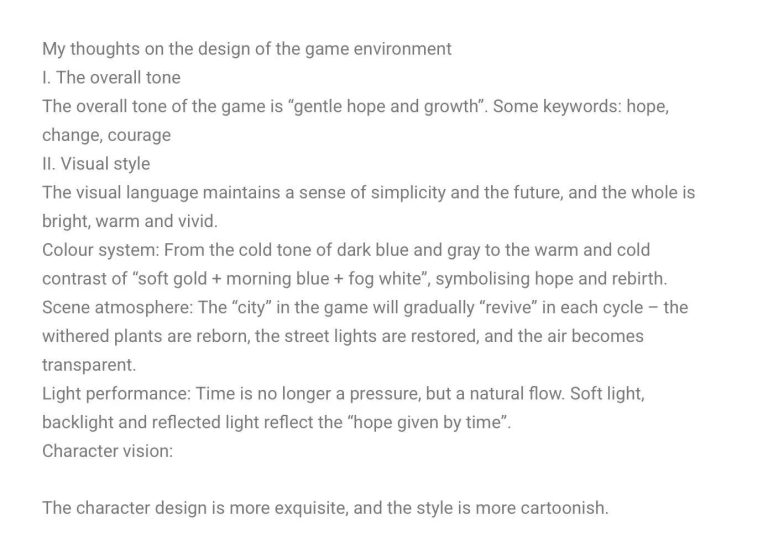
In tutorial ,I discussed my game design documentation with Vanissa, and she told me about the missing parts of the documentation and gave me some helpful advice:
First I decided on my major: Game Character Design
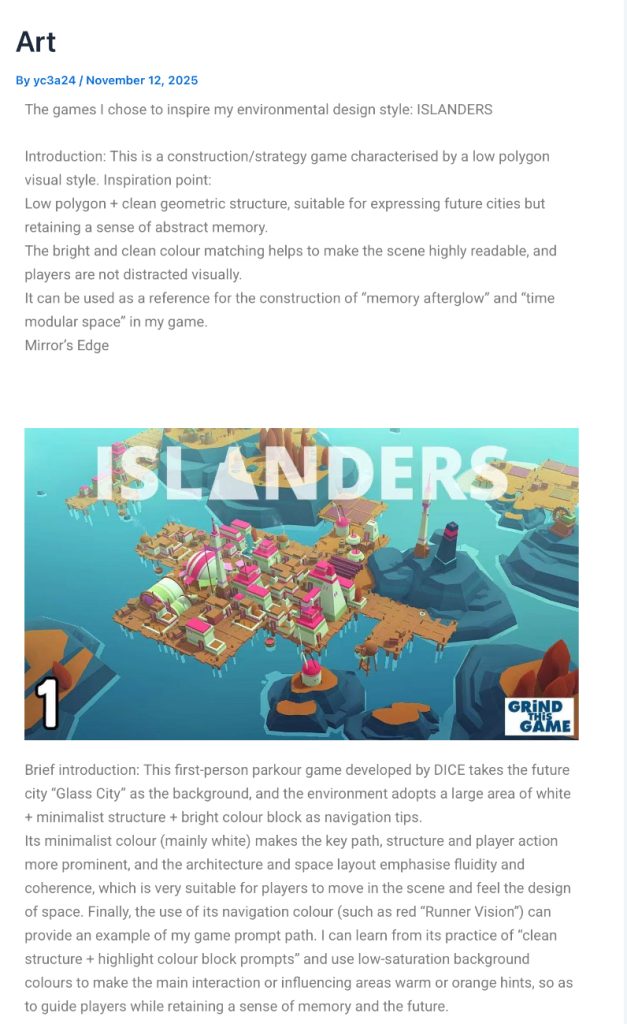
My minor: Game 2D Environment Design
I thought that the part I was interested in and good at the art, and I would like to work on game art in my future work.
For GDD, I added some new things:
For the construction of the worldview:
1.Why is Steve?
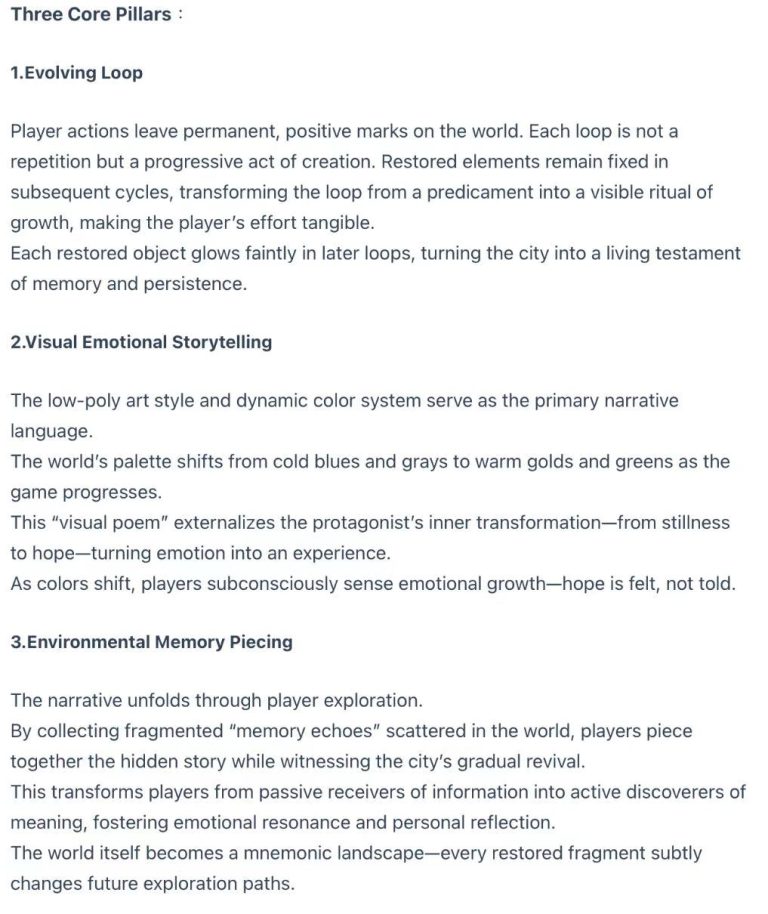
The character of “World in the Loop” is named Steve, and it is inspired by a real person – my friend Steve, who is an engineer. He loves to quietly observe the world around him. When he traveled, he paid attention to the small details and brought back a souvenir from each city, not for decoration, but to preserve memory and meaning. This way of interacting with the world directly influenced my game design. The game encourages players to slow down, observe environmental changes, and collect fragments of their memories over time. By using Steve as a character model, I wanted the main character to feel grounded, authentic, and touching, rather than a heroic or symbolic image. He represents the idea that growth and change come from patience, reflection, and repeated small actions, not dramatic moments.
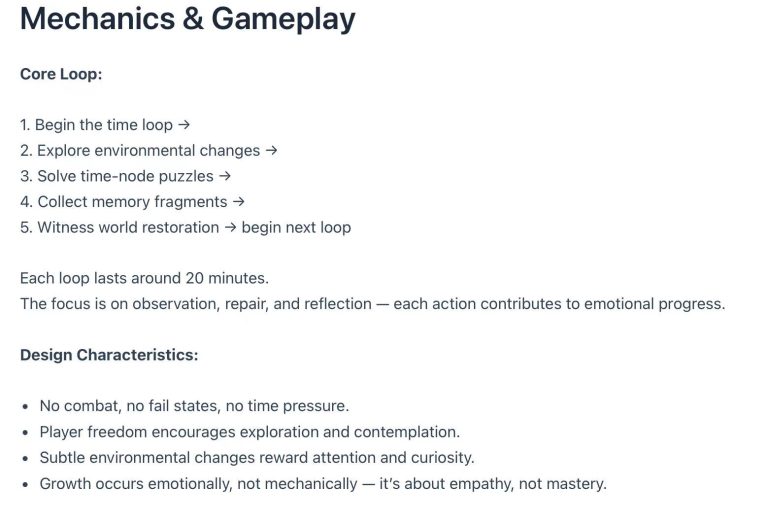
And this game is only designed with a character Steve, the player controls Steve to complete tasks and pass levels.
2.Why is the city called Luma?
The city name Luma is derived from lumen, which means “light”. I chose this name because the city in “Cyclical World” is not only a physical space, but also an emotional field that reflects time, memory and hope. Early in the game, Luma appears dim and silent, and the light gradually returns to the city as players repair the time fault and collect memory fragments. This change is manifested through subtle processes such as color warming, shadow softening, and plant rejuvenation. The name “Luma” emphasizes the core idea of the game: hope does not come instantly, but grows slowly through constant care, understanding and change.
3.Additional explanation of the world building:
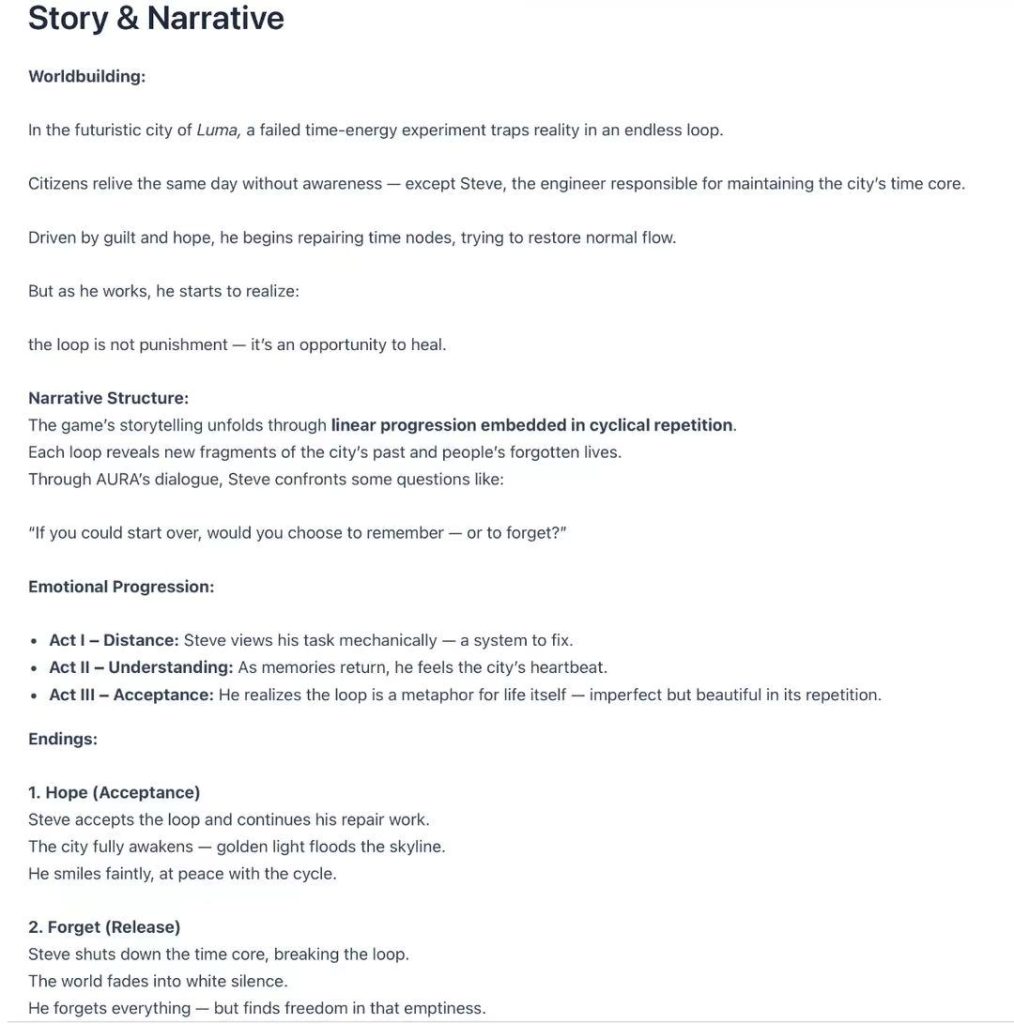
“World in the Loop” is based on a futuristic city “Luma” wrapped in a time loop. In Luma, a time experiment that was supposed to repair the city’s ecology and energy system is biased, locking the city into a cycle of the same day.
People lose their memory with each cycle and continue to live the same daily life, and the world itself gradually stagnates and darkens. Steve, the engineer, is the only one who keeps his memory intact.
He is not a heroic savior, he is just an ordinary person, but he is now on a mission to repair time, and he must repair the “time fault” of the city in the cycle to bring the world back to life little by little.
(I’ll add them to my GDD)