Class Note:
Core Principles of Level Design
- Flow: Designing the player’s journey.(A valid guideline for narrative arcs, skill development, spatial design)
- Affordances: Defining what’s possible.(The environment teaches interaction)(Objects, textures, and layout
communicate what can be done without text) - Guidance: Visual and spatial cues.(Direct players subtly through composition)(Guidance leads exploration while preserving freedom)
- Gating and Keys: Structuring progression
- Difficulty Curves: Balancing challenge and flow
Level Design Procedures:
- Spatial layout and narrative action bubbles
- Blockmesh
- Environment art
- Scripting
- Lighting
- Optimisation
- Playtest
World Setting: The Sky Kingdom
Background:
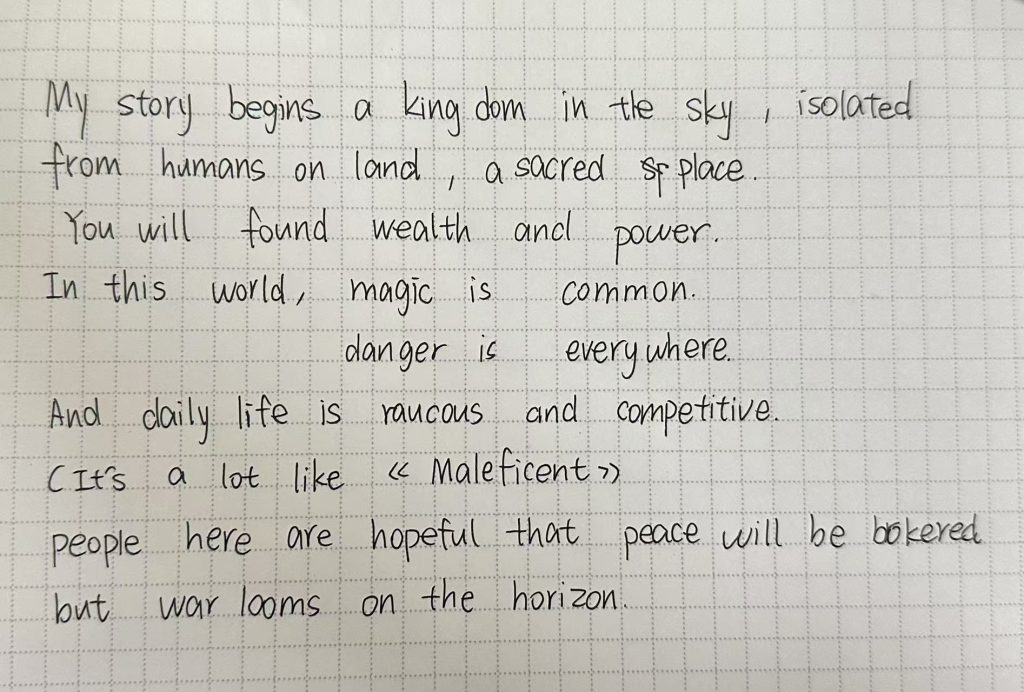
Above the seas of clouds once existed a civilization known as the Sky Kingdom.
It was built upon floating islands, sustained by ancient mechanisms that maintained balance and levitation.
Over time, the kingdom declined and its people vanished, leaving behind broken sky islands and still-functioning ruins.
The Sky Kingdom relied on a core device to stabilize its floating islands.
As the core weakened, the islands began to fracture and drift apart.
The core device now lies dormant, awaiting reactivation.
The player is a lone explorer who arrives at the edge of the sky islands using a simple flying device.
With no guides or records, the explorer must understand the kingdom through the ruins themselves.
The goal is singular:
traverse the ruins and activate the core device.
Narrative Tone: The tone is quiet, vast, and slightly lonely. It emphasizes height, space, and exploration rather than tension or combat.
1. Flow
Player Journey
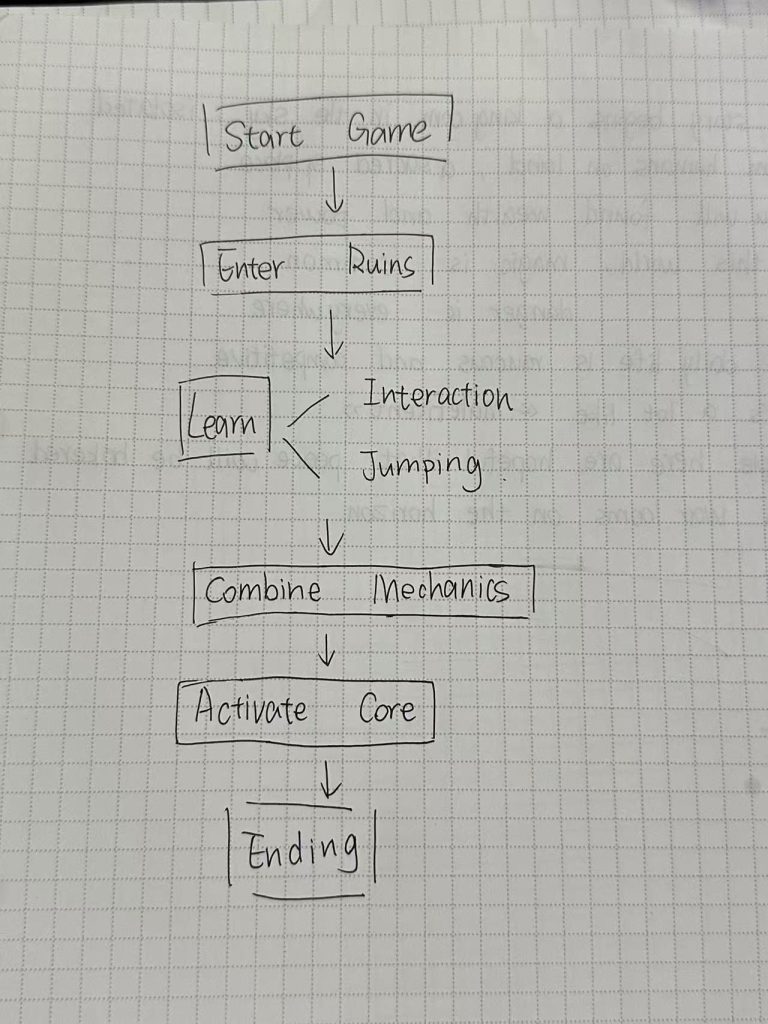
The game follows a single-level, linear flow.
The player begins at the edge of a floating island and progresses forward through the ruins, ending at the core device.
Flow Structure:
Entrance Island → Tutorial Area → Movement Area → Combination Area → Core Chamber
• No branching paths
• No backtracking
• The player always moves toward a clearly defined goal
2. Affordance
What the Environment Communicates
The environment teaches the player what actions are possible through form, placement, and spatial logic, without text or UI prompts.
Key affordances include:
• Levers clearly shaped and positioned to indicate they can be pulled
• Raised platforms and broken terrain suggesting jumpable surfaces
• Doors and corridors communicating passable routes once unlocked
• Edges and gaps indicating traversal limits or required movement actions
All interactions are visually understandable at first glance.
3. Guidance
Visual and Spatial Direction
Player guidance is achieved through subtle visual and spatial cues, preserving player autonomy.
Guidance techniques include:
• A linear spatial layout that naturally points forward
• Door frames, bridges, and corridors acting as visual focal points
• Key interactable objects remaining within the player’s field of view
• Goal areas designed with larger, more open spaces to attract attention
The player is guided without feeling forced or constrained.
4. Gating and Keys
Structuring Progression
Progression is controlled through simple gates.
Keys are not collectible items, but learned player actions.
Gate Key
Closed doors Pulling a lever
Unreachable heights Jumping
Broken paths Finding a jumpable route
Each key is introduced safely before it is required for progression.
5. Difficulty Curves
Challenge Progression
The difficulty curve is intentionally gentle and focuses on understanding rather than skill mastery.
No challenge
↓
Single interaction (lever)
↓
Single movement action (jump)
↓
Combined interaction + movement
↓
No challenge (ending)
• No enemies
• No severe failure penalties
• Low cognitive and mechanical load
The curve ensures a smooth and stress-free learning experience.
Conclusion
Ruins Walker uses minimal mechanics and a clear spatial structure to create an intuitive player experience.
Flow, affordance, guidance, gating, and difficulty are carefully aligned to support exploration, learning, and completion without unnecessary complexity.