After analysing the original GDD, I began to study how to adapt the original game mechanism into our current version of the game. Because our project was adapted based on last semester’s GDD, I don’t want to completely overturn the original design direction. On the contrary, I am mainly concerned about which mechanisms are the most important part of this game experience, and which content needs to be simplified or adjusted according to Elina’s updated story and the production scope of our group.
The original GDD was designed as a 2D point-and-click adventure game. Its main gameplay includes exploring, talking with NPCs, collecting items, using objects in the scene, combining items, and solving puzzles. By studying the original documents, I understand that these mechanisms are important because they support the nostalgic sense of adventure of the game. Players do not need to rely on quick reaction or complex operations, but solve problems by observing the environment, communicating with the characters, and understanding the situation.
However, when I analysed the original gameplay structure more carefully, I found that some mechanisms were too complicated for our current project. The original GDD contains many different interaction methods, such as “Use”, “Talk To”, “Give”, “Push”, “Pull” and “Combine Items”. It also has a long puzzle chain, that is, one action will lead to many follow-up actions. Although these designs are reasonable as a complete game concept, they will require a lot of programming, dialogue text, animation, prop drawing and testing. Due to the limited time of our project, I think we need to simplify the mechanism while retaining the point-and-click adventure feeling.
In the current version, we retain the core point-and-click interaction, but also add keyboard movement. That is to say, players can control the movement of the Mabel with a mouse click or the movement of the keyboard. I think this adjustment is helpful because it gives players a greater sense of control over the character while maintaining the ease of the game. The mouse is still used for interaction, such as clicking NPCs, selecting objects and triggering dialogues. In this way, we not only retain the original point-and-click style, but also make the mobile operation more familiar and smooth for different types of players.
Another important change is the addition of the backpack / inventory page. In the original GDD, item collection and item use are an important part of the gameplay, but I think players need a clearer way to understand what they have collected. Therefore, I designed the backpack as a simple inventory system.
This is after drawing the side of Mabel according to Jess in the early days, I drew the style of the front of the backpack according to her design, because we need to reserve some space for Yufan Wei to fill in the position of “BAG”, so I adjusted the size of the front pocket of the backpack:
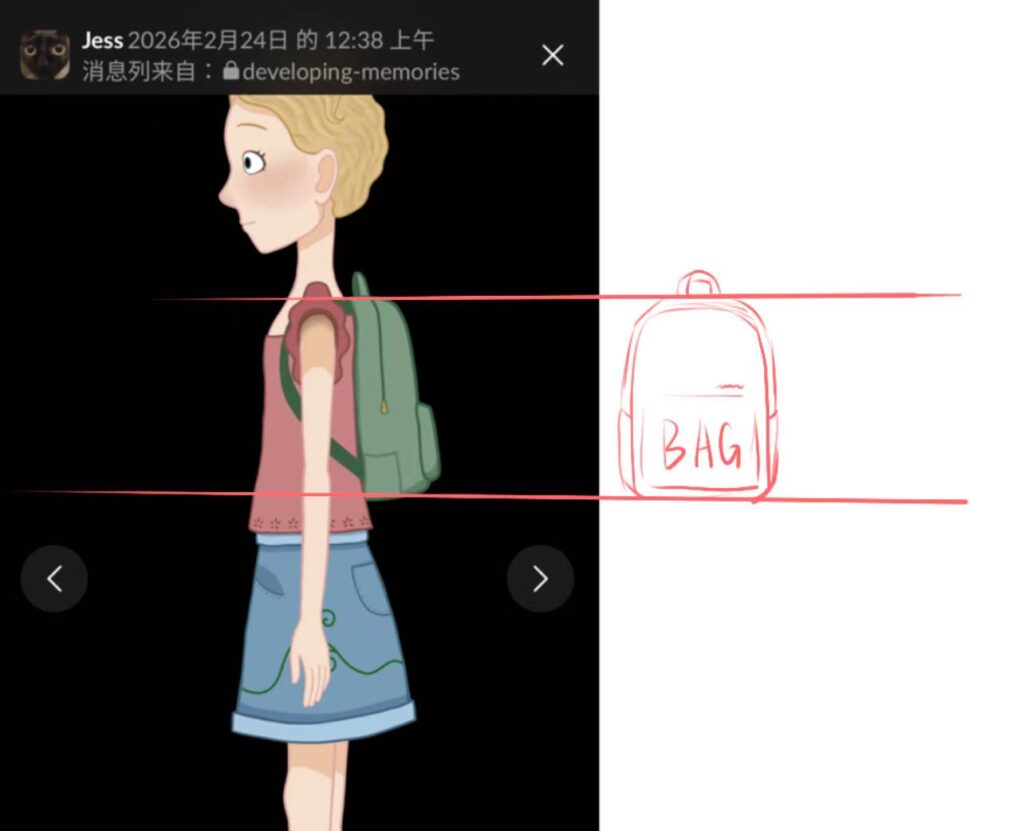
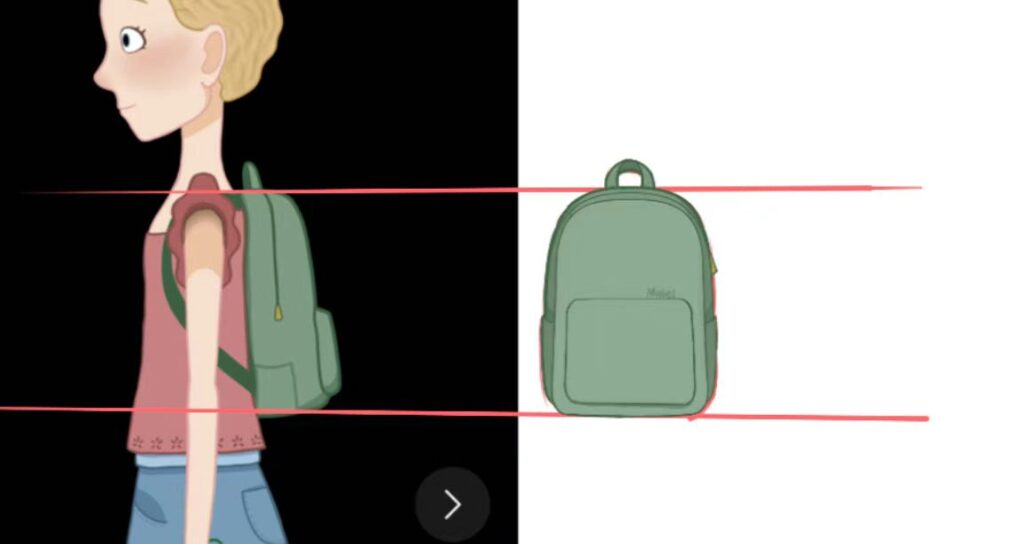
When Mabel collects useful items, these items will enter her backpack. Players can click the backpack icon to open the backpack page and view the items they have. This makes the game flow easier to understand, especially because some puzzles require players to find and use the correct items.
The camera is still one of the most important objects retained from the original GDD. Whether in the original version or the current version, the main goal of Mabel is to find the missing camera parts. In our current version, we keep the setting of the camera consisting of three parts: lens, body and camera button. This can give players a clear main goal, because the whole game structure revolves around finding these three parts. I think this is very important, because even when players complete small tasks of different NPCs, they can always remember what their ultimate goal is.
The updated story of Elina also affects our adjustment to the gameplay. In the new version, the game begins with a child looking at old photos on the table. The child picks up the photos, arranges them, and then enters the dream world created by the photos. This design retains the theme of memory and imagination in the original GDD, and also makes the process of players entering the game world clearer. Because of Elina’s new story, I adjusted the gameplay more intensively to the process of “investigation”. Mabel needs to ask around, talk to different NPCs, and help them solve some small problems in order to find the parts of the camera. Compared with a very complex puzzle chain, this kind of gameplay is more in line with the current story, because Mabel’s behaviour is more like his own search and investigation. The game is no longer just about completing a bunch of random tasks, but advancing by finding clues, helping characters and gradually returning the camera. The following figure is a flowchart written by Elina:
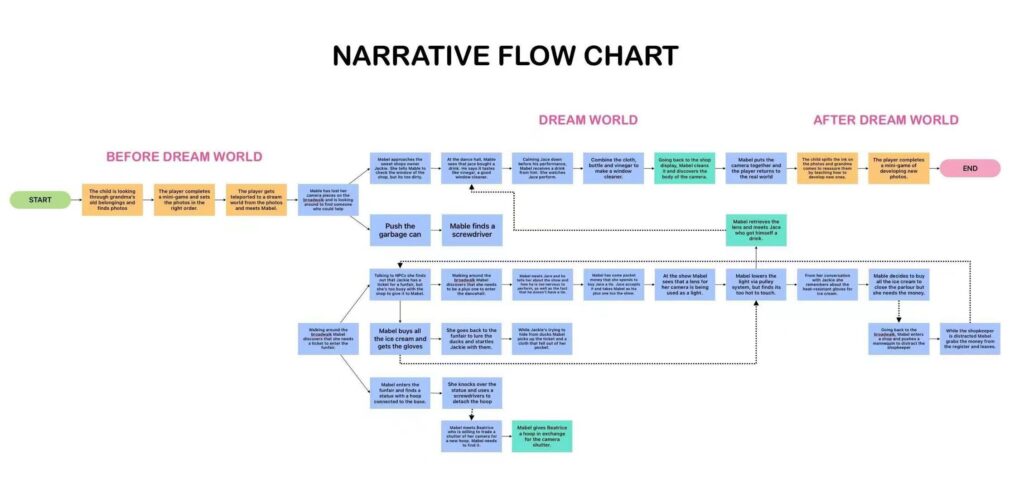
The original GDD had a very complex and detailed puzzle structure, but in our current version, we have simplified it into three main NPC tasks. Now the important NPCs in the story are Jackie, Beatrice and Jace. Each NPC is related to a part of the gameplay. For example, Beatrice needs help finding a new hoop, Jace is nervous because of the upcoming performance, and Jackie is related to dessert shops and dirty shop windows. Such a structure can make the game easier for players to understand, because each character can give players a clearer task purpose.
I also considered how much freedom players should have. I hope players can explore the scene in a more flexible order and talk to NPCs. But at the same time, puzzles still need a certain structure, because some item rewards will affect the follow-up. For example, helping a character may allow Mabel to get an item, which can later be used to solve another problem. Therefore, this game is not completely linear, but it is not completely open. I think this balance is more suitable for student projects to be completed in a short time, because players can explore, but they will still be guided by clear goals.
One of the main mechanisms we deleted is the photo development game in the original GDD. In the original design, the last part is for the grandmother to teach the child how to develop the photos. Although the idea is interesting, it will produce a new gameplay system that separates it from the main adventure part. It will also require additional UI, teaching instructions, art resources and tests. For our current project, we decided to make the main point-and-click part more complete instead of adding a new game. This decision is related to the scope of the project, and also makes the game experience more centralised.
In general, my research on gameplay and mechanism has helped me understand how to adapt an existing GDD into a more achievable version. I keep the core ideas of exploration, NPC dialogue, item collection, simple puzzle solving and finding camera parts. At the same time, we simplified the originally longer puzzle chain, deleted the photo development game, added keyboard movement, and designed a clearer backpack system. These adjustments make the gameplay more in line with Elina’s updated story, and also make the project more realistic for our group.
This process also made me realise that the adaptation is not just about reducing the content. What is more important is to judge which parts of the original design are the most important and reorganise them into a form suitable for the new version. For this project, I hope the gameplay still retains the feeling of nostalgic 2D adventure game, but at the same time has a clearer goal, a simpler interaction method and a structure that is easier to manage. This is also more conducive to me completing visual tasks later, such as designing the main menu, pictures in front of the dream, camera props and Mabel’s backpack icons.