Game Process
The game is divided into three levels, each of which will guide players to repair important objects in the city and gradually restore the vitality of Luma.
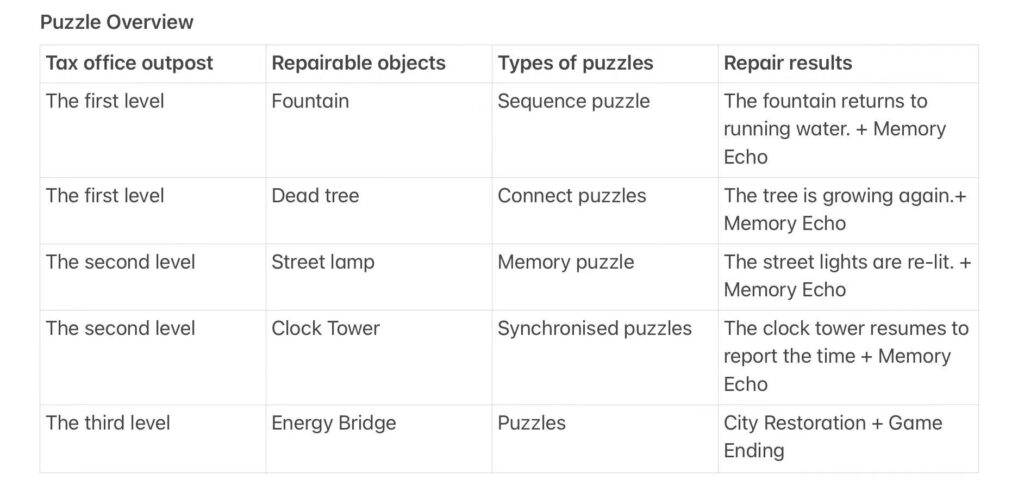
The first level
The first level contains two puzzles: the fountain that stops flowing and the withered tree.
Players need to explore the surrounding environment, find hidden clues, and complete the corresponding puzzles to repair the object. Whenever an object is successfully repaired, a Memory Echo will be played, allowing the player to see a memory of the city that the object once carried, and the surrounding environment will also change.
After completing the restoration of fountains and trees, players can enter the second level.
The second level
The second level contains two puzzles: the broken street lamp and the asynchronous clock tower.
Players continue to explore the city, find clues by observing the environment, and complete the corresponding puzzles.
After the repair was successful, the street lights were turned on again, the clock tower was synchronised, and the city gradually regained more vitality, while playing the corresponding Memory Echo.
After completing the second level, the final area will be opened.
The third level
The third level comes to the Luma City Core (Energy Bridge).
Unlike the previous two levels, players first need to find the energy bridge control system.
After starting the system, you will enter the final puzzle.
The content of the puzzle is a complete Luma city, which contains important places that the player has repaired before, including fountains, dead trees, street lights and clock towers.
When the last piece of the puzzle was put back to the correct position, the memory of the city was restored, the energy bridge was restarted, the whole city regained its vitality, and the residents also regained their own memories, and the game entered the end.
Gameplay Loop
The whole game follows a unified gameplay process:
Explore the environment → Find repairable objects → Investigate the environment to find clues → Complete the puzzle → Repair the object → Play Memory Echo → Restore the environment → Open the next area
Every puzzle follows the same design logic. Players first need to observe the environment to find clues, then complete the corresponding puzzle repair object, then watch Memory Echo, and get instant feedback through environmental changes. This unified game loop can help players quickly understand the gameplay and strengthen the core theme of “repairing urban memories”.
Puzzle design:
1. Fountain Puzzle
Players will first find a fountain that has stopped running water.
A damaged road sign is erected near the fountain, with a set of symbols engraved on it:
Fish → Flower → Star → Moon
These symbols correspond to the four water valves around the fountain.
Players need to observe the order on the road sign first, then click the fountain to enter the water valve operation interface, and click the corresponding water valve in the correct order.
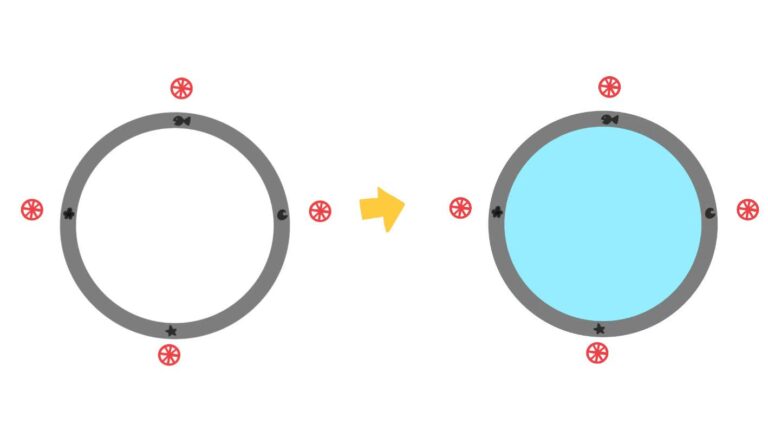
When the order is correct, the fountain will resume running water and play the corresponding Memory Echo.
2. Withered Tree Puzzle
After the restoration of the fountain, the water source has been restored, but the water still cannot flow to the trees.
Players will find that the underground water pipe has been broken.
Players need to rotate the water pipes in different directions and reconnect all the pipes so that the water can flow smoothly to the trees.
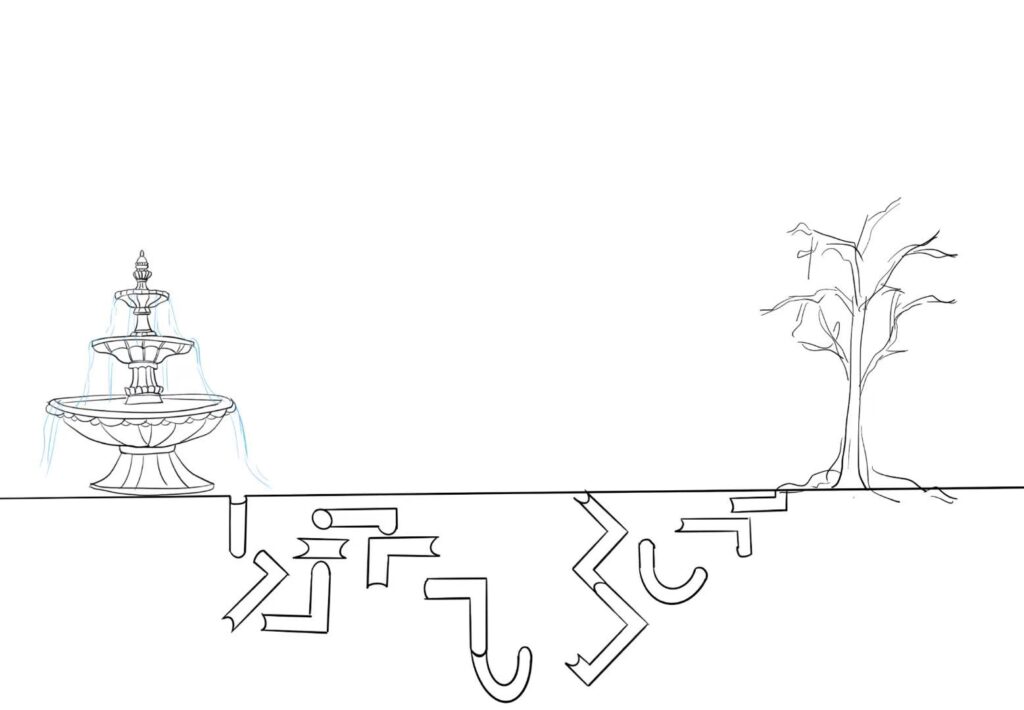
After the repair:
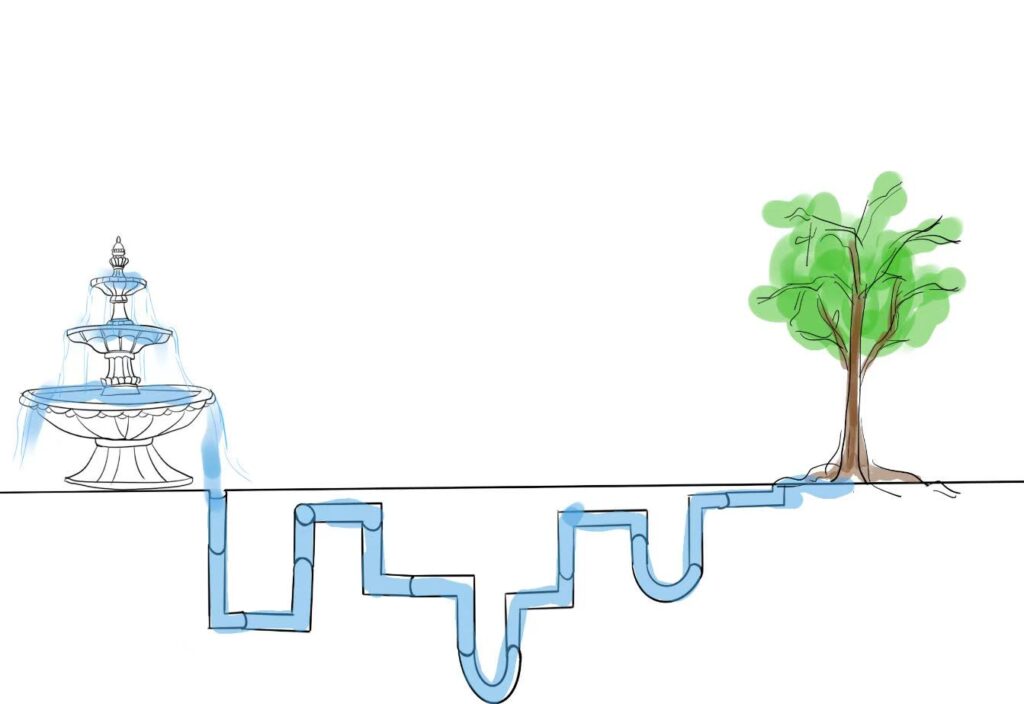
When the water successfully flows to the roots of the tree, the tree grows green leaves again, revives, and plays the corresponding Memory Echo.
3. Streetlight Puzzle
After the player clicks on the broken street lamp, he will enter a memory game.
Several light points will light up in turn.
Players need to remember the order in which they light up and click again in the same order.
If the click order is correct, the street light will turn on again, the surrounding streets will be restored, and the corresponding Memory Echo will be played.
4. Clock Tower Puzzle
After completing the repair of the street lamp, the player came to the clock tower that stopped synchronisation.
Players need to adjust the hour and minute hands of the left and right clock towers respectively, so that the two clock towers display the same time.
When the synchronisation was successful, the two clock towers restarted operation, the bell rang again, and the surrounding environment regained more vitality. At the same time, the corresponding Memory Echo was played.
Five. Energy Bridge Puzzle
After finding the energy bridge control system, the player will enter the final puzzle.
The content of the puzzle is a complete Luma city. The screen contains important places that players have previously repaired, such as fountains, dead trees, street lights and bell towers. As the puzzle is gradually completed, these familiar scenes will reappear.
When the last piece of the puzzle is put back to the correct position, the whole city is presented intact, the energy bridge resumes operation, the city regains vitality, and the player completes the whole repair journey.
Memory Echo
Every time an object is successfully repaired, a Memory Echo will be played.
Memory Echo consists of two parts:
A static memory picture
A short sentence
It is not only a reward for players after completing the puzzle, but also an important narrative method for the game, allowing players to gradually understand the story that happened to Luma.
Fountain Memory Echo:
Picture: Two children throw coins by the fountain.
Text:
“I wished tomorrow would come.”
Tree Memory Echo:
Picture: A student planted a seed under a tree.
Text:
“If I forget, let this grow for me.”
Streetlight Memory Echo:
Picture: Two people standing under the lamp waiting for each other.
Text:
“Same place, tomorrow.”
Clock Tower Memory Echo:
Picture: A couple of tourists are taking photos under the clock tower.
Text:
“Be sure to take photos of my best-looking angle.”
Types of puzzles
In order to meet the project scale of the two-hour game and keep the gameplay simple and easy to understand, the puzzles in the game are mainly divided into four types:
1. Sequence Puzzle
Players need to click symbols, switches or patterns in the correct order according to the environmental clues.
(Fountain)
2. Connection Puzzle
Players need to rotate or arrange the parts to reconnect the water flow.
(Dead tree)
3. Memory Puzzle
Players need to remember the order of system display and re-enter them in the same order.
(Street lamp)
4. Synchronisation Puzzle
Players need to adjust the two time devices to make them reach the same state.
(Clock Tower)
Five. Jigsaw Puzzle
Players need to complete the final puzzle, restore the memory of the whole city, and restart the energy bridge.
(Energy Bridge)
Prompt system
In order to keep the game gentle and clear, while avoiding players getting stuck because there is no obvious HUD or mission arrow, Echoes of Luma adopts a simple prompt system.
When the player does not move for a long time, does not interact with the scene, or stays in the same puzzle area for too long without any progress, the game will automatically provide a short prompt, and the important objects related to the puzzle will emit a slight light to guide the player to continue exploring.
The prompt system consists of two parts:
A brief hint + the key object glows slightly Fountain:
Players don’t know the order of water valves.
Level one
“The fountain remembers a pattern.”
The fountain glows slightly.
Level two
“The wall shows the order of the valves.”
The road sign glows slightly.
Dead tree:
Players have been trying to cultivate trees, but the fountain has not been repaired yet.
Level one
“The tree is waiting for water.”
The direction of the fountain glows slightly.
Level two
“Restore the fountain before the tree can bloom.”
The fountain glows.
The second level:
Street lamp:
Players don’t know the order in which the lights are turned on.
Level one
“The light remembers a sequence.”
The light on the street lamp flickered slightly.
Level two
“Repeat the lights in the same order.”
The light point lights up again in order.
Clock Tower:
Players don’t know how to synchronise the two clocks.
Level one
“The towers are speaking at different times.”
The two bell towers flashed slightly at the same time.
Level two
“Match both clock faces to the same time.”
The clock face glows slightly.
The third level:
Energy Bridge:
Players don’t know where the puzzle should be placed.
Level one
“The city is waiting to become whole again.”
The puzzle frame glows slightly.
Level two
“Some memories belong together.”
The correct position is slightly luminous.
Game mechanics
1. Exploration
Players need to explore Luma freely, find objects that can be repaired, and find puzzle clues by observing the surrounding environment. The game will not use mission arrows, but encourages players to actively explore and observe the environment.
2. Puzzle Solving
Each repairable object will correspond to an independent puzzle.
The game contains five types of puzzles:
Sequence puzzle
Connect puzzles
Memory puzzle
Synchronised puzzles
Puzzles
All puzzles adopt a simple and intuitive interactive way, which can not only maintain a certain level of challenge, but also will not interrupt the rhythm of players’ experience of the story.
3. Object Restoration & Memory Echo
After the player completes the puzzle, the corresponding object will return to normal operation and play a Memory Echo. It consists of a static picture and a short text to present a piece of urban memory that the object once carried. Players can not only gain a sense of accomplishment by completing the puzzle, but also gradually understand Luma’s past, so that the repair behaviour can be combined with the story narrative.
4. Environmental feedback
As more and more objects are repaired, Luma’s environment will gradually recover its vitality.
For example:
The fountain flows again.
Trees grow again.
The street lights are re-lit.
The colour of the city is warming
Environmental sound effects become relaxed and pleasant.
These changes can make players intuitively feel that their actions are changing the whole world and further enhance the immersion of the game.
Five. Hint System
In order to avoid players getting stuck for a long time, the game has designed a two-stage prompt system.
When players stay in the same area for too long or do not interact for a long time, the system will automatically provide a short prompt and let the relevant clues or important objects glow slightly to guide the player to continue exploring. The tips will gradually become clearer as the dwell time increases. While ensuring the smoothness of the game, it also minimises the impact on immersion.