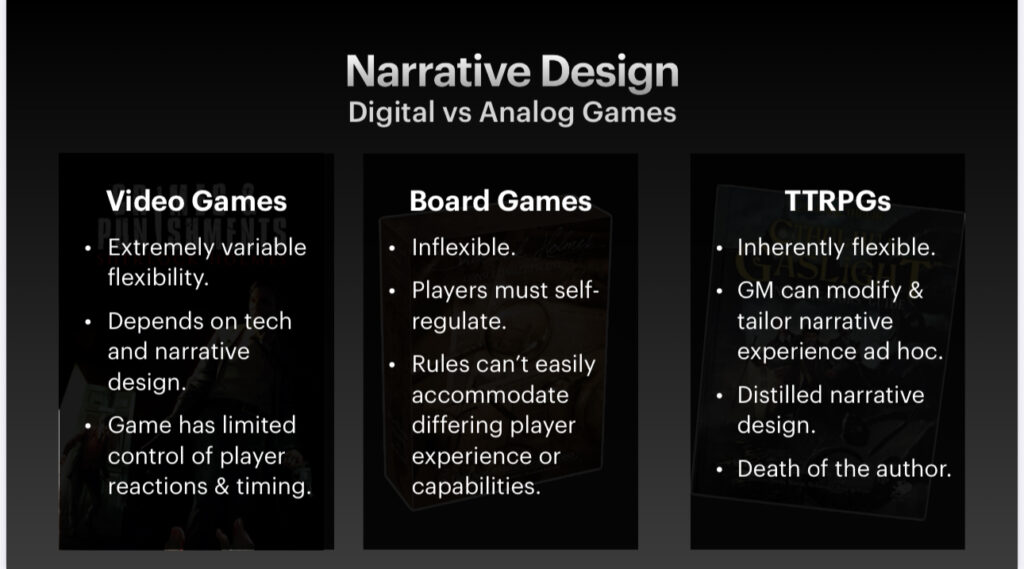
On Monday, we attended a lecture by Sarah Cloe, and one point particularly interested me. Since I’m responsible for narratives in Backchat, I paid close attention to the different ways narratives are designed in various games.
– Video games are described as extremely flexible but technologically dependent. This flexibility is actually a costly freedom. Players seem to have a vast world to explore, but in reality, every interaction is pre-programmed. This is a selective flexibility—players can make countless choices within the rules, but they can never step outside the framework to modify the rules, which would become a bug.
– Board games embody the purity of rules. They require all players to self-regulate under the same rules. This design is extremely fair, but also extremely cold, because it cannot accommodate differences in player experience or ability, placing the responsibility for adjusting inequalities entirely on the players themselves.
– The existence of TRPGs (Tabletop Role-Playing Games) represents a dialectical unity of the former two. It is both fixed (the rulebook is fixed) and flexible (the GM can adjust it at any time). The “death of the author” mentioned in the notes is particularly important here: when the game master (GM) gains the power to make impromptu changes, narrative authority is liberated from the designer and flows to the group interacting in the present moment.
This reminds me of how our team’s collaboration in game development often oscillates between video game and TRPG modes. We want the flow to be clear and predictable (execute like code), yet we also crave the ability for a GM to step in and say, “Let’s slightly modify the rules here,” in case of unexpected situations.
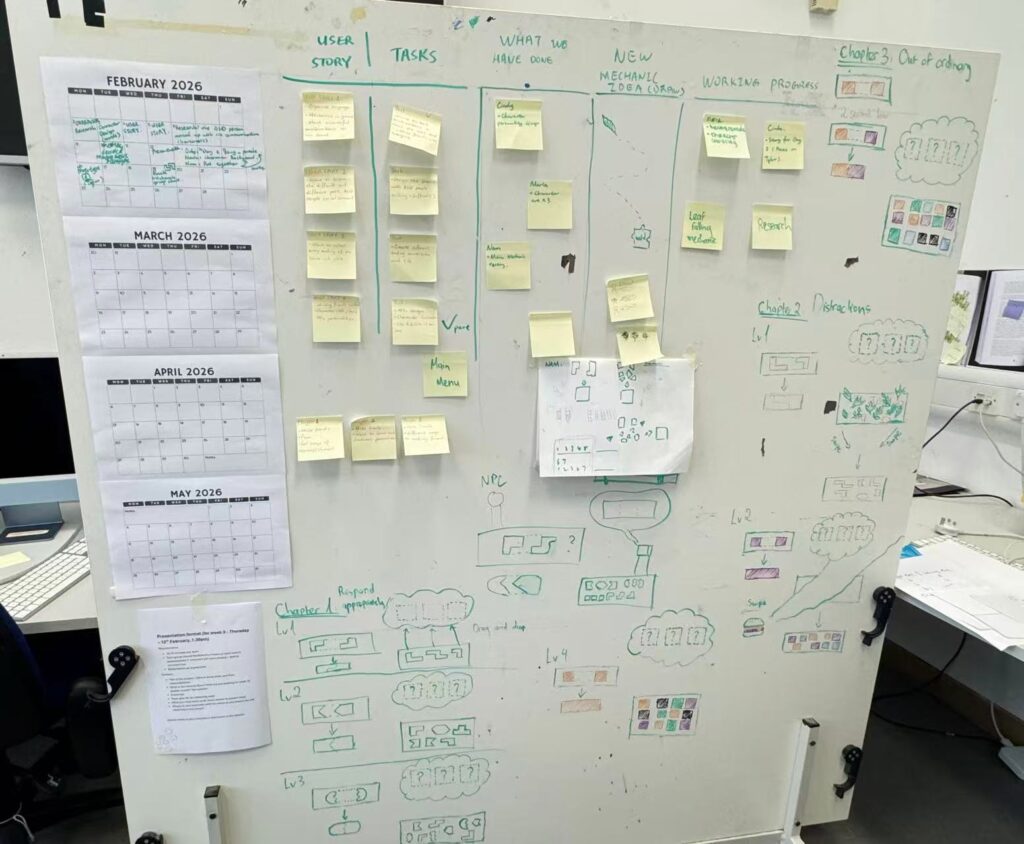
The problem we encountered after the last game test was the desire to add a new mechanic. Both mechanics have their strengths and weaknesses, so we wondered if we could combine them to achieve a moderate level of difficulty while increasing enjoyment.
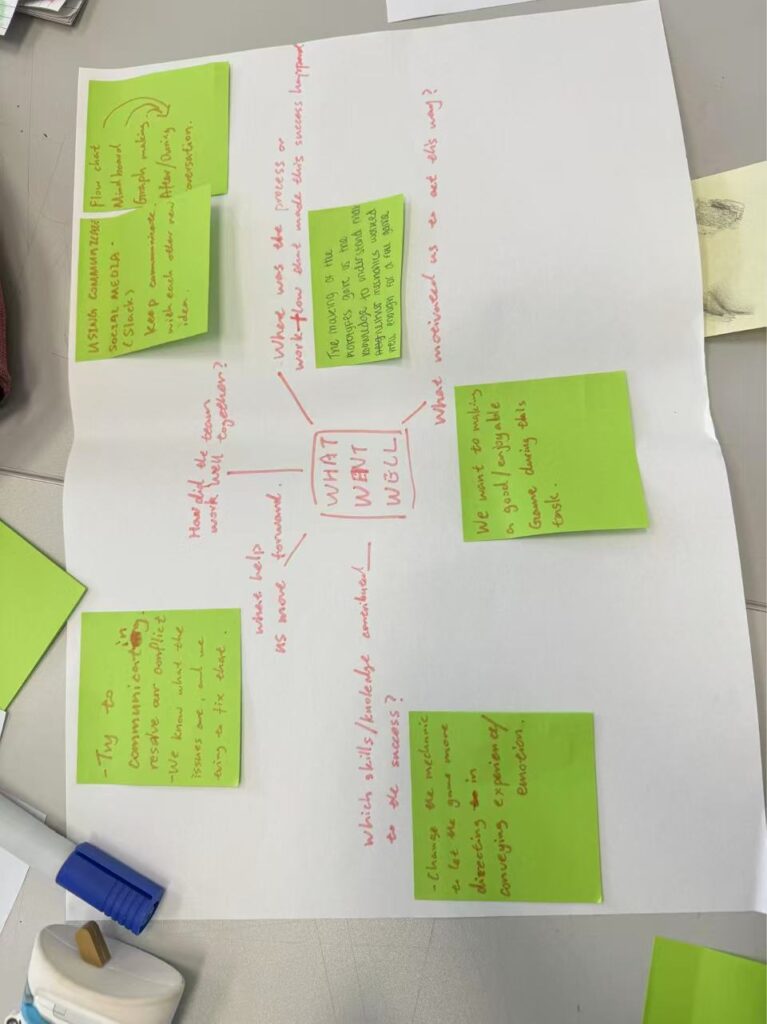
Meanwhile, in Thursday’s class, we also summarized some of the good and bad aspects of our group’s collaboration. The bad aspect is simple: our group lacked a leader to make decisions. Everyone had many ideas, which is a good thing, but not every idea could gain everyone’s support. Therefore, my solution is to let whoever is responsible for the project make the final decision, so as not to delay progress. The good aspect is that we maintained good communication habits. Everyone wanted to do a good job with the game, and we were good at using whiteboards and sticky notes to record our ideas. This is very helpful for a long-term project because we sometimes forget some key keywords and ideas from the early stages.