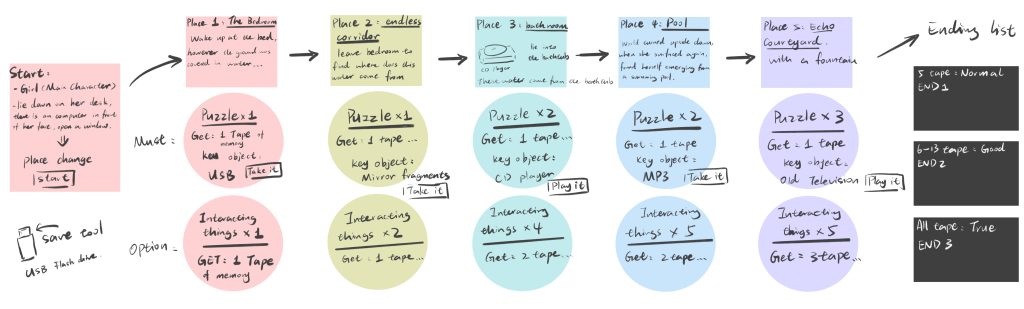
Monday’s class focused on creating a gameflow map and designing levels. There’s a lot I need to think about. The game’s levels must follow a certain rhythm and engage the player emotionally, so it’s best to include some climactic moments in the latter half of the game to ensure the player is fully immersed. Each level needs to provide players with equipment or important items, and I need to consider their connection to the environment. There should be some introductory sections or tutorials at the beginning to help players quickly understand how to play, before gradually increasing the difficulty. The level’s environment needs to convey more information to the player, as there’s virtually no text in the game.
On Thursday, we divided into groups for a story-making activity. We had to choose our preferred story direction from a list of options, ultimately connecting them into a complete story. Each option contributed to the world-building of that story. This was very helpful for shaping our own game world: what elements constitute a world’s setting, how the story begins, and whether magic exists within it. I also learned that the story players learn during gameplay is only a part of the overall setting. We need to construct the entire background world completely, but not necessarily present it all in the game.

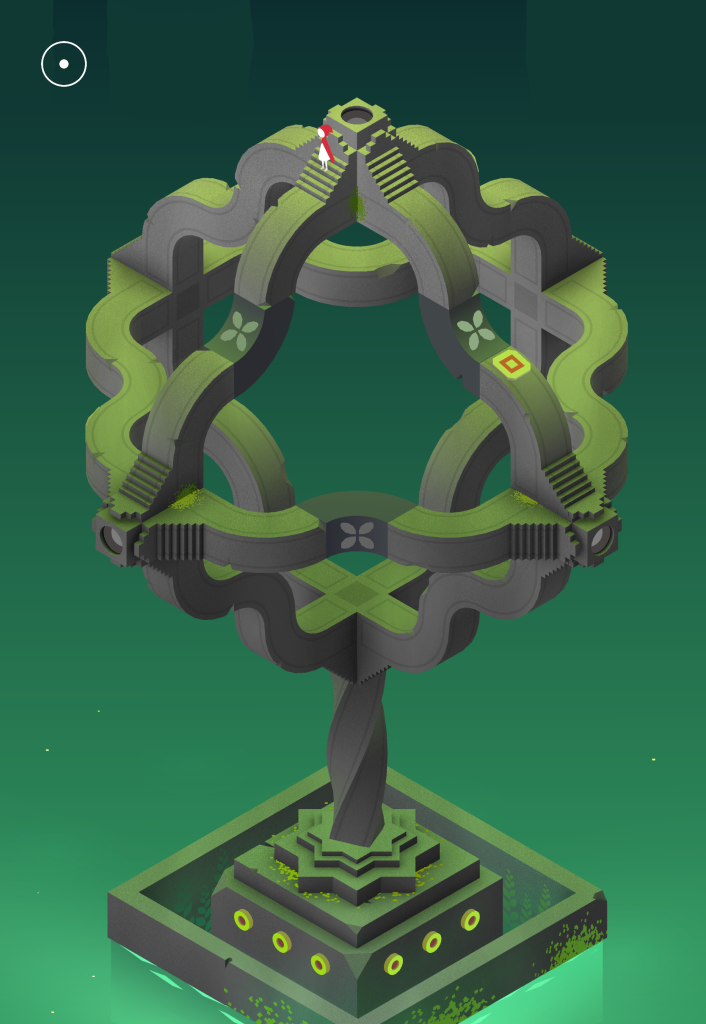
I played ‘Monument Valley’ in my free time.
Monument Valley greatly helped me think about game development, not so much in terms of level design, but in how it uses levels to tell a story. Simply put, it’s about how to combine the player’s experience—what they see, what they feel—into the final game experience.
In Monument Valley, turning mechanisms to create a path isn’t just about passing a level; it’s about helping the silent princess overcome her inner turmoil. Your game should be the same. Don’t let visual illusions be just a test of eyesight. For example, when a player crouches down and sees through a fake wall, what’s revealed behind it shouldn’t be a treasure, but rather a scene from her childhood that she’s afraid to confront. Make the act of “solving the puzzle” itself a confrontation for the protagonist. Every action is a step towards helping her overcome her inner conflict.
Monument Valley’s visuals are clean and colorful, yet they look incredibly sophisticated and calming. Your game should also learn about color schemes and guidance.
1. Few but High-Quality Items: Choose a few of the most representative items (e.g., cassette tapes, old televisions, tin boxes) and have them appear repeatedly in the game, but with different states and meanings each time. This makes players feel that these items have a life of their own and are part of the story.
2. Use Sound as a Guide: With a simple visual style, sound must take center stage. When players approach key items, don’t just make them glow; let your MP3 player emit a unique electrical sound, or let a familiar melody suddenly appear in the background music. Sound creates a sense of “déjà vu” more effectively than a flashing cursor.
3. Don’t Make it Too Difficult and Scar Away Players: If you make a mistake, you can always go back; you can always get to the next point. Your game should be like that too.
4. No Penalties for Failure: Players shouldn’t be punished or stuck if they can’t solve a puzzle. You can design different endings with small penalties, such as not being able to unlock the true ending without a perfect completion.
5. Design a space for ‘breathing’: Between puzzles, include a quiet moment where you can do nothing but enjoy the scenery and music. This could be a cutscene or supplementary explanation of the plot. Allow the player’s mind and emotions to slow down and process the events. Like a lyrical segment in a movie, it’s essential.
The brilliance of this game lies not in how difficult the level was, but in a sense of tranquility, solitude, and a touch of relief after completion. That’s what you need to learn. After you finish your game, players shouldn’t remember “that underwater puzzle was amazing,” but rather the feeling of “when I pulled that metal box out of the water, I felt a sense of relief.”