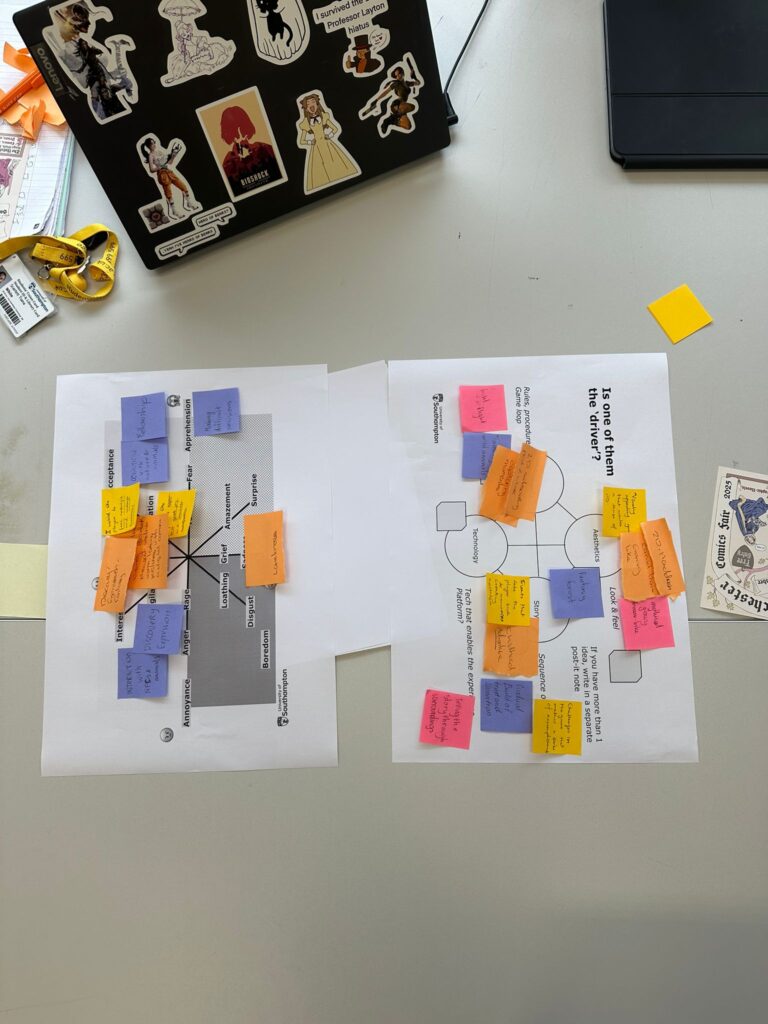
This week focused on moving from broad ideation to intentional design, encouraging me to clearly articulate what my game aims to make the player feel and why. Building on Weeks 1 and 2—where I explored inspiration, themes, and early mechanics—this session helped me formalise my design direction through design intention, essential experience, and early pillars. This marked a shift from collecting ideas to committing to a focused vision, which directly informed the development of my GDD.
Using the design intention framework introduced in the session, I defined my game’s core goal as:
“I want players to feel an adrenaline rush mixed with tension and nostalgia by navigating stealth-driven environments set within fragmented versions of 1900s Britain.”
This statement became a grounding point for all future decisions. Rather than designing features in isolation, the focus was placed on how mechanics, visuals, and narrative collectively support the intended emotional experience. This helped narrow my project away from being overly broad and ensured that every element added serves a clear purpose.
Through class discussion and worksheet exercises, I reflected on what the essential experience of my game should be. For my concept, this experience centres around:
- Heightened tension created through stealth and risk
- A sense of nostalgia driven by historical settings
- Emotional immersion through atmosphere rather than exposition
Players encounter this experience through careful movement, observation, and decision-making. Instead of constant action, the game encourages patience and awareness, allowing moments of silence and anticipation to amplify emotional impact. This reinforced my decision to prioritise feeling over spectacle.
This week also highlighted the importance of design pillars in maintaining clarity and cohesion throughout development. Based on my intention, I drafted early pillars that focus on:
- Stealth-driven gameplay that rewards observation and timing
- Atmospheric world-building through lighting, sound, and abstract realism
- Environmental storytelling that allows players to piece together meaning organically
These pillars act as a filter for decision-making and later became foundational components of my GDD. They ensure that new ideas enhance rather than dilute the core experience.
By applying the Elemental Tetrad (mechanics, narrative, aesthetics, and technology), I identified aesthetics and mechanics as the primary drivers of my design. Narrative plays a supporting role, emerging through environment and implication rather than direct storytelling. This balance felt appropriate given thegame’s stealth-focused,d atmospheric nature and helped clarify how each design element contributes to the overall vision.
This week was a turning point in my project. I moved from experimentation into intentional commitment, which significantly strengthened my confidence in the concept. The clarity gained here directly informed the structure and tone of my GDD and provided a strong foundation for future prototyping and refinement.
Moving into Week 4, this clear design intention allows me to begin testing mechanics and visual styles with purpose, ensuring all experimentation remains aligned with the core experience I aim to deliver.