In this group project, I took on the role of Mechanics Designer. To clearly define my responsibilities within the team, I referred to industry standards for the Game Mechanics Designer position and adapted them to our project context.
Industry Description:
Game Mechanics Designer Career Path, Skills & Advice 2026
In the game industry, a Game Mechanics Designer is primarily responsible for designing and refining the core gameplay systems that shape how players interact with the game. This role focuses on building the rules, systems, and feedback loops that create challenge, progression, and engagement.
Key responsibilities typically include:
Designing core gameplay mechanics and defining player actions and system responses.
Developing rulesets, numerical balance models, and progression systems.
Creating prototypes to test whether mechanics are functional, engaging, and intuitive.
Conducting playtests, gathering feedback, and iterating based on qualitative and quantitative data.
Balancing difficulty curves, reward structures, and risk–reward dynamics.
Collaborating closely with programmers, level designers, artists, and producers to ensure mechanics are feasible and aligned with the overall game vision.
Ensuring gameplay systems support player retention and, in commercial contexts, monetisation strategies.
The essence of the role is to translate abstract gameplay ideas into structured, testable, and balanced systems that deliver a compelling player experience.
However, our project differs significantly from a large-scale industry production. As a five-person indie development team, there are more responsibilities on each person. Unlike in larger studios where roles are highly specialised, I should not only design mechanics but also participate in implementation tasks, including scripting and technical adjustments within the game engine. This meant balancing conceptual system design with practical problem-solving and technical constraints.
In this context, my role will be:
Assisting with gameplay implementation and scripting.
Adjusting parameters directly within the engine.
Communicating technical limitations back into design decisions.
Supporting rapid iteration cycles due to limited team resources.
What is Mechanics?
Video Game Mechanics: A Beginner’s Guide (with Examples)
When defining my role as a Mechanics Designer, I realised that I was actually confused about what “game mechanics” truly means. The term is widely used in the industry, yet often misunderstood.
To clarify my responsibilities, I conducted research to better understand the precise definition of game mechanics and how it differs from related concepts such as gameplay, features, rules, and design.
1. Definition
Game mechanics are the meaningful interactions between the player and the game world, as well as interactions within the game system itself. If an action meaningfully changes the game state, affects player strategy, or alters outcomes, it is a mechanic.
2. Mechanics vs. Fluff
A flaming arrow that burns vines and reveals a new path → Mechanic (it changes the world state).
A flaming arrow that only produces visual effects but behaves like a normal arrow → Fluff (no gameplay consequence).
3. Mechanics vs. Gameplay
Game Mechanics = the specific rules and interactions designed by the developer. (e.g.“Climbing”
Gameplay = the overall player experience that emerges from mechanics + player behaviour. (e.g.Using climbing to escape enemies or explore hidden areas.
Gameplay includes dynamics such as tension, cooperation, competition, and strategy. These emerge from mechanics but are not mechanics themselves.
4. Mechanics vs. Features & Rules
Game Features are broad selling points (e.g., multiplayer mode, skill trees, online store).
Game Rules are structural constraints (e.g., win/lose conditions, required actions).
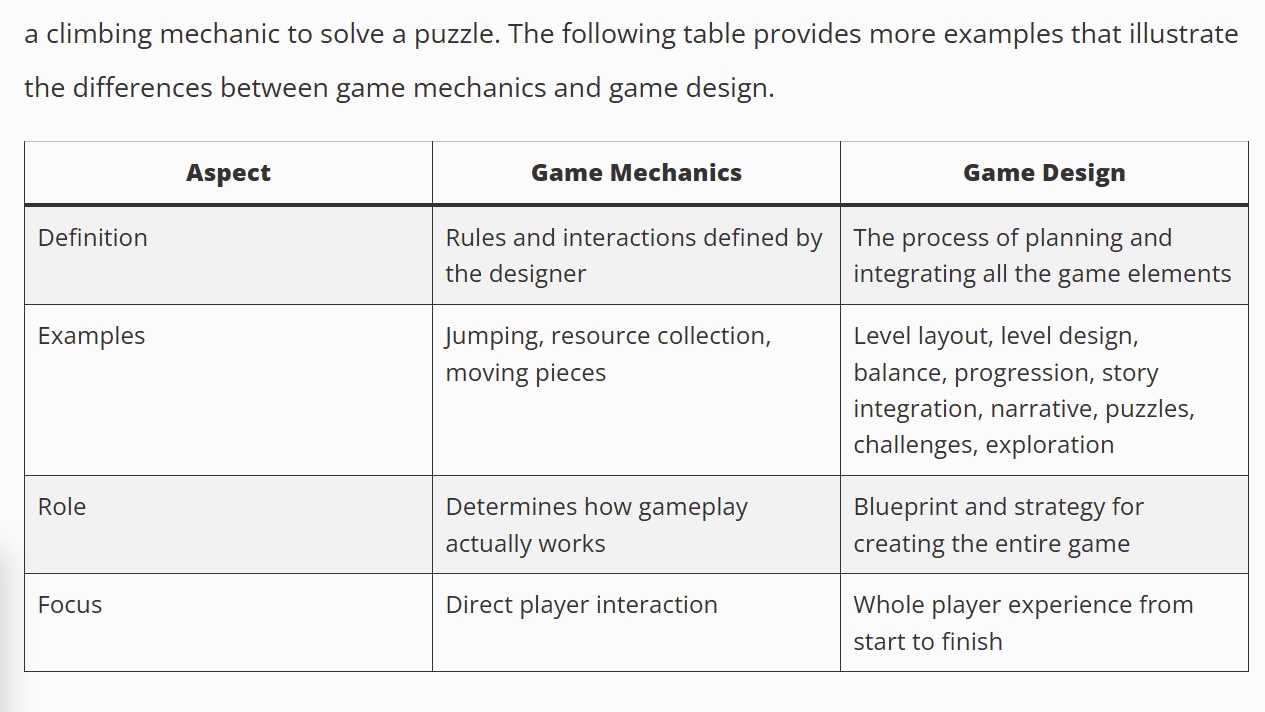
Game Design is the broader discipline that includes mechanics, level design, narrative, balance, and more.
5. Key Insight for My Role
Through this research, I learned that as a Mechanics Designer, my responsibility is not to focus on visual polish or high-level concepts.
I’ll be mainly focused on:
Create meaningful consequences
Shape player decisions
Influence strategy and interaction
Change the game state
Leave a Reply