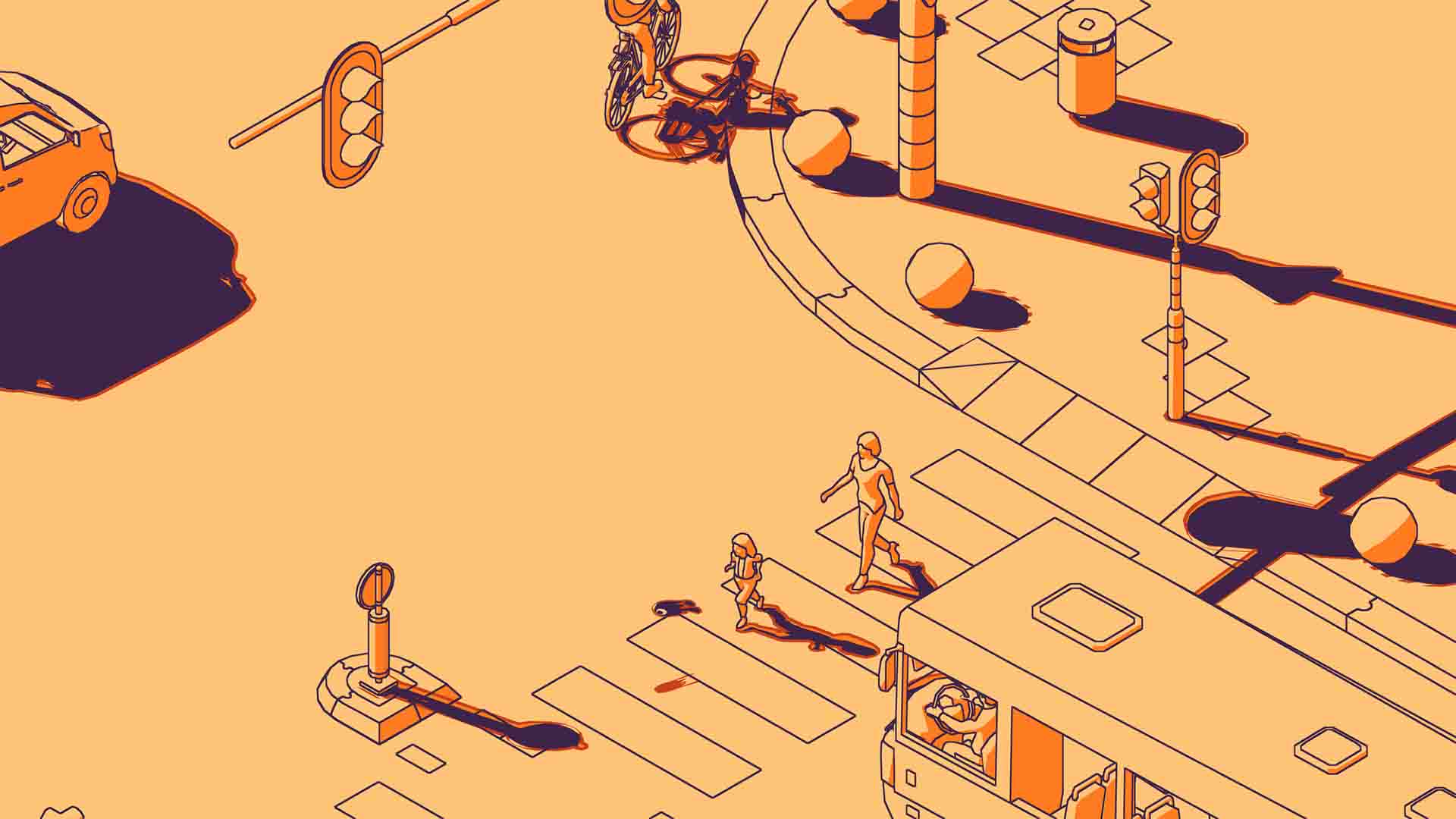
– Art: Schim presents a striking, minimalist visual identity built entirely around silhouettes, bold colour blocks, and high-contrast environments.
Instead of texture, detail, or shading, the game relies on flat graphic compositions that shift from warm yellows to cool blues, vibrant pinks, and monochrome tones depending on the emotional energy of the scene.
Shadow-based design: Characters and movement are represented as silhouettes, reducing the visible world to abstract shapes.
Colour palettes tied to the environment’s mood:
– Urban streets use high-contrast yellow/black schemes.
– Indoor scenes shift to muted tones.
-Parks, festivals, and crowds explode with saturated colours.
Clear visual hierarchy: The player can immediately distinguish between “jumpable shadows” and the larger environment.
The art direction balances simplicity and readability while creating a playful, animated world where shadows behave like living ecosystems.
Despite the minimalist approach, the environments feel alive because the game uses motion and rhythm—traffic lights blinking, people walking, signs flickering—to animate each space.
– Mechanics: The core mechanic of Schim is shadow-hopping: the player, a frog-like shadow creature separated from its human, can only move by jumping from one shadow to another.
Single mechanic with deep expressiveness: The game builds every interaction—platforming, puzzle-solving, pacing—around shadow connectivity.
Environmental puzzles emerge naturally: Moving shadows from cars or cyclists create temporary platforms. Static shadows from benches, trees, or buildings form safe zones. Crowds become moving networks of connecting silhouettes.
Rhythm as a mechanic:
Because many shadows move, players learn to time jumps with passing objects, turning the game into a rhythm-puzzle hybrid.
No direct failure penalty: When the player falls out of the shadows, the game encourages quick recovery rather than punishment.
The mechanic is elegant and readable, showing how a single system can carry an entire game when tightly integrated with art and level design.
-Narrative: While Schim features minimal explicit storytelling, it conveys narrative through movement, environment, and the relationship between Schim and its person.
Silent emotional framing: The story begins with the schim being separated from the person it belongs to, immediately creating a metaphor for feeling disconnected from oneself.
Environmental micro-stories
Each area presents a small narrative:
– A cyclist being chased by a dog
– A street performer entertaining a crowd
– A construction site in motion
The schim navigates these scenes without interrupting them, reinforcing the idea of being a small, unnoticed presence within a larger world.
Journey toward reconnection
The schim follows the trail of its person through the city, and players read emotional beats through visual cues—colour changes, crowd density, movement speed—rather than dialogue.
-Theme: identity and belonging
The schim’s desire to reunite with its human forms a simple but universal theme presented through pure environmental storytelling.
Leave a Reply