Game Poems With Jordan Magnuson:
First, what exactly is a game poem? Why are these two words, which sound unrelated, combined? Before the lecture began, we played several games in the studio.
These are the games that inspired me most:
 “Asunder” by Ash, Brittany, and Kate
The game starts within a room filled with floating objects and ambient sounds. Players must drag items to the right positions using the mouse. Initially, the room’s utter disarray leaves the player in a state of chaos, and they don’t know where to start. This evokes memories of my own bouts of procrastination, where mounting tasks create both inertia and anxiety. Yet once that first step is taken, the initial object is placed in its proper place. Everything becomes effortless, even inducing a state of mindflow. The game’s brilliance lies in visualising this sensation as an interactive experience, using harmonious pastel hues, cheerful music, and sound effects to offer a space of calm and enjoyment within the chaos.
 “Loneliness” by Jordan Magnuson
The game “Loneliness” is, as its name suggests. Players navigate their Avatar (a simple square) across the screen. Whenever this square approaches other squares gathered together, those groups scatter and drift away from the Avatar. I consider this the most minimalist game I’ve ever played, both in mechanics and presentation. It offers no guidance, no objectives, yet conveys the profound sensation of loneliness with the barest of information.
These games are all very short, hyperbolic, subjective, and full of metaphors in mechanics. They often focus on and explore the personal expression or a specific emotion, which holds many similarities to poems.
Things we can summarise and learn from game poems:
1. Stripe away the inessentials (focus on simple, personal elements
2. Leverage poetic devices (pauses and breath.
e.g., A bench to sit and view the landscape
3. Embrace ambiguity
4. Reimagine “fun gameplay” (not just limited to MDA and assumed design goal
5. Respect the poetic process
Bitsy Game Jam:
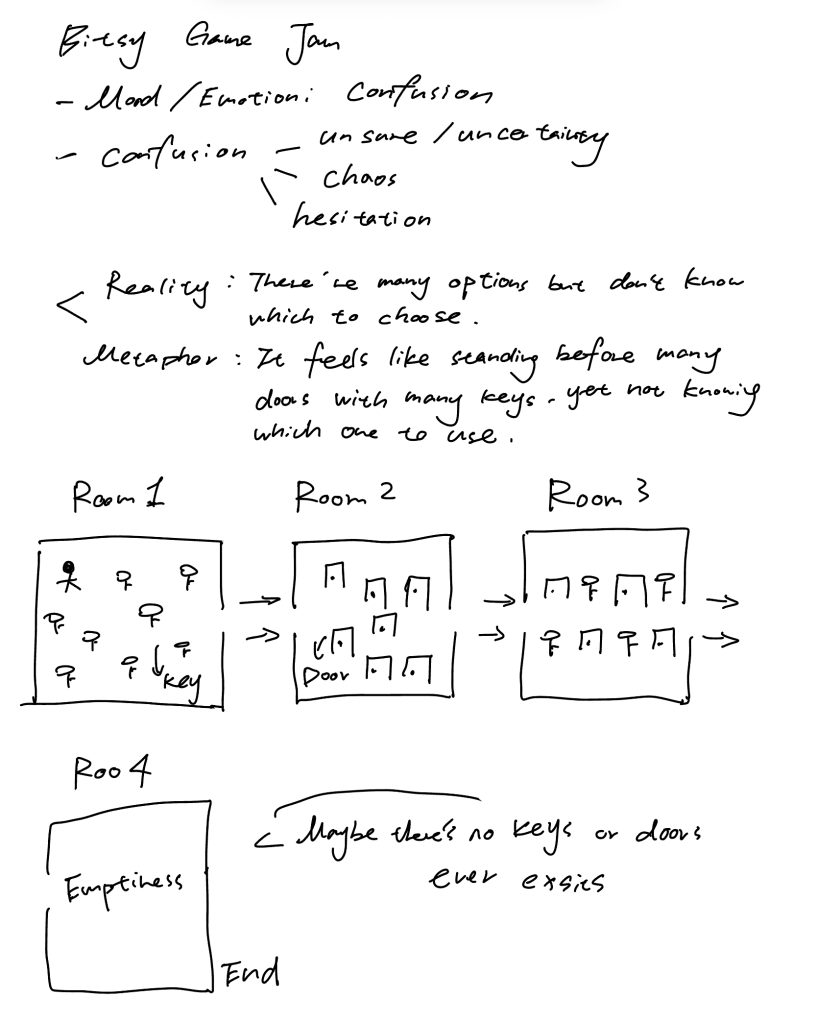
My initial ideas
I began designing my bitsy mini-game after contemplating the emotion of “confusion. Upon associating relevant vocabulary and metaphors, the gameplay mechanics crystallised in my mind, prompting me to sketch reference images. Then, I explored the functionality and applications on the Bitsy website. This process eliminated certain unfeasible mechanics overlooked during conceptualisation while refining the viable elements. Ultimately, I arrived at a game demo that I’m thoroughly satisfied with.
Game link: The missing key by Zer046
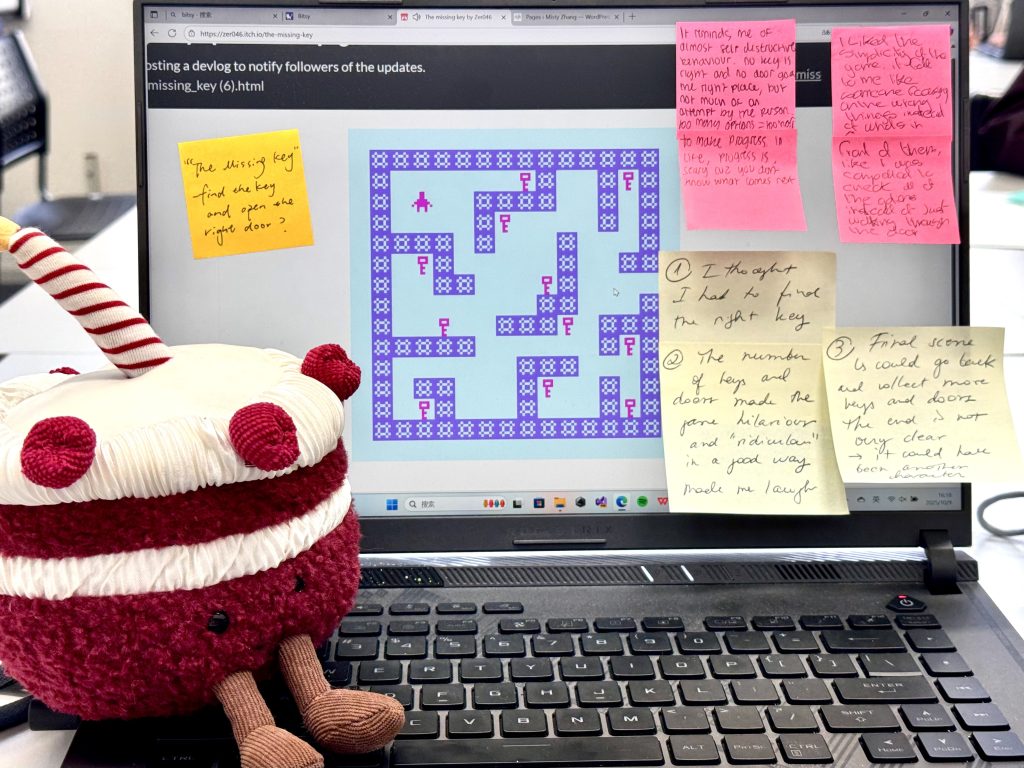
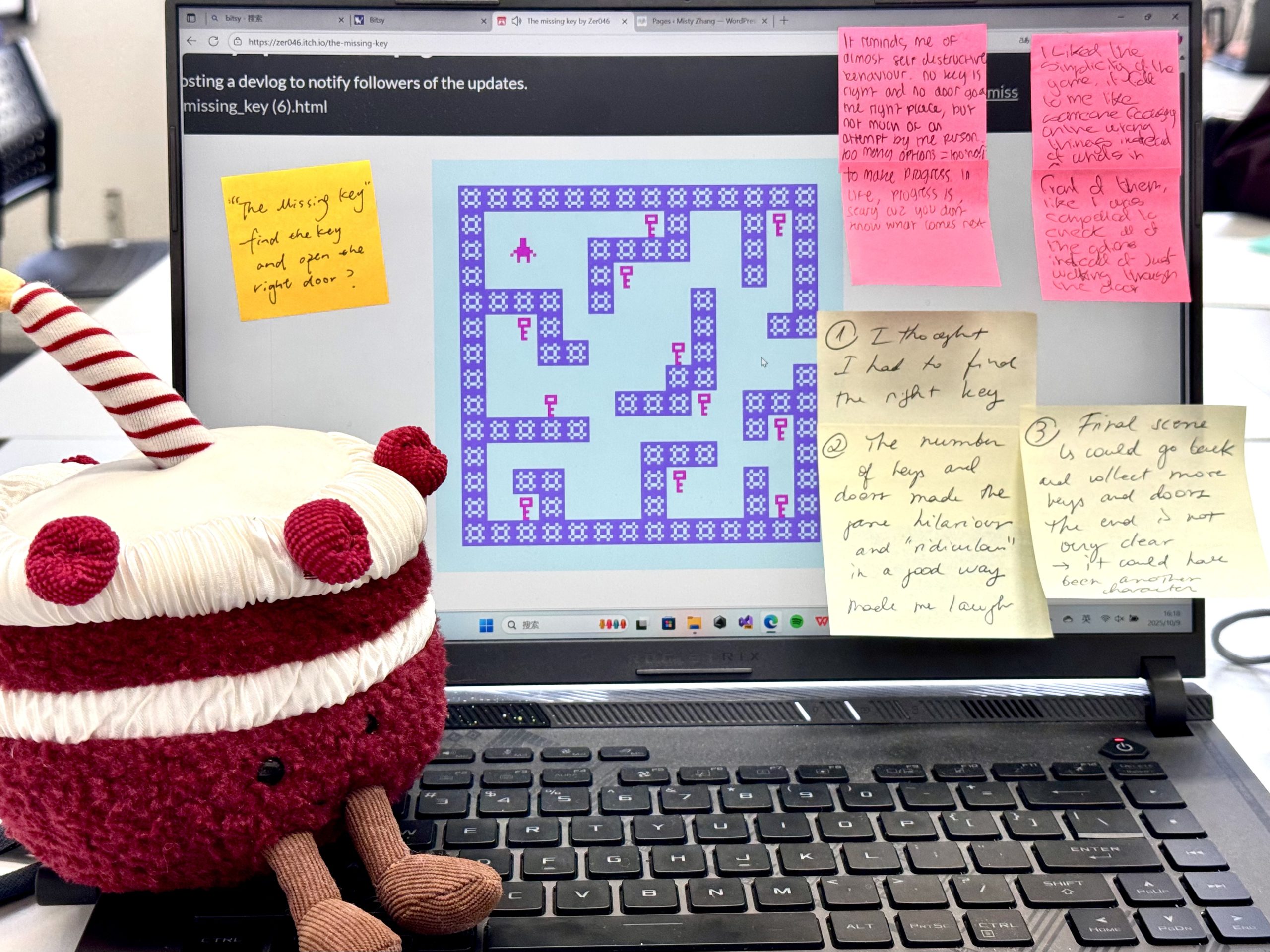
My game playtesting & REVIEWS
After completing the game, my classmates and I played each other’s creations. Based on feedback from the professor and fellow students, I made adjustments to the game’s detailed design. Overall, most players successfully grasped the initial feeling I intended to convey through the game. Receiving playthrough evaluations and gaining recognition from others proved immensely rewarding. I was delighted to discover diverse perspectives and associations emerging from the comments.
Games from other students:
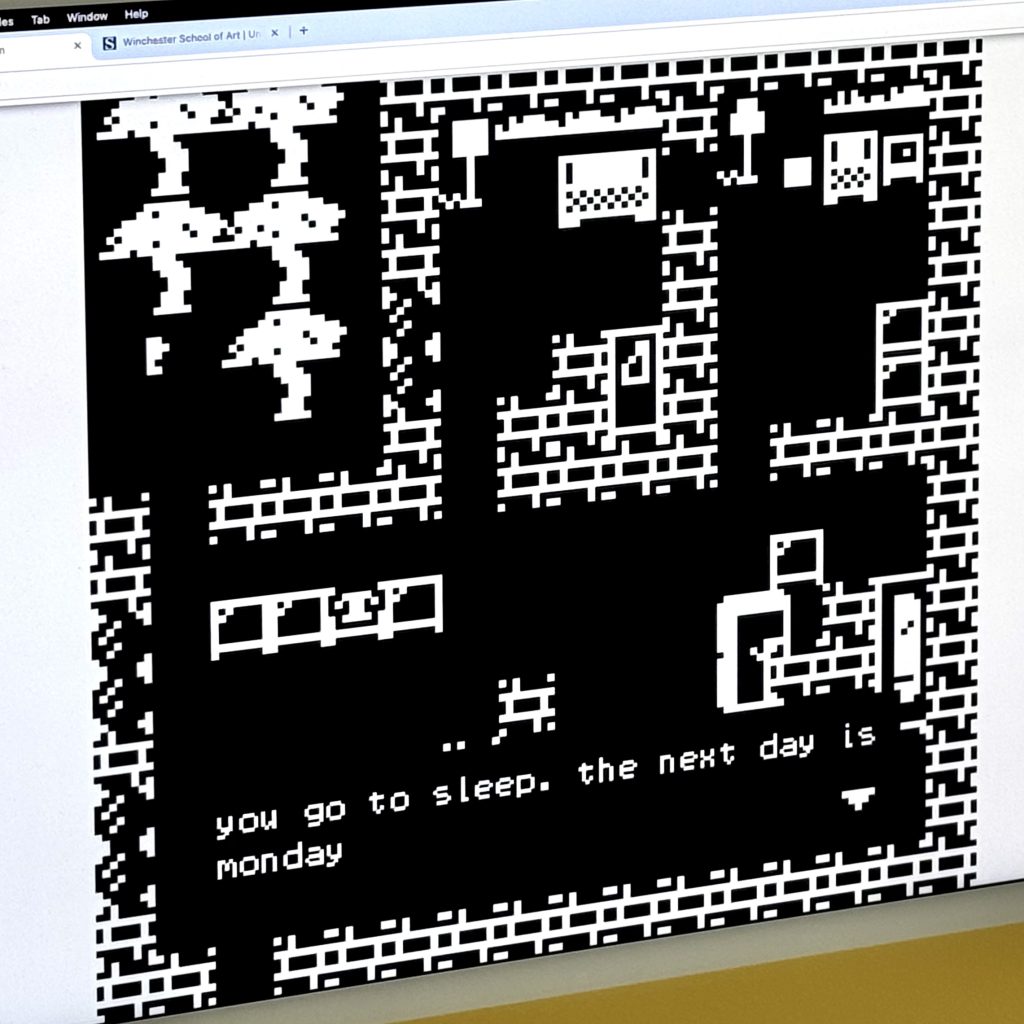
Olle’s game “FLO”
This is a game rich in narrative. I was surprised that he could convey such a complete story through a small game in just two days. I enjoyed the dramatic twists and conflicts within the game, as well as how he depicted the protagonist’s inner collapse by allowing the details of the scenes to crumble. After experiencing the earlier breakdowns, the warm scene at the end felt deeply cathartic. It leaves players feeling that ordinary days are truly worth cherishing.

“An Enjoyable Day for a Cat”
Much like the game’s title suggests, it’s so enjoyable. Players take on the role of a cat, wreaking havoc and causing trouble throughout the owner’s room. I love the cat perspective: delighting in mischief, utterly proud. It reminds me of Natsume Sōseki’s book, The Cat.
“Whispers”
Unlike other games with clearly visible characters and objects, the protagonist and objects in this game are invisible (blending into the background). Consequently, players can only determine which direction to proceed by interacting with invisible objects through collision. This renders the game exceptionally challenging, demanding persistent trial and error to uncover the correct path and exit. It evokes a sense of uncertainty and anxiety.
Leave a Reply